
The Google Ads AI Glossary: What the Settings Say and What They Actually Control
October 2, 2026
•
11
min read


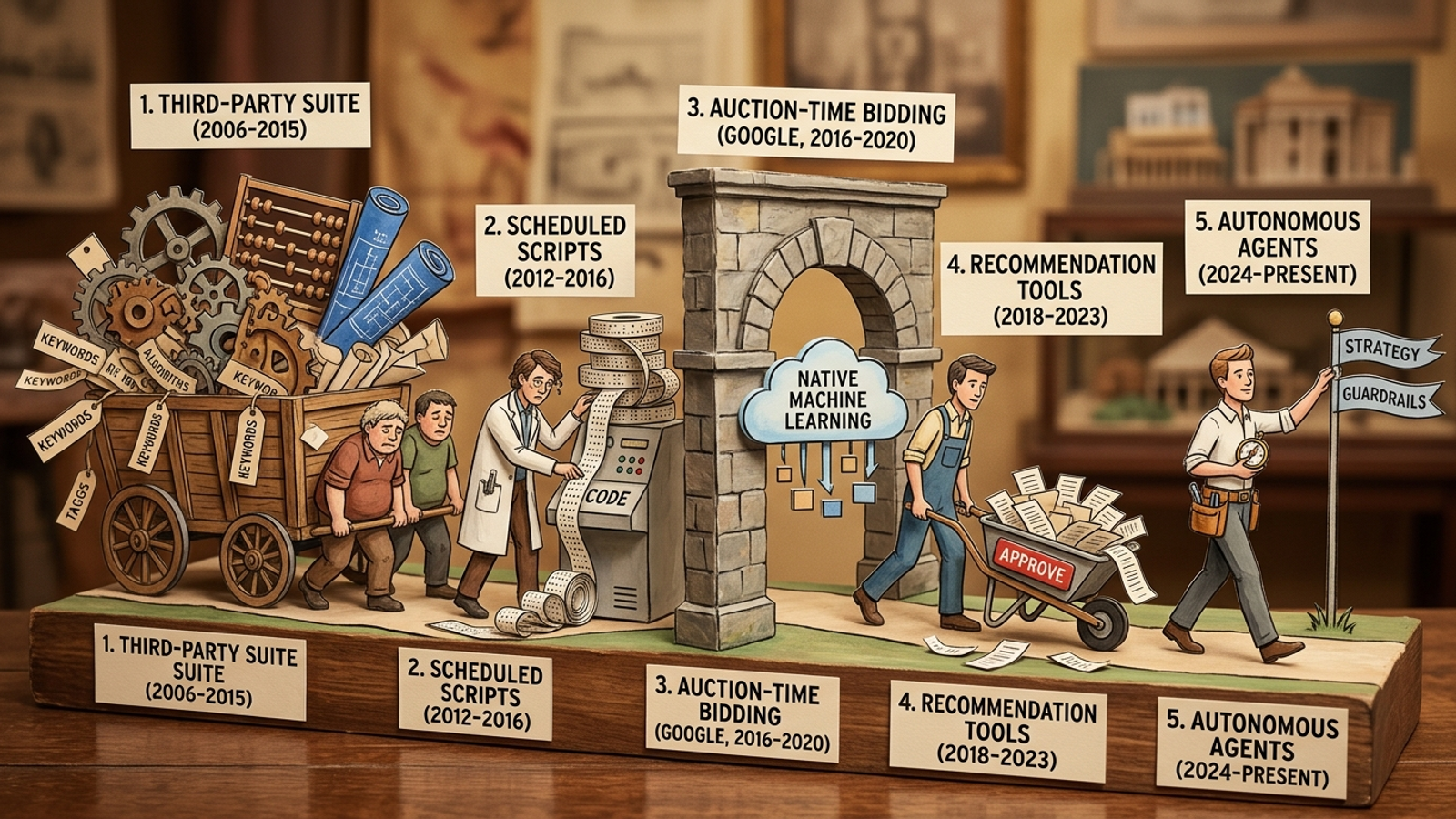
Most agencies will not tell a client this: the work behind a search bid has changed beyond recognition, but the invoice often has not. We went from enterprise suites and spreadsheet work to scripts, auction-time bidding and autonomous execution. At each step, the effort fell. Percentage-of-spend fees largely stayed put.
An account manager might charge 10% to 20% of monthly media spend, or a flat $4,000 retainer. That bill may cover valuable judgment, but it does not tell you how much judgment you are buying. If software calculates bids and handles routine changes, a fee that rises automatically with spend deserves scrutiny.
This timeline follows the work, not the sales pitch: what changed, what it fixed, and what practitioners still had to do. It also explains why I think today’s percentage-of-spend fee looks less like a price for bid management and more like an artefact of an older operating model.
Marin Software and Kenshoo, both founded in 2006, addressed a real problem. Google AdWords gave advertisers manual bid controls and limited automated portfolio intelligence. At enterprise scale, managing large keyword sets across Google, Yahoo and Bing called for more than a patient person with a spreadsheet. Third-party platforms offered algorithms and workflows to do that work.
Marin’s March 2013 IPO, at a valuation over $400 million, showed how substantial that business had become. Kenshoo later unveiled the Kenshoo Infinity Suite on March 4, 2015, marketing predictive cross-channel budget optimization and attribution across search, social and display. Marin emphasized bidding across keyword portfolios. For a buyer comparing the two, the question was which system could manage a sprawling account more effectively.
The price reflected that enterprise positioning. The draft-era model was 1% to 3% of media spend for the software, alongside setup fees, annual contracts and monthly minimums. At $500,000 in monthly search spend, that percentage works out to $5,000 to $15,000 a month for the license. Agencies could charge their own percentage on top.

The suite solved scale, not latency. A third-party platform still had to sync through an API, calculate changes and push them back. The draft’s typical four-to-twelve-hour batch cycle could not respond to an individual auction as it happened. Practitioners also had to reconcile data, structure campaigns and keep the machinery calibrated. Automation removed a great deal of manual bid entry; it did not remove operational work.
I would not call those early fees absurd in their own time. Native tools left a gap, and the suites filled it. But that defense depends on the gap staying open. It did not.
On June 14, 2012, AdWords Scripts entered limited beta. Advertisers with some coding ability could run JavaScript in AdWords and connect account work to Google Sheets. Practitioners shared scripts for bid scheduling, budget pacing, weather-triggered changes and negative-keyword checks. Work that once made an enterprise platform look indispensable became possible with code a smaller advertiser could use.
Consider a simple bidding routine: pull conversion data, compare it with a Target CPA in a spreadsheet, then update keyword bids on a schedule. It is not a replacement for every enterprise algorithm. It is, however, a direct challenge to the idea that every routine bid calculation warrants a percentage of media spend. For an account spending $20,000 to $100,000 a month, freely shared scripts could make parts of that work far cheaper to execute.
The catch was maintenance. Scripts could time out after thirty minutes, break when reporting endpoints changed or hit spreadsheet limits. Someone still had to decide what the rules should do, check whether they ran and repair them when they failed. The job shifted from entering bids to supervising code. That is a meaningful change, even if it is not the same as hands-off management.
Agency pricing did not necessarily follow the shift. A scheduled script could be presented as a custom algorithmic bidding engine, while the client continued paying for hands-on optimization. Sometimes building and maintaining that system justified the fee. Sometimes the impressive name described a spreadsheet and an error check. Ask which one you are buying.
Google introduced the Smart Bidding name on July 28, 2016, putting its machine learning at the center of automated bidding. The consequential change for outside bid tools was auction-time bidding. Instead of adjusting a keyword bid from historical averages and waiting for a sync, Google could evaluate contextual signals just before an impression: the query, device, browser, time of day and remarketing lists among them.

An external tool using the Google Ads API could not see and act on that same auction-time context in the same moment. That asymmetry weakened the central pitch of a standalone search bid engine. A third party might still help with workflows and decisions around the campaign, but it faced a different contest if it claimed to outbid Google’s own system at each auction. As one r/PPC discussion put it, “bidding is better done inside Google ads.”
For practitioners, the work moved up a level. Conversion tracking, campaign structure, targets and the quality of the signals fed into the system mattered. An account manager could still do valuable work there. What changed was the case for charging as though that manager personally calculated thousands of bids. I would want a retainer to explain the decisions made around Smart Bidding, not claim credit for calculations Google already performs.
Once native bidding handled the auction-time calculation, outside tools had a clearer opening in workflow. Platforms such as Optmyzr and Opteo offered rules, alerts and recommendation queues for issues including conflicting negatives, weakening ad copy and budget pacing. Optmyzr and similar tools brought flat-rate or spend-tiered subscriptions in the $200-to-$800-a-month range, a different proposition from an enterprise bid-suite contract.

A recommendation is not an action. If a tool flags a budget problem on Saturday and nobody reviews the alert until Monday, the account waits. If an irrelevant query is wasting spend, an approval card does not exclude it. These products can make a manager’s review faster and more consistent; they do not, by themselves, remove the delay caused by waiting for that review.
That distinction also created an attractive agency workflow. A manager could oversee more accounts with pre-screened queues than with manual account checks. The client might still pay a familiar percentage-of-spend retainer. Efficiency for the agency is not inherently bad, but it raises a fair question: did the client receive faster decisions or just help fund a larger client roster?
The market’s direction was visible beyond recommendation tools. Kenshoo rebranded as Skai on June 8, 2021, with a broader focus that included retail media. For a search advertiser, the practical lesson is not that every outside platform became useless. It is that the old pitch, a superior standalone engine for pushing search bids, no longer explained the full fee. Judge a workflow tool by the work it gets done, not the number of suggestions it produces.
Autonomous agents target the gap left by recommendation queues. Google’s Smart Bidding handles auction-time pricing; an agent works on the operational environment around it. The proposed change is straightforward: instead of producing a card for a person to approve later, software can monitor search terms, adjust assets and budgets, and act within defined guardrails throughout the week.

The useful distinction is between a rigid rule and a decision informed by business context. A basic rule might exclude any search term that spends more than $50 without a conversion. That could cut a relevant term before it has enough time to convert, while irrelevant variants each remain below the threshold. For a B2B software company, “free excel bookkeeping sheet” and “multi-entity erp accounting connector” suggest very different intent. An agent’s value depends on recognizing that difference and acting within the advertiser’s rules, not merely running the old $50 rule faster.
That is the case for groas. It combines specialized models for campaign, keyword, creative and budget work with a named human strategist responsible for direction and guardrails. Rather than selling another dashboard of tasks for an account manager to clear, groas positions itself as a fully autonomous growth engine with a flat monthly fee. The human still matters. The human should be setting priorities and answering for outcomes, not serving as an approval button for every routine change.
This period also marks how far the earlier suite model has receded: Marin Software filed for Chapter 11 bankruptcy in 2025. I would not pretend that one filing settles every product comparison. The more useful question for a buyer now is whether a tool acts on the work it identifies, how its guardrails operate and who is accountable when the business goal changes.
Put the turning points side by side and the pricing question becomes hard to dodge:
| Era | Bid calculation | What practitioners still manage | Typical model described here |
|---|---|---|---|
| 2006–2015 | Third-party suite algorithms | API syncs, account structure and oversight | Enterprise software tied to media spend |
| 2012–2016 | Scheduled scripts | Rules, failures and maintenance | Freely shared code; agency fees continue |
| 2016–2020 | Google auction-time machine learning | Targets, tracking and campaign direction | Native bidding; agency fees continue |
| 2018–2023 | Native bidding plus outside recommendations | Review and approval queues | SaaS subscription plus management fees |
| 2024–Present | Native bidding plus autonomous operations | Strategy, guardrails and accountability | Flat-fee autonomous alternative to legacy retainers |
These periods overlap because new tools did not arrive on a morning when every older tool vanished. They changed the economics anyway. Each shift reduced the amount of repetitive bid work a person had to perform. Each left more room for strategy, measurement and judgment. Yet a percentage-of-spend fee can still rise without showing that any of those contributions increased.
Take an account whose monthly spend grows from $20,000 to $60,000. At a 15% management fee, its invoice rises from $3,000 to $9,000. More spend can bring more complexity; I would not assume the workload stays identical. But the extra $6,000 is not proof of extra work, stronger judgment or faster execution. The buyer should be able to see what changed besides the number on the media bill.
My buying rule is blunt: do not pay a percentage of spend merely because software now does the bid work that once consumed human hours. Ask what the fee buys beyond native bidding. Does the service execute routine changes continuously or leave them in a queue? Who sets the guardrails? Who owns qualified pipeline and attributable revenue instead of reporting clicks and calling it a week?
I read this timeline as a line pointing toward autonomous execution with visible human accountability, not toward another dashboard or a larger bill whenever the budget grows. Search still needs good decisions. Moving bids stopped being a convincing reason to charge for all of them.
Common agency charges run from 10% to 20% of monthly media spend, sometimes replaced by a flat $4,000 retainer. Those bills were set under an older operating model where people did manual bid work, so a fee that simply scales with spend no longer reflects the effort involved.
At the height of the enterprise era, these platforms cost roughly 1% to 3% of media spend for the software alone, plus setup fees, annual contracts and monthly minimums — around $5,000 to $15,000 a month on $500,000 of monthly search spend. On top of that, agencies could charge their own percentage.
In many cases yes: since 2012, freely shared scripts covered scheduled bid updates and other routine work that used to justify enterprise licenses. However, someone must maintain them constantly—debugging timeouts or broken integrations—which shifts responsibility away from actively placing bids rather than eliminating human involvement entirely.
Probably not consistently. Since introducing auction-time bidding in mid-2016, Google evaluates contextual factors—the exact user's location, browsing habits and countless others—right before displaying each ad. External APIs don't get that granular visibility simultaneously, meaning separate vendors essentially face losing battles against internally integrated systems regarding raw pricing accuracy.
Not on their own—they require humans periodically approving queued actions during business hours. Fast turnaround requests flagged overnight remain untouched weekends due solely to staffing constraints inherent wherever final authorization rests manually with consultants juggling dozens of concurrent customer engagements.