

 LinkedIn

Search “best CRM for small law firm” in 2022 and the bargain was familiar: ads at the top, organic links underneath, clicks for the pages that ranked. Rank third and you had a useful piece of the page.
Run that query today and third place may sit beneath an AI answer that occupies the first screen. A few sources get cited inside the answer; ads can appear around it. The reward for ranking has shrunk, while the reward for being cited has grown. Google did not flip that switch overnight. It changed the page one dated move at a time, and the ads team got an early signal: Google showed paid units in AI Overviews while plenty of SEO advice still revolved around position one. Here is the sequence as I read it from the paid seat. Watch where the ads go. They tell you where Google expects attention to go.
May 2023: SGE puts an answer above the links
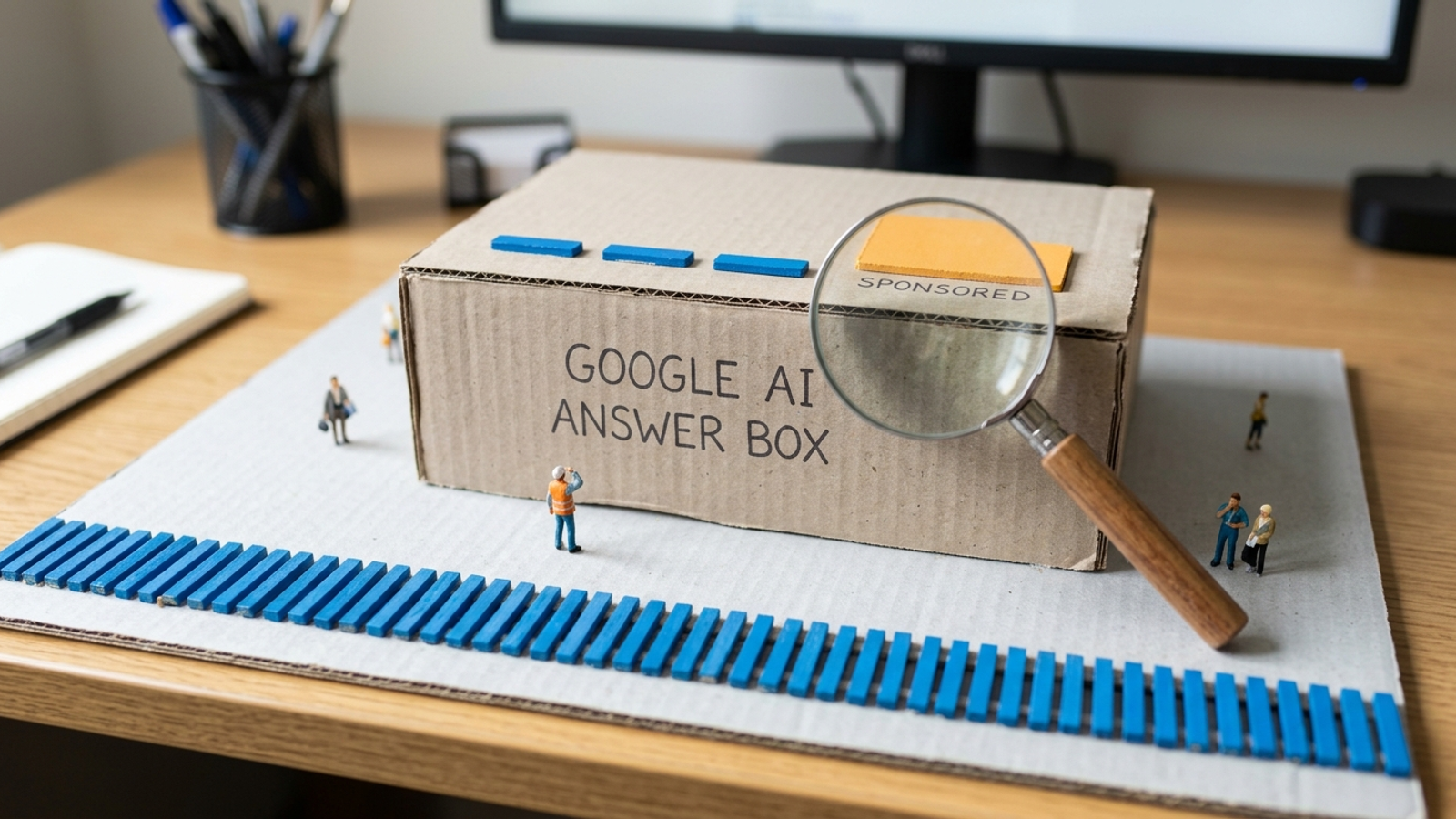
Google unveiled Search Generative Experience at I/O in May 2023 as an opt-in Search Labs experiment. The important change was not the name. It was the placement. A generated answer sat above the familiar organic results, with source links inside it. A page could still rank first and no longer own the first screen.
At that stage, SGE was an experiment. Treating every existing ranking as worthless would have been a bad call. But treating the placement as a cosmetic change would have missed the point. Google was testing whether the answer could live on the results page rather than at the end of a click. That altered the job for publishers before it altered every search: a high-ranking page now had to compete with a response assembled from several pages.
For a business owner, the distinction is practical. A page might deserve a visit because it contains a thorough explanation. The answer box can satisfy the reader before that visit happens. If the page also contains a clear, usable piece of the answer, it has a chance to appear in the box. Ranking still matters; ranking alone no longer guarantees the most visible spot.
May 2024: AI Overviews leave Labs, and citations gain ground
A year later, Google dropped the Labs label. AI Overviews launched broadly in the US in May 2024, then expanded to the UK, India, Japan, Brazil, Mexico and Indonesia by August and to more than 100 countries by October. The experiment had become a feature that far more businesses had to account for.
For informational queries, the difference between a ranking and a citation became hard to ignore. A ranking could put your page below the summary. A citation could put your name and link inside it. Neither guaranteed a click; that is precisely why the distinction matters. Someone who gets an adequate answer on Google may not visit any site. Someone who wants more detail has a short list of cited sources in front of them.
This is where a lot of advice about making a page “comprehensive” starts to sound incomplete. Depth is useful when it supports the answer. It is less useful when a reader has to wade through an introduction to find a definition, step or number. I would not strip a good page down to a collection of snippets. I would make sure its clearest answer is easy to find before asking anyone to appreciate the rest. A citation needs something the answer can use; a ranking by itself does not supply that.
May 2024: Google shows ads in AI Overviews
Within a week of the AI Overviews expansion, Google used Marketing Live to show ads above, below and inside AI Overviews, drawing on existing Search, Shopping and Performance Max campaigns. This was a demonstration of where paid placements could go, not proof that every advertiser immediately appeared in an answer box. It was still a useful tell.
Google did not present the answer as a separate world where commercial attention stopped. It showed how the campaigns advertisers already ran could fit around, and potentially inside, the new surface. For an SEO team, that should have changed the conversation. The question was no longer just whether an AI Overview displaced an organic listing. It was whether the remaining attention would be divided among the answer, its citations and paid placements.
Paid and organic have always shared the page. Now they were being arranged around a generated response. What the deck might call “native consideration,” I call paying to sit near the thing that made your old ranking less prominent. When Google designs ad space for a new search surface, treat that surface as part of the results page, not a passing novelty.
November 2024: Perplexity tests ads beside answers
In November 2024, Perplexity began testing sponsored follow-up questions in the US, placed beside answers and labeled sponsored. This was not a Google product change, and the formats were different. It belongs on this timeline because it made the same shift visible elsewhere: a conversational answer could carry both source links and advertising.
A sponsored follow-up question is not the familiar ad sitting above ten results. It invites the next step while the user is still reading the answer. That makes the competition for attention easier to see. A source can be cited, a paid prompt can be offered, and the user can continue without opening a conventional results page.
I would not take one company’s test as evidence that every search will work this way. I would take it as a reason to stop treating the answer as an advertisement-free waiting room before the “real” results. For practitioners, the question becomes sharper: if someone stays in the conversation, where does your business appear in it? A link below the answer and a source inside it are not equivalent placements.
March–May 2025: AI Mode makes search a conversation
Google launched AI Mode as a Search Labs experiment in March 2025, then opened it to all US users in May and rolled it out market by market afterward. It appears as a tab alongside All, Images and Videos. Unlike an AI Overview above conventional results, it gives the user a dedicated conversational search experience built around an answer and follow-up questions.
That changes what a business is trying to win. On a conventional page, you can point to a ranking for a particular query. In AI Mode, the user can refine the question instead of returning to a list of links. One answer can cite several pages for different sub-questions. A page that answers one part cleanly may earn a citation without being the page you would have expected to lead a standard results list.
This does not make head terms or rankings irrelevant. They still describe part of search. They describe less of the experience when a person asks, reads, follows up and reads again. A page built only to target the initial phrase may have little to offer once the question becomes more specific. A page that gives direct answers, then supports them with detail, has more to contribute along the way.
In a conversation, prepare for the next question as well as the first one. That is a more useful editorial test than asking whether a page repeats the head term often enough.
September 2025: Click data puts a cost on the answer box
The change in page layout is visible. The size of the click loss is easier to grasp with numbers. Seer Interactive tracked 3,119 informational queries from June 2024 to September 2025 and found organic CTR on AI Overview queries fell 61%, from 1.76% to 0.61%, while paid CTR fell 68%, from 19.7% to 6.34%. A separate Pew analysis of March 2025 browsing found that people clicked traditional results far less often when a summary was present: about 47% less often in that summary.
The paid number matters. This is not a tidy story in which Google takes organic clicks and hands them all to ads. When the answer satisfies the query, fewer people may click anything. If your report looks only at organic rankings, it can miss that the paid listing is working against the same change in behavior.
There is also a difference among the brands that appear in the answer. In Seer’s analysis, cited brands earned 35% more organic clicks and 91% more paid clicks than non-cited brands on the same queries. That comparison does not prove the citation caused every extra click; brand authority may help explain both outcomes. It does tell us where to look when a ranking holds steady and traffic does not.
Check the citation, not just the position. If the answer has taken a share of the clicks, being among its sources is a different outcome from appearing somewhere below it.
November 2025: Sponsored results enter AI Mode tests
In November 2025, users spotted sponsored results at the bottom of AI Mode answers, styled like organic link cards and labeled sponsored. Google confirmed a test it had first flagged at Marketing Live in May. This was another test, not a claim that every AI Mode answer contained ads. But it continued the sequence: Google had shown paid placements for AI Overviews, then tested a paid placement within its conversational search experience.
The placement is what counts. A sponsored card at the bottom of an AI Mode answer meets the user in the flow of a response, not in the old row of ads above blue links. Organic sources and paid results do different jobs, but both now have to earn attention in a space organized around the answer.
Put the dates together: SGE placed an answer above results. AI Overviews brought that format to a wider audience. AI Mode offered a dedicated conversation. Google showed, then tested, ways to place ads alongside those experiences. The record does not say every query has completed that journey. It does show why a position report cannot tell the whole story.
Say you spend $20k a month on Search. You would want to know when your paid placement appears near an AI answer and whether your business is cited in that answer, not just where your organic page ranks underneath it. Measure the surface the user sees. The old ranking is still a data point, but it is no longer the entire page.
October 2026: Fix the answer before buying another page
Read the entries in order and the work changes. In 2023, the immediate risk was losing the first screen to an experimental answer. In 2024, AI Overviews made citations a more important part of visibility. In 2025, AI Mode gave users a way to keep asking without returning to the old list, while click data showed what an answer box could do to both organic and paid CTR.
My read for the present is not “stop optimizing pages.” A citation still needs a page worth drawing from. It is stop treating the page’s rank as proof that its best answer is being seen. If the useful part is buried, make it easier to find.
Start with one page that already sits around position five to ten for a query you care about. Rewrite its opening answer block around one buyer question: give the direct answer first, then put the explanation and proof underneath. The block may take 40 to 60 words; the point is that someone can understand it without reading the entire page. That is the move I walk through when I fix the page already at position 8 instead of commissioning another post. Keep the depth. Cut the windup.
Next, make your business facts boringly consistent. A different phone number on Google Business Profile and the site footer, pricing that exists only in a PDF, or a service area described three ways across three pages gives a reader more work to do. It also makes a clean answer harder to assemble. Pick one name, one address format, one service list and one price frame, then use them consistently on your homepage, location pages and profiles. Give the answer a clear fact to use, not a set of discrepancies to navigate.
Finally, change the weekly check. A position report can say “third” while clicks decline. For five to ten buyer queries, record whether your domain appears in the answer, along with the date and a screenshot. Keep tracking rankings; add citations so you can see the part the ranking report misses. The breakdown of which measurement approaches hold up from 2022 to now is useful here because a dashboard number is only as good as the surface it measures.
This is not the first job for every advertiser. If your money queries are purely transactional and have no informational wrapper, I would keep ads and feed work first. For everyone else, the next move is modest enough to test without building a new content calendar: fix one existing answer, make your facts match, and log whether you get cited. The dates point in one direction. There are fewer clicks to assume a ranking will deliver, and more reason to care which sources the answer names.