

 LinkedIn

Google charges $0 to cite you in an AI Overview. ChatGPT does not charge a placement fee for an organic mention either. The bill arrives from the people doing the work: roughly $1,500 to $5,000 per month for competent small-business execution under one roof, or potentially twice the retainer if you hire separate SEO and AI-search agencies to do the same job.
I spent years watching clients confuse the placement fee with the cost of earning the placement. Organic citations are earned, not bought. Paid ads appear in a labeled Sponsored section inside AI surfaces; buying ads does not make an organic citation more likely. There is no extra AI Overview file, markup requirement or payment that unlocks a mention. You pay for useful content, technical fixes, evidence that others trust your business, and tracking that tells you whether any of it worked.
The $0 citation: five line items behind it
Price the work, not the acronym. A citation costs nothing from the platform. The labor that may earn one falls into five buckets. Some charges recur; others should buy a defined fix once. These are line-item ranges, not amounts to add blindly to a retainer that may already include them.
| Line item | What you buy | Typical range | One-off or recurring | Source |
|---|---|---|---|---|
| Buyer-question content | Pages answering questions customers ask | $200 to $2,000 per article; research depth, briefing and review rounds drive the price | Recurring | Serpreach line-item survey |
| Technical fixes | Crawl cleanup, structured data, page speed and indexation work | $500 to $5,000 audit, then $1,000 to $10,000+ fix batch; site size and developer access drive the price | Mostly one-off, then maintenance | Serpreach line-item survey |
| Authority and citations | Links and mentions on relevant sites | $83 to $2,000 per link, with an average quality link near $509; often 32 to 36% of budget | Recurring | Serpreach line-item survey |
| AI visibility tracking | Monitoring selected prompts across AI search tools | $29 to $300 per month among the listed tools; prompt count and billing terms drive the price | Recurring subscription | Rankite tracker comparison |
| Strategist time and reporting | Priorities, coordination and proof of what happened | Usually folded into $1,500 to $5,000 monthly small-business retainers; focused local work $500 to $1,500 | Recurring | Search Engine Watch pricing survey |
Content: answer the question before you sell
Say you sell garage doors in Dallas. Nobody cites your homepage for “how much does a 16x7 insulated door cost installed.” A page that gives sizes, insulation values, installation steps and a price range in plain numbers has something an answer engine can use. That page costs $200 to $2,000, depending on the brief, the research and how many review rounds your lawyer adds.
I used to tell clients cheap content was fine if we published enough of it. I was wrong. One page that answers the question in its first 100 words and backs it with specifics is worth more than ten pages that circle it. Buy two to four answered buyer questions a month before buying a ten-article blast nobody reviews.
Technical fixes: pay for changed URLs, not a grade
Google cannot cite what it cannot read. An audit that finds blocked pages, duplicate location pages, missing product data or a slow contact page generally runs $500 to $5,000. The subsequent fix batch runs $1,000 to $10,000+. Site size matters, but developer access can determine how quickly the work gets done. On a small WordPress site where I had admin access, a fix could take an afternoon. On a custom site where every change needed a ticket, it could take three weeks and a second invoice. Those are the ranges in the line-item survey behind the table.
Ask for an audit that names files, URLs and the first ten fixes. If it only grades your site A to F, you paid for a PDF, not a repair plan.
Authority: links are where small budgets bleed
A link can cost $83 to $2,000, with an average quality link near $509. The line-item survey puts links at 32 to 36% of budget in serious campaigns. The work is not buying a number in a spreadsheet. It is earning relevant mentions that give other sites a reason to vouch for yours. A plumber with real mentions on local supplier and review sites has more to show than one with a stack of cheap directory listings.
I learned this the hard way buying a link package for an ecommerce client in 2019. Rankings jumped for three weeks, then fell below where we started. If a proposal spends more on links than on pages worth linking to, flip the order.
Tracking: monitor money questions, not dashboard capacity
You cannot fix what you never check. You also should not pay $1,000 to check ten prompts. Entry tools price around prompt counts and billing terms: the tracker comparison lists Otterly at $29 per month for 15 prompts, Peec at $95 for 50, and Scrunch at $250 billed annually or $300 monthly.
Pick your 20 money questions and check them weekly. Then look at the pages and mentions behind the answers, not just a visibility score. A 500-prompt dashboard you never open is a subscription, not insight. Before buying another seat, check whether your retainer already includes monitoring.
Strategy: find out who owns the work
The fifth line item is the person who decides the order of the other four. In small-business retainers of $1,500 to $5,000 per month, or focused local work at $500 to $1,500, strategy is usually baked in rather than billed by the hour (pricing survey). That is exactly why you should ask what it buys.
A good strategist can tell you which ten pages come first, what changes this week and what moved CPA as a result. A weak one sends a 14-page PDF of traffic charts and recommendations nobody has time to build. I have sent both kinds. The PDF is cheaper to produce. It also leaves execution on your desk. If you still own every next step, you bought advice, not management.
The hidden bill: duplicate work, marked-up tools and your time
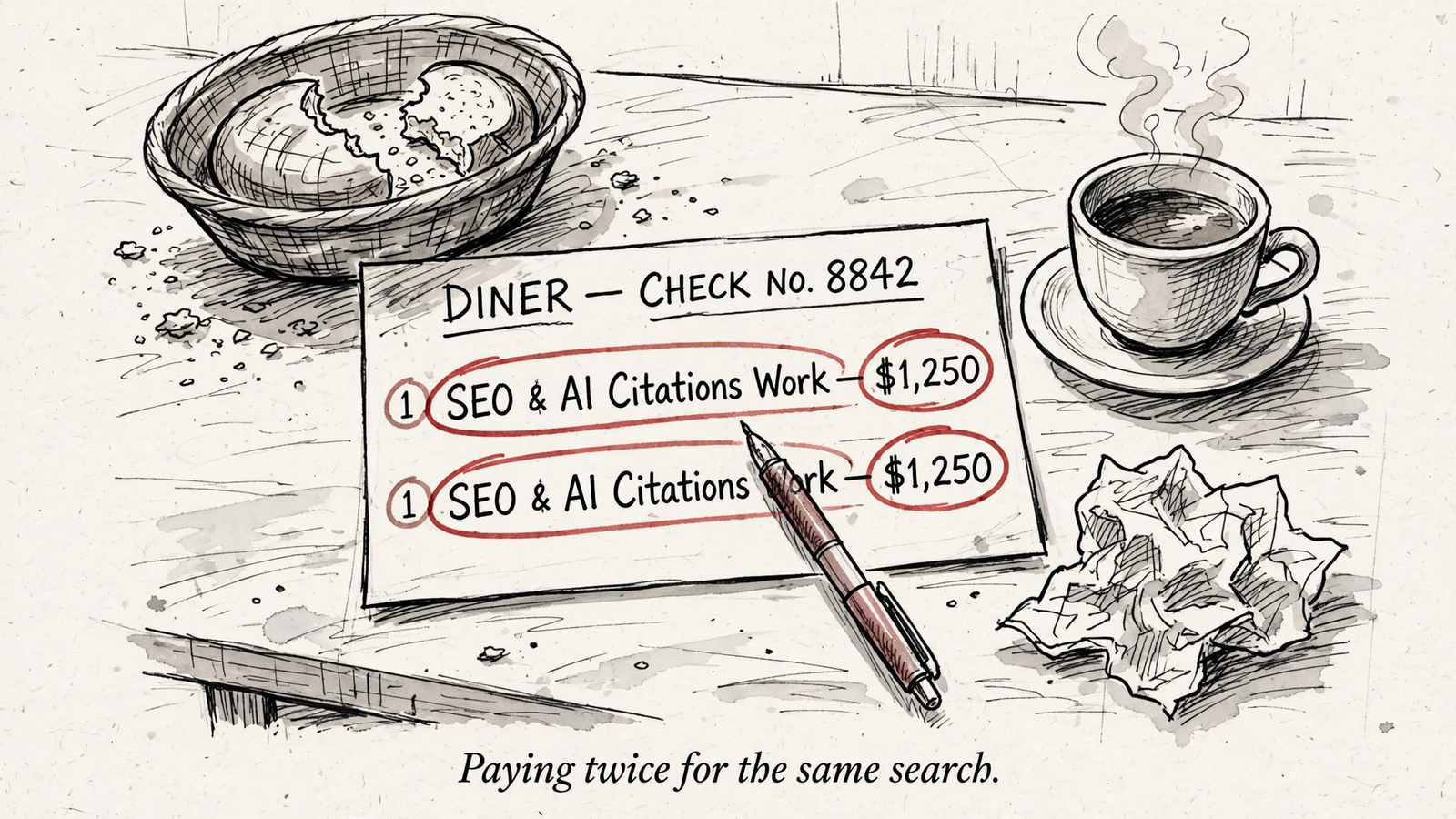
The quote is rarely the total. The most expensive overlap I see is an SEO retainer plus a separate GEO retainer covering the same pages, fixes and links under a new label. Standalone GEO retainers run $1,500 to $50,000+ per month in the WebFX cost breakdown, with small-business basic work at $1,500 to $5,000 and medium-sized work at $5,000 to $25,000+. If your SEO agency already writes buyer-question pages, fixes crawl issues and builds relevant mentions, ask what the second agency will do that the first one will not.
Tracking can be duplicated too. As the same breakdown notes, a separate subscription may buy data your retainer already includes. An agency might pay $95 a month for a tracker and bill you $300 as “AI visibility software.” Ask for the tool name, seat count and monitoring deliverables before you sign. I break down what a year of overlapping retainers can look like in The $800 SEO Retainer That Can Cost Nearly $18,000 a Year.
Setup fees and commitments belong on the same sheet as monthly fees. Six months at $3,000 per month is $18,000 before setup fees. A quote of $3,000 a month plus $1,200 for writing, $800 for development and a $2,000 setup fee reaches $32,000 over six months, according to the pricing survey. I have seen the same shape in local offers: a $1,299 per-location plan beside a $3,000 plan requiring a six-month commitment. Software for a local checklist may cost about $15 to $55 per month, while retainers start at $499 per month. The gap can fairly pay for labor and attention. Make sure someone actually supplies both.
Then add your own time. Nobody invoices you for reviewing drafts, correcting business hours and explaining your services to a junior writer for the third time. You still pay for it. Four hours a week is about 16 hours a month to value against your time. I once had a home-services client who approved every blog post by rewriting it himself. He paid us $2,000 and did half the job. The reports looked fine; the pages shipped late, and CPA did not move. If the process needs you to finish the work, it is not done-for-you. For that owner, a free 30-day playbook would have been cheaper than the retainer.
Two agencies, one set of pages: where the overlap lands
For almost every business under $50k a month in revenue from search, I would start with one owner for SEO and AI-search work, not two agencies. Both need useful pages that engines can read and other sites have reason to mention. Split the job, and you risk buying two audits, two trackers and two status calls to produce one set of pages. Ask each proposal to mark the shared line items and identify who will make the changes. If neither vendor can do that, you have your answer.
I also filter fast on guarantees. Google’s hiring guidance, quoted in a local cost analysis, says no one can guarantee a number-one ranking. The same common sense applies to guaranteed AI Overview placement. Citations can change by query, location and week. Nobody selling you a fixed slot owns that slot. A serious operator can commit to outputs: pages shipped, technical blocks cleared, relevant mentions pursued and priority prompts checked. Buy a plan you can inspect, not certainty the vendor cannot deliver.
A $1,500–$2,000 monthly budget: buy in this order
If you have $1,500 to $2,000 a month, spend it in this order and stop when the money runs out:
- Make the site readable. Check indexation, duplicate pages, titles customers would click, and a contact or quote page that loads fast on a phone. Do not pay to promote pages an engine cannot use.
- Publish buyer-question pages. Aim for two to four that answer with relevant numbers, sizes, timelines and prices. Put the answer near the top; make it easy for a reader to verify.
- Earn relevant mentions. Pursue five to ten real mentions on supplier, review and local sites that already matter in your town. Skip links sold by the hundred.
- Track a small set of prompts. Check 20 money questions weekly with a $29 to $95 tool, then investigate the questions where your pages do not appear.
What I would skip at this budget: a 500-prompt enterprise dashboard and a separate GEO audit that repeats your SEO audit. Do not buy tracking before you have pages worth tracking. Otherwise, you pay every month to watch yourself not appear.

Where groas’s $1,499 sits on the bill
groas offers SEO and AI Search for $1,499 a month. The flat fee covers work across Google, ChatGPT, Perplexity, Gemini and more, with new pages, technical fixes, authority work and a strategist responsible for direction. There are no setup fees or long-term lock-in: it is month to month, with cancellation at any time. That puts it at the bottom of the $1,500 to $5,000 small-business retainer range and below a split SEO-plus-GEO stack that can clear $3,000 to $6,000 before tools.
That math favors an owner who wants one team to ship pages, apply fixes, pursue mentions and check prompts, rather than manage two vendors doing overlapping work. Skip the retainer if you only need a one-time technical cleanup, if your development team must rebuild the site first, or if you want to review every draft yourself and use the free 30-day playbook instead. I would rather tell a $400-a-month business to run the playbook than sell them a retainer that cannot pay back.
The cheapest mistake and the most expensive one
You pay for pages, fixes, authority and tracking, not for the citation itself. Pay once for each job. The cheapest mistake is the $29 tracker you never open. The most expensive is hiring two agencies to do one job and paying $36,000 a year for $18,000 of work. Kill the duplicate charge, then put the first dollar into the page your best customer already asked for.