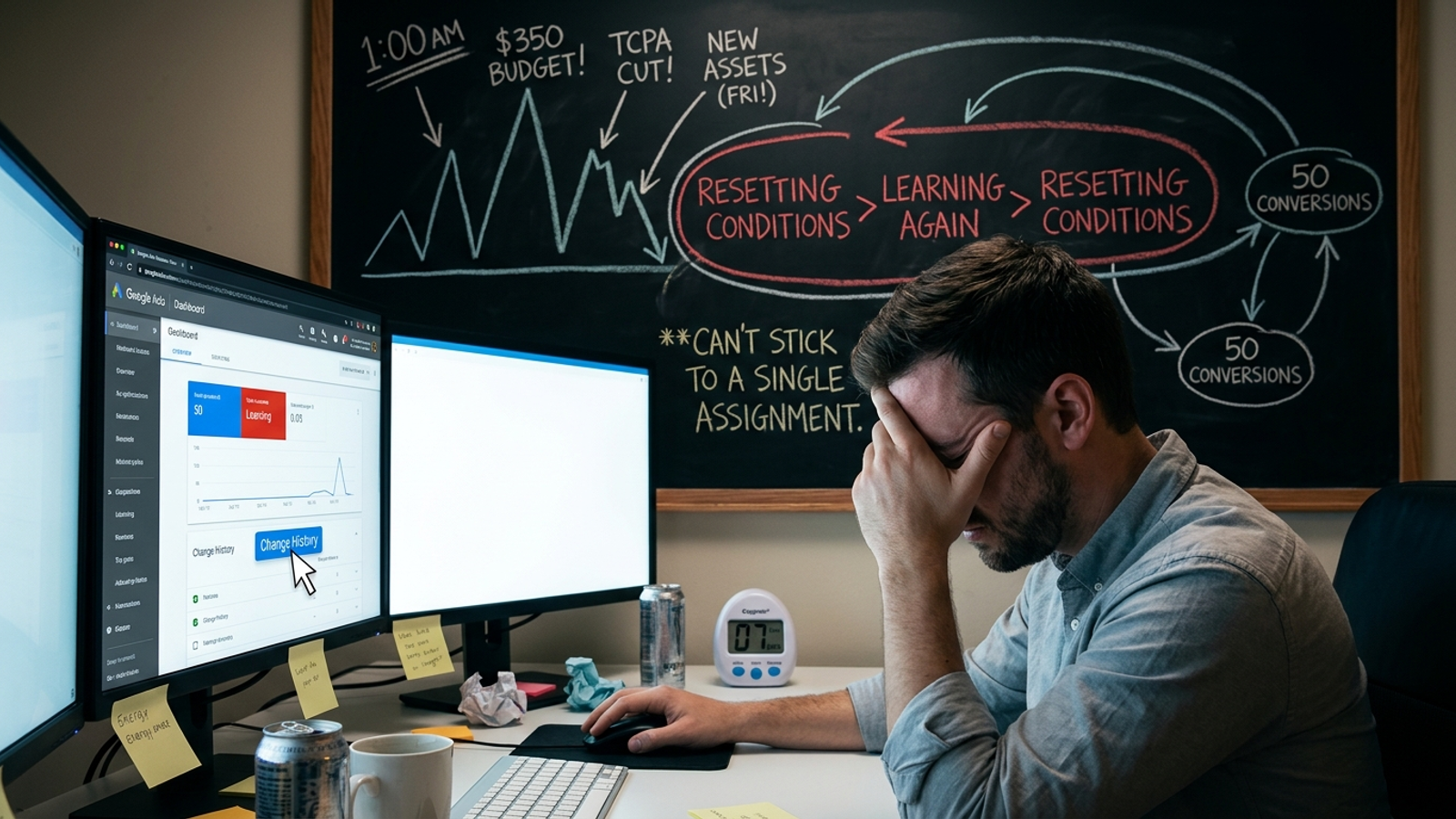
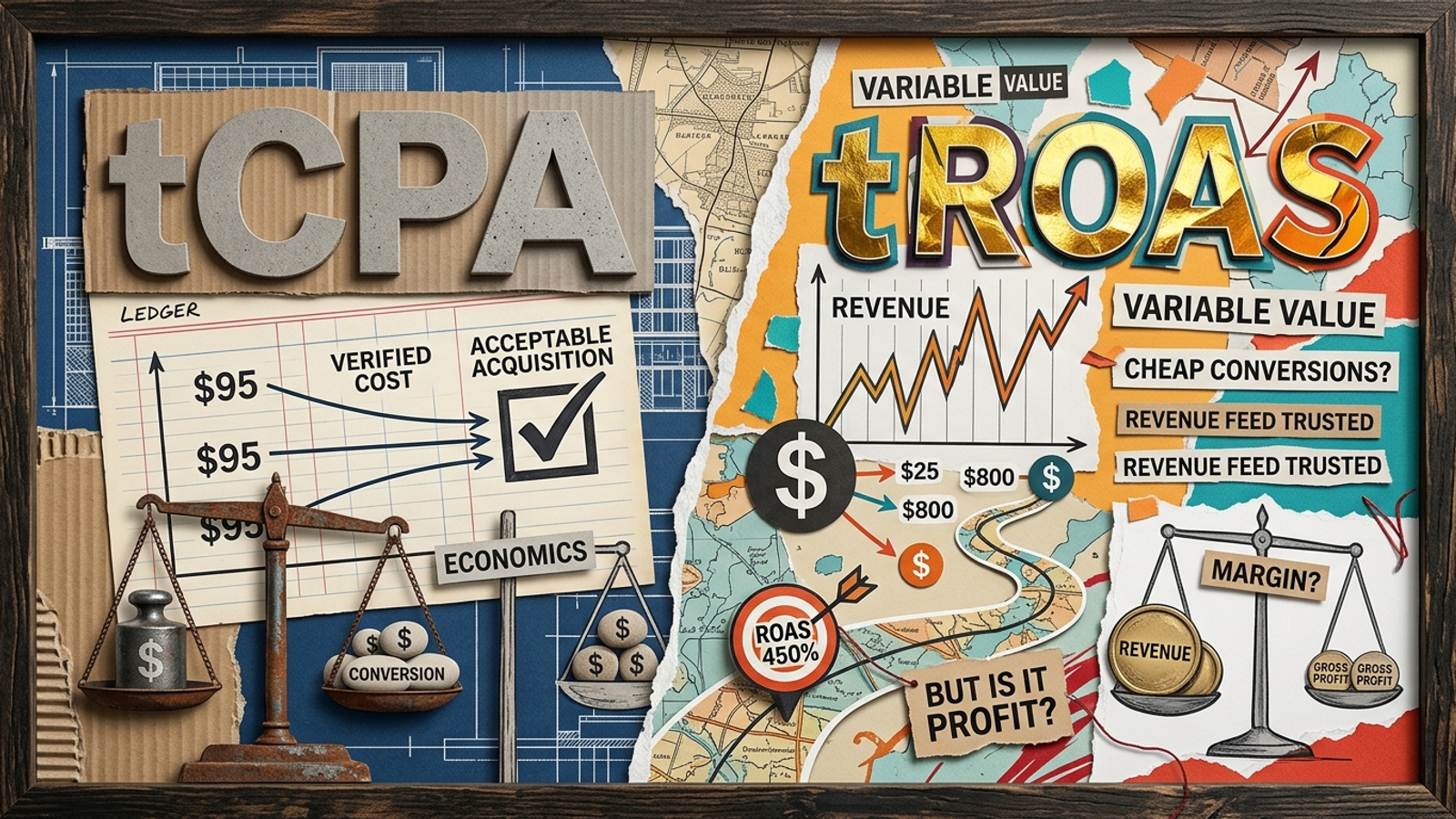
At eight conversions a month, collecting around 50 conversion events takes roughly 188 days. That is arithmetic, not a prediction that Google Ads will display Learning for six months. It is why the familiar seven-day answer can be useless for a low-volume account: the calendar advances whether or not the bidding system gets another example.
I used to tell clients to sit tight for a week after a big edit. I was wrong to make the week the unit of analysis. Google describes learning in terms of conversion volume, conversion-cycle length, and bid strategy; calibration can take one to two conversion cycles. A reported working benchmark is up to around 50 conversion events or three conversion cycles after a change. None of those figures makes seven days a dependable deadline. Count the conversions, identify the cycle, and note what changed.
What the 50-conversion figure can—and cannot—tell you
The 50-event figure is an approximate upper benchmark, not an entry requirement for Smart Bidding. Treating it as a gate creates two bad decisions. One is waiting to turn bidding on until you have already accumulated the data you hoped bidding would help you collect. The other is declaring a campaign broken because its Learning label has not vanished on a date you picked in advance.
Google’s API offers a more useful view of what is happening. It distinguishes LEARNING_NEW, LEARNING_SETTING_CHANGE, LEARNING_BUDGET_CHANGE, and LEARNING_COMPOSITION_CHANGE, alongside statuses for conversion-setting and conversion-type changes. When conversion traffic has been insufficient over past weeks, it can instead report LIMITED_BY_DATA. Those names do not give you a countdown. They tell you whether the system is adapting to a change or short of observations.
That distinction matters in a B2B account. Say you spend $20k a month and book eight qualified calls. A week after a tCPA edit, the strategy may have seen only a handful of new calls. Telling the client that the week is over answers the easy question and misses the expensive one: what has the strategy learned from since the edit?
Nor does losing the badge mean the model stops updating. Learning continues after the visible label disappears. I use the label as a diagnostic, not a graduation certificate. Before judging a new build, I also want to see at least one full conversion cycle. Until then, I check for broken tracking, disapprovals, and delivery constraints rather than turning every early CPA swing into a strategy change.
The volume math exposes the calendar trap
Here is the simple division behind the headline. The monthly volumes below are illustrative account scenarios, not measured outcomes. Each estimate assumes a steady pace and divides the approximate 50-event benchmark by that pace. It does not forecast the date a label will disappear; conversion-cycle length, strategy, prior history, and later edits still matter.
| Illustrative conversions per 30 days |
Calendar time to collect ~50 at that pace |
What the calculation tells you |
| 50 |
~30 days |
Volume arrives much faster than it does in the rows below. |
| 25 |
~60 days |
A quiet week supplies relatively few new examples. |
| 15 |
~100 days |
Repeated material edits can interrupt a long assessment window. |
| 8 |
~188 days |
A seven-day promise says almost nothing about the data collected. |
The last row is not an argument for waiting 188 days before doing anything. It is an argument for checking whether the campaign is optimizing toward the right event. B2B, high-ticket, and lead-generation accounts may not reach 50 events at the conversion stage they care about most. If closed deals are scarce, insisting that Smart Bidding optimize only to closed deals can leave it with very little to work from.
The usual options are to consolidate campaigns, choose an earlier-funnel action, or pool data through a portfolio strategy. None automatically improves the business outcome. An earlier action helps only if it remains a useful signal of eventual revenue; otherwise you have made the conversion count look healthier while teaching the system to pursue the wrong thing. Below roughly 15 conversions in 30 days, that signal choice deserves attention sooner than the age of the Learning badge. More examples help only when they are examples of something worth buying.
Which changes prompt re-learning—and what is still unknown
The API separates learning statuses by cause. It does not publish a universal tariff of days lost for each edit. I would not tell a client that a budget change costs three days and a conversion change costs three months; the account’s volume and cycle length make that sound precise when it is not. What we can do is identify which changes alter the signal, which alter delivery, and which deserve a clean observation window afterward.
| Change |
Why it matters |
Sensible response |
| Conversion setup or type |
The event used to evaluate bidding changes. Google identifies conversion-related learning statuses. |
Fix broken tracking immediately. Plan discretionary changes together, then assess the new signal on its own terms. |
| Bid strategy or target |
The bidding objective or constraint changes. A new CPA or ROAS target does not erase everything the model already knows. |
Avoid treating a target edit as either costless or a complete restart. Give the change a conversion cycle before judging it. |
| Budget |
Delivery can change, affecting the pace and mix of new observations. Google identifies a budget-change learning status. |
Use measured steps where you can; the 20% single-change limit is a practitioner rule of thumb, not a guaranteed safe threshold. |
| Campaign composition |
Broad structural edits can change what auctions and assets the strategy encounters. Google identifies a composition-change learning status. |
Use Experiments for structural ideas instead of repeatedly rebuilding the live campaign. |
This is the cost I care about: a material edit can make the next stretch of performance harder to interpret. Changing the primary conversion is not the same thing as nudging a target, and neither is the same thing as fixing a typo in an ad. I cannot turn that distinction into an exact number of re-learning days from the available figures. Anyone who can do so for your account without looking at its conversion pace and cycle is selling a calendar.
There is a practical order here. Repair bad measurement first; protecting a clean test is no reason to keep feeding bidding a broken signal. Then separate necessary changes from experiments. If you must change the event you optimize for, avoid simultaneously changing the strategy, budget, and campaign structure unless the account genuinely requires it. Otherwise, when CPA moves, you will not know which lever moved it. What the deck calls re-entering learning, I call making your next read less clean.
Make the next observation window worth having
My default is not “touch nothing.” It is change the thing that is wrong, then stop changing everything else. With solid tracking and a high-quality primary conversion, starting on Max Conversions or tCPA can make sense. Prior account conversion history can speed learning. Neither point promises a quick exit for an account with a long sales cycle or thin volume.
For a starved account, I work through the decisions in this order:
- Check the feed. Is the primary conversion firing correctly, and does it describe an outcome the business actually values? Do not celebrate a higher count if the added events are weak.
- Check the pace. How many relevant conversions have occurred since the last material change, and how long does a conversion usually take? Compare those answers with the volume table, not with a week on the calendar.
- Reduce needless fragmentation. Consider consolidation or a portfolio strategy if related campaigns are each short of data. Test structural changes rather than making them casually.
- Choose the evaluation point. After a meaningful edit, allow a full conversion cycle before calling an early performance swing a verdict. Keep checking for breakage in the meantime.
A campaign closing six deals a month on a 45-day cycle illustrates the limit. At that pace, collecting 50 closed deals takes roughly eight months, even before you ask how the cycle affects what the system can observe today. No bid trick changes that arithmetic. An earlier qualified step may provide a more frequent signal, provided it still predicts the outcome you want; closed revenue can remain part of how you evaluate the work. If the signal stays too thin, reconsider the bidding approach while you fix the offer or landing page rather than pretending that time alone will supply conversions.
This is also why I want an audit trail, not a weekly reassurance that someone is “monitoring learning.” At groas, the engine I work with logs bid, budget, and composition changes with their reasons. That lets me connect a new learning status to an actual edit instead of guessing which dashboard click did it. The log cannot manufacture conversion volume. It can stop the team from mistaking its own interventions for a mysterious algorithm mood.
The numbers leave four myths worth retiring. They sound plausible because each borrows a piece of truth and stretches it into a rule.
“Learning takes 7 days since your last edit”
People believe this because the older, still-circulating seven-day explanation is easy to remember. A week is also a convenient date to put in a client email. Google’s current description instead points to conversion volume, cycle length, and strategy. Seven days may be enough for an account producing plenty of relevant conversions quickly. For an account producing eight a month, seven days will usually contain very few.
The better question is what happened in the week. Count the conversions and check whether a material edit changed what the strategy is trying to learn. The date by itself is not an answer.
“Don’t touch anything while it’s learning”
People believe this because the warning looks serious. Sometimes “leave it alone” is also a respectable-sounding way to avoid making a decision while spend continues. The useful rule is narrower: do not stack discretionary changes until you cannot read their effects. A new CPA or ROAS target does not discard prior learning wholesale, and the 20% budget guideline is a caution against shocks, not a ban on managing budgets.
Fix broken tracking now. Test speculative structure changes with Experiments. Protect the quality of the signal, not the sanctity of the badge.
“When the label goes away, you’re done”
People believe it because the interface presents a neat status change. The model does not graduate. It keeps learning after the Learning label disappears. A cleared badge is useful context, not proof that CPA or ROAS has settled and certainly not proof that the funnel works. I still want a meaningful conversion window before making the next big call. Read performance; do not outsource judgment to a status label.
“PPC takes 2 to 3 months to work. That’s just learning”
This is the hardest one to kill. It sounds patient and professional, and it borrows from real timelines for preliminary PPC results and longer-term ROI. Those timelines cover more than bid-strategy calibration: copy, landing pages, the offer, and the sales process can all need work. Calling all of that learning hides the part somebody can fix.
When an account is losing money in month three, I do not accept “the algorithm needs time” as a diagnosis. I ask what conversion the strategy has been shown, how often it has seen it, how long that conversion takes, and what material changes happened along the way. If volume is thin, improve the signal or its feed rate. If the strategy has seen enough relevant examples and performance is still flat, inspect the funnel instead of buying another month of patience. The decision the numbers support is to manage the evidence, not wait for a date.