

An AEO retainer should pay you to change what AI search engines can find and cite, not to watch a dashboard count mentions. Price it around a client domain and the work you ship. Price it around tracked prompts, and you risk repeating the percentage-of-spend mistake agencies made in paid search: tying your fee to a convenient meter instead of the job the client hired you to do.
I understand the temptation. Prompt counts are easy to put in a proposal. You can show a client screenshots from ChatGPT, Claude, Perplexity, or Google AI Overviews and call it coverage. But prompts are a monitoring unit, not a deliverable. A client wants to know whether their brand appears when buyers ask relevant questions, what you changed to improve that position, and whether the work contributed to pipeline. They do not want to fund an increasingly elaborate Tuesday-morning screenshot habit.
The retainer I would sell is per domain, scoped around technical fixes shipped, direct-answer pages published, and third-party citations earned. Monitoring tells you where to work. It is not the work.
What am I actually selling each month?
A self-serve AI tracking dashboard can cost $29 to $99 a month. If your $3,500 retainer consists mostly of a rebranded export and an email about whether ChatGPT mentioned the client, the client can see the gap. In traditional white-label SEO, wholesale execution ranges from $300 to $1,200 per client per month. AEO adds a distinction agency owners need to keep clear: paying to observe an answer is different from paying to change the material an engine reads.
When I decide what belongs in an AEO retainer, I use one test: did we alter the client’s digital footprint, or did we just take notes on it? Three work streams pass that test.
What technical work can we ship?
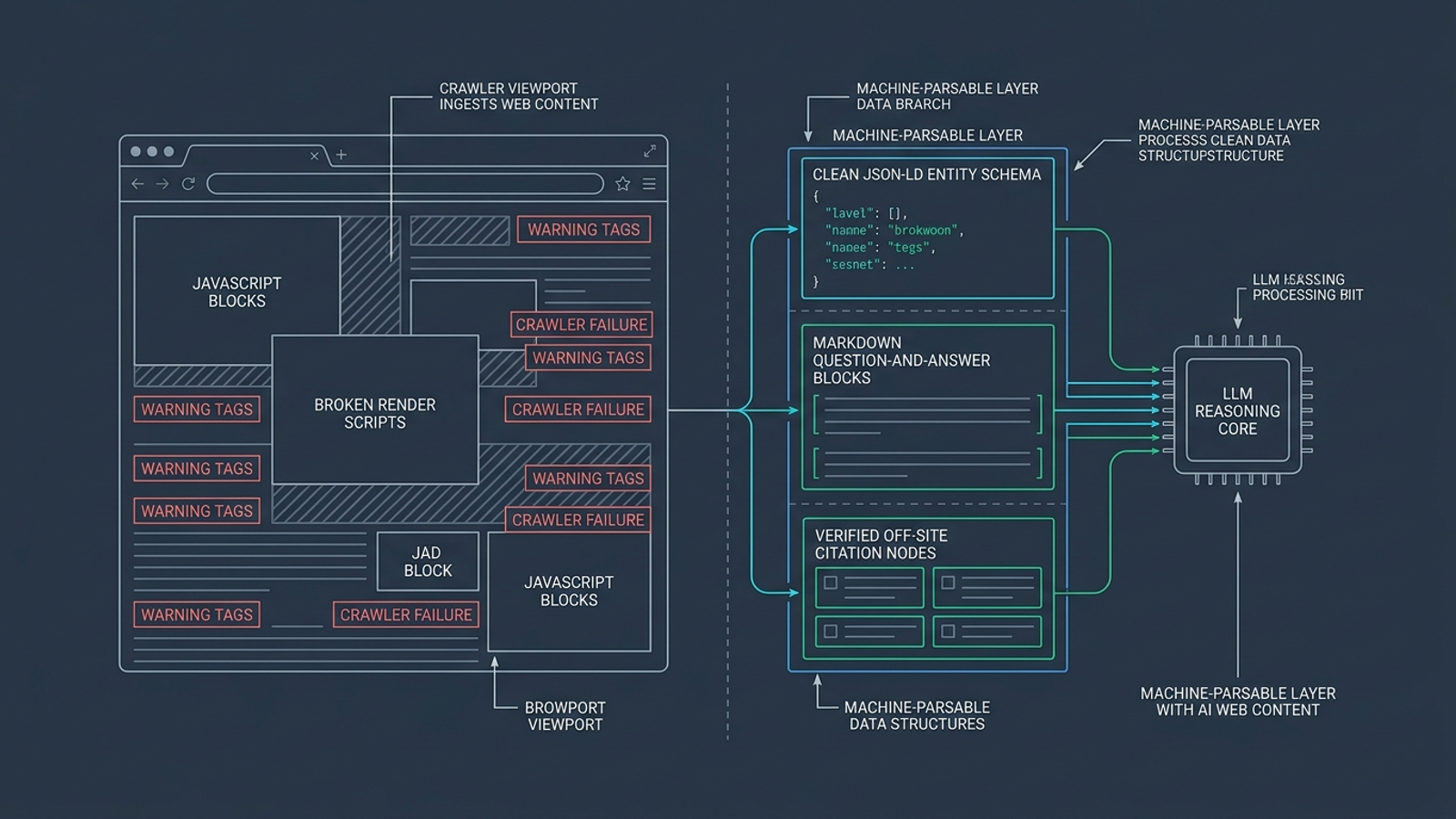
A site that depends on client-side JavaScript, hides useful text in dynamic tabs, or blocks relevant crawlers makes its content harder for AI systems to access. The retainer should cover an audit of server responses and crawler access, followed by the fixes the client’s setup requires: removing render blocks, improving machine-readable content, and deploying valid JSON-LD entity schema. Where it belongs in the implementation, the draft scope also includes configuring llms.txt.
Do not sell the audit as the finished job. The deliverable is the fix deployed to the site, with a record of what changed. If CMS access or a client developer is needed, establish that before you quote.
What content needs to go live?
A long article padded to catch secondary search terms is not automatically useful as a direct answer. Publish modular answer blocks, explicit definitions, and comparative tables that address buyer questions without making a reader excavate the point. One retainer example bundles four citation-targeted assets a month; use a quantity your team can actually publish, not one that looks impressive in a proposal.
Count published assets, not drafts in a queue. A document waiting for CMS approval cannot do much for a buyer or a search engine.
Where does corroboration come from?
A brand’s own page is only one part of its footprint. Build relevant citations in trade directories, industry publications, and community discussions where independent sources can corroborate its claims. This is not permission to promise placements you cannot secure. Scope the outreach, track what lands, and distinguish a live citation from an email sent to an editor.
What should I leave out of the contract?
Leave out work that consumes hours without changing the client’s footprint or clarifying a decision:
- A fixed prompt count. Promise topic coverage and a monitoring method, not 75 prompts that invite an argument about why you did not track 150.
- The 40-page screenshot deck. A manual capture of 50 answers is a record of what appeared at those moments, not next month’s execution plan.
- Every speculative AI search surface. Focus the scope on the engines relevant to commercial queries: Google AI Overviews, ChatGPT, Perplexity, and Copilot.
Track thematic buyer questions internally. Report the fixes deployed, the pages published, the citations verified, and whatever assisted conversion evidence you can connect to the work. Do not confuse breadth of monitoring with depth of delivery.
How should I tier the retainer by domain?
Custom-scoping every inbound client sounds attentive until each account needs its own delivery process. Standardise the baseline by domain scale, then price exceptions explicitly:
- Core Domain Retainer, $2,500 to $3,500 a month: For a single-domain business with a defined product catalogue or localised service area. Scope crawlability fixes, twice-monthly schema updates, two to four extractable answer pages per month, and baseline directory citation work.
- Multi-Category Retainer, $4,500 to $6,500 a month: For a B2B or ecommerce brand with multiple product lines. Add weekly direct-answer publishing, off-site outreach, cross-engine competitor citation-gap analysis, and ongoing CMS schema synchronisation.
- Enterprise Multi-Domain Retainer, $8,000 or more a month: For an organisation managing separate web properties. Scope technical alignment across domains, direct CMS publishing, and custom entity-graph work.
Those are scoping bands, not a licence to promise unlimited work. More domains, more categories, and harder publishing access change the delivery load. Put the included work in the proposal before you put a margin in the forecast.
What will delivery cost, and what gets missed?
For planning, the draft delivery estimate is $1,350 to $3,550 per domain per month, against retainers commonly modelled here at $3,000 to $6,500. Do not treat that spread as an automatic gross margin. The lines below describe different ways of fulfilling the work: a flat execution platform and a manual stack are alternatives in parts, not seven charges to add blindly. The recurring costs belong in your monthly model; the setup work does not disappear just because you bill it once.
| Line item | Timing | Figure | Basis and cost driver |
|---|---|---|---|
| Multi-engine tracking | Recurring | $399 to $999/month | Profound workspace comparison lists $399 per client workspace; ReachLLM Scale comparison lists $999 for 10 projects. Workspace or project limits drive the bill. |
| Flat per-domain execution platform | Recurring | $999/domain/month | Flat-rate execution model used in the draft’s agency comparison; domain count drives the bill. |
| Four direct-answer drafts | Recurring | $400 to $1,700/month | Draft planning range for automated or freelance production; four drafts at the cited $425-per-draft rate reach $1,700. |
| Technical schema and CMS work | Recurring | $400 to $1,192/month | Four to eight hours at $100 to $149 an hour; access and implementation complexity drive time. |
| Off-site citation work | Recurring | $500 to $1,500/month | Draft planning allowance for outreach, directory work, and corroboration campaigns; scope and placements drive cost. |
| Screenshot and reporting labour | Recurring, internal | $300 to $600/month | Draft estimate for four to eight non-billable hours; reporting time is easy to omit from a tool quote. See the retainer-fee calculator. |
Initial entity audit and llms.txt deployment | One-off | $500 to $1,500/domain | Draft setup allowance for headers, crawler directives, and schema-template mapping; site condition drives the work. |
A vendor’s listed price is not your cost to serve. The hidden line is the human work left after the software bill: editing, approvals, CMS deployment, outreach follow-up, and reporting. Decide which tasks a platform actually executes before you remove their labour from your forecast.
What happens when the client count grows?
The arithmetic exposes both the appeal and the limit of a flat fee:
- At five domains, $399 per client workspace is $1,995 a month for tracking alone. In the draft’s manual-delivery example, total fulfilment reaches $12,500 against $17,500 in retainers at $3,500 per client, leaving about 28.5% gross margin. A $999-per-domain platform costs $4,995 for five domains. That leaves $12,505 before strategist time and any work the platform does not cover. It is not a 71.4% delivery margin.
- At ten domains, a $999 plan capped at 10 projects and 500 pooled prompts leaves an average of 50 prompts per client. Five buyer questions checked across four engines already create 20 question-and-engine combinations before variations. Read the prompt allowance and overage terms; a cheap headline price is less useful if ordinary monitoring pushes you past the cap. The flat-rate AEO pricing analysis examines that trap.
- At fifteen domains, the draft’s manual model estimates more than $32,000 in monthly fulfilment against $52,500 in retainers. Fifteen flat $999 domain fees total $14,985, but that is still only the platform bill. Add strategic oversight and uncovered delivery work before you claim a gross margin.
Here is the formula I would put beside every tier: Price = Cost ÷ (1 - Target Gross Margin). A 50% markup on $1,000 of delivery cost produces a $1,500 fee and only a 33% gross margin. A 50% gross margin requires a $2,000 fee. Markup and margin are not interchangeable, however often an agency spreadsheet pretends they are.
Which software belongs behind the retainer?
Monitoring tools have a job. Peec AI, Otterly, and ReachLLM can help an agency observe how a brand appears across AI answers. But a chart does not write an answer page, deploy schema, or pursue a citation. Buy a dashboard as a diagnostic tool if you need one; do not present it as the engine fulfilling the contract.
The useful dividing line in our ranking of AEO tools by the work they do is execution versus an unpaid to-do list. For this retainer model, look for software that can support publishing, show what changed, fit white-label reporting, and charge predictably per domain rather than making more prompt checks eat your margin. groas is built around autonomous search execution with human strategic ownership; that is a better fit for a work-based retainer than selling a monitoring seat as the service. Check the client’s CMS access and the actual delivery scope before assuming any platform eliminates every manual task.

How do I move an existing SEO client over?
Do not pitch AEO as a speculative $500 widget attached to an otherwise unchanged SEO contract. Explain the infrastructure work: the client’s content needs to be accessible, directly useful as an answer, and corroborated beyond its own site. Traditional organic search work does not vanish. The scope expands to account for buyers encountering direct AI answers as well as conventional results.
Give an existing client a 90-day delivery sequence, not a promise that an engine will recommend them by a particular date:
- Month 1: Make the site readable. Inspect crawler responses, review the primary entity templates, deploy appropriate JSON-LD, configure
llms.txtwhere scoped, and remove identified CDN or JavaScript blocks. - Month 2: Publish answers to buyer questions. Rework suitable existing posts into extractable Q&A modules and publish four new direct-answer assets aimed at commercial queries.
- Month 3: Corroborate and connect the evidence. Align relevant directory data and industry citations with on-site claims, then connect available lead attribution to assisted conversions from AI search surfaces.
Sell the sequence of work, not a guaranteed model response. Clients can approve and inspect the former. Nobody can put the latter on a dependable production schedule.
What should the monthly report prove?
A visibility chart can tell you where to investigate. It cannot, by itself, tell a client’s marketing lead what their fee bought. Keep the report to three useful sections:
- Execution log: Technical fixes deployed, including what changed in the CMS.
- Published footprint: Direct-answer URLs, crawler-access findings, and verified off-site citations. Distinguish pages published from pages you can confirm were accessed.
- Business evidence: Relevant visibility observations and the assisted conversion pipeline you can attribute to AI search referrals.
If you shipped four structured pages, cleared two crawl blocks, and secured three verified citations, say so. If you did not, do not bury the gap under 40 prompt screenshots. A renewal conversation is easier when the work is inspectable.
What do I check before sending the proposal?
Run this pre-flight check before you quote a new domain or convert an organic client:
- Calculate margin, not markup. If tools and fulfilment cost $1,200, a $2,400 fee leaves a 50% gross margin. A 50% markup gives you an $1,800 fee and less room to deliver.
- Confirm CMS access. Find out whether your team or execution software can publish schema and answer pages in WordPress, Webflow, or Shopify without an unpriced client-developer queue.
- Remove prompt quotas. Define the domain, topic coverage, monitoring approach, and executed deliverables instead.
- Inspect crawler access. Check responses for GPTBot, ClaudeBot, and PerplexityBot before scoping work for those surfaces.
- Set an initial 90-day term. Give the technical fixes, publishing, and citation work time to be delivered and assessed without promising a specific model-update date.
The cheapest mistake is confusing a 50% markup with a 50% margin; you can catch it with a formula before the proposal goes out. The most expensive is leaving deployment and reporting labour out of the cost model until your strategists spend every Friday copying answers into slides. Today, pick one client domain, inspect its crawler access, and cost the fixes you would actually ship. Then price the retainer for doing that work, not for watching the prompts.
Frequently asked questions
Why shouldn't I price an AEO retainer based on tracked prompts?
Prompts are a monitoring unit, not a deliverable. Pricing around tracked prompts ties your fee to a convenient meter rather than the job the client hired you for, repeating the percentage-of-spend mistake agencies made in paid search. Price the retainer around the client domain and the work you actually ship.
What work belongs in a monthly AEO retainer?
Scope it around technical fixes shipped, direct-answer pages published, and third-party citations earned. A good test is whether you altered the client's digital footprint or merely took notes on it. Monitoring tells you where to work, but it is not the work itself.
Should I sell the technical audit as the deliverable?
No. The deliverable is the fix deployed to the site, with a record of what changed. Audit server responses and crawler access first, then ship fixes such as removing render blocks, improving machine-readable content, and deploying valid JSON-LD entity schema. Confirm CMS access or client developer availability before you quote.
What should I leave out of an AEO contract?
Leave out a fixed prompt count, the large manual screenshot deck, and speculative AI search surfaces beyond Google AI Overviews, ChatGPT, Perplexity, and Copilot. A screenshot is a record of what appeared at one moment, not an execution plan. Promise topic coverage and a monitoring method instead of a specific number of prompts.
How much should I charge for an AEO retainer per domain?
Standardise by domain scale rather than custom-scoping every client. A Core Domain Retainer runs $2,500 to $3,500 a month, a Multi-Category Retainer $4,500 to $6,500, and an Enterprise Multi-Domain Retainer $8,000 or more. Treat these as scoping bands and put the included work in the proposal before setting a margin.
What is the difference between 50% markup and 50% gross margin?
They are not interchangeable. A 50% markup on $1,000 of delivery cost produces a $1,500 fee and only a 33% gross margin, while a 50% gross margin requires a $2,000 fee. Use the formula Price = Cost ÷ (1 - Target Gross Margin) before the proposal goes out.
What does fulfilling an AEO retainer actually cost per month?
The draft delivery estimate is $1,350 to $3,550 per domain per month against retainers commonly modelled at $3,000 to $6,500. A vendor's listed price is not your cost to serve: the hidden line is the human work left after the software bill, such as editing, approvals, CMS deployment, outreach follow-up, and reporting.
How do I move an existing SEO client onto an AEO retainer?
Give a 90-day delivery sequence rather than promising an engine will recommend them by a date. Month one makes the site readable, month two publishes answers to buyer questions, and month three corroborates with citations and connects assisted conversions. Sell the sequence of work, not a guaranteed model response.