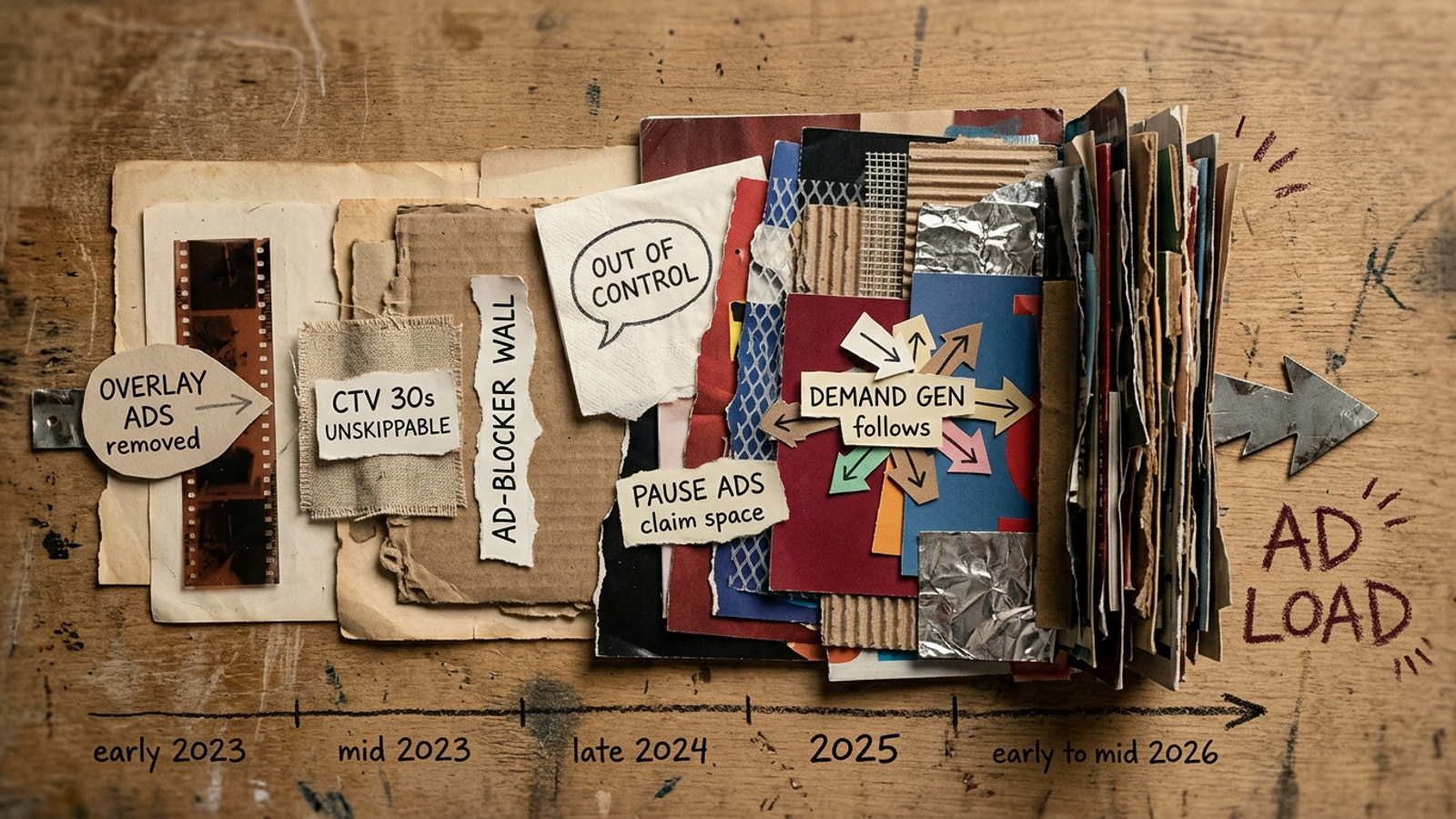
YouTube did not flip an “add more ads” switch in January 2026. What viewers describe as three ads in a row and breaks every three to four minutes sits at the end of a three-year sequence: new places to serve ads, longer TV units and more ways for existing budgets to reach the same audience.
I understand why people went looking for one announcement. In an Android Authority poll, 86.7% of respondents called the current ad experience “out of control”. That sounds like the aftermath of a single big change. It wasn’t. The useful question for advertisers is not which 2026 switch they missed, but which older assumptions about exposure and format mix they still use. Here is the timeline, including the places where the record is thinner than the complaints.
April 6, 2023: YouTube removes overlay ads
YouTube discontinued overlay ads on April 6, 2023. They were a legacy, desktop-only format that YouTube considered disruptive. Removing a banner sounds like a move toward a lighter experience. It was, for anyone who disliked a banner sitting over the video. But it also removed one way to advertise without asking the viewer to watch another video ad.
That distinction matters to a buyer. An overlay impression and a pre-roll view were never interchangeable forms of attention. Once the overlay disappeared, an advertiser looking for YouTube reach had one fewer low-attention format to use. That does not prove every dollar moved into pre-roll or mid-roll, and it does not explain the 2026 ad load by itself. It marks the first change in this timeline from an easier-to-ignore format toward video inventory carrying more of the work.
I used to dismiss overlays as throwaway reach. Looking at the sequence now, I wouldn’t dismiss their removal. If the format changes, the creative and the measure of useful reach have to change with it.
May 2023: A longer unskippable ad comes to TV
At Brandcast in May 2023, YouTube introduced a single 30-second unskippable ad on connected TVs in place of two 15-second spots, sold through YouTube Select. Its stated reach case was 150 million US viewers on TV screens. For advertisers, the notable change was not just the number of seconds. It was the shape of the break: one longer, uninterrupted unit on the biggest screen in the room.
That creates a different creative problem from buying a short mobile impression. You have to hold attention for 30 seconds, and a weak opening has more time to become painful. For viewers, a single longer interruption may feel different from two shorter ones even when the total time is the same. Later complaints about heavy TV breaks make more sense against that backdrop, though this launch alone does not account for them.
Plan CTV as its own viewing situation, not as spare reach attached to a mobile campaign. The screen and the commitment you ask of the viewer are different.
Fall 2023: The ad-blocker wall narrows the escape route
That fall, YouTube began blocking playback for viewers using ad blockers unless they allowed ads on YouTube or paid for Premium, then priced at $13.99 per month. All About Cookies recorded a 336% rise in traffic to its YouTube ad-blocker pages in the month after the crackdown. In its survey, 52% of users said they would not pay for an ad-free experience, while only 11% said they were less likely to use a blocker.
Those figures show attention and resistance, not how many people ultimately watched more ads. The practical change is narrower and still important: for a free viewer who stayed, bypassing ads became harder. At the same time, YouTube was developing a more substantial TV ad experience. More inventory matters more when fewer viewers can simply opt out of seeing it.
For buyers, that is a reason to watch repeat exposure, not an invitation to chase every available impression. A viewer who has fewer ways around ads still has ways to resent yours.
September 18, 2024: Pause ads claim idle time
After a pilot that began in early 2023, YouTube widely rolled out pause ads to all advertisers on September 18, 2024. Pause a video and an ad appears beside the paused picture. No pre-roll has to get longer. No creator has to add a mid-roll break. YouTube can place an ad in a moment that previously had no ad at all.
YouTube described the format as less interruptive. I can see the logic: the viewer has already stopped playback. But “less interruptive” is not the same as “instead of another ad.” The rollout did not come with a promise to remove pre-rolls or mid-rolls in exchange. That is why pause ads belong in an ad-load timeline even though they do not explain complaints about longer breaks.
Count exposure across the session, not just interruptions during playback. A pause ad can be easy to miss in a discussion about pod length and still be another brand impression for someone watching that evening.
September 2024 to Q2 2025: Demand Gen changes where a budget can follow viewers
In September 2024, Google announced that Video Action Campaigns would begin upgrading to Demand Gen in Q2 2025. New Video Action Campaigns would stop being available from March 2025, with automatic upgrades to follow. Google pitched 20% more conversions at the same CPA by using video and image assets across YouTube, Shorts, Discover and Gmail.
This is not a new mid-roll slot, and I would not count a Gmail impression as another ad break in a YouTube video. The change matters for a different reason: a performance budget that a buyer once understood primarily through video action can now work across more surfaces. The same person may encounter that advertiser in a Short, in Discover and elsewhere, not only in a conventional in-stream session.
For practitioners, the broken assumption is that one campaign label describes one kind of exposure. It doesn’t tell you enough about screen, format or pace. Separate the surfaces in your planning and reporting before you interpret frequency as though every impression felt alike. A short vertical exposure and a 30-second TV ad may reach the same person, but they are not the same creative job.
May 12, 2025: Natural breaks open up the back catalog
Effective May 12, 2025, YouTube shifted mid-roll delivery toward natural breakpoints such as pauses and transitions, rather than slots that cut through a sentence or action. For videos uploaded before February 24, 2025, creators with manual placements also received additional automatic slots unless they opted out in YouTube Studio.
The viewer-facing improvement is real enough: an ad at a pause can feel less rude than one in the middle of a thought. The inventory change is real too. Older videos with manually placed breaks could gain more eligible slots. A less jarring location does not necessarily mean fewer chances to show an ad during a session.
Creators had a reason to accept the shift. YouTube said interruptive slots would earn less after the change. That does not establish how many creators kept every automatic slot. It does explain the incentive behind moving toward them.
This is where I would stop treating the back catalog as fixed inventory. A video does not need to be new for its ad opportunities to change. If your exposure expectations rested on old placement patterns staying put, revisit them before blaming every increase in frequency on newly uploaded content.
Early 2026: Viewers describe density, not a new format
By February and March, the complaints sounded different. Viewers described three back-to-back ads instead of two and breaks every three to four minutes. Reports covered the free tier and Premium Lite. The language was blunt: “out of control,” “unwatchable,” “every three minutes.” These were reports of what people encountered, not evidence of a newly announced universal frequency policy.
The preceding changes help explain why the experience could feel heavier without one headline launch. Pause ads added a place to advertise during a session. Demand Gen broadened where performance budgets could appear. Automatic mid-roll slots changed the opportunities on older videos. Longer CTV units had already made some breaks feel more substantial. None of those changes, on its own, proves the cause of every viewer’s reported ad sequence. Together, they make the search for a single 2026 switch the wrong way to read the problem.
For advertisers, the warning is creative wear, not just a possible CPM increase. If the same audience can meet your ads in more places, a cap or rotation plan built around in-stream alone tells you less than it used to.
April 8–9, 2026: The 90-second scare is not a new format
On April 8 and 9, TV app viewers reported 90-second unskippable ads, apparently beyond YouTube’s stated limits of 15 seconds on mobile and 30 seconds on CTV. TeamYouTube replied on X on April 9 that it did not have a 90-second non-skippable format, was not testing one and was looking into the reports.
I would not put a 90-second unit in a media plan on the strength of those reports. The record here is a reported delivery problem and YouTube’s denial that it was policy. Calling it a new format turns the loudest incident into a false explanation for the wider ad-load complaints.
It does tell us something about the mood. After months of complaints about density, an extreme-looking break was readily read as the next deliberate increase. Plan around the stated formats, not the scare. A 30-second unskippable CTV ad already asks enough of your creative without inventing a 90-second one.
Mid-2026: No clean cap announcement explains the load
I could not verify a mid-2026 policy that established a new universal frequency cap. The material YouTube published in this stretch included creator-monetization guidance, such as its February 2026 advertiser-friendly content update, rather than a buyer-facing announcement that neatly explains what viewers reported. That gap is worth stating plainly instead of filling it with a theory dressed as a fact.
The timeline already contains several changes that did not require a universal cap announcement: another place for an ad when playback stops, broader campaign surfaces and additional eligible mid-roll slots on older videos. Those are different mechanisms. Their common effect is to make an old, simple picture of “YouTube frequency” less useful.
Say you spend $20k a month. If you still evaluate the whole buy as one blended line, you may miss whether repeated exposure is coming from TV breaks, Shorts or another surface. Look for the actual pattern in your delivery before trying to fix an imaginary rule change.
September 2026: The next change may look small, too
Here is my reading of the line. YouTube removed a legacy overlay in 2023 and introduced a longer CTV unit. The ad-blocker crackdown made avoiding ads harder for free viewers who stayed. Pause ads opened idle time in 2024. Demand Gen broadened where a performance budget could serve, and automatic mid-roll slots changed the opportunity on older videos in 2025. By early 2026, viewers were complaining about density. The 90-second reports made the frustration louder, but they were not proof of another official format.
Those moves do not all have the same cause, and I would not pretend they add up to a measured number of extra ads per viewer. They do point in one direction for a buyer: there are more ways for a person to encounter your advertising than a plan built around in-stream breaks can account for. The next tightening, if the pattern continues, may arrive as another modest delivery or placement change rather than a dramatic new ad unit. That is a forecast, not an announced policy. I would prepare for it without buying the story that every complaint predicts a new format.
Set frequency around the viewing situation
Start by separating CTV from phone viewing in your plan. Then examine Shorts and the other Demand Gen surfaces rather than folding them into one notion of a YouTube impression. Where your campaign setup supports frequency limits, set them with the screen and format in mind; where it does not, use delivery reporting and creative rotation instead of assuming a single limit controls every encounter. Rotate creative in response to exposure, not just because a calendar quarter ended.
The detailed cap-and-rotation discussion is in YouTube’s heavier 2026 ad load: how to control frequency before it wastes your budget. My shorter rule is less elegant: if you cannot tell where repetition is happening, you cannot manage it by changing one account-wide number.
Give each format a job
Stop buying YouTube as one blended line item. Give the 30-second CTV unit a cut built for an uninterrupted TV break. Use skippable in-stream for reach and testing, and keep Shorts and broader Demand Gen delivery visible as distinct parts of the plan. That separation is not paperwork for its own sake. Each surface creates a different viewing situation and a different pace of exposure; mixing them hides which creative is doing work and which is merely showing up again.
The fuller format-by-format setup is in YouTube Advertising in 2026: complete strategy guide for high ad load competition. For now, separate the TV screen from the phone screen. The next small change will be easier to spot if you stop treating every impression as the same one.