

 LinkedIn
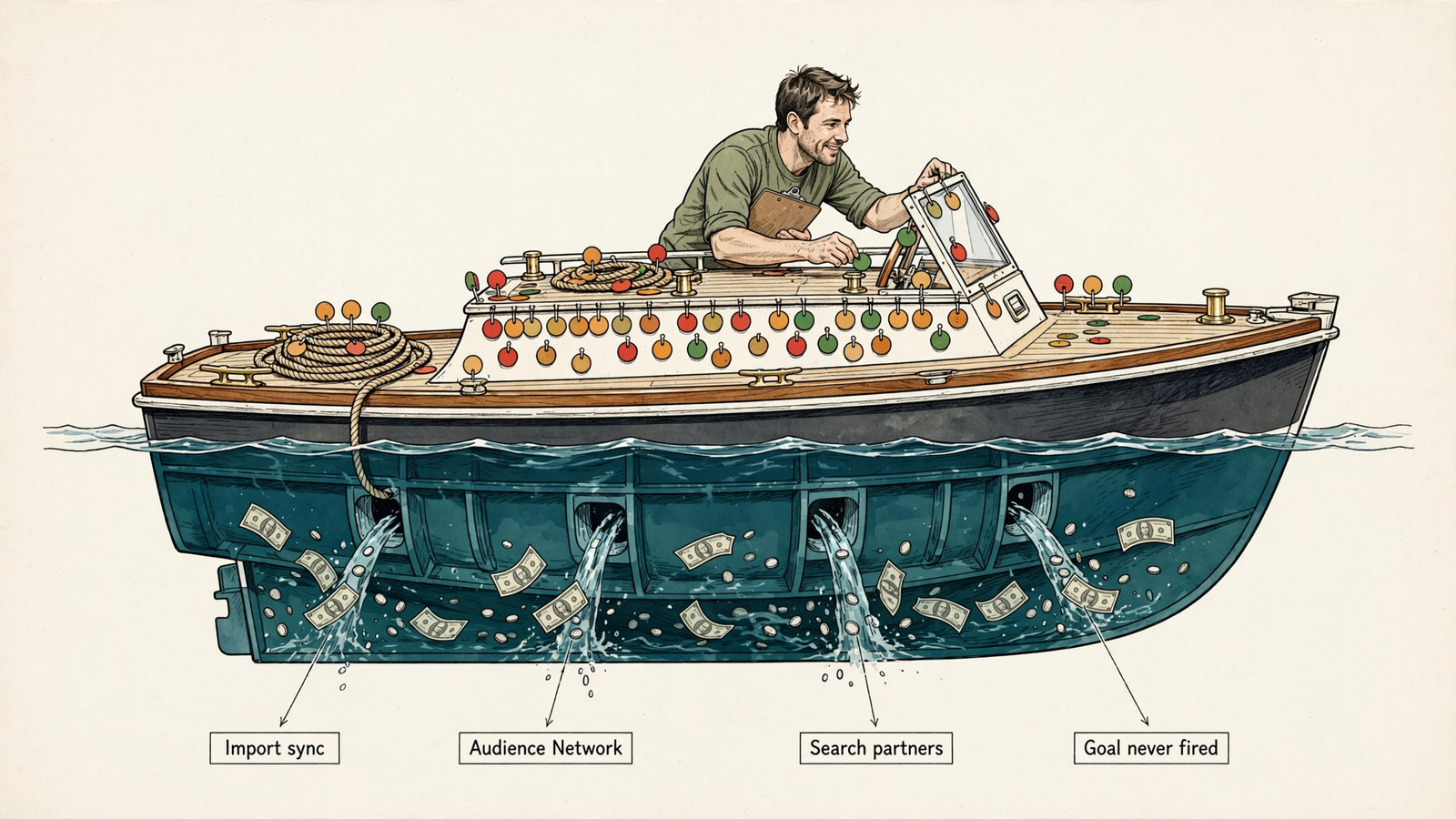
Thirty findings. Not one answered why the Bing account spent money without producing leads. Last month a founder forwarded me the free audit he had received before an agency takeover pitch, and I picked it apart because it looked like the document you are likely to get when you ask for help with Microsoft Ads campaigns that spend without converting.
The verdict is blunt: this was a Google audit with the Microsoft logo swapped in. Four checks mattered, and the audit missed all four: scheduled Google Import, Microsoft Audience Network spend, syndicated search partner traffic, and conversion goals that had never fired. Those checks could explain the account’s clicks without leads. A traffic-light score could not.
The document ran eight pages. Page one gave the account 62 out of 100. Page two displayed the traffic lights: red for ad strength, amber for Quality Score, green for location targeting. Then came 30 findings across account structure, keywords, ad copy and assets, ad strength, Quality Score, bidding, location targeting, campaign types, attribution and conversion tracking. If you run Google Ads, you know the shape of this report. That familiarity is the problem.
Findings 1–9: the account structure looks familiar
The first nine findings covered structure: too many keywords per ad group, no STAGs, missing ad extensions. They described an account that began as a Google Import and still shared its skeleton with Google. They did not establish why Microsoft spend failed to become pipeline.
I used to write the same tight-ad-group notes myself in 2017, when that structure gave us more control over matching. I kept writing them longer than I should have after broad match and close variants changed the job. An extension check still belongs in an audit, especially when assets might not have carried over from an import. But a note that says “missing extensions” needs to tell me what is missing and where, not serve as finding number nine on the way to a pitch.
Verdict: keep the extension check; stop treating the imported structure as a diagnosis. A recognisable Google campaign layout tells me where the account came from. It does not tell me where the money went.
Findings 10–16: scores before causes
Next came the scolding section. Three keywords had a Quality Score of 5/10. Four responsive search ads had ad strength rated Poor to Average. The recommendations were predictable: rewrite ads, add headlines, pin less.
Google and Microsoft calculate Quality Score differently. Grading a Microsoft score as though it were a Google score, without looking again at expected CTR, ad relevance and landing page experience, makes the comparison less useful than the traffic light suggests. The report gave me a grade, not a reason to believe that grade explained the missing leads.
I used to tell clients a 5/10 meant we needed to fix the ad. I was wrong to make that my first conclusion. On an imported account, I would look at whether the bids and landing pages brought over from Google fit Microsoft’s auction before spending a week rewriting headlines. If they do not, a better-looking ad-strength box will not fix the underlying problem.
Verdict: note the scores, then follow the spend. The account may need better ads. This audit had not shown that ads were why it failed to convert.
Findings 17–22: the keyword section nearly earns its space
Findings 17 through 22 moved to keywords and match types: add negatives, split broad from exact, close a few loose variants. This section had a pulse. Bing’s search terms are worth reading on their own terms, not as an appendix to Google’s. The same keyword can bring a cheaper click, a different user and a stranger long tail.
The audit suggested 14 negatives without saying which came from Microsoft queries and which had been carried over from Google. That is not a small omission. I once mined negatives at 1am for a home services client and blocked the phrase that drove half his Bing calls because I had copied the Google list. The lesson was not “never add negatives.” It was “show me the query before you tell me to block it.”
Verdict: useful category, unsupported list. Give me the Bing search terms behind each proposed negative, or leave the recommendation out. The remaining findings returned to bidding, targeting, campaign types and tracking. They did not answer the four questions I would ask before touching any of those settings.
Missing check 1: is Google Import undoing the work?
Say you spend $20k a month on Microsoft Ads and get clicks but no calls. I would open Import, then Scheduled, before changing a bid. In inherited accounts, a daily sync can still be running. That means changes made in Microsoft can be overwritten by imported Google settings, including bids, bid strategies and budgets. You lower a bid in Bing; the next import raises it again. You pause a campaign; the next sync can put it back in play.
The audit never opened that tab. Its bidding recommendation was therefore incomplete: it proposed changes without checking whether those changes would survive the next morning. Google-level bids can be too high for Microsoft’s auction, and imports can bring missing extensions and mismatched locations. I have seen a paused brand campaign spend for three weeks after everyone thought it was off, purely because of sync.
Verdict: a bid recommendation is not actionable until the auditor checks the import schedule. Pause scheduled auto-imports before making fixes, then re-enable only the items you intend to sync or leave it off. Otherwise, the account can quietly reverse your work.
Missing check 2: how much spend went to the Audience Network?
The report graded search ads without separating search spend from Microsoft Audience Network spend. That matters because Search campaigns have included Microsoft Audience Network by default since 21 February 2023, without a campaign bid modifier that simply opts out. The available controls described here are website exclusions or a backend request to support. The audit discussed neither.
A third of the spend shown in its screenshots was not on search at all. Yet the document treated ad strength as the urgent issue. First split the traffic; then decide what the search ads are doing. Without that split, an auditor can blame a search campaign for spend that reached a different set of placements.
One operator reported 30% or more of budget going to non-converting placements. Full removal, according to that account, required asking support to disable the network at account level; the request takes around four working days. Those are reasons to inspect the spend before promising that new headlines will solve it.
Verdict: separate Audience Network from Search before grading either. If your Bing spend behaves nothing like your Google spend, check the MSAN share before you rewrite an RSA.
Missing check 3: which search partners received the clicks?
The next omission sat inside the word search. Syndicated Search Partners can include directory, parked-domain, arbitrage, mobile-app and email placements. This audit did not segment partner traffic from Bing, AOL and Yahoo search, so it could not tell whether the clicks it judged came from search proper or the wider partner network.
That distinction can change the diagnosis. One UK advertiser spent over £20,000 on 42,700 clicks with zero sales, mostly from Microsoft partner traffic that included parked domains. After partner traffic was turned off, clicks fell 80% and conversions improved. The lesson is not to turn partners off blindly. It is to check their performance before calling the account’s keywords or ads the problem.
The method is dull, which is usually a good sign in an audit: open the Website URL (publisher) report, sort by spend, flag publishers with spend and zero conversions, and test one campaign without partner traffic. Ad distribution can be set at ad-group level to Bing, AOL and Yahoo search only. Review the result, then repeat the publisher check weekly.
Verdict: an auditor who cannot show the publisher report has not explained the clicks. A big click count is not evidence that the right people saw the ads.
Missing check 4: did the conversion goal ever fire?
Here the report did make a definite call, and it got the check wrong. Conversion tracking received a green tick because a UET tag was present and a goal was set up. Neither observation proves that the goal recorded a conversion. A campaign can spend while Smart Bidding learns from nothing.
The failure I look for is a goal marked No recent conversions while the tag appears to fire. An Event Action mismatch such as submit_lead versus submit_lead_form can cause that: the matching is exact, so the action name in the tag must match the goal. One underscore is enough to leave the goal empty. A green tick for “tag present” does not catch it.
There is an opposite failure too. An imported Google goal can sit alongside a UET goal for the same action, counting a sale twice and feeding automated bidding a distorted signal. The fix the report never named is specific: keep one primary goal per action and turn off conversion-goal import. Then check the last conversion date for each UET goal, not just whether a tag exists.
Verdict: the green tick was not a tracking audit. If the auditor cannot show when each goal last recorded a conversion, do not let that tick settle the question.
Why this audit missed the expensive questions
A 30-point PDF makes a convincing takeover document. Structure scores, ad-strength grades and Quality Score warnings fit neatly into red, amber and green rows. They also look familiar to anyone who has audited Google Ads. The four missing checks take less polished work: inspect scheduled imports, split Audience Network from Search, pull the publisher report, and verify a UET goal end to end.
None of that gives you a glamorous slide about better copy. It might tell you that the proposed copy changes will be overwritten tomorrow, or that the spend you are trying to fix did not come from search, or that the goal meant to judge the work has never fired. Those are useful findings precisely because they can upset the pitch.
What the deck calls synergy, I call two people doing the same Google job on Bing. I kept some of that habit longer than I should have. If every finding could apply to a Google account word for word, ask what the auditor actually checked in Microsoft.
The 12-item check before you hand over the account
Before anyone takes over Bing spend, ask for these checks in writing, with the relevant screen and the date of the data. This is the compact version; keep our Microsoft Ads audit checklist beside any pitch that arrives as a PDF.
- Scheduled Google Import status and last sync date: note whether status, bids, budgets or strategies still sync.
- Bid levels against Microsoft auction averages; flag Google bids carried over too high.
- Location targets against Google; flag presence settings that do not match the intent.
- Imported ad extensions; identify any missing callouts, locations or images.
- Audience Network spend versus Search spend: segment the last 30 days before judging search performance.
- Website exclusion list, including the date it was last updated.
- Search partner versus owned-and-operated traffic: show the top Website URL publishers by spend.
- Bing search terms behind every proposed negative, not a pasted Google list.
- Expected CTR, ad relevance and landing page experience assessed for Microsoft, not graded from Google QS.
- Bidding strategy against actual conversion volume, not target CPA on four conversions a month.
- One primary conversion goal per action, with conversion-goal import off to prevent double counting.
- Last conversion date for every UET goal and an exact Event Action match: one wrong underscore can leave bidding without a signal.
That last item is the easiest to replace with “tag installed” and a green tick. The cost is an account spending while the goal you expect it to optimise toward records nothing.
Final verdict: keep the Bing evidence, lose the scorecard
I would keep the keyword section if the auditor rebuilt it from Bing search terms. I would keep the extension check as a short import check. I would not act on the scorecard until someone showed me the import schedule, the Audience Network split, the publisher report and the last conversion date for each goal. This audit gave those four questions zero useful answers, including one false green tick for tracking.
That is why I stopped treating inherited Bing accounts as Google accounts with a second login, and why work like ours at groas treats Microsoft as its own channel instead of a mirrored copy. The operating job is to keep imports from undoing fixes, keep audience and partner exclusions current, read the publisher report, and make sure one UET goal per action fires cleanly. It runs continuously under guardrails you set, for a flat monthly fee rather than a cut of spend, with a named strategist who owns the number. Ask any bidder to show that operating list before they touch a headline. Whoever cannot show it should not get your login.