

 LinkedIn

If you run a SaaS company buying free trials on Meta, you are choosing between a percent-of-spend agency, a freelance media buyer, and a flat-fee done-for-you team at $1,499 a month. The cheapest signup is not the prize. The right hire finds users who activate after signing up and keeps making ads that bring in more of them.
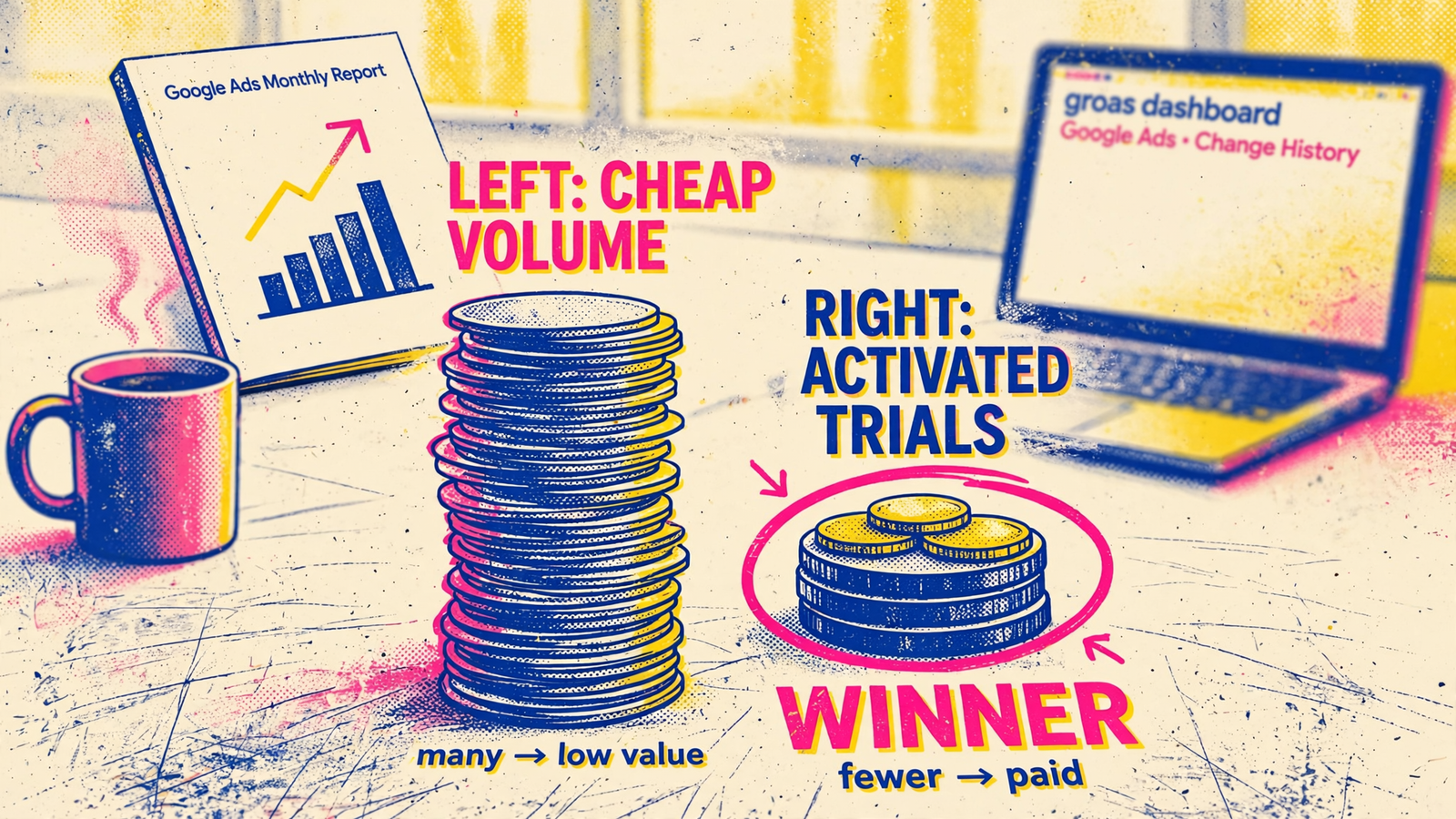
Meta is very good at finding people who sign up and never come back. When you optimize to trial start, you train the system to find curious clickers, not necessarily users who connect a data source, finish onboarding, and stick around to pay. I watched one account celebrate 220 trials at $9 each while 4 turned paid. Another ad set brought in 140 trials at $15 each and drove 19 paid customers. Cheap signups lost. That gap is what this comparison is about.
Why a cheap trial can be the expensive one
Trial start is the easiest event to get. It fires in the browser when someone submits an email, so Meta gets fast feedback and reports a low cost per result. Activation is slower. It means the user did the thing that predicts payment: connected a data source, invited a teammate, or ran a report. One SaaS breakdown I keep coming back to defined activation as connecting a source and completing a report, then advised advertisers to optimize to activation once it clears about 50 events per ad set per week. Below that volume, keep trial start as the delivery event but judge the account on activation anyway.
The tracking gap makes this worse. In AI SaaS especially, the paying conversion happens 7 to 14 days after first touch in your backend, not on a thank-you page. If that backend purchase never reaches Meta, Ads Manager shows zero purchases, and the account keeps chasing the event it can see: free trials.
I would put cost per activated trial on the report before I hired anyone. That is ad spend divided by the trials that hit your activation milestone. Check trial-to-paid weekly alongside it. If nobody owns those numbers, cheap signups win every report and lose every quarter.
Meet the three contenders
The percent-of-spend SaaS agency sells the full-funnel pitch: pipeline, SQLs, closed-won revenue, CRM-integrated tracking, and campaign management. Good agencies differentiate on what they optimize to, not CPL or CTR. The catch is the fee. Agencies typically charge $1,000 to $5,000+ a month or 10% to 20% of spend, with 15% as a common middle. At that rate, $5k in spend carries a $750 management fee; $20k carries a $3,000 fee.
The freelance media buyer is usually a solo operator on retainer or hourly, hired through a network or a marketplace such as Upwork, where ongoing management runs $500 to $3,000 a month and advanced strategists bill $100 to $150+ an hour. I used to be this buyer. The model works when you need fast launches and direct access to the person touching the account. It strains when you also need backend tracking fixes and a steady stream of new creative. One person can only ship so much.
The flat-fee done-for-you team offers one price for Meta Ads: $1,499 a month regardless of spend, with audiences, budgets, and ads worked around the clock and new ads tested while winners scale. That is the Meta Ads tier on groas pricing, month to month with no cut of spend. But the fee alone does not win this comparison. For SaaS trials, the team must own both halves of the job: the activation signal and the ads that bring in activated users. Keep that test in mind through every axis below.
Axis 1: Which conversion counts when Meta learns?
Trial start, activation, and paid conversion are not interchangeable settings. Meta’s own peak-season analysis found ad sets under about 50 conversions a week ran roughly 28% more expensive per purchase. That is why the 50-event threshold keeps coming up. Divide your weekly budget by 50 times your cost per result to estimate how many ad sets you can support at that event. If an activated trial costs $60, feeding one ad set 50 of them takes $3,000 a week, or about $12k a month. Most SaaS accounts spending $5k cannot get there.
The agency is best placed to push toward activation or paid conversion early if it can wire backend events through Conversions API. The freelancer may stick with trial start, not out of laziness but because, with limited volume and development help, it is the event Meta can learn from. The flat-fee team wins only if it handles both realities: use trial start for delivery when activation volume is too low, while using activation data to judge creative, move budget, and decide when the conversion event can change. Calling a signup an activated user does not count.
For a fuller look at that gap, I point founders to these nine fixes for trials that sign up but never activate. In the hiring conversation, ask who wires the event, who checks that it fires, and what the weekly report calls success. If your hire will not own the measurement, someone on your team must.
Axis 2: Who keeps new ads going live?
Trial campaigns on Meta can run out of fresh creative before they run out of audiences. What the deck calls creative strategy, I call a production schedule. At $10k to $25k in monthly spend, the benchmark here is 3 to 4 distinct new creatives a month, about one a week, rising to 6 to 20 a month at $50k to $100k. With a hit rate near 10%, ten tests produce about one winner, while hooks can go stale in two to three weeks. Two polished brand videos a month may look good in a review meeting. They are not much of a testing pipeline.
This is where the solo freelancer usually loses. One buyer can manage bids, budgets, and reporting. Making and iterating four fresh angles every month is another job. An agency can solve that by selling creative on a separate retainer, but the extra fee belongs in the comparison. The flat-fee team has to include ongoing testing in its $1,499 or it is merely cheaper management of the same ad fatigue.
Ask each contender three questions:
- How many new concepts go live next month?
- Who makes them, and is that included in the quoted fee?
- What changes when a concept fails to produce activated trials?
Get a production plan, not the phrase “creative strategy.” If nobody can name what ships next, targeting will take the blame when cost per activated trial climbs.
Axis 3: What happens to the fee when spend doubles?
Say you spend $10k a month on Meta. A 15% agency bills $1,500 on top. Raise spend to $20k and the fee becomes $3,000. The management work does not automatically double with the budget. You may add money to winners, kill two losers, and launch four new creatives. The percentage fee doubles anyway. That is my structural complaint with the model: spend is not a reliable measure of work done.
A flat $3,500 retainer, for comparison, equals 15% at about $23k in spend and 10% at about $35k. A freelancer on a $1,500 to $2,500 retainer plus a creative package of $300 to $1,500 per batch stays roughly flat until a higher tier or percentage kicker enters the contract. The $1,499 flat-fee team stays at $1,499 whether you spend $10k or $20k on media. It can look expensive at $4k in spend and cheap at $25k.
None of that makes the lowest fee the winner. A low management bill attached to stagnant ads and trial-start reporting is an expensive way to admire a dashboard. Below $8k in spend, I would buy creative output and measurement work before obsessing over fee percentage. Above $15k, I would make a percent-of-spend agency explain exactly what the rising fee pays for. More media spend is not, by itself, an answer.
Axis 4: Can you leave with your account intact?
Ask who owns the ad account before you sign, not after you want to leave. The client should own the ad account, pixel, audiences, and data inside its own Business Manager, with the agency or freelancer granted access. Accounts created inside an agency portfolio cannot be transferred. I used to tell clients this was paperwork. I was wrong. It is the whole exit.
With an agency, check whose Business Manager holds the account, what happens to creative files and historical learnings, and whether a 60- to 90-day notice period applies. A freelancer can be simpler to remove if you set ownership up correctly: revoke access when the project ends. Set it up badly and a friendly working relationship will not fix the account structure. The flat-fee model earns trust here only if the terms are plain: month to month, cancel anytime, and your accounts, pages, and data remain yours. That is what the groas Meta tier promises at $1,499 a month. I would ask any other contender to put the same ownership terms in writing.
Here is the comparison I would keep beside the proposals:
| Decision | Percent-of-spend agency | Freelance buyer | Flat-fee team ($1,499/mo) |
|---|---|---|---|
| Conversion focus | Can push toward activation or paid if backend tracking is wired | May use trial start when activation volume is low | Wins only if it owns activation measurement as well as ads |
| Creative output | Can provide it, often for an extra retainer | Limited by one person’s hours unless you supply production | Must keep testing inside the flat fee |
| Fee at $10k / $20k spend | $1,500 / $3,000 at 15% | Roughly $1,500 to $2,500 retainer, plus creative batches | $1,499 / $1,499 |
| Exit | Check portfolio ownership and notice terms | Straightforward if you own the account | Month to month; accounts and data stay yours |
Verdict: hire the team that owns the event and the ads
If you are pre-product-market-fit, spend under $5k a month, and have fewer than 50 activations a week, hire no one yet. You cannot feed Meta’s activation event at that volume, so a manager may optimize to trial start while you still cannot tell whether those trials are worth buying. Put the retainer toward wiring activation through Conversions API, tightening onboarding until trial-to-paid is measurable, and running one broad campaign yourself. The six-option ranking of who to hire for SaaS Meta ads past the signup makes the same point at greater length: outside help multiplies a working funnel; it does not build one.
From $5k to $30k a month, pick the flat-fee team. At $20k in spend, a 15% agency takes $3,000 while the solo buyer runs out of hours just when you need regular new concepts. The $1,499 fee holds still as spend rises. That advantage matters only if the team does the work that decides trial economics: measuring activation and shipping ads that bring in more activated users. My test for groas, or anyone else selling a flat fee, is blunt: show me the activation event and show me last month’s shipped concepts. Pass both. Then we can talk about the fee.
Above $30k to $50k, a percent-of-spend agency can earn its cut for a narrower buyer: one running multiple regions, a sales-led motion with SQLs and pipeline value flowing back into Meta, and dedicated creative already in house. An agency working deeply in that CRM data can be worth paying for. A freelancer is the better hire if you already have a creative producer and tracking in place and only need a steady hand on the account two days a week.
But for the SaaS founder buying trials without those pieces, the choice is not between an expensive agency and a cheap freelancer. It is between paying someone to report signups and paying a team to find users who actually get started. Hire the flat-fee team that owns both the conversion event and the ads.