

 LinkedIn

A $300 management quote can make a $2,000 Meta Ads budget look affordable. Then the creative batch and tracking repair arrive on separate invoices. In the worked examples below, the first-month cash total runs from $2,400 for DIY to $3,499 for a flat-fee route. A low percent fee can cost more than that flat fee when the work it excludes gets billed separately.
I ran small accounts by hand for years. The fee was rarely the part that sank them. Creative went stale, tracking sent Meta bad signals, or the budget was split so thin that no ad set saw enough results to learn. A $1,499 flat fee is also a lot beside $2,000 in media spend. The point is not to pretend otherwise. It is to price the whole month before deciding whether to hire anyone.
The $2,000 month: every line on the bill
Only the first line goes to Meta. The others depend on who does the work, what the scope includes, and whether the account is already set up. Do not add all three management options together: they are alternative routes.
| Line item | Cost at this budget | When it comes due | Basis for the figure |
|---|---|---|---|
| Ad spend to Meta | $2,000 | Every month | The budget used throughout this example |
| Creative batch, 2–3 concepts | $300–$800 | About every 6–12 weeks at this spend | Asset and production price ranges; batch estimate used in this draft |
| Pixel and Conversions API setup or repair | $0 if already working; $300–$600 for a modest fix | Usually one-off | Setup estimate used in this draft; custom builds can cost more |
| Gateway hosting, if needed | $10–$100 per month | Recurring | Low-volume portion of published hosting ranges |
| Reporting and admin | $100–$300 in paid help or tools; otherwise your time | Every month | Estimate for the 3–5 hours of work described below; DIY time has an opportunity cost |
| Percent-of-spend management | $200–$500 at 10–25% | Every month | Published fee range applied to $2,000 |
| Small-business flat retainer | $500–$2,000 | Every month | Management fee range; check what the scope excludes |
| groas flat fee | $1,499 per service | Every month | groas pricing; confirm the creative and tracking scope before comparing totals |
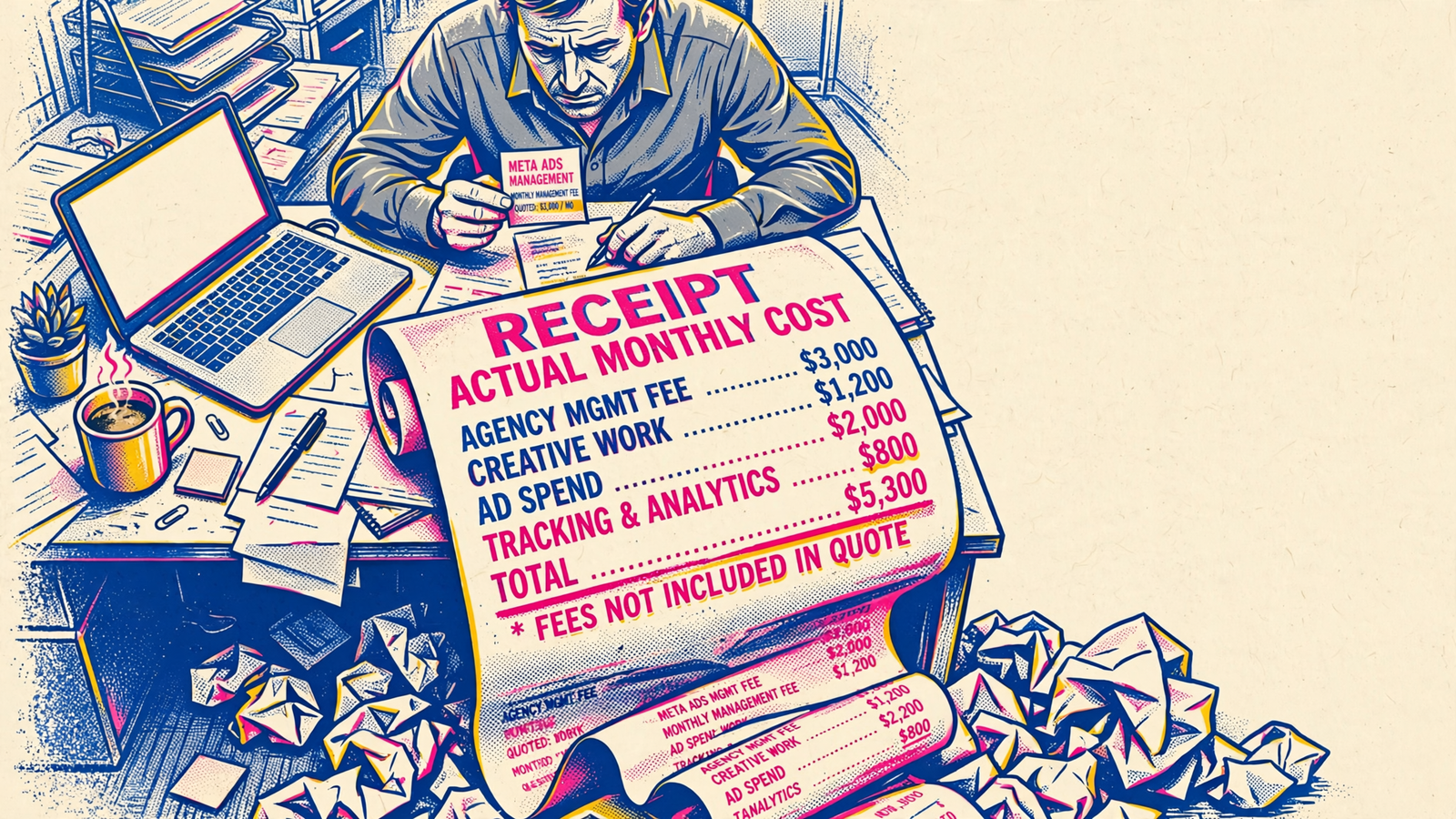
The setup bill is one-off. Creative, management, reporting, and any hosting are recurring. Your own hours may not show up as cash, but they do not disappear because an invoice leaves them blank. With that distinction made, the first constraint is not a vendor fee at all. It is what $2,000 can ask Meta to learn.
Line 1: $2,000 in spend does not buy four learning ad sets
Meta optimizes toward the event you choose. Its commonly cited learning threshold is about 50 optimization events per ad set in seven days. If an event costs $50, that pace takes roughly $2,500 per week, per ad set. That is the mechanism behind the spend-floor example, not a new charge Meta puts on your invoice.
At $2,000 a month, the arithmetic gets uncomfortable. Take $12 CPM and 1.5% click-through rate as a working case within the cited Facebook CPM and CPC ranges. That buys roughly 166,000 impressions and 2,500 clicks. At the cited median $27.39 cost per lead, $2,000 buys about 73 leads in a month, or roughly 18 a week. Split those leads across three ad sets and each gets around six a week. None is close to 50.
I used to tell clients that more ad sets meant more testing. I was wrong at this budget. Splitting a thin signal does not create three meaningful tests; it creates three small piles of evidence. Start with one campaign and one ad set, and choose an optimization event you can generate often enough without losing sight of the outcome you actually want. A cheap content view is not a substitute for a sale. Give the setup a week without unnecessary edits so you can see what it does.
Practical takeaway: consolidate the budget before paying someone to manage a needlessly fragmented account. A manager cannot invoice their way around the event math.
Line 2: creative is a recurring bill, not a launch task
Meta can work with one ad set. One tired ad is another matter. As the same audience sees the same hook, people scroll past it and response can fall. Cold-prospecting risk rises once seven-day frequency passes roughly 2 to 2.5, with performance often declining after 3 to 4. The manager may blame targeting because targeting is easier to discuss than another production bill.
A new concept is a new angle, hook, or opening. Three hook swaps cut from the same shoot are variations, not three fresh ideas. Separate creative quotes matter here: statics run $50–$300, short-form UGC $150–$300 per asset, and professional short-form can cost more. Upwork postings show a broad spread for individual videos and packages too. Those prices explain why a usable batch of two or three concepts can land around $300–$800. At this spend, allow for another batch in roughly 6–12 weeks rather than treating launch assets as permanent.
An agency can put “creative included” in a deck and still deliver hook variations from the same asset until everyone has seen it twice. I would ask how many new concepts the fee covers, who produces them, and when the next batch arrives. Get the answer into the scope.
Practical takeaway: compare creative output, not the presence of the word “creative” on a quote.
Line 3: tracking is usually one-off; a bad signal keeps costing you
A browser Pixel and the Conversions API send Meta event data by different routes. If events are missing or counted twice because deduplication is wrong, Meta optimizes against a distorted picture. Cause first: bad signal in. Effect: spend goes toward the wrong pattern while the report still looks busy.
If your Pixel and Conversions API already send and deduplicate the events you need, this line can be $0 in new setup cash. If they need a modest repair, allow $300–$600 one-time in this budget example. A gateway, if you need one, can add $10–$100 a month at the low end of the published hosting range. Custom events or a direct API build are a different job: the cited range for that work is $500–$5,000 one-time. Do not let a vendor call the integration “free” and then hide the development work needed to make it useful.
I have watched a $2,000 account spend a month optimizing toward double-counted purchases because deduplication was never set. There is no clever bid adjustment for that. At this budget, two weeks of bad learning take a large bite out of the month.
Practical takeaway: establish whether tracking is already sound, needs a modest fix, or needs a custom build before you compare fees.

Line 4: reporting is more than the monthly call
The call takes 30 minutes. Someone still has to reconcile Meta against Shopify or the CRM, fix the UTM typo that broke attribution, export numbers the bookkeeper trusts, and answer why spend paced at 130% last Tuesday. Even on one ad set, allow three to five hours a month for that work.
If you DIY, those are your hours. If someone else handles it, put roughly $100–$300 in the comparison rather than assuming “reporting” means the underlying checks get done. Full DIY management is a larger time commitment: the cited shorthand uses $100 an hour and 15–25 hours a month to illustrate its opportunity cost. I would not pretend every owner can turn every spare hour into $100. I also would not call those hours free.
What the sales deck calls “transparent reporting,” I call finding out who reconciles the numbers on Sunday.
Practical takeaway: name the person doing the checks. If it is you, count the time.
Line 5: the fee looks different after the extras
Percent of spend is the seductive quote. At 10–25%, $2,000 in media spend produces a $200–$500 monthly fee. It can be a fair price for the work covered. The trouble starts when creative, tracking, and reporting are outside that scope. I have seen a $300 fee become $1,100 in month one once creative and a Conversions API repair appeared on separate invoices. As spend grows, the fee grows with it; I have priced out that incentive at $5,000 a month.
A conventional flat retainer is not automatically all-inclusive. Management alone is often quoted at $500–$2,000 a month, separate from spend, and creative may still be extra. A $750 retainer plus a $500 creative batch and a $400 tracking repair is $1,650 before media spend or reporting. “Flat” describes the fee, not necessarily the final bill.
groas publishes a $1,499 monthly price per service and lists new ads tested and winners scaled. That is a clearer creative comparison than a low management quote that leaves production for later. Confirm what tracking setup or repair the proposed scope covers before treating it as included. At $2,000 in spend, $1,499 is about 75% of the media budget. I will not dress that up. But if the alternative is a low fee followed by separate creative, tracking, and admin bills, compare the totals, not the first line of each quote.
DIY wins on cash when you can make the assets, check delivery, and fix problems yourself. A tool might run roughly $80–$150 a month, and phone-shot creative can keep a batch near $150–$300. I ran that setup for a home-services client in 2019: morning delivery checks, Sundays fixing tracking, no management invoice. The cash cost was low. The hours were real. Guidance that puts the $1,000–$3,000 monthly spend band in a hiring grey zone fits this decision better than any rule that says every account needs an agency.
Practical takeaway: ask for a month-one scope with separate prices for management, creative, tracking, and reporting. Then ask what repeats.
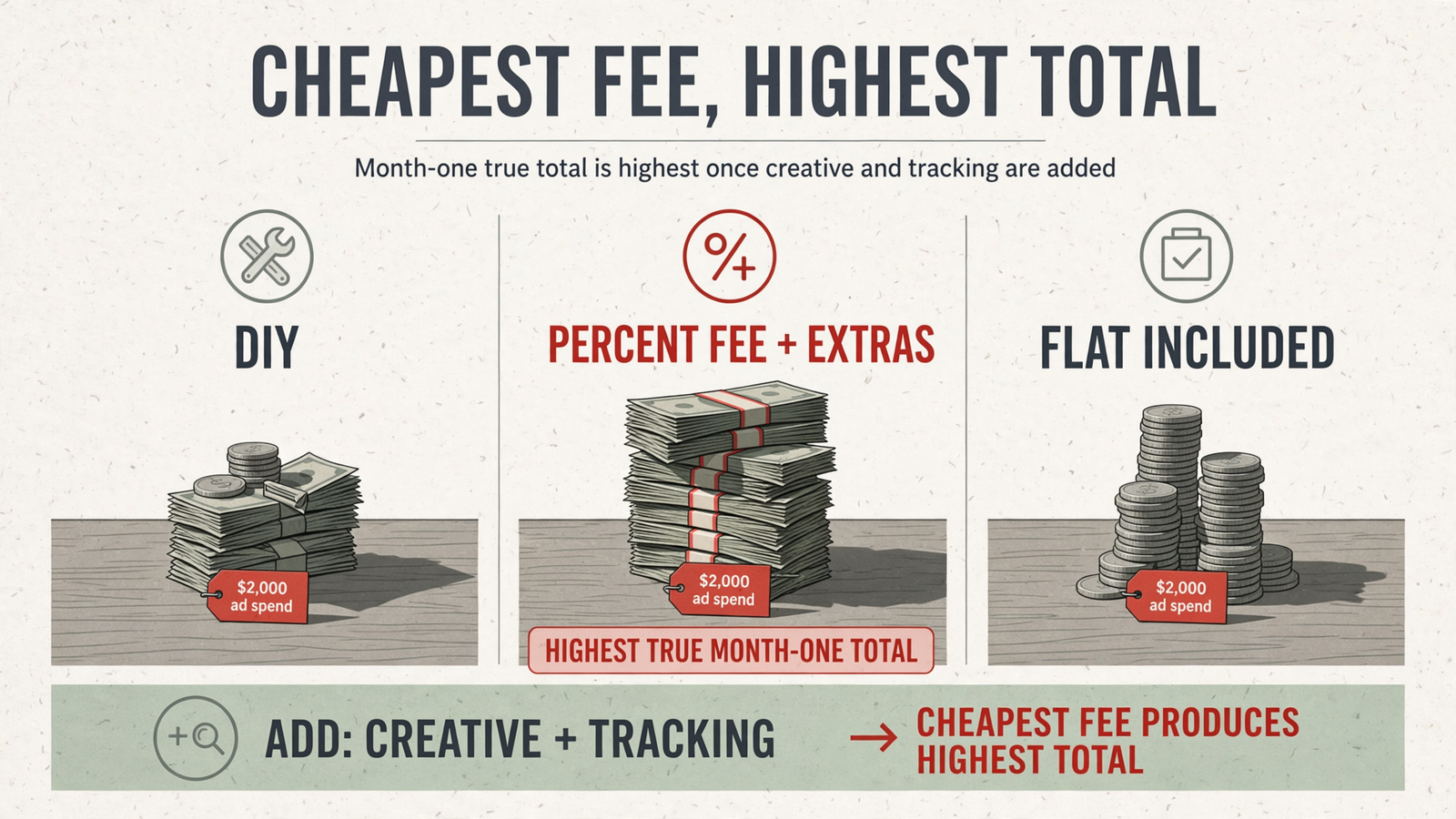
The worked totals: first month versus steady month
These are illustrations, not three promises of identical scope. The DIY route assumes tracking already works. The percent-fee route includes a one-off repair. The groas route shows the published fee with no separate creative bill in the example; confirm the proposed tracking scope before using that total as a quote. None includes optional gateway hosting, and DIY time remains unpaid cash cost. In a steady month, the examples allow $200 for creative rather than buying a new batch every month.
| Route | First-month cash | Steady-month cash | What the headline leaves you doing |
|---|---|---|---|
| DIY + tool | $2,000 spend + $100 tool + $300 phone creative = $2,400 | $2,000 spend + $100 tool + $200 creative = $2,300 | Making ads, checking the account, and reporting |
| 15% fee + separate bills | $2,000 spend + $300 fee + $550 creative + $400 tracking fix + $150 reporting = $3,400 | $2,000 spend + $300 fee + $200 creative + $150 reporting = $2,650 | Coordinating the work outside management |
| $1,499 flat fee, with no separate creative or tracking bill in this example | $2,000 spend + $1,499 fee = $3,499 | $3,499 | Confirming that the written scope matches the total |
That 15% route looks cheaper than the flat route in this example, but only by $99 in month one. Change the separate bills to the upper figures already on the table: a $500 fee, $800 creative batch, $600 tracking fix, and $300 reporting bill. The first month becomes $4,200 including spend. That is where the cheap-looking quote loses. It has not become a better deal because its biggest costs arrived later.
At $2,000 in spend, who should skip the hire?
Skip it if $2,000 is already a stretch. A $1,499 fee on top puts you near $3,500 a month before Meta has learned anything. At the 73-lead illustration above, you need enough close rate and margin to carry that cost. If an average job brings in $150 and you close one in five leads, roughly 14 jobs bring in about $2,100 against $3,500 in spend and fees. No manager fixes that arithmetic.
In that position, I would keep one ad set, make two phone videos a month, and put the fee I did not pay toward another month of spend. Pay for help when the account can support both its learning and the work around it. That is not anti-agency. It is anti-paying for a structure the budget cannot carry.
The cheapest mistake is choosing the $300 percent fee on its headline, then discovering $950 in creative and tracking bills you never budgeted for. The most expensive mistake is letting $2,000 run for months across four ad sets with one tired video and broken tracking. One consolidated ad set, fresh creative, clean events, and a total you saw before signing. That is the quote worth comparing.