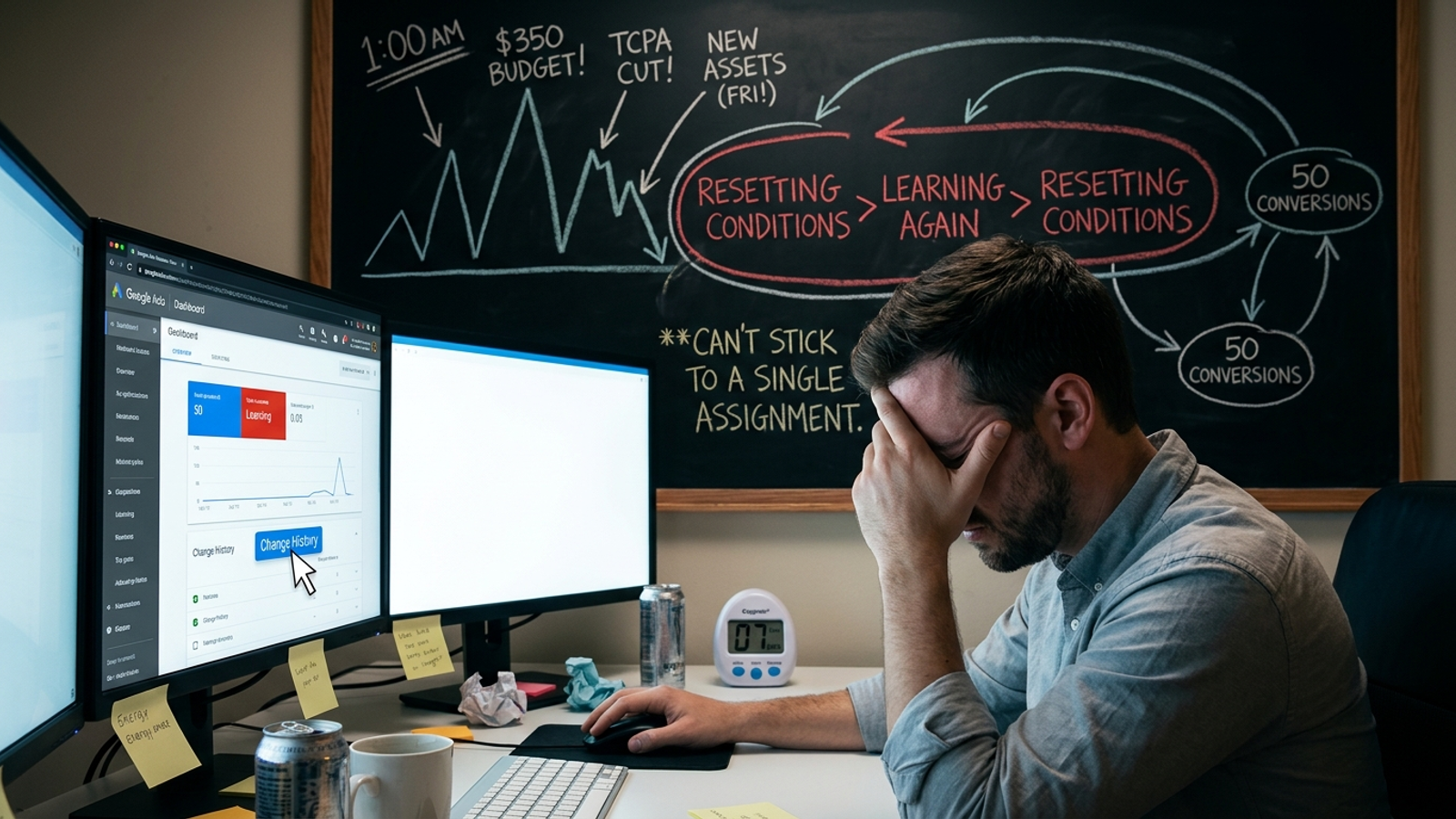
A home services account sat in Learning for 41 days on $20k of spend. The manager touched it every three days to help: a bid tweak on Monday, a pause overnight, a new ad group on Friday. I used to tell clients to wait seven days and leave the campaign alone. I was wrong about the seven days. Learning is not a timer you wait out; it depends on conversion data, and some of the fixes people reach for can interrupt the calibration they want to finish.
Myth 1: “It’s a fixed seven-day timer”
People believe this because Google once put a number on it. A January 2018 whitepaper said one to two weeks, and that line got copied into a thousand decks and never left. I still see it quoted in old audit threads like policy. It was never a countdown.
Google’s current help page says Learning duration depends on how many conversions you get, how long your conversion cycle runs and which bid strategy you use. Calibration typically takes one to two conversion cycles. Last September, Google reframed the guidance around volume: it can take up to around 50 conversion events or three conversion cycles, while accounts with enough history learn faster.
So a lead-gen campaign with a 21-day sales cycle does not exit in seven days just because you waited politely. Seven days can pass without enough useful outcomes coming back to the strategy. Judge the conversion count and cycle, not the date on the calendar.
Myth 2: “More budget buys a faster exit”
This survives because it works just often enough to look true. Raise the budget, get more clicks, get more conversions, exit sooner. The step people skip is the middle one: budget helps only if the extra spend produces conversions. Google prices auctions from conversion history, not from the amount on your invoice.
The arithmetic is plain. At a 1% conversion rate, you need 5,000 clicks to bank 50 conversions; at 10%, you need 500 (illustrated here). I have seen the slow version: 10 clicks a day at 1% works out to roughly one conversion every ten days. Getting to 50 at that pace takes months. That is arithmetic, not a penalty Google applies to small accounts.
More budget can help when the campaign can find more of the right traffic. If it mostly buys the same unqualified clicks, you have spent more without giving the strategy much more to learn from. Check the conversion path before you pay to accelerate it.
Myth 3: “Editing ad copy is safe during Learning”
It feels safe because ads and bidding look like separate jobs. One writes the pitch; the other prices the click. But a new ad can change which queries bring people in and which clicks convert. That changes the outcomes the strategy is trying to predict, even when the edit is not itself a bid-strategy switch.
Google’s list of Learning triggers includes composition changes such as adding or removing campaigns, ad groups or keywords, as well as settings changes and new or reactivated strategies. I would not treat every copy tweak as an automatic reset. I also would not rewrite a responsive search ad mid-calibration and pretend the input stayed the same.
The older volume guide behind this discussion put numbers on the difference between thin and substantial data: campaigns around 30 conversions in 30 days learned slowly, while campaigns around 500 learned very fast; Target ROAS needed at least 50 (history here). When data is scarce, a change to the traffic mix matters more. Write the ads before you turn on Smart Bidding; save nonessential rewrites until you have enough conversions to evaluate them.
Myth 4: “Learning happens once, then you’re done”
The badge clears, the status column goes quiet, and people read that as graduation. I read it that way for years. Google says the system keeps adjusting after the Learning tag disappears. The same help page that lists the triggers also explains how a strategy can enter Learning again: a new or reactivated strategy, a settings change, a composition change or a Shopping target change.
That does not mean the account forgets everything the day you edit it. It means the visible badge is not a certificate that future changes are free. Treat a restructure as a new calibration decision, not routine housekeeping. If the structure needs fixing, fix it. Just count the relearning cost when you decide when to do it.
Myth 5: “Pausing overnight saves money for free”
This advice makes sense on a spreadsheet. No spend while you sleep; no midnight tire kickers eating the budget. What that sheet leaves out is the conversion count. If the campaign is still gathering outcomes, a paused night gives it no new ones. And if you switch a bid strategy off and on, reactivation is one of the events Google names as a Learning trigger. Those are related costs, not the same claim: pausing can slow the flow of data; reactivating a strategy can put it back into Learning.
I watched a services client pause a $300-a-day campaign every night to save $40 in junk clicks and add three weeks to calibration. The junk clicks were a real problem. Turning off the whole campaign was a blunt way to solve it. Use ad scheduling or bid adjustments to thin out bad hours instead of repeatedly stopping the feed.
Control the bad hours without treating every night as an emergency shutdown. Saving money on clicks that will never convert is useful. Starving a campaign that needs conversion data is not free.
Myth 6: “tCPA and tROAS learn at the same speed”
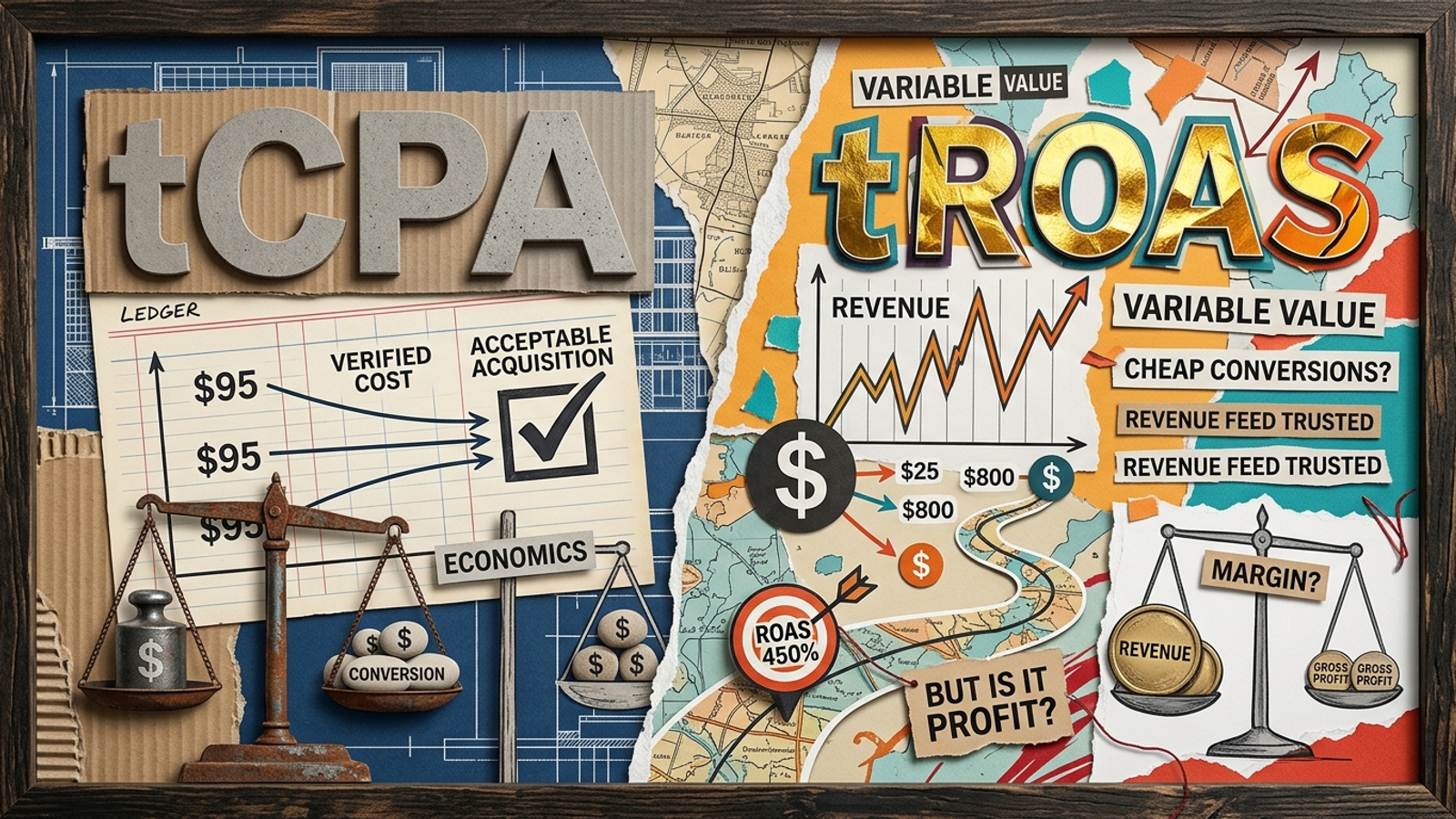
They look like siblings in the interface: two targets under one Smart Bidding roof. I used to brief them the same way. The difference is what each strategy has to predict. Target CPA needs to learn whether a click converts. Target ROAS has to learn whether it converts and for how much. That is a harder prediction and needs more examples.
The old volume benchmarks still get quoted for a reason. Campaigns near 30 conversions in 30 days learned slowly on Target CPA, campaigns near 500 learned very fast, and Target ROAS needed at least 50 (history here). Practitioners use that split when deciding when they have enough data to evaluate performance: at least 30 conversions for Target CPA and 50 for Target ROAS (same practitioner notes). These are evaluation guides, not two dates Google has promised to clear a badge.
Putting a 12-conversion campaign on Target ROAS does not give it a stricter teacher. It gives it homework it cannot finish. Pick the strategy with the data available, not the target that looks more impressive in a plan.
Myth 7: “Low-volume accounts are stuck in Learning forever”
This belief comes from watching the badge sit there for a month and deciding the account is broken. Low volume does mean slow calendar progress. Google says that accounts with enough historical data learn faster. A campaign with fewer conversions has fewer outcomes to learn from. Longer is not forever, but waiting will not manufacture volume.
I check three things before I blame the model:
- Is the budget fragmented? Consolidating can give one campaign a usable stream of conversions instead of spreading spend across ten ad groups that each get four (the classic extender). Make that structural change deliberately; it can itself require recalibration.
- Does the status actually say Learning? Limited points to constraints on delivery, such as inventory, bid limits or budget. It is not another word for insufficient learning data.
- Is there enough volume for the strategy? One practitioner guide puts a usable floor for reliable Smart Bidding at roughly 30 to 50 conversions a month per campaign (guide here). Below that, consolidation or a looser target may matter more than another week of patience.
Low volume is often a structure problem before it is a patience problem. The aim is not to make the badge disappear by rearranging boxes. It is to give the strategy enough real outcomes to make better decisions.
Myth 8: “The smart move is to wait it out and touch nothing”
Waiting feels disciplined because Google tells you not to make major changes while a strategy learns. Half the forums turn that into do absolutely nothing. I followed that advice once on a lead-gen account and waited 30 days while broken tracking fed it nine conversions. It learned exactly what I fed it: nothing useful.
Patience does not fix inputs. The extenders practitioners keep naming include constant bid and targeting swaps, low-quality traffic that never converts, slow or mismatched landing pages, broken conversion tracking and budget split across tiny ad groups. Waiting preserves every one of those conditions. Hands off needless bid-strategy changes; hands on the plumbing that produces the data.
My screen checklist during Learning is short:
- Check that the conversion action fires once per real lead.
- Check whether negatives block junk clicks and whether the landing page turns the clicks you bought into conversions.
- Check whether the campaign has enough volume to judge Target CPA at roughly 30 conversions or Target ROAS at 50, using the evaluation window experienced buyers use rather than the badge alone.
- Leave targets stable while that data comes in. If the campaign needs a restructure, make it deliberately instead of nudging it every few days.
For lead gen, that evaluation may mean 50 conversions or a full month excluding ramp-up. What the deck calls “patience,” I call letting bad data compound when nobody checks the tracking. Fix the feed, then give the strategy room to use it.

Myth 9: “Every bid change restarts Learning”
This is the myth I find hardest to kill because it is half true. People believe any bid edit resets the clock because someone once told them never to touch anything, probably in caps lock. That warning is easier to remember than the distinction that matters.
Google names four Learning triggers: a new or reactivated strategy, a settings change, a composition change or a Shopping target change. Not every small bid tweak inside the same strategy is a restart. But repeatedly flipping strategies or moving targets mid-calibration is not harmless maintenance either. One practitioner guide calls those daily interventions a top mistake because they can discard accumulated progress and take one to two weeks to rebuild. The folklore about a 20% budget-change rule was never published by Google; that audit history traces it to borrowed Meta advice about 50 optimization events.
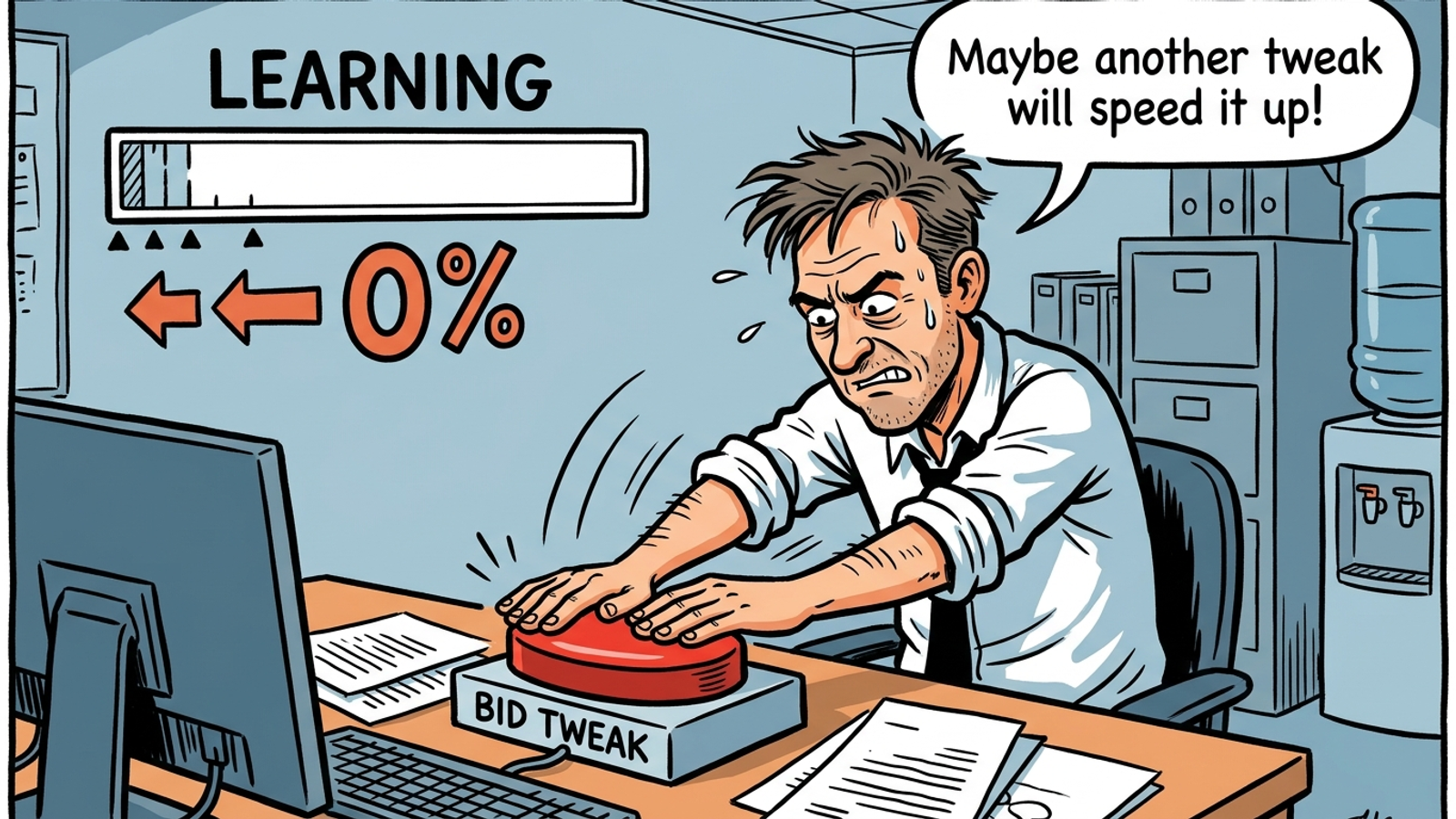
The distinction changes what you do. Freeze a broken conversion action because you fear any edit, and you keep feeding the strategy bad data. Change targets every day because you think Learning has already restarted, and you deny it a stable run. Stop switching strategies to fix Learning. The switch can be the reason you are back there.
That is why I prefer execution that watches an account continuously over a manager who checks in on Tuesdays: catch bad inputs without turning every quiet afternoon into a bid-strategy experiment. It is the pitch behind groas in one sentence. If you want the plain reference on how long the learning phase lasts, what resets it, and how to shorten it, read that next. Then check the conversion count, fix what is broken and leave the targets alone long enough to learn something true.