LinkedIn

A $1,499 monthly fee can remove a pile of Meta Ads work from your desk. It can also leave the hardest parts sitting there with a neater invoice. I am taking apart groas’s own pricing page because its Meta Ads offer makes a useful test case: the price is exact, the execution promises are short, and the gaps matter when you are comparing managers.
The page says $1,499 a month for Meta Ads. It names Facebook and Instagram ads, audiences and budgets worked around the clock, and new ads tested with winners scaled. I will walk through those lines, then the house terms around them. At each stop, the question is the same: what work has groas actually agreed to take off your desk, and what still needs a written answer? A fixed fee tells you what the invoice will be. It does not answer that question for you.
The card: a fixed price, then three execution promises
Our pricing page lists Meta Ads at $1,499 a month, flat, whatever you spend on ads. Under that price sit the offer’s three short lines. Around them are the house terms: month to month, cancel anytime, no setup fees, never a cut of ad spend, a 7-day money-back guarantee starting at checkout, and a statement that your accounts, pages and data stay yours.
That is enough to understand the shape of the offer. It is not enough to know whether it covers every task on your current marketing calendar. The card does not promise a cost per lead, a return on ad spend, or a date when either arrives. Nobody managing Meta should promise those outcomes in writing. The useful reading is narrower: which jobs does the service undertake, and which details remain unspecified?
“Facebook and Instagram ads”: where the remit starts
The first line names the channels. You are buying Meta Ads management for Facebook and Instagram, not a vague promise to handle whatever your team calls social. That distinction helps when another quote bundles several channels into one attractive number but gives none of them much attention.
It also leaves a practical question. “Facebook and Instagram ads” tells you where the work happens; it does not inventory the work inside those accounts. If you have a campaign already running, ask what groas takes over. If you have nothing live, ask what has to be supplied before an ad can launch. A channel name cannot tell you whether you will still be chasing approvals, supplying assets or sorting out account access on Monday morning.
Verdict: this line defines the playing field. Before comparing prices, make each finalist describe the handoff for your account, not an imaginary tidy one.
“Audiences and budgets worked around the clock”: action, not a daily edit quota
This is the line that most clearly promises ongoing execution. Audiences and budgets are not presented as a set of recommendations for you to implement at the next meeting. The offer puts the work with groas and describes it as continuous.
Anyone who has managed Meta knows why that distinction matters. A creative fatigues on a Tuesday. An ad set spends without producing sales. A weekly review may catch the problem, but the budget has already gone. The appeal of an around-the-clock service is that someone can notice and act without waiting for the account to become your Friday problem.
But “around the clock” does not specify a response time or a decision rule. Nor should you read it as a promise to change every campaign every day. Good management often means watching closely and leaving an ad alone until the signal is worth acting on. Constant edits can make a test harder to read. The question is whether the manager can explain why a change happened, or why one did not.
A scope checklist pairs daily checks with a shared test log. That is a useful standard to put beside our line, not a feature our pricing card explicitly lists. Ask what gets checked daily, what triggers a budget or audience change, and where you can see the decision afterward. If the answer is “we optimize continuously,” ask again in plain English.
Verdict: the page commits to ongoing account work. Get the triggers and the record of that work in writing before you count it as time saved.
“New ads tested, winners scaled”: the creative promise needs a number
Here the offer goes beyond watching existing campaigns. New ads will be tested, and winners will be scaled. That matters if the competing quote covers media buying while you supply every image, video and copy variant. In that arrangement, the manager may run the tests, but the blank Canva file still belongs to you.
Our line does not say how many new ads arrive in a month. It does not specify the mix of images and videos, revision rounds, who supplies raw footage, or who approves an ad before it spends. It also does not, by itself, establish that every production task is included. “New ads tested” is an execution commitment; it is not a production schedule.
Those omissions become more important as spend rises. One creative-testing discussion offers a rough rule of one new ad per $3,000 in monthly spend. It describes accounts spending $10k to $50k as averaging about four new creatives a week, with top-quartile accounts shipping around eight, only about 5% of which become winners. A separate scope checklist uses 8 to 16 new assets a month plus a shared test log as a full-service bar. These are comparison points, not quantities promised by our page.
I used to tell clients creative volume was a nice-to-have. I was wrong. On Meta, the ads you can put into the auction shape what the media buyer has to work with. A manager cannot scale a winner that has not been made and tested. Equally, shipping assets for the sake of hitting a quota does not make them useful.
Verdict: keep this line on the shortlist if testing new ads is work you need removed. Ask how many net-new images and videos you should expect at your spend, who supplies footage, who handles revisions, who approves the final ad, and where you see the test log. If your designer already ships creative every week, a cheaper buying-only quote may fit better. If you need a shoot crew or contracted creators, do not infer that from this sentence.
Tracking: the work the card does not spell out
The three execution lines are done. Now look for the job that can make all three difficult to judge: measurement. The pricing page does not spell out a tracking audit or a Pixel and Conversions API setup. That does not prove the work will not be done. It means you cannot treat it as a written commitment based on this card.
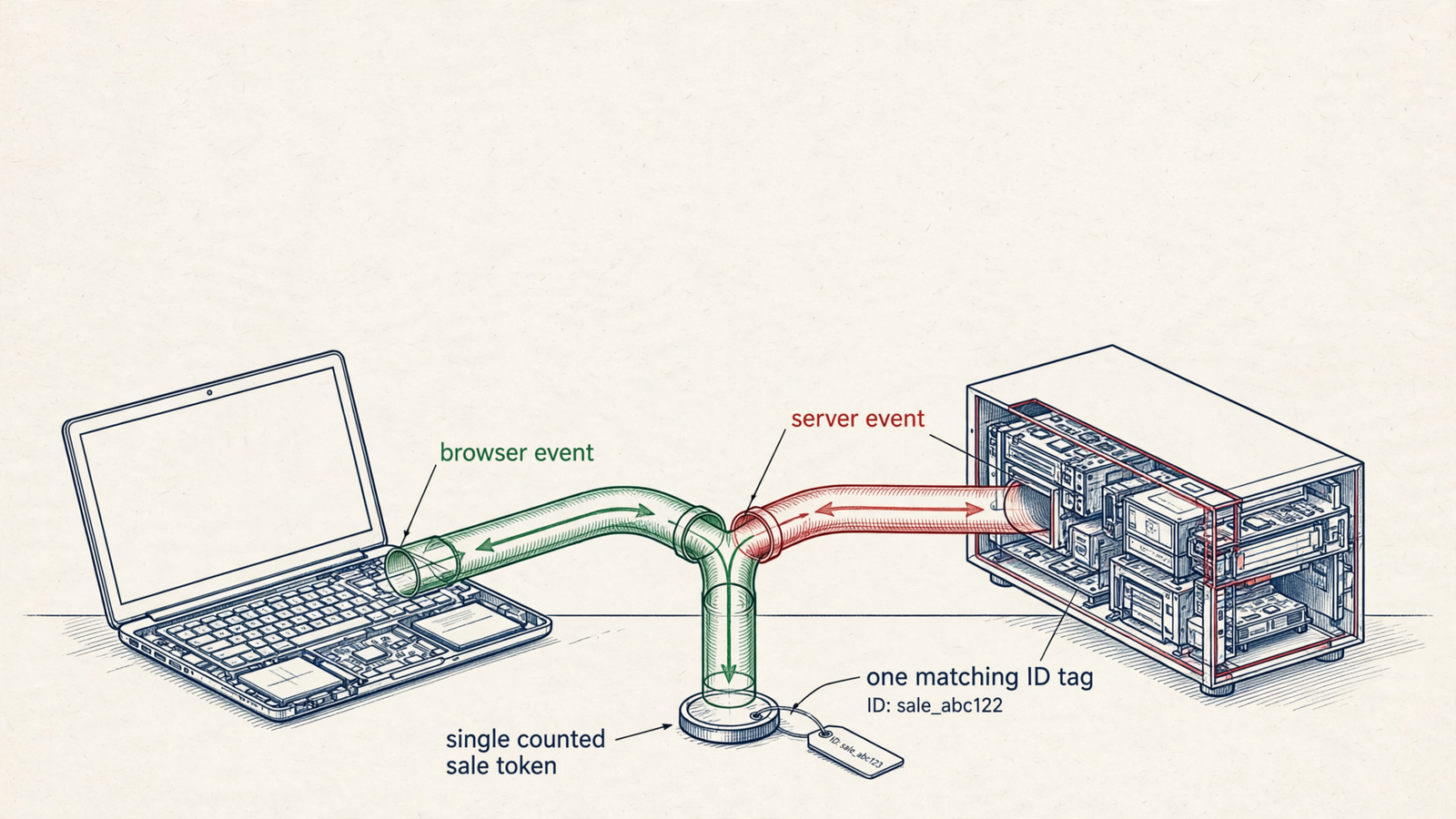
This is where I would press hardest, on us or anyone else. If a campaign is optimising against the wrong event, fast budget changes only make the mistake faster. If your business cares about a booked job or a paid sale, a thank-you page view does not settle whether that outcome happened. The Pixel and CAPI tracking discussion also explains why browser and server copies of an event need matching names and stable IDs to avoid double counting.
You do not need to turn a shortlist call into a technical exam. You do need to learn who is responsible. Ask whether Pixel and CAPI are in scope, who implements them, where the token lives, and how a qualified sale or booked job gets back into the measurement you use to judge the account. If CRM work or consent handling sits with your team, find that out before the management fee starts. “We handle the ads” is not an answer to “who fixes the event?”
Verdict: treat tracking as an open scope question, not as a hidden feature of the flat fee. Get the owner and the handoff in writing.
Reporting: useful numbers are not the same as useful answers
The card also does not specify a weekly report or its contents. I would want a plain-language account of leads, sales, cost per lead and ROAS. I would not stop at those four numbers, because they can describe activity without showing whether the customers you wanted actually arrived.
Platform attribution is one reason. Meta’s commonly used 7-day click and 1-day view window can credit outcomes that a stricter last-click read treats differently; one discussion of ROAS reporting describes drops of 30 to 40% when accounts make that switch. Blended ROAS can hide a different set of questions: new versus repeat buyers, returns, cost of goods and failed deliveries. None of this makes a platform report useless. It makes it incomplete as an answer to “did this spend produce the business we wanted?”
Ask how your actual customer outcome enters the report. Who supplies the qualified sale, booked job or refund, and how often? If you are working through questions to ask a Meta Ads agency before you compare quotes, put this near the top: show me a report line that depends on what my CRM says closed. A manager can report platform CPL and ROAS while also showing closed revenue beside them. You need to know whether that second part is in scope.
Verdict: do not mistake a reporting style you would like for one this card promises. Ask for the measures, the source of each measure and who supplies the missing data.
Back to “$1,499 per month”: what the fee protects, and what it cannot
Now the price has some context. Management is included. Media is not. Say you spend $20k a month on Meta. A manager charging 10 to 20% of spend bills $2,000 to $4,000 for that month; one cost comparison cites an average flat retainer of $5,108 a month on Clutch. Our management fee stays $1,499 whether your media spend is $3k or $30k. That is the advantage of the flat line: the invoice does not rise just because the ad budget does.
At the low end, the arithmetic is less flattering. If you spend $2,000 a month on ads, a $1,499 management fee is roughly 75% of that media budget again. A fixed fee does not fix that ratio. If your spend is that low, you should hear it from us before you pay us. A tighter buying-only setup, or getting measurement in order first, may remove more of your immediate problem.
The surrounding terms offer different kinds of protection. Month to month and cancel anytime address lock-in. No setup fees and no percentage of spend tell you how the bill is structured. The 7-day money-back guarantee starts at checkout, so count from checkout rather than from the day you first see an ad. None of those terms promises a performance result, and none fills in the creative, tracking or reporting scope left open above.
Then there is the exit question. The page says your accounts, pages and data stay yours. That is important, but ask what it means for the assets in your setup. An ad account’s owning portfolio and an agency’s access are different things; account-transfer guidance explains why ownership can be hard to untangle later. Ask which Business Manager owns the ad account, pixel and dataset on day one, and what access groas has. Make the promised ownership legible before you need to leave.
Verdict: the fixed fee is a clear advantage over a spend-linked bill when your spend makes the management cost sensible. It is not a substitute for a scope of work or an asset map.

The shortlist verdict
Choose groas when the work you want gone matches what the page commits to: ongoing work on Facebook and Instagram ads, audiences and budgets, plus testing new ads and scaling winners. At, say, $5k a month in media and up, $1,499 may be easier to justify than it is on a $2k budget. The fee stays flat as spend changes. Whether the service removes all the work you expect depends on the written answers to the gaps, particularly creative production and measurement.
Send every finalist the same six questions:
- How many net-new images and videos will you test at my spend, and who supplies raw footage?
- Who handles revisions, and who approves an ad before it spends?
- What gets checked daily, what triggers a budget or audience change, and where can I see that decision?
- Who implements Pixel and CAPI, and who owns the token and event setup?
- How does my closed sale or booked job enter the measurement and reporting you provide?
- Which Business Manager owns the ad account, pixel and dataset on day one, and what do I keep on exit?
Walk away from us if you need commitments this page does not make and cannot get them in writing. If media spend is $2k a month, the management overhead may be the wrong first expense. If you need a shoot crew, UGC contracts or a contracted number of concepts each week, compare a production-led option against our specific answer, not against the phrase “new ads tested.”
My overall verdict: the offer is strongest as a flat-fee execution commitment, not a promise that every adjacent marketing job disappears. I would keep the clear price, the ongoing account work and the commitment to test new ads. I would make the six answers part of the shortlist decision. The manager who answers in tasks and owners rather than adjectives is the one most likely to take work off your desk.