

 LinkedIn
Do not pay your Google Ads agency per acquisition. If you just fired a shop that took 15% of every dollar you spent, a proposal promising you only pay when a lead lands sounds like the fix. It is the next trap.
I ran accounts under both models for years. Percentage-of-spend pays the manager to spend more. Pay-per-acquisition pays the manager to count more. Whoever decides what counts as a conversion decides how many invoices they send you. The fair-sounding model can cost you more in bad pipeline than it saves in fees.
The reasonable instinct that walks you into the next trap
You got burned the standard way. Spend went up, fees went up with it, results did not. The agency took 10 to 20% of spend, so every budget increase was a raise for them whether your cost per acquisition improved or not. Of course you started asking who charges on cost per acquisition instead.
It is a rational reaction. It also takes you from one misaligned incentive to another. Percentage-of-spend rewards more spend. Pay-per-acquisition rewards more countable acquisitions. The first manager gets paid when your budget grows. The second gets paid when the system records more of whatever your contract calls an acquisition. Neither invoice tells you whether your sales team got a buyer.
That distinction matters before you compare proposals. A fee can move in the same direction as a metric you like and still reward the wrong behavior.
Percentage-of-spend punishes the manager for cutting waste
I used to bill this way, so I know how it bends decisions. At 15% of a $50k budget, you pay $7,500. If your manager cuts waste to $35k for the same results, their fee drops to $5,250. The agency takes a pay cut for doing the job well. No one says it out loud on the monthly call, but every budget review carries quiet pressure to keep the account worth staffing.
The small-account version is uglier. A quoted 15% with a $1,000 minimum on $1,500 in spend is not 15%. It is $1,000 on $1,500, or about 67% of spend before Google takes a dollar. Then come the parts proposals bury: $500 to $3,000 in setup and $1,000 to $5,000 per landing page, plus call tracking and a 3- to 12-month lock-in. Put a $500 setup charge and a $2,000 page beside that $1,000 minimum, and the first month reaches $3,500 in fees.
You are right to leave a contract that pays the manager more for spending more. Just do not mistake the next pricing model for a cure.
Pay-per-acquisition pays the manager to loosen the definition
Pay-per-lead deals commonly run $10 to $100 per qualified lead, or 5 to 15% of attributed revenue. That looks like alignment until you ask who wrote the definition of qualified. The cheapest lead that passes the definition is margin for the agency. Finding a lead that becomes revenue is harder work. Under this contract, the agency gets paid for the first kind and has every reason to call it the second.
One agency directory warns that performance pricing can drift toward quantity over quality unless the lead is tightly defined with an agreed lead-to-customer rate. A pay-per-meeting calendar can fill with anything bookable while the client sorts out the bad appointments afterward. The invoice arrives before that sorting is finished.
The contract turns conversion tracking into a billing dispute
Under percentage pricing, a loose conversion definition does not directly increase the agency fee. Under pay-per-acquisition, it does. So the negotiation shifts from bids and budgets to paperwork: What length of phone call counts? Does a duplicate form count? What about an out-of-area quote request or a second submission from the same person?
Unless you settle written rules for duplicates, wrong numbers, and out-of-area leads before the first ad runs, you will argue about each one after the invoice arrives. Even with rules, someone has to review the exceptions. That work does not disappear because the contract calls the lead qualified.
I used to tell clients a form fill was a conversion. I was wrong. A form fill is a person who typed something into boxes. The invoice treats every submit the same. Your sales team does not. Once the fee is tied to that submit button, the manager has no financial reason to tighten the definition.
Brand search makes cheap leads look like new business
Here is the oldest trick in the pay-per-acquisition playbook. The agency bids on your brand name, captures people already searching for you, and bills you for each form fill as an acquisition. Brand clicks can be cheaper than cold non-brand clicks, so the report shows more conversions at a lower cost per acquisition. Whether those people needed an ad to find you is a different question.
Say you spend $20k a month. The agency carves out $3k for brand, generates 150 brand form fills at $20 each, and bills you $75 a head. That is $11,250 in fees for people who were already looking for you; some might have arrived through organic or direct traffic instead. Your cheapest conversions become the agency’s highest-margin product.
Do not let brand and non-brand disappear into one blended CPA. Segment and report them separately, then decide what each is worth before a per-acquisition invoice makes that decision for you.
Lead quality stays off the invoice
Google Ads sees a form submit. By itself, that event does not tell you whether the person can buy, lives in your service area, or gave you a real number. In financial services, one breakdown put the raw lead at $74.44. At a 40% qualification rate, that works out to roughly $186 per qualified lead; at 25%, roughly $298 (DesignRush). The click price did not have to change for the useful lead to get much more expensive.
Bidding trained on raw submits then learns to find more submitters, not necessarily more buyers. If you scale on that signal, the problem scales with the budget. Under a per-lead fee, the decay does not appear on the invoice. You pay the same $75 for the buyer and the tire-kicker. Your close rate drops, your sales team loses faith in the queue, and the report still says cost per acquisition is flat.
Count qualified pipeline, not just form fills, before you call CPA an outcome metric.
The cheap inventory has a ceiling
Ask a pay-per-acquisition shop to double qualified volume next quarter. The easiest inventory does not double on command. Once brand, high-intent exact match, and retargeting have supplied their cheap conversions, the next acquisitions may require harder keywords and colder traffic. With an average cost per lead of $66.69, a $5.42 average CPC, and an 8.18% conversion rate, you can see why the economics get uncomfortable as the easy pool runs out.
Every additional acquisition that costs more to produce eats into a fixed per-lead bounty. The manager can respond by narrowing the geography, limiting spend, or stopping where the report still looks efficient. You wanted growth. The contract rewards stopping at good enough.
What the three contracts cost on $20k a month
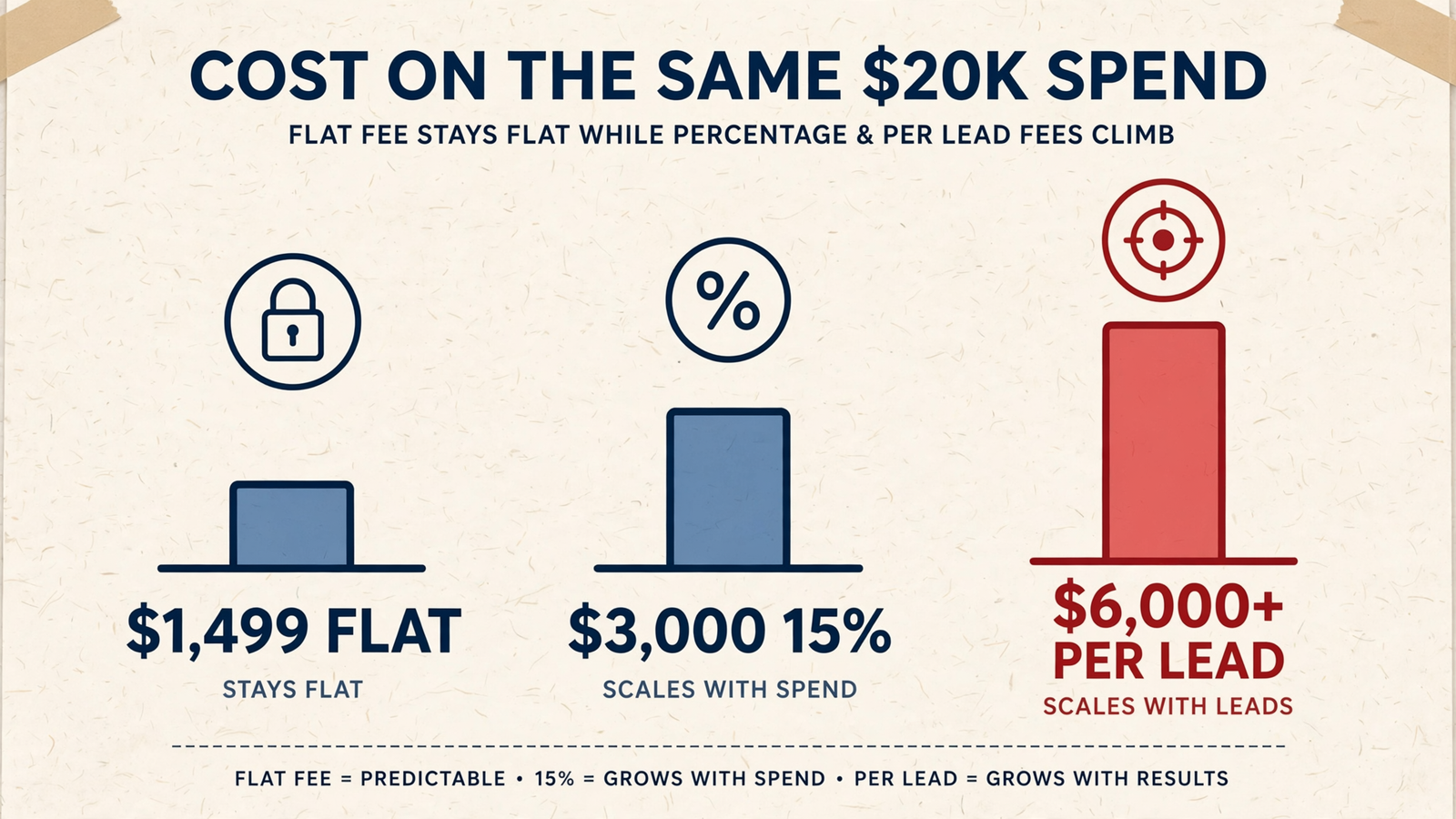
On an illustrative $20k monthly Google Ads budget, the management fee starts at $1,499 for one flat-fee service. A 15% fee comes to $3,000 a month before extras. A per-lead bill at 300 leads and $20 to $50 each comes to $6,000 to $15,000, with no fixed ceiling if more leads count. None of those figures includes the $20k paid to Google.
Here are the listed recurring fees first, then the one-off charges and hidden costs. The 300-lead example is roughly what $20k buys at the cited $66.69 average cost per lead; it is an illustration, not a forecast for your account.
| Model | Listed recurring management fee on $20k spend | One-off charges and costs the headline price misses | Illustrative month-one management fees |
|---|---|---|---|
| 15% of spend (typical range: 10 to 20%) | $3,000 at 15% | $500 to $3,000 setup; $1,000 to $5,000 per landing page. Call tracking can add cost; a 3- to 12-month lock-in limits your exit. | $4,500 to $11,000 with one page, before call tracking; more pages cost more. |
| Pay per acquisition ($10 to $100 per qualified lead) | $6,000 to $15,000 at an illustrative 300 leads billed at $20 to $50 each; lead volume is based on the cited average cost per lead. | No one-off charge assumed here. Duplicates, brand leads, and disputed definitions can raise the recurring bill if they count. | $6,000 to $15,000 under those assumptions; there is no fixed cap tied to your ad budget. |
| Flat monthly fee (scoped flat fees: $750 to $1,500; groas: $1,499 per service) | $1,499 for one groas service. | No percentage cut or per-lead bounty. Check the scope of any flat-fee proposal rather than assuming every service is included. | $1,499 for that service. |
The listed price is not the whole comparison. Setup and landing-page work hit once; management fees recur. Call tracking has no price in this example, so I am not pretending it costs a neat round number. The per-lead contract hides a different cost: the number of billable leads can rise even when qualified pipeline does not. Vendors love a headline rate that makes you do the multiplication after you sign.
The cheapest mistake is overlooking a $1,000 minimum on small spend. The most expensive is signing a per-lead deal without owning the definition of a lead. One overcharges you for being small. The other can overcharge you for succeeding on paper. For a deeper line-by-line comparison, see Percentage of Spend vs Pay-Per-Acquisition vs Flat Fee: The $20k Google Ads Test.
Follow the extra dollar
Under a 15% contract, each extra $1,000 in spend adds $150 to the manager’s fee without requiring a better result. Under a per-acquisition contract, each extra countable conversion adds another bounty, whether it becomes a customer or not. A flat fee adds $0 in either case. That is the useful test, not whether the proposal calls itself performance-based.
Flat pricing does not make a manager good at the job. It removes these two ways to earn more while doing the job badly. The manager has to justify the relationship through results instead of a rising budget or a widening definition. That is why I look for the pricing conflict before I look at the dashboard.
I thought tighter paperwork would fix this
I used to tell burned buyers the answer was pay-per-lead with a tight definition: qualified leads only, recorded calls over 60 seconds, no duplicates, no out-of-area requests. On paper, that sounds airtight. In practice, the definition needs a referee. Who listens to calls to check duration? Who decides the gray ones? Who owns the CRM import when offline conversions stop syncing and Smart Bidding starts optimizing on partial data?
I thought paperwork could fix incentives. I was wrong. Paperwork moves the argument from spend to semantics, then makes someone spend time refereeing it. A rule against duplicate leads helps, but it does not change which side gets paid when a borderline lead slips through.
When the manager earns more by counting loosely, tight definitions need constant defense. For the questions I now ask before signing anything, see Who Charges on CPA Instead of Ad Spend? Nine Pricing Questions, Answered With the Math.
Demand a fee that stays still when the numbers move
A fee that does not move with spend or conversion count. That is the test. If the manager earns the same $1,499 for a service whether you spend $12k or $28k, and earns nothing extra when the conversion count doubles, neither number gives them an automatic raise. You want the manager bored by your spend and obsessed with your pipeline. Put the structure in writing: one flat monthly fee for the agreed service, no percentage, no per-lead bounty, no setup ambush.
Demand three things alongside it:
- Conversion definitions you own and approve. Segment brand from non-brand. Put raw submits below qualified pipeline in the report, where they belong.
- CPA after all fees and at qualified stages. Raw form cost tells you what a submit button cost, not what it cost to find a buyer.
- Month-to-month terms. Keep performance as your leverage. If the shop needs a 12-month lock-in to survive your second month of data, pay attention to what that says about the third.
A flat invoice is not permission to ignore lead quality. It is how you stop the invoice itself from rewarding worse lead quality. You still own the definition and still inspect the pipeline. The difference is that improving either one does not trigger a bigger bill.
Keep the pen, or pay for the definition
The question was never percentage versus per-lead. The question is who profits when the numbers move. Percentage-of-spend profits when spend moves. Pay-per-acquisition profits when the count moves. A flat fee is the only one of these structures where the manager earns nothing extra from either.
That is why I run my recommendation through groas now: a $1,499 flat fee per service, execution around the clock, changes logged with a reason, and a named strategist who answers for pipeline instead of hiding behind an invoice. The fee stays still so the work has to move something real.
Sign the CPA deal and you could spend next quarter auditing call durations and duplicate submissions instead of building pipeline. You left the agency that taxed your spend and hired the agency that taxes your dictionary. Keep the pen that defines an acquisition in your own hand, or someone else will bill you with it.