

 LinkedIn

Paying your Meta agency per acquisition is the worst incentive you can sign. You think you are paying for results; you may be paying the other side to decide what a result means, then find the cheapest way to put one on the invoice.
Your complaint about percentage-of-spend fees is correct. When an agency takes 15% of spend, every extra dollar you spend raises its pay whether it raises your profit or not. I billed that way early in my career, and I watched how it bends decisions. But pay-per-acquisition does not fix the bend. It moves it somewhere harder to audit: into the definition of an acquisition, the attribution window that counts it, and the audience it comes from. The manager who controls the count controls the deal.
Percentage-of-spend pays them to spend
The standard Meta rate card is still 10 to 20% of spend with a minimum fee, and many small-business retainers land between $500 and $3,500 a month before larger agency pricing. Say you spend $20k a month at 15%. Your fee is $3,000. Grow to $30k and the fee becomes $4,500 for what is often the same account with a higher budget slider. The work did not get 50% harder. The invoice did.
I used to tell clients that percentage kept us aligned because we grew when they grew. I was wrong. It aligns the manager with spend, not profit. A manager who suggests a 20% budget increase gets a 20% raise even if marginal CPA rises. The math is obvious, which is why owners go shopping for pay-per-acquisition in the first place. They want the fee tied to something the business earns rather than something the business spends.
Fair instinct. Wrong contract.
Pay-per-acquisition moves the markup into the result
Buyers ask for alternatives to percent-of-spend pricing menus by name: who charges on cost per acquisition, and who charges a flat monthly fee for Meta ads? The performance pitch is simple. Cost-per-lead deals often quote $50 to $200+ per qualified lead by industry, while revenue share commonly runs 3 to 10% of tracked sales. Ad spend still goes straight to Meta on top. You pay more per unit, but only when the unit arrives.
That feels like risk transfer. If the agency fails, it does not get paid. The problem is that risk goes into the price. Pure-performance deals usually carry higher effective rates than a retainer because the agency must cover accounts that fail. Agencies also cherry-pick proven offers and pass on risky ones, as performance guides admit.
You did not remove the markup. You hid it inside the CPA rate. Worse, you gave the manager a reason to make the billed unit easier to produce. A purchase from someone encountering your business for the first time and a purchase from someone already returning to your site may both appear as conversions. Only one tells you much about whether your acquisition budget found a new customer. Paying per result is not alignment when the result is loose enough to bend.
Whoever defines an acquisition controls the invoice
Whoever defines and measures a result controls the invoice. That sentence is the whole contract. If the agency counts conversions its own way or controls tracking you cannot audit, you pay against numbers you do not control. Keep the ad account, the pixel and Conversions API in your ownership, or you have already lost the negotiation. A CPA deal without that is a blank check with your logo on it.

A lead is not a qualified lead is not a sale, and CPA pricing can blur all three. A $45 lead that never picks up the phone costs you more than a $120 qualified appointment that shows up. The difference is not a philosophical debate about lead quality. It is what happens after the form submit, in the part of the business the ad dashboard does not settle for you.
Then add the attribution window. Meta’s default is 7-day click plus 1-day view, so an eligible view yesterday can count alongside a click today. One worked example showed retargeting at 30 purchases under the default but only 12 under 7-day click alone: 18 were view-throughs from people already returning. Change the setting and the same account produces a different reported CPA without changing a single ad.
That does not mean every view-through is worthless. It means the billing rule must not be a setting you discover after the invoice arrives. If you cannot trace a billed acquisition back to a definition you agreed to, the price per acquisition tells you very little.
Three ways a CPA contract bends the account
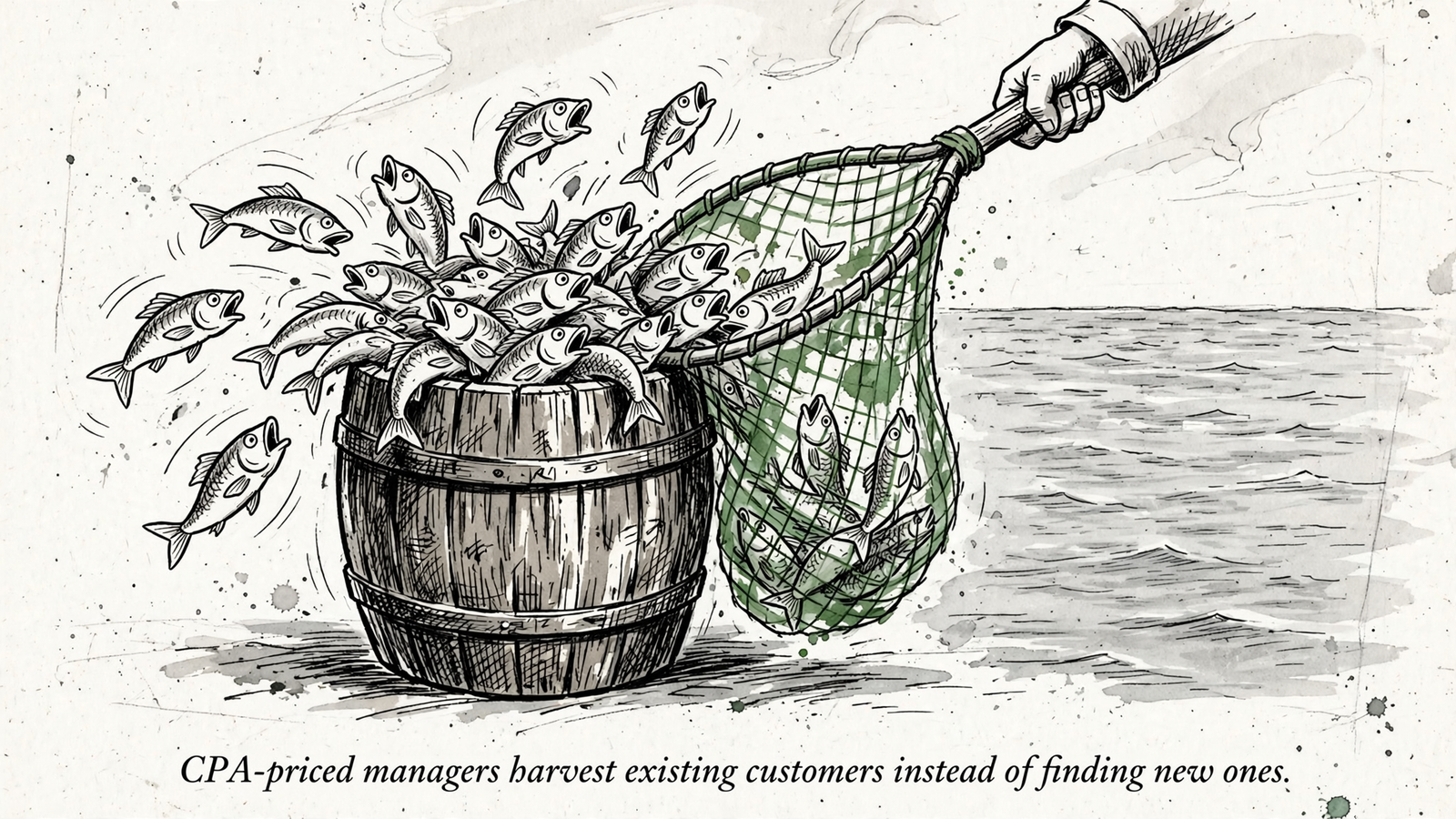
The first bend is retargeting people who may have bought anyway. Meta already drifts toward cheap conversions in warm audiences, retargeting and repeat buyers because they are cheap and reliable. Put a manager on CPA and you pay them to accelerate that drift. Platform ROAS looks strong while new-customer acquisition stalls. I have seen accounts where retargeting took full credit for buyers who had the site open in another tab. That is not acquisition. That is harvesting.
The second bend is cheap Instant Form leads that never answer the phone. Whatever metric pay is tied to becomes the metric the manager optimizes, at the expense of the business. Pre-filled forms make it easy to submit, not necessarily easy to find a customer. The illustrative math is brutal: $6 instant-form leads converting at 2% cost $300 per appointment, versus $18 landing-page leads converting at 17% and costing $106 per appointment. The $6 lead is cheaper only if you stop counting before the appointment. Your sales team does not get to stop there.
The third bend is capping volume where marginal CPA rises. Real growth often sits past the cheapest conversions. A CPA manager has a reason to stay with the easy ones because harder-won incremental sales threaten the average cost of producing a billable result. You get a flat line of wins that look efficient and a ceiling no one names. When you ask why volume has stopped, the answer can sound prudent: protect CPA. The contract made that caution profitable.
These are not three unrelated tricks. They follow the same instruction: produce the most billable units for the least effort and spend. If those units also become profitable new customers, fine. If they do not, the invoice still works.
The $10k comparison: listed fees versus hidden costs
At $10k a month in Meta spend, these illustrative arrangements put total monthly cash out between $11,499 and $21,000. The range is not a market quote for identical services. It compares the same ad spend against three different fee arrangements, using 100 counted acquisitions for the CPA example. That count is precisely what you would need to inspect before treating the totals as comparable.
| Model | Listed recurring monthly fee | Recurring ad spend paid to Meta | Hidden cost or incentive | Illustrative total cash out | Figure source |
|---|---|---|---|---|---|
| Percent of spend at 15% | $1,500 | $10,000 | Fee rises to $2,250 if spend rises to $15k, whether or not the work changes | $11,500 | 10–20% rate range; $10k scenario calculated here |
| Pay per acquisition at $110 × 100 counted | $11,000 | $10,000 | Billing depends on what counts; one retargeting example counted 30 purchases under the default window but 12 under 7-day click alone | $21,000 | Illustrative $110 rate within the $50–$200+ per-lead range; attribution example |
| Flat fee, groas Meta Ads | $1,499 | $10,000 | No fee increase tied to spend or conversion count; no setup fee | $11,499 | groas pricing |
Keep one-off charges separate from recurring charges. Some agencies put $1,000 to $2,500 in setup costs on the table before anything runs; groas charges no setup fee. The monthly totals above exclude any one-off setup charge. Ad spend, by contrast, recurs and goes to Meta on top of the management fee in every row.
Also keep listed costs separate from hidden ones. The percent-of-spend fee announces its incentive every time you raise the budget. CPA pricing can obscure its incentive behind a reasonable-sounding rate per result. The $110 in the table is not proof that a particular manager will pad an invoice. It shows how quickly the total changes when each of 100 counted units triggers a fee. Ask what those units are before you compare the totals.
At $10k spend, the listed percent-of-spend fee is only $1 above the listed groas fee. Pretending that $1 is the crisis would be silly. The cheapest mistake is comparing fee labels without checking what makes each fee rise. The most expensive one is paying per head for view-through retargeting and Instant Form filler your CRM marks unqualified. You thought you bought acquisitions. You bought a count.
The narrow case where CPA pricing can work
CPA pricing can work in one narrow setup: high volume, a proven offer, and tracking you control. Think of an ecommerce store doing hundreds of tracked purchases a month where the agency takes a cut of reported sales and you reconcile every order in Shopify. The definition is tight, the window is short, and you can audit the count in one export. You still have to decide whether the price is worth paying. At least you know what you are paying for.
Even guides that sell performance deals acknowledge the tradeoff: flat retainers remove the spend incentive but must be scoped to workload, while performance models can require lengthy attribution windows and favor short-term optimization over brand building, as one agency guide puts it. An auditable purchase count does not make every performance deal cheap. It makes the argument about price possible.
Skip CPA pricing everywhere else. Skip it if you sell an $8,000 service off a 90-day sales cycle and the agency wants to get paid on form fills. Skip it if you cannot say what a qualified lead costs in your CRM today, because the agency will have to supply the definition you lack. I wrote separately about why the per-lead Meta agency deal collapses on lead quality, and about who charges on CPA instead of a percentage with the longer pricing math. The pattern is the same: the manager gains from how a conversion is counted, so the count can stop measuring your business. If pay depends on the count, the count will grow.
Five questions to ask before you sign
Ask these on the sales call and put the answers in the contract. I ask them in this order because each removes a hiding place. The questions matter under retainers too, but vague answers are especially costly under CPA: each disputed definition can become a billable result.
- What exactly counts as an acquisition on the invoice? Is it a form submit, a qualified lead in my CRM, or a closed sale? If it is a lead, what makes it qualified, and who decides? If the manager cannot point to the relevant field in your CRM, expect to argue over names.
- What attribution window and view-through rule determine the bill? Is it 7-day click only, or 7-day click plus 1-day view? Get the rule in writing and ask for the corresponding Ads Manager column. The retargeting example above shows how much a window can change the count without changing an ad.
- Who owns the ad account, pixel and Conversions API dataset? The answer should be you, with admin access from day one. If the agency owns the tracking you pay against, auditing an invoice becomes its decision rather than yours.
- What share of billed conversions can come from retargeting and existing customers? Ask for a cap in the insertion order, such as no more than 20% from 30-day site visitors and customer lists. Without one, your warmest audience remains the cheapest path to the manager’s fee.
- What happens to the fee if spend or counted volume doubles? Under percent-of-spend, doubling spend doubles the fee. Under the illustrative CPA deal, another 100 counted acquisitions add another $11,000. Under the flat fee shown above, neither change raises the management fee. That is the incentive you are choosing.
A flat fee is the only one of these three structures where the manager gains nothing from what you spend and nothing from how a conversion is counted. groas runs Meta Ads for $1,499 a month, with the same fee at any spend, no setup fee and month-to-month cancellation. That removes both fee incentives at once. There is no management-fee bonus for pushing budget to $30k and none for calling a 1-day view a win.
The work that remains is the work you actually want: testing new creative, finding cold audiences that turn into customers, and killing placements that fill your CRM with people who never pick up. Sign a CPA deal without those five answers and you can get exactly what you paid for: a low reported CPA and a high real cost per customer. Your dashboard can look aligned while your sales team quietly stops following up on the leads. By the time you trace the problem back to the definition, you have paid for the lesson twice.