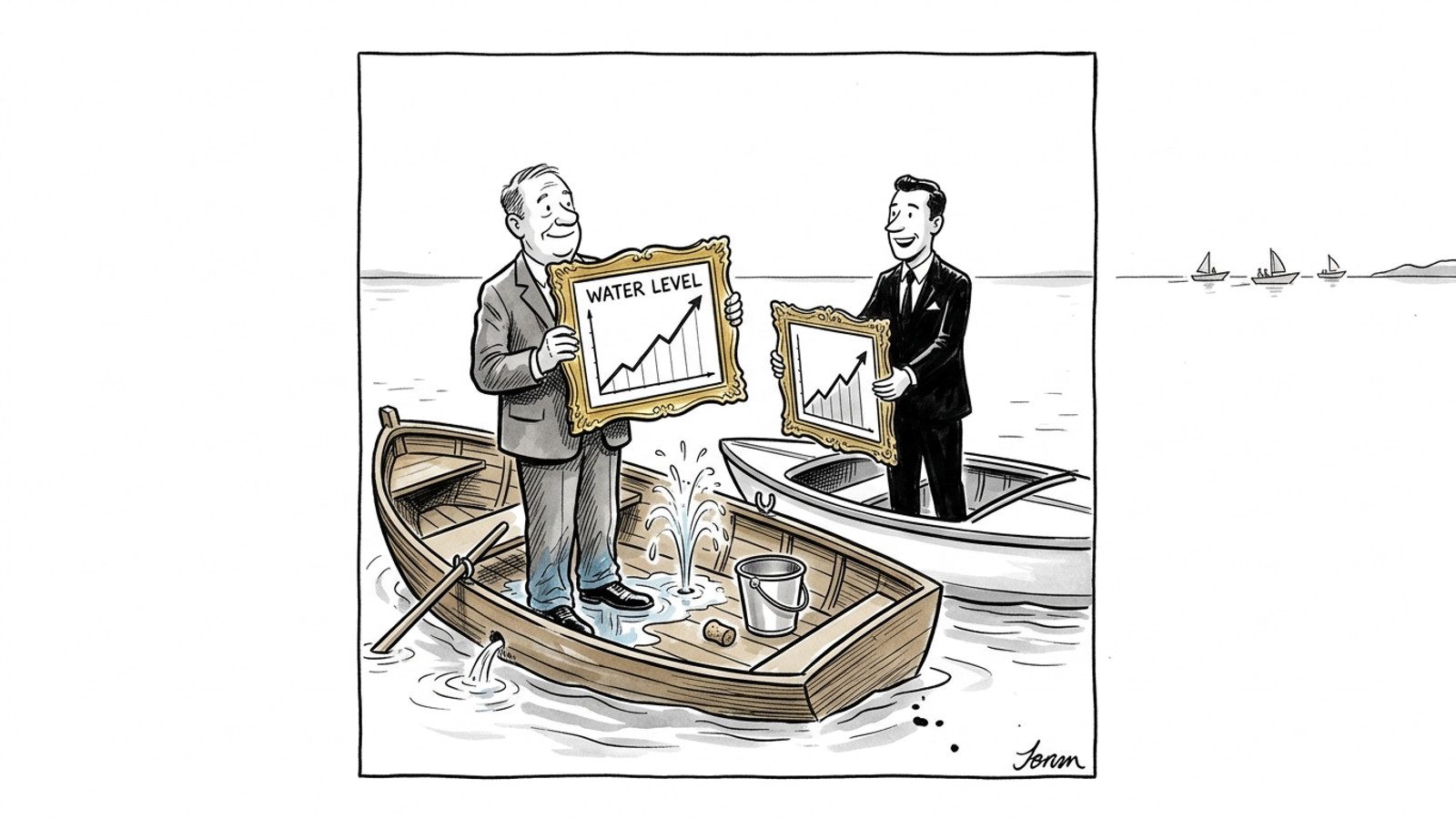

Per-prompt AEO pricing is the percentage-of-spend racket in a new hoodie. The vendor earns more every time your agency tracks another buyer question, whether or not your client gets cited once.
I spent a decade managing Google Ads accounts while agencies charged clients 15% of gross ad spend for work that automated scripts increasingly handled. Spend went up, the invoice went up. Qualified sales opportunities did not have to follow. Now answer engine optimization vendors have swapped ad spend for prompt counts and put the same incentive on a SaaS pricing page.
The pricing page charges you for curiosity
I opened four AEO pricing pages while auditing tools for a client portfolio, and the entry tiers made me close the tabs. Otterly.ai’s listed plans offer 15 prompts for $29 a month, then 100 for $189 and 400 for $489. PromptWatch’s listed starter tier costs $95 a month for 50 prompts across four models, with no content generation; its next tiers list 150 prompts for $245 and 350 for $579. Profound’s listed entry tier starts at $99 a month for 50 prompts on ChatGPT alone, then jumps to $399 for 100 prompts across three engines.
Even the Semrush AI Visibility Toolkit adds $99 a month per domain to an existing subscription while capping monitoring at 25 custom prompts. That is $3.96 per tracked prompt every 30 days for monitoring. Across the tracker category, listed prices run from $0.86 to $3.96 per tracked prompt per month.
Those tiers turn a basic planning question into a budget question. Before I can ask what buyers see when they compare a client with an alternative, I have to ask whether that comparison fits the plan. Before I track another regional query, I have to decide which existing one to remove. The pricing page is already shaping the research.
Ask why another question about your client’s buyers triggers another charge, and the answer tends to involve compute or fair usage. Fine. Compute costs money. But the bill rises precisely when you try to understand more of the market. You are paying a toll on your own curiosity.
I’ve seen this incentive before
In paid search, percentage-of-spend pricing put agency revenue on the wrong side of the client’s efficiency. Say I audited a search term report on Tuesday and added 50 negative keywords that eliminated $4,000 in garbage broad-match clicks. At a 15% management fee, the agency took a $600 haircut on that month’s invoice. The client saved money; the agency earned less. That is the structural trap behind percentage-of-spend pricing for Google Ads agencies and clients. The same objection runs through critiques of percentage-of-spend versus value-based pricing: the vendor’s incentive should not pull against the client’s results.

Per-prompt AEO pricing repeats the part that matters. The vendor does not earn more because your client appears in a ChatGPT, Claude, or Google AI Overviews answer. It earns more because you ask more questions. If a plumbing client expands into commercial water heater maintenance and needs 60 more intent queries tracked, the software bill can rise before you write a line of copy or fix a schema tag.
A thorough account manager becomes a cost center. Check 15 ways a buyer compares CRM software and the vendor treats the extra coverage as an overage event. The model penalizes you for looking harder, not for wasting work.
Twelve domains make the meter hard to ignore
Picture a four-person agency with 12 client retainers. One client sells B2B logistics software, another handles high-end residential remodeling, and a third provides specialty dental implants. Fifteen canned questions per client will not tell that agency much about how buyers encounter those businesses in AI answers. Prospects ask about alternatives, pricing, setup time, integrations, and regional reliability. For this example, give each client 80 active buyer prompts.
That is not an extravagant research project. The logistics client’s pricing questions are not interchangeable with its integration questions. The remodeling client’s regional questions will not stand in for the dental client’s comparisons. If the agency compresses those different buyer concerns into a handful of convenient prompts, it can still produce a chart. It cannot pretend the chart describes everything the client needs to know.
The arithmetic is plain: 12 domains × 80 prompts = 960 tracked prompts.
Otterly.ai’s listed top plan stops at 400 prompts for $489 a month. PromptWatch’s stops at 350 for $579. Covering 960 prompts at those stated limits would take three top-tier subscriptions: $1,467 a month at the former price or $1,737 at the latter, assuming you can split the work that way. The alternative is a custom agreement. Either way, the software cost climbs before your team touches client copy or an indexation blocker. Peec AI’s listed agency pricing presents another kind of bracket: an entry level of around $245 or €205 a month, limited to three client projects, with Looker Studio connectors and expanded model access reserved for higher tiers.
What does an agency owner do when monitoring eats into retainer margin? Ration it. Set a 25-prompt limit per client. The strategist keeps five branded queries where the client was likely to appear anyway, ten broad category questions that look presentable in a PDF, and a few others that fit under the cap. The messy mid-funnel comparisons are the first to go because they are harder to track and explain.
That choice rarely announces itself as a cut to quality. It arrives as a tidy prompt list, approved before anyone has looked closely at what it omits. A new buyer question means a meeting about which old question to drop. The team spends time managing the measurement plan instead of using it.
Now the client sees an 85% visibility score inside a tiny 25-prompt bubble. The slide looks good. It does not show the questions the agency stopped asking, including the ones that might reveal where competitors appear instead. A prompt cap becomes a coverage cap.
The compute excuse does not explain the meter
Vendors often defend tight prompt tiers with infrastructure costs. Running model queries is not free, and an AEO platform does more than send one API request. But the price of a model call helps put the metering argument in perspective.
OpenAI lists GPT-4o-mini at $0.15 per million input tokens and $0.60 per million output tokens. For an illustrative monitoring query using roughly 1,000 tokens in total, the input-output mix matters. At an estimated $0.00045 per query, one check a day for 30 days comes to about $0.014 per prompt per month in model charges. Perplexity’s listed search-request pricing of $1 to $5 per thousand requests puts 30 daily checks at roughly $0.03 to $0.15 per prompt per month in request charges.

Those are not a vendor’s total costs. They do not account for every engine, feature, or operating expense. They do show why a $1-to-$3.96 monthly charge for each additional tracked prompt deserves a better explanation than compute is expensive. The customer is not buying raw tokens. But the vendor is also not selling a result each time the meter ticks.
I am not asking a platform to run without limits on its own expenses. I am asking why the customer-facing limit lands on the very activity an agency needs to do well. If broader coverage is the point of the tool, charging extra whenever coverage broadens is an odd way to price it. The agency has to make the case for every new question; the vendor only has to count it.
The fair usage explanation misses the agency problem in a different way. A limit of 50, 150, or 350 prompts forces a growing agency into the next tier as its client coverage expands. The vendor gets a larger invoice as soon as you ask more questions. The client may not have gained a single citation. I know which side of that arrangement I would rather invoice from.
Price the domain, then do the work
The useful unit for an agency is the client domain, not an individual prompt string. When you take a search-growth retainer for a B2B software company or a regional home services group, you are responsible for that business’s visibility and its contribution to pipeline and revenue. You cannot decide in advance that its buyers will ask only 25 questions worth observing.
Per-prompt pricing turns an account manager into a bookkeeper. Is this product comparison worth one slot? Do we drop a regional question to make room for an integration question? None of that improves the client’s visibility. It just keeps the software invoice inside the retainer. A flat price per domain with no prompt ceiling lets the team track the questions its buyers actually ask.
There is another problem with paying dearly for monitoring: a notification is not a fix. Suppose a tracker tells you on Friday afternoon that your client lost a prominent Perplexity citation for a high-value comparison question. Your strategist still has to investigate, revise content, address technical issues, and get changes published. The dashboard found work. It did not do it. Our argument for flat-rate AEO pricing per domain is that uncapped tracking protects agency margins best when execution comes with it.
The distinction matters when you price a retainer. A monitoring subscription is one cost; the hours spent acting on what it finds are another. Put both in the same calculation. Otherwise, a cheap-looking tracker can leave your team doing the investigation and the fixes while the client reasonably assumes the subscription covers the problem. A report full of things to do is not a work plan someone has completed.
That is the model groas offers agencies: a flat $999 a month per client domain, no prompt caps, and execution included. Specialized AI models handle technical fixes, content updates, citation signals, and paid search optimization, while a named senior strategist sets direction and guardrails. The agency stays client-facing with branded weekly reports. Instead of deciding which buyer question deserves a slot, your team can focus on whether the work improves pipeline and revenue.
I do not want a prettier meter. I want the meter gone.
Three questions to put to the sales rep
Before you hand an AEO platform the corporate card or sign an annual contract, ask three questions. Make the rep answer with a number or a description of work, not a slide about intelligence.
- What happens to our monthly bill when we add 100 buyer prompts? If that means an overage, a contract amendment, or a jump from a $189 tier to a $489 tier, you are paying extra to understand your client’s market. Expect your team to start rationing questions.
- Does the platform execute fixes, or give us a list of chores? An alert that your client disappeared from a recommendation does not restore the citation. If your strategists still have to investigate and carry out every change, budget for their time as well as the subscription.
- Can we cancel month to month, with no onboarding fee? An annual lock-in or a $2,000 setup fee puts more of the risk on your agency while you find out whether the platform earns its place in the workflow. Ask what you can stop paying if it does not.
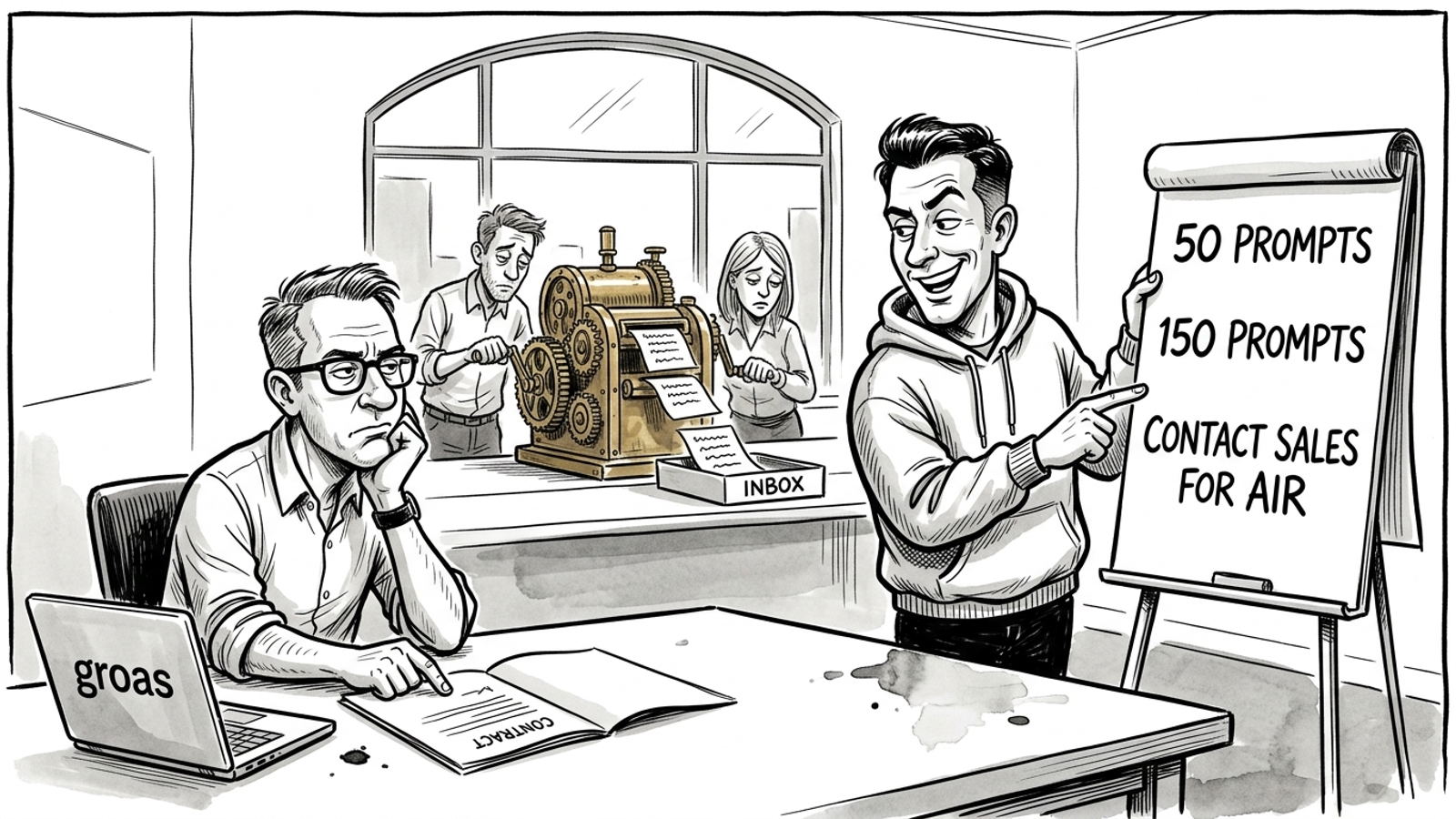
Together, the answers expose the deal. The prompt meter charges for diagnostic coverage. A read-only tool sends the labor back to your payroll. A long contract keeps the vendor’s revenue steady while your client retention remains your problem.
Performance marketing has spent years arguing against percentage-of-spend fees that reward a bigger bill rather than better results. We do not need the same incentive attached to conversational search. For a multi-domain agency, the sane unit is a flat price per domain, uncapped prompts, and execution behind the data. If a platform cannot offer that, it is not an intelligence engine. It is a tollbooth.
Häufig gestellte Fragen
Why is per-prompt AEO pricing compared to percentage-of-spend agency fees?
Both models make the vendor's revenue grow as usage grows, not as results improve. AEO vendors charge more each time an agency tracks another buyer prompt, even if the client never gains a citation, the same way agencies charging 15% of ad spend earned more when spend rose.
How do prompt limits affect the research an agency can do?
Before tracking a new comparison or regional query, the agency must decide which existing prompt to remove, so the pricing page shapes the research itself. A thorough account manager becomes a cost center, because extra coverage is treated as an overage event rather than better work.
What would it cost an agency with 12 client domains to track 80 prompts each?
Twelve domains with 80 prompts each is 960 tracked prompts. Otterly.ai's listed top plan stops at 400 prompts for $489 a month and PromptWatch's at 350 for $579, so covering 960 prompts would take three top-tier subscriptions: $1,467 or $1,737 a month, assuming the work can even be split that way.
What does a 25-prompt cap do to a client's visibility reporting?
The agency keeps branded queries and broad category questions that look good in a PDF and drops messy mid-funnel comparisons first. The client can then see a high visibility score inside a tiny 25-prompt bubble that does not show the questions the agency stopped asking, including where competitors appear.
Does the compute-cost excuse justify per-prompt AEO pricing?
Not really. Using GPT-4o-mini's listed pricing, an illustrative daily check costs about $0.014 per prompt per month in model charges, and Perplexity's listed request pricing puts 30 daily checks at roughly $0.03 to $0.15. Those are not a vendor's total costs, but they sit far below the $0.86 to $3.96 per prompt per month listed across tracker tools.
Why do agencies benefit from flat per-domain pricing instead of per-prompt tiers?
The agency is responsible for a client's whole visibility, and it cannot predict in advance that buyers will ask only 25 questions. A flat price per domain with no prompt ceiling lets the team track the questions buyers actually ask instead of turning the account manager into a bookkeeper who rations prompt slots.
Is a monitoring alert the same as fixing a lost citation?
No. If a tracker reports a client lost a prominent Perplexity citation, a strategist still has to investigate, revise content, address technical issues, and publish changes. A notification finds work but does not do it, so monitoring costs and execution hours belong in the same retainer calculation.
What should I ask an AEO platform's sales rep before signing?
Ask what happens to the monthly bill when you add 100 buyer prompts, whether the platform executes fixes or only delivers a list of chores, and whether you can cancel month to month with no onboarding fee. A meter that charges for coverage, a read-only tool, or an annual lock-in puts the risk on your agency.