

A commercial HVAC contractor can spend $20,000 a month on Google Ads and still teach the system to find homeowners who need a window repair. The problem is not that Performance Max or AI Max misunderstood the business. It is that the account counted the wrong people as wins.
Both campaign types are prediction engines. They allocate budget toward the users and auctions their conversion data suggests are valuable. A vague objective or a form-fill goal that counts junk leads does more than underperform: it gives the system a reason to fund more junk. That is why choosing what counts as a conversion is, in practice, part of choosing your bid strategy.
Take a contractor selling $35,000 rooftop ventilation systems to warehouse developers and facility managers. The offer has a buyer, a price, and a limited pool of relevant searches. Activating Performance Max or AI Max for Search does not persuade an industrial landlord to need a new system. It changes how Google looks for opportunities to show an ad and how it bids on them. The question underneath each bid is roughly: Given what we know now, how likely is this person to complete the action the advertiser values?
If the account calls every contact form a valuable lead, the answer may have very little to do with selling commercial HVAC. Let’s build the mechanism from there.
First, the system needs a definition of value
The contractor knows the difference between a facility manager requesting a rooftop installation quote and a homeowner asking about a window unit. The bidding system does not get that judgment for free. It sees auction signals and the outcomes recorded in the ad account. The conversion action is the bridge between a real business result and the pattern the system can learn.
That bridge can be sturdy or flimsy. A verified sales-qualified opportunity tells the system something about the kind of inquiry the business wants. A thank-you page visit says someone reached a URL. It may be a useful early signal, but it is not the same claim.
This distinction matters before campaign settings do. You can write precise ads, set a Target CPA, and give the platform plenty of room to spend. If the recorded outcome is too far from an actual sale, those controls still point at the wrong destination. For the HVAC contractor, the first decision is not whether to use more automation. It is whether the word lead means a possible commercial buyer or simply anyone who submitted a form.
Then, auction signals shape the prediction
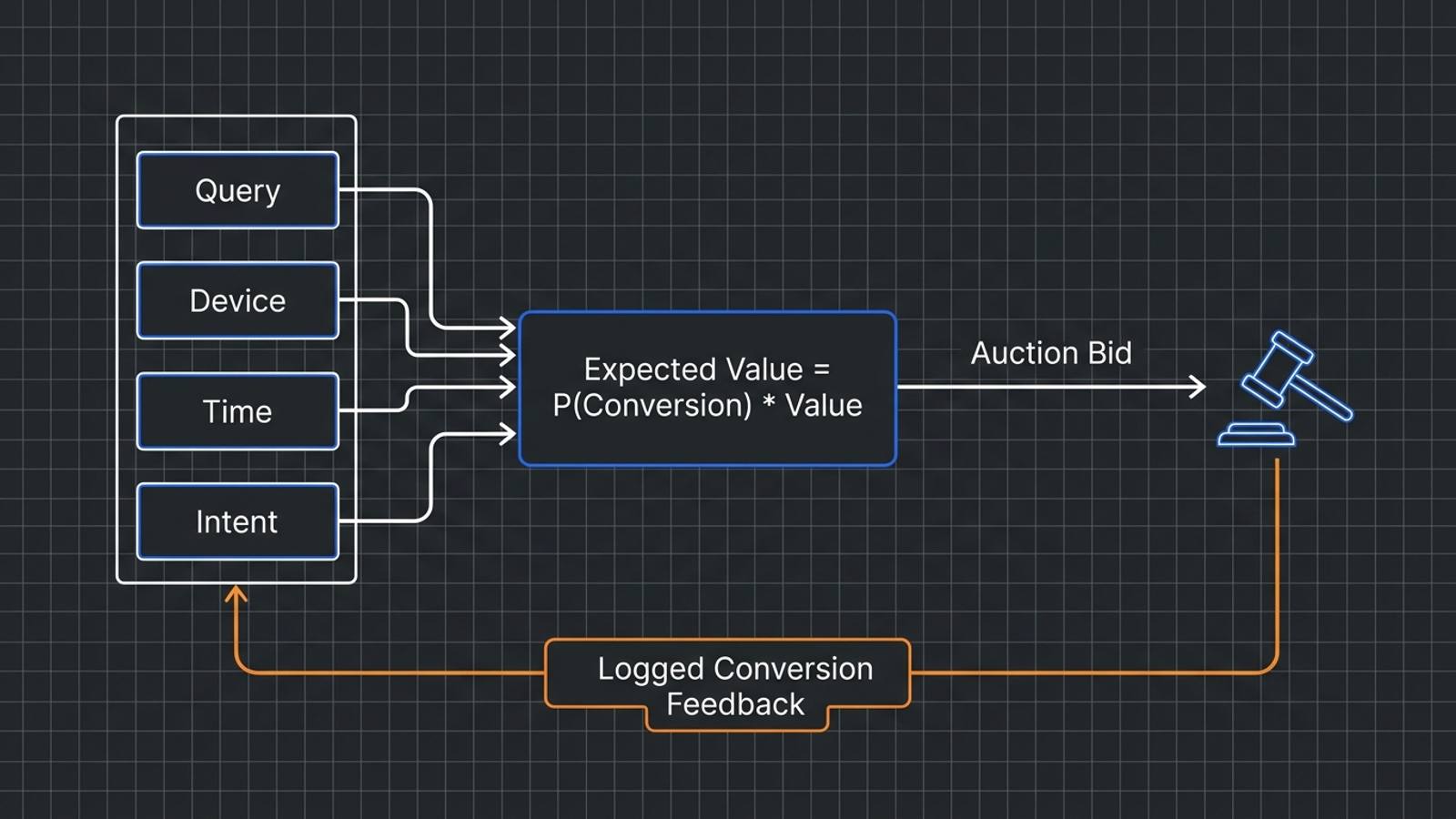
Years ago, I could express much of an account strategy through blunt rules: a mobile bid adjustment, a time-of-day adjustment, and a max CPC on an exact-match keyword such as [industrial rooftop hvac repair]. Automated bidding uses more context in each auction. Query wording, location, device, and other available signals can all affect its estimate.
The useful mental model comes from Google’s Smart Bidding documentation: the system predicts the likelihood of a conversion and weighs that likelihood against the value assigned to it. In simplified form, Expected Value = P(Conversion | Signals) × Value. That is a model for understanding the decision, not a claim that Google plugs those three visible numbers into a public bid formula.
Suppose our contractor assigns a form submission a value of $150 and sets a Target CPA of $120. A prospect the system estimates has a 5% chance of submitting the form looks more attractive than one with a 0.5% chance, all else equal. The target shapes what the system can afford to pursue. But it cannot repair the definition of form submission. If the more likely person is also more likely to be an irrelevant homeowner, the system has no reason to reject that opportunity unless better feedback reaches the account.
This is the first practical boundary: better predictions about a bad goal are still bad business decisions.
A conversion closes the loop, whether it was useful or not
After an ad click, the visitor reaches the landing page and triggers a conversion event. That event becomes feedback for future bidding. Similar auction conditions may look more promising because they preceded an outcome the account marked as successful.
Notice what the event does not say. A tag firing does not confirm that the inquiry came from a facility manager, that the company owns a warehouse, or that anyone plans to buy a $35,000 system. It says the tracked action happened. I have spent enough time sorting real inquiries from junk to know those are different statements.
This is why the objective and the quality of its underlying signal have to be considered together. Selecting Leads tells Google the campaign is pursuing inquiries; the platform’s form-submission objective guidance reflects that basic choice. But the label Leads cannot distinguish a strong quote request from a useless form fill. Your primary conversion actions and the data you pass back have to do that work.
A Target CPA then operates against the recorded conversion, not the deal you meant to record. That is the sense in which your choice of objective is effectively your bid strategy: it determines which outcomes the bidding system has evidence and an incentive to pursue. A $120 target for raw forms and a $120 target for verified commercial inquiries may display the same number in a settings screen. They describe different businesses to the machine.
Bad leads can make a dashboard look healthy
Now leave the contractor’s form open to anyone. Imagine the account records forty leads in a week at $60 each, but thirty-five are residential homeowners looking for a $200 window repair. The dashboard reports a CPA below the $120 target. The sales team gets five potentially relevant conversations and a great deal of sorting to do.
The arithmetic is not broken. The account counted forty successes, so the bidding system has reason to seek more traffic resembling the people who produced them. ClickCease’s discussion of automated-campaign spam describes a harsher version of the same problem: automated or otherwise low-quality submissions pollute the feedback an advertiser relies on. No specific placement or deadline is required for the mechanism to hurt. Once junk counts as success, more efficient delivery of junk can look like improvement.

The sorting-machine image maps to one part of the job: the business must separate valuable outcomes from weak proxies before using them to steer spend. It does not mean every lead can be judged instantly. A commercial sale may take longer than a form submission, which is precisely why raw forms are tempting. They arrive quickly and give the system more events to learn from.
The tradeoff is real. Wait for verified sales-qualified opportunities and feedback arrives later. Count every form and feedback arrives sooner, but may reward the wrong traffic. The contractor can use form data to watch volume while passing qualified opportunities back as the stronger signal for bidding. Our piece on fixing Google Ads lead quality without increasing budget examines that distinction in an in-house setting.
Do not call a lead qualified merely because the form was submitted. That small naming decision can govern a lot of spend.
More budget amplifies the signal you already have
A demand-led approach makes room in the budget to capture available demand when campaigns can do so within their efficiency goals. Google’s explanation of the approach for AI Max and Performance Max emphasizes having sufficient budget for the reach these tools can find. Brainlabs has estimated that 27% of Google Ads spend is constrained by account budgets.
There is a sensible argument here: an arbitrary cap can stop a campaign from entering auctions it could profitably win. Our contractor should not reject a qualified facility manager at midday solely because the daily budget ran out. But removing a budget constraint does not establish that every additional opportunity is good. Headroom helps only when the bidding goal gives the system a useful way to judge what to pursue.
AI Max and Performance Max also need a distinction the budget conversation often blurs. AI Max expands how a Search campaign can find and serve relevant search demand. Performance Max can pursue conversions across multiple Google channels. They are both automated prediction systems, but giving them more budget does not give them identical places to spend it.

For the HVAC contractor, a larger budget might capture more relevant searches that the account previously missed. If the goal is raw form submissions, it can also buy more opportunities to collect the wrong forms. With Performance Max, that risk includes expansion beyond the Search inventory the contractor has been watching. Demand-led budgeting is not a vow to spend without a ceiling. It is a willingness to fund additional opportunities after the account can tell a valuable inquiry from an easy one.
Search gives a narrow-demand business a useful boundary
The same model explains why I would start this contractor with Search rather than launch Performance Max simply because it can reach more inventory. A business selling expensive rooftop systems to a small, specific set of buyers benefits from controlling which commercial queries get attention. Search gives the team a clearer place to inspect those queries, refine exclusions, and learn what a real prospect asks for.
This is not a claim that Performance Max never belongs in B2B. It is a sequencing argument. When high-intent search demand is finite and lead feedback is still weak, broader reach creates more chances to pay for outcomes that look good in the account but mean little to sales. Our analysis of why search-first wins for mid-market advertisers makes that case, and Farsiight’s B2B discussion places Performance Max later in an account rollout, after Search and conversion feedback have a stronger foundation.
Running both types does not mean every query is divided between them by a coin flip. Google’s campaign prioritization rules give eligible, identical Search keywords priority in relevant cases; other overlaps depend on the applicable auction and eligibility rules. The operational point is simpler than memorizing every branch of that policy: launching Performance Max does not automatically preserve the traffic mix or control you had in Search.
The boundary changes when the feedback changes. Consider an ecommerce account with hundreds of physical products in Merchant Center, dozens of purchases a day, and purchase revenue reported back promptly. Performance Max has a more direct measure of value and product inventory it can use across channels. That does not make every bid right. It does make the distance between the recorded conversion and the business outcome much shorter than it is for the HVAC contractor’s unqualified form.
So the choice is not manual versus smart. It is how much room to give the prediction engine, given the quality of its feedback. Start narrow when the buyer is specific and the signal is weak. Broaden only when the account can recognize the business you actually want.
Test the model on a different kind of lead
Take a private medical clinic advertising high-value elective surgeries. A calendar button click is easy to count. A patient who arrives for an appointment is closer to the outcome the clinic cares about. If the clinic makes button clicks its primary success signal, the system can learn to find people willing to click a calendar without learning much about who attends.
Run the reasoning in order:
- Name the business outcome. The clinic wants prospective patients who arrive for appointments, not merely people who open a calendar.
- Identify the available proxy. A button click arrives quickly, but leaves a gap between the measured action and the desired one.
- Predict the failure mode. Bidding toward clicks can favor users who take that easy action but do not show up.
- Improve the feedback. Pass back a confirmed arrival as a stronger downstream conversion signal, rather than treating every click as the final win.
The principle transfers to a SaaS company offering a free 14-day trial. An email registration is not the same as a user reaching a verified product activation milestone. The product and timeline change; the reasoning does not. In each case, ask what event tells the system enough about commercial value to justify the next bid.
Fix the signal before you touch the settings
I would rather spend an hour tracing an ad click through a form, a qualification decision, and a sale than spend it debating a 10% Target CPA adjustment on an account that counts junk as revenue. Bid targets, exclusions, and budget limits matter. None can make an unqualified form fill mean something it does not.
For the HVAC contractor, that means checking which events count as primary conversions, passing qualified opportunities and downstream sales data back into Google Ads where possible, and protecting high-intent Search while that feedback improves. Then a larger budget or broader campaign type has something useful to work with.
groas combines continuous automated execution with human strategic ownership and guardrails. That combination matters because faster execution is valuable only when the account is pointed at the right outcome. The engine will spend toward the demand you define. Make sure your definition describes a customer.
Frequently asked questions
Why does choosing a conversion action matter as much as my bid strategy in Google Ads?
Your choice of conversion action determines which outcomes the bidding system has evidence and an incentive to pursue. A Target CPA operates against the recorded conversion, not the deal you meant to record. The same $120 target applied to raw form submissions and to verified commercial inquiries describes two different businesses to the machine.
Is a form submission a good conversion signal for Performance Max or AI Max?
It can be useful as an early signal, but it is a weak proxy for a real sale. A tag firing only confirms the tracked action happened, not that the inquiry came from a relevant commercial buyer. A verified sales-qualified opportunity tells the system far more about the kind of inquiry the business actually wants.
Can bad leads make my Google Ads performance look better than it is?
Yes. If an account records many cheap but irrelevant leads, the bidding system treats them as successes and seeks more traffic resembling the people who produced them. More efficient delivery of junk can then look like improvement on the dashboard, even though the sales team receives mostly conversations it cannot use.
Should I count every form fill as a conversion or wait for qualified leads?
There is a real tradeoff. Counting every form gives the system faster feedback and more events to learn from, but it may reward the wrong traffic. A practical approach is to use raw form data to watch volume while passing qualified opportunities back as the stronger signal for bidding.
Will increasing my budget improve Performance Max or AI Max results?
Only if the bidding goal gives the system a useful way to judge what to pursue. Removing a budget cap can stop a campaign from missing profitable auctions, but if the goal is raw form submissions, more budget can simply buy more of the wrong leads. Fix the conversion signal first, then add headroom.
Should a niche B2B business start with Search or Performance Max?
A business selling expensive products to a small, specific set of buyers usually benefits from starting with Search. Search gives the team a clearer place to inspect queries, refine exclusions, and learn what real prospects ask for while conversion feedback is still weak. Performance Max can be added later, once the account can recognize the outcomes that actually matter.
Is a calendar button click a good conversion to optimize toward for a clinic?
A calendar button click is easy to count, but it does not tell the system who actually attends an appointment. If clicks are the primary success signal, bidding can favor people willing to click without showing up. Passing a confirmed arrival back as the stronger downstream conversion signal improves what the system learns.