

 LinkedIn
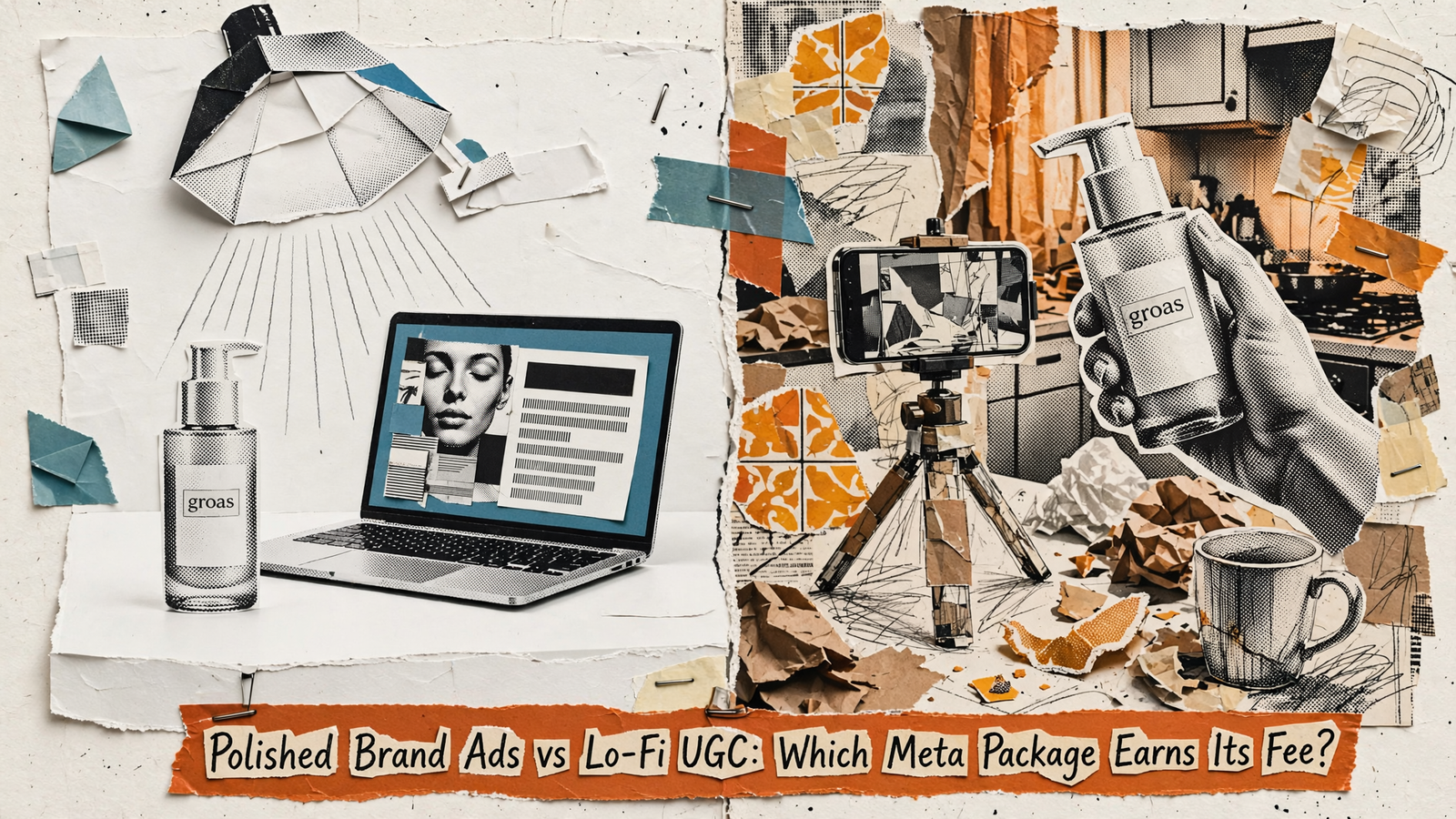
A growing business with a modest Meta budget has two agency packages on the table: polished ads cut from brand assets, or commissioned lo-fi creator content. Start with the assets you already own if they explain the offer. Make UGC earn its production cost by showing a demonstration, perspective, or proof those assets cannot supply.
I used to tell clients lo-fi always won on Meta. I was wrong. A phone-shot ad does not deserve an authenticity premium just because someone left the studio lights off. The choice is about what the creative communicates, what it costs to produce and keep running, and what your budget can actually test.
The contenders: brand assets against creator-led work
Forget the mood-board labels for a minute. Polished brand creative means clean, edited work made from product photos, designed statics, motion graphics, or video you already own. In the Biddyco data set I keep coming back to, polished includes designed statics and edited UGC, not just expensive shoots. A brand package can therefore be mostly editing, or it can require production from scratch. Those are very different quotes.
Lo-fi creator content means a person showing or talking about the product, usually in a format that feels less produced. But UGC gets used to mean three things at once: shot on a phone, featuring a creator, and feeling unscripted. They overlap; they are not interchangeable. A creator video can be tightly scripted and heavily edited. A brand ad can be shot simply and still read as polished because the lighting, sound, and message are clean.
That distinction matters before an agency sends a proposal. If it promises 10 UGC videos, find out who appears in them, who writes them, who edits them, and whether you can run them as ads. If it promises polished creative, find out whether it works from files you own or expects a new shoot. Buy the production job, not the aesthetic label. Truly lo-fi phone clips and highly polished studio shoots are both edge cases in real accounts; most of the useful work sits between them.
Before round one: spend share is not a sales result
Across 483 top-spending creatives from 17 US accounts and $5.1 million in spend, polished creative took a median 63% of top-creative spend in all 17 accounts. Creator-led ads took roughly a third of that spend in 16 of 17 accounts. Truly lo-fi footage was under 1% in only 2 accounts, while studio or cinematic work was under 1% in 4 accounts. Most of what Meta delivered was clean brand work or edited creator work, not shaky phone clips or Super Bowl spots.
The study also says plainly that spend share does not identify a conversion winner. Polished creative averaged 4% below account-average cost per result and came in below average in 12 of 14 measurable accounts; creator-led creative averaged 10% above average. Yet creators led the majority of spend in 4 consumer-brand accounts. I would not turn either finding into a rule for your account. Polished holds up at scale, and creator work carries real weight in some consumer categories. Neither delivery pattern proves which style caused a sale.
An agency can put a spend chart in a deck and call it validation. It tells you what received delivery, which is useful. It does not tell you whether paying to produce that format improved your cost per purchase. Do not buy a style because it got spend; buy a way to find out whether it earns spend in your account.
Round 1: what does the first usable ad really cost?
Polished starts cheap when you already have decent assets. Sharp photos, product shots that show the offer, and existing video give an editor material to turn into statics or motion in days. If you own nothing usable, the calculation reverses: you may need to pay for a shoot before you pay for media. The polished package is no longer the inexpensive one simply because it says brand creative on the quote.
Creator content has a different upfront cost. You pay for each video before you know whether the message works. Beginners charge $80 to $150 per video, mid-tier creators $150 to $300, experienced creators $300 to $600, and senior creators $600 to $1,500 or more. The same guide puts a typical $5k-to-$15k-per-month advertiser at $1,500 to $4,000 a month for 10 to 20 videos. That volume may suit an account with room to test it. It is a lot of production to buy on faith when your media budget is $3,000.
Then read the rights line. Perpetual usage adds 50 to 100%, whitelisting for partnership ads adds 30 to 50%, and exclusivity adds another 20 to 40%. One Toronto practitioner guide quotes basic UGC at $150 to $250 per video, scripted or demo work at $250 to $400, and experienced creators with paid rights at $400 to $800, with paid-ad usage adding 30 to 50%. Revisions can add cost, too. Miss those terms and the apparent bargain becomes an ad you cannot keep running without another payment.
The mechanism is not complicated: production costs money whether an ad works or not. Every additional version or right raises the cost of finding and using a winner. With assets you already own, you may have fewer new rights to negotiate. With commissioned work, ask exactly what the quoted fee lets you publish, edit, and continue running.
Separate that creative bill from management. Meta management runs $500 to $5,000 or more per month, often a flat $1,500 to $3,000 for $10k to $50k in spend or 10 to 15% with minimums; creative production usually costs another $1,000 to $3,000 per month. Fresh creative is part of the work, not an optional flourish buried after the retainer. I have seen the math that breaks small budgets: $1k to $3k in spend beside a $1,500 to $3,000 retainer means fees can equal or exceed media spend before production enters the picture.
Round-one winner: polished, if you already own usable assets. Ask what each retainer includes before comparing prices. A cheaper creator package with two included videos, costly revisions, and no lasting usage rights may be the expensive package by month two.
Round 2: which format does the selling job?
Polished wins when the buyer needs clarity. Price, offer, sizes, flavors, what is included, how it arrives: clean design can put those details in one glance. The same Toronto practitioner guide that claims first-person UGC out-converts polished brand creative by 2 to 4 times on cold prospecting still reserves 20% of the mix for polished creative in remarketing and brand trust. When someone already wants the product and needs to confirm the details, a sharp product shot can do more work than a monologue.
I would start there if your current files make the offer obvious. Not because polished always wins, but because the files are available and the job is clear. Make a proposed creator video answer a harder question: what could a person show that those files cannot? If the answer is merely “it will feel authentic,” I would keep the production money for testing.
Creator content earns its fee when proof is the selling job. A hand opening the box, a short demonstration on real skin or a real lawn, an objection answered in plain words: those can show an experience a static cannot. The best argument for paying a creator is not a vague promise about authenticity. It is a specific demonstration, perspective, or testimony the brand does not have.
Distribution may matter as well. Across $130 million and 65,000 Meta Partnership Ads, the same licensed creator asset running via the creator handle delivered 19% higher CTR, 10% higher conversion rate, and 5% lower CPA than it did from the brand handle. Whitelisted partnership ads are also claimed to lift CTR by 20 to 30% against non-whitelisted ads. That gives the handle a job, not just the video: the person presenting it changes how the message lands. It also makes those usage and whitelisting terms from round one part of the performance conversation, not boring contract trivia.
Round-two winner: the format that supplies the missing information. Use polished assets for an offer they already explain. Commission a creator when you can name the demonstration or testimony you need, and make sure the quote includes the rights to run it the way you intend.
Round 3: what can a modest budget actually test?
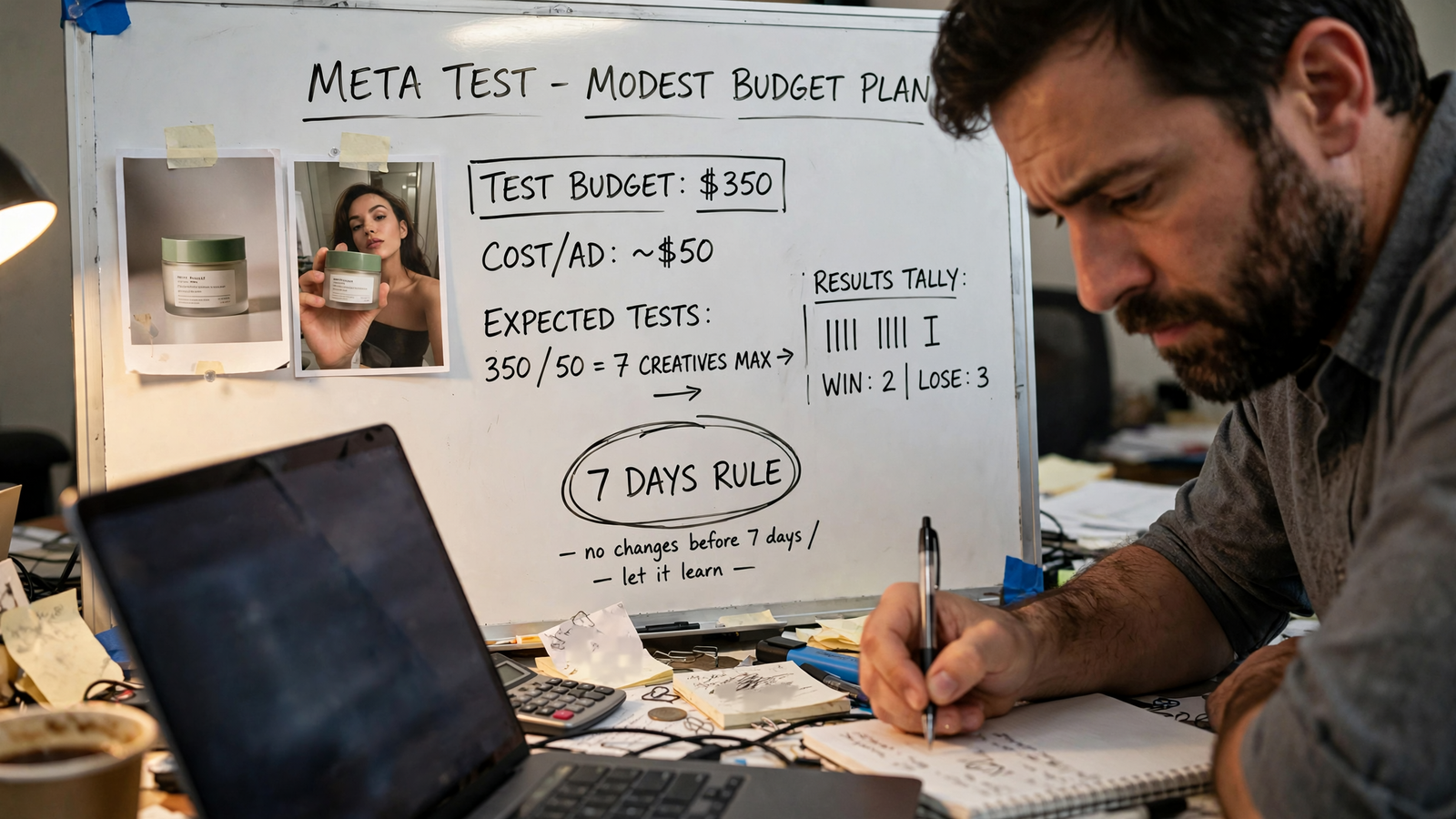
Say you spend $3,000 a month on Meta. A suggested test allocation is 15 to 25% of monthly spend, with 2 to 3 times target CPA per ad and about 10 results before you call a winner. That gives you $450 to $750 for testing. At a $50 target CPA, $100 to $150 on an ad buys an early read of roughly two or three results, not the 10 results needed for a firmer call. Ten results at that CPA imply about $500 in spend on one ad. The same test budget cannot give three to five ads that level of evidence.
This is where packages promising piles of new variations start to look less generous. You may be able to give several ads a small first look, but you cannot properly judge all of them at once on $450 to $750. Pick a question, fund a candidate, and decide whether its early read earns more budget. Keep the existing ad running as a comparison rather than replacing everything because a new thumbnail got a good Tuesday.
Delivery makes the picture messier. In 69 tests, the top three ads took 45 to 80% of test spend, while 40 tests received under 2%. An ad Meta barely served is untested, not a proven loser. Judge after at least seven days, not after one day of easy buyers; if purchases take longer to appear, do not pretend the seven-day check settles them. Meta directs delivery toward what it expects to convert, so a report with unequal spend is not a clean head-to-head just because the columns sit next to each other.
Larger-account data shows why an endless creative treadmill is the wrong model for a small budget. Across $130 million in Partnership Ads data, only one in five tested ads became a winner, and 45% of winners looked like losers before $100 in spend. Winners fatigued after 36 days on average, and median CPA rose 1.4 times when they stayed live. Holding 10 concurrent winners took about 40 new tests a month, each funded to about $1,000 before a kill call. That is not a production plan for an advertiser spending $3,000 a month. It is a warning against buying a package designed around volume you cannot evaluate.
Test in sequence instead. Keep the number of live bets small enough to give each a useful read, retain a winner while it works, and bring in the next idea when you have room to fund it. Fragmenting spend across 10 to 20 campaigns can break learning: Meta needs about 50 optimization events per ad set in seven days. Whether the candidate is polished or creator-led, more files in a folder do not create more evidence.
Round-three winner: neither style. The package wins this round if it gives each tested idea enough budget and time to tell you something. Compare downstream outcomes per tested idea, not the number of variations an agency promises to launch.
The agency that prefers UGC may show you CTR and thumb-stop rate. The agency that prefers polished may show you brand lift and comment sentiment. Neither pays your invoices. Choose the downstream measure that matches the sale, such as cost per qualified lead or cost per purchase, and agree on it before creative goes live. Check performance after seven days rather than declaring a winner after 48 hours; allow for conversion lag before the final call. If the finalists name a winner from unequal delivery and count unspent ads as failures, they have read Meta’s delivery report back to you. They have not settled the creative argument.
| What decides it | Polished brand creative | Lo-fi creator content |
|---|---|---|
| First usable ad | Lower production cost if usable assets exist; a new shoot changes the price | Pay per video before you know whether it works |
| Best selling job | Explain the offer and product details at a glance | Demonstrate use, supply a perspective, or answer an objection |
| Revisions and rights | Fewer new rights to negotiate when you own the assets | Confirm edits, paid usage, whitelisting, and duration |
| Testing on $3k a month | Still needs enough spend and time for a useful read | Same media constraint, plus production cost for each miss |
| Buy it when | Your existing files communicate the offer clearly | You can name proof those files cannot provide |
The verdict: make UGC earn the production line
For a growing business on a modest Meta budget, polished brand creative wins by default when usable assets already explain the offer. Run the photos and clips you own before commissioning a person to repeat the same message on a phone. A creator pitch should identify the missing proof, show how the video will deliver it, and price the rights needed to keep it in market.
Who should pick lo-fi anyway? Consumer brands where a face and a demonstration carry the sale, the kind of accounts represented by the four in the Biddyco set where creators led spend. It also makes sense when polished assets are genuinely unusable and a creator supplies a way to show the product working. Even there, I would buy one defined job before buying a stack of videos under the heading authenticity. UGC gets hired for a role, not a vibe.
Before signing, ask each finalist to itemize the same three things:
- Production: How many new ads arrive each month, who makes them, and what revisions are included?
- Rights: Where can you run the work, through whose handle, and for how long?
- Judgment: Which downstream result decides whether an ad stays, when will you review it, and how will you label ads that received too little spend to judge?
If a package hides any of those lines, walk away. For a closer look at what the production line can hide, read what 20 new Meta ads a month actually cost. I run Meta inside groas, where the Meta Ads package is $1,499 a month for Facebook and Instagram ads, with audiences, budgets, and ads worked around the clock and new ads tested as winners are scaled. No percentage of spend, no creative mystery fee. Buy the missing capability, test in sequence, and keep the style that earns its keep.