

 LinkedIn

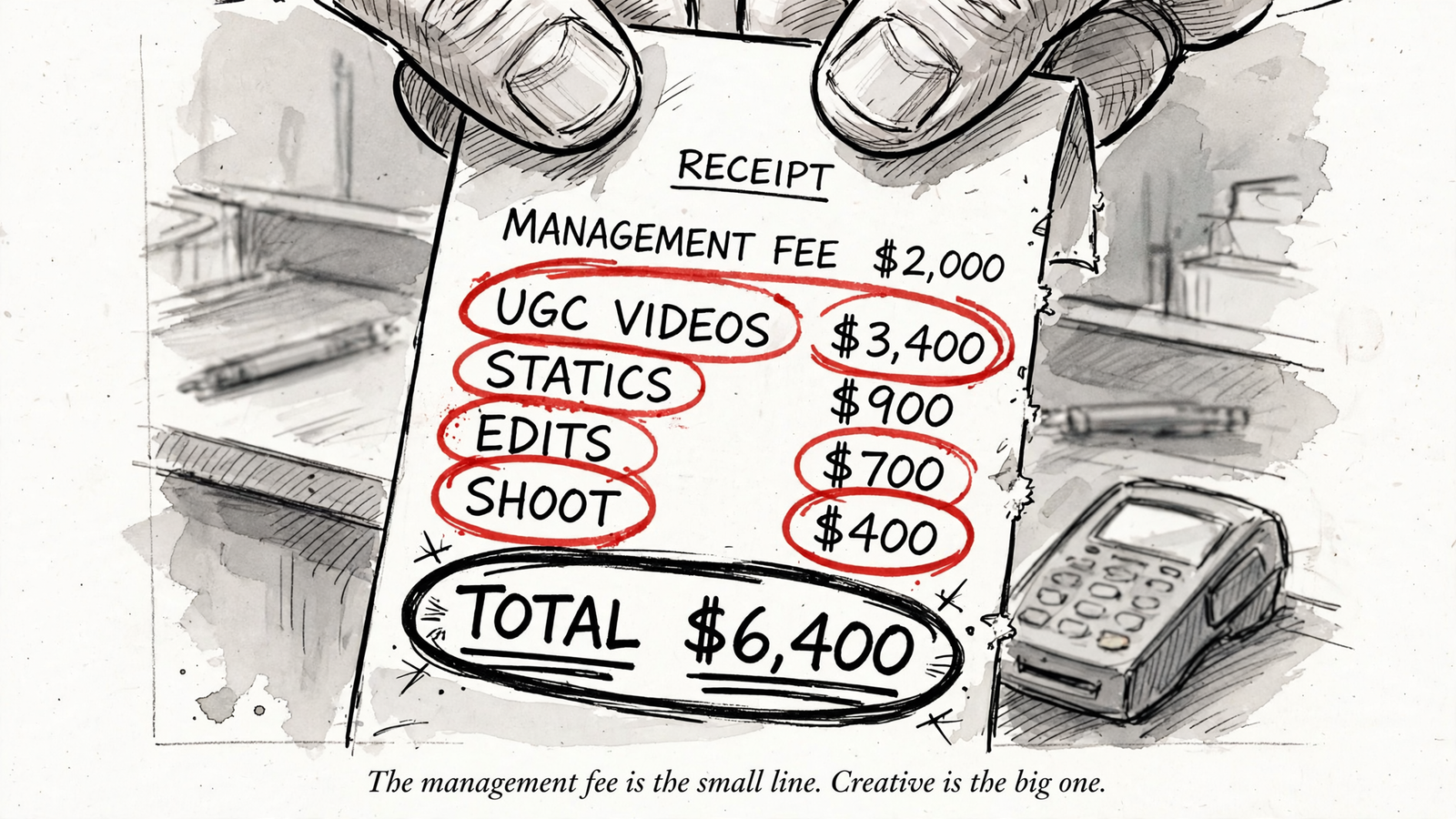
Most Meta proposals put the management fee in big type and leave creative marked extra or client to supply. For an ecommerce store buying a steady stream of new ads, that blank line can cost more than the fee.
Here is the total before the sales pitch: the 20-ad monthly basket below adds up to roughly $1,200 to $4,700 assembled yourself, or $4,000 to $10,200 bought piecemeal at the agency-extra rates shown. Those are production-and-tool ranges from the line items, not media spend or management fees. Your review time sits on top. If someone offers a $1,200 management fee and leaves production open-ended, compare the total before calling it cheap.
I am pricing a planning basket for a store spending $5k to $15k a month on Meta: 7 short UGC videos, 9 statics and carousels, 4 hook or format variants, and a product shoot spread across the quarter. That is a comparison device, not a claim that every store needs exactly 20 new ads. Beginner creators quote $150 to $300 per video before usage rights; reported DTC testing rates run $150 to $350 per UGC video, rising to $300 to $700 with paid usage. The rights and the edits matter as much as the shoot. Vendors know that. Their first-page fee does not always show it.
Price the 20 ads, not the management retainer
Say you spend $5k on media and pay a 20% management fee with a $2,000 minimum. The fee is $2,000. Buy creative separately at the agency-extra rates in the table, and the combined bill starts around $6,000 before media, pass-through tools or your time. I used to tell clients the fee was the decision. I was wrong. The management fee pays for account work; the creative line pays for the material that work needs to test.
Meta can keep spending on tired ads. That is not the same as keeping them effective. One creative-fatigue guide puts cold-prospecting warning signs around 2 to 2.5 frequency on a 7-day view and describes declines after 3 to 4. It suggests 2 to 4 fresh variants a month below $10k in spend, while higher-spend concepts may last 2 to 6 weeks. Those are reasons to plan a refresh cadence, not a universal order for 20 ads.
My 20-ad basket is deliberately more substantial than the minimum refresh. It gives you distinct videos and designs, plus variants you can cut from work that already exists. Ask what a quoted “new ad” actually is. A fresh concept, a new hook and a resize should not all carry the same price merely because they each produce a file.
The monthly basket, line by line
I use the same 20 deliverables across quotes: 7 creator videos, 9 statics or carousels, and 4 hook or format variants. A quarterly product shoot supplies a bank of material behind them. The shoot is not a twenty-first ad. The table shows monthly planning costs, with that shoot averaged over three months; the shoot invoice itself arrives when you book it. The last row records your time separately because hours are not a vendor price.
| Line item | What you are buying | DIY plus tools | Agency billed as extra | What moves the price |
|---|---|---|---|---|
| UGC videos (7) | Creator-shot video; confirm paid-use rights separately | $693 to $2,450, from Billo’s $99-per-video starting price, including creator pay to reported $150–$350 testing rates | $2,100 to $4,900 at reported $300–$700 rates with paid usage; an agency pricing guide lists UGC acquisition at $1,500–$5,000 a month | Creator, usage rights and length of use; one pricing guide describes 50% extra for 30 days and 100% for 90 days |
| Statics and carousels (9) | Concepts, copy lockups and cards | $135 to $540 at listed freelance design rates of $15–$60 each | $450 to $1,800 at listed agency concept rates of $50–$200 each; another guide puts monthly design at $500–$2,000 | Original concept versus adaptation of an existing design |
| Edits, hooks and resizes (4-plus) | New hooks, captions and format cuts | $120 to $800, using $30–$60 per finished ad and a $200 captioned-edit price as reference points | $600 to $1,500 as a budgeted slice of video-project pricing listed at $2,000–$10,000 | Number of cuts and revision rounds; a $998-a-month offer lists 15–25 videos with unlimited revisions |
| Product shoot refresh | New product and lifestyle material, booked quarterly | $200 to $600 a month when amortized; listed basic images cost $25–$75 and standard images $50–$200 | $800 to $2,000 a month when amortized; lifestyle images, a $1,500-plus model day and $150–$300-an-hour studio time are possible cost drivers | Packshot versus on-model; studio versus natural light |
| Tools and subscriptions | Design, editing and reporting | $65 to $300; Canva Pro and Adobe prices and creative and analytics stack ranges provide reference points | Confirm whether tools are included or passed through; Madgicx lists $45 a month below $1k in spend and higher $129–$649 bands | Seats, software mix and spend-banded pricing |
| Revision rounds and your review | Approvals, comments and file handling | Budget 6 to 10 hours of your time | Budget 3 to 5 hours of your time, and check for change-order fees | Brief quality, approval speed and what the contract calls a revision |

The ranges are not a promise that every item can be bought at its lowest listed price simultaneously. In particular, a low starting video price does not establish that the paid-use rights you need are included. Ask for the rights term in writing. That single question can turn an attractive per-video quote into a useful quote.
Add your hours without charging yourself twice
Revision rounds are where the spreadsheet gets smug. The invoice says two rounds included. You still consolidate comments, check exports, approve usage and rewatch the same hook because the logo safe zone is wrong. A guide estimates 15 to 25 hours a week for DIY Meta management once creative handling is counted. That is broader account work, not 15 to 25 hours for the review row alone.
For this basket, price the 6 to 10 review hours at whatever you use for your own ops time. At $75 an hour, even six hours adds $450 that no vendor put on its invoice. If you choose DIY, do not add the table’s tool row again when you total the bill. It is already there. What remains outside the table is management work, your time and the media budget.
Three checkouts at $5k and $15k in media spend
Run the basket through three ways of buying it. Keep media spend separate: the comparison is what you pay to manage and make the ads, in addition to the amount Meta spends.
- DIY production plus tools: The table adds up to about $1,200 to $4,700 a month when the quarterly shoot is amortized. Add your review hours and the time spent managing the account. A low software bill does not make the production hours disappear.
- Percent-fee agency with creative extra: A pricing guide lists management at 15% to 25% of spend, often with $2,000 to $5,000 minimums. At $5k in spend, a $2,000 minimum plus the table’s roughly $4,000 to $10,200 agency-extra production range puts the combined bill around $6,000 to $12,200, before pass-through tools and your time. At $15k, a 15% to 25% fee is $2,250 to $3,750 before minimums; with that same production range, the combined figure is about $6,250 to $13,950. A higher minimum or tool charge raises it further.
- Flat management fee: groas lists Meta Ads at $1,499 a month, with new ads tested and winners scaled. That makes its stated management fee easier to budget than a percent-of-spend fee. Do not mistake “new ads tested” for a quoted price to produce this entire 20-ad basket. Ask what production, creator sourcing, edits and usage rights your agreement includes, then add anything you must supply or buy separately.
That last distinction is the point, not a footnote. The draft version of this comparison could have called a $1,499 management fee an all-in 20-ad production price. It would have made a lovely chart and a bad purchasing decision. I would rather put groas ahead on the comparison I can actually make: a stated flat management price versus a fee that rises with spend, with the creative scope exposed instead of hidden. I break out the management models further in percent-fee agency versus flat-fee versus DIY tool at $5k a month.
Takeaway: a proposal that does not name who shoots, who edits, how many concepts you receive and who pays for usage is not a lower price. It is an unfinished total.
The hidden costs: rights, queues and tired ads
The invoice is only part of the cost. Start with rights. Paying a creator to make a video and paying to use that video in ads may be different charges. If the quote says usage extra, ask for the term, channels and price before calculating a per-video rate. The 30-day and 90-day uplifts cited above show why an omitted rights line can matter. They are a prompt to check the contract, not a surcharge to add automatically to every video in the table.
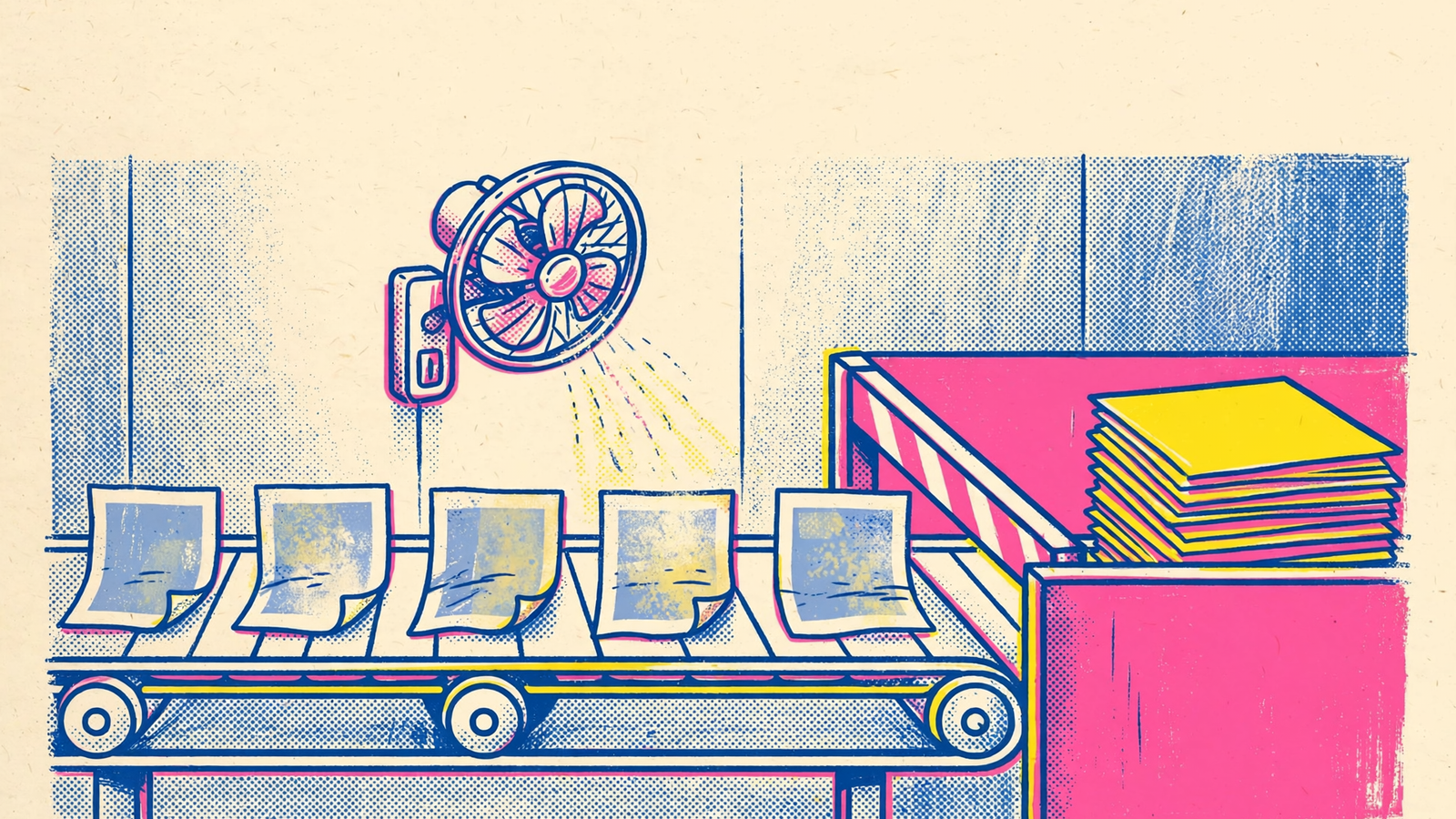
Then check turnaround. Stale creative does not pause media spend while the next cut waits for approval. The account keeps delivering; the prospecting hook may simply work less well. The fatigue guidance on frequency gives you a reason to watch for that, but it cannot tell you that a fixed percentage of your spend is wasted. I would not put an invented fatigue-tax number on a quote.
A 10-day revision queue is still a cost, even without a neat percentage beside it. The replacement ad sits in comments while the current ad continues to run. A freelancer quoting $30 per finished ad can be the right buy; three rounds of fixes and a slow handoff can make that price beside the point. Judge the process on days from brief to live, not just dollars per asset.
The product shoot is a different kind of trap. The table spreads one quarterly shoot across three months to make proposals comparable. Cash does not arrive in tidy monthly slices. If the photographer, studio or model requires payment when the shoot happens, budget for that one-off bill as well as its monthly planning cost. Do not add the full shoot invoice and its amortized amount to the same quarter’s total; that would count it twice.
Run this formula before you sign
True monthly planning cost = management fee + creative production + tools not already counted + your hours at your ops rate. Keep media spend beside that figure, not buried inside it. For a quarterly shoot, use one-third of its cost in the monthly comparison and keep the payment date visible in your cash plan.
I use four questions to fill the blanks in a proposal:
- How many new concepts, videos and adaptations arrive each month? Get the deliverables, not a promise of “ongoing creative.”
- Who shoots, edits and approves them? If the answer is client to supply, price the work you will supply.
- What paid usage is included, and for how long? Do not assume the creator’s production fee buys every right.
- How many days pass from brief to live, and how many revision rounds are included? A low asset price cannot fix a queue you did not plan for.
A note if you arrived here while shopping for a Madgicx alternative: I get the instinct. Tool fees are visible, so they are easy to compare. An alternatives list quotes Ryze AI at $89 a month, Birch at $49 for Essential with rules requiring its $99 Pro tier, and Optmyzr from around $208. Compare those prices if the software matters to your workflow. Just do not confuse a cheaper dashboard with a cheaper video shoot. The tool does not automatically pay the creator, secure usage or clear the edit queue.
The flat-management route will not fit everyone. If you already employ a creator who shoots frequently and an editor who turns cuts around quickly, you may have covered the biggest production line with salary. Keep that machine and compare management on its own merits. For everyone else, the creative scope belongs beside the fee in the first conversation, not in the change order after you sign.
The cheapest mistake is haggling $300 off the management fee while leaving creative open-ended. You can win that negotiation and still buy a much larger production bill. The most expensive mistake is staying on tired ads because the replacement work is stuck in a queue: the spend continues while the refresh does not. Buy the total, not the fee.