

I used to report ROAS to ecommerce clients as if it meant profit. It doesn’t. A 400% ROAS can lose money, and a $15 CPA can leave money in the till. The difference is not which number looks better in a dashboard. It is what the sale costs you and whether the customer buys again.
Get that part wrong and Google will optimize toward the target you gave it, not the profit you meant to ask for. That was my mistake for longer than I care to admit.
Belief 1: “I just need to choose which number to track”
It is a tempting first question. CPA tells you what you paid for one conversion. ROAS tells you how many dollars of revenue came back for each dollar of ad spend. Pick the one that matches your business, set a target, move on. Clean enough for a slide.
But neither number answers the question an owner is usually asking: Did we keep any money? As Tinuiti’s comparison puts it, CPA does not tell you whether a conversion was worth $20 or $200, while ROAS stops at revenue rather than production cost. One tells you the price of the conversion. The other tells you a revenue multiple.
The missing number is margin. Breakeven ROAS = 1 / gross margin. At 25% margin, you need 4:1 ROAS to cover the sale and its ad spend. At 60% margin, breakeven is about 1.67:1. The same 400% ROAS that merely breaks even for one business leaves room for profit in the other. No bidding setting changes that arithmetic.
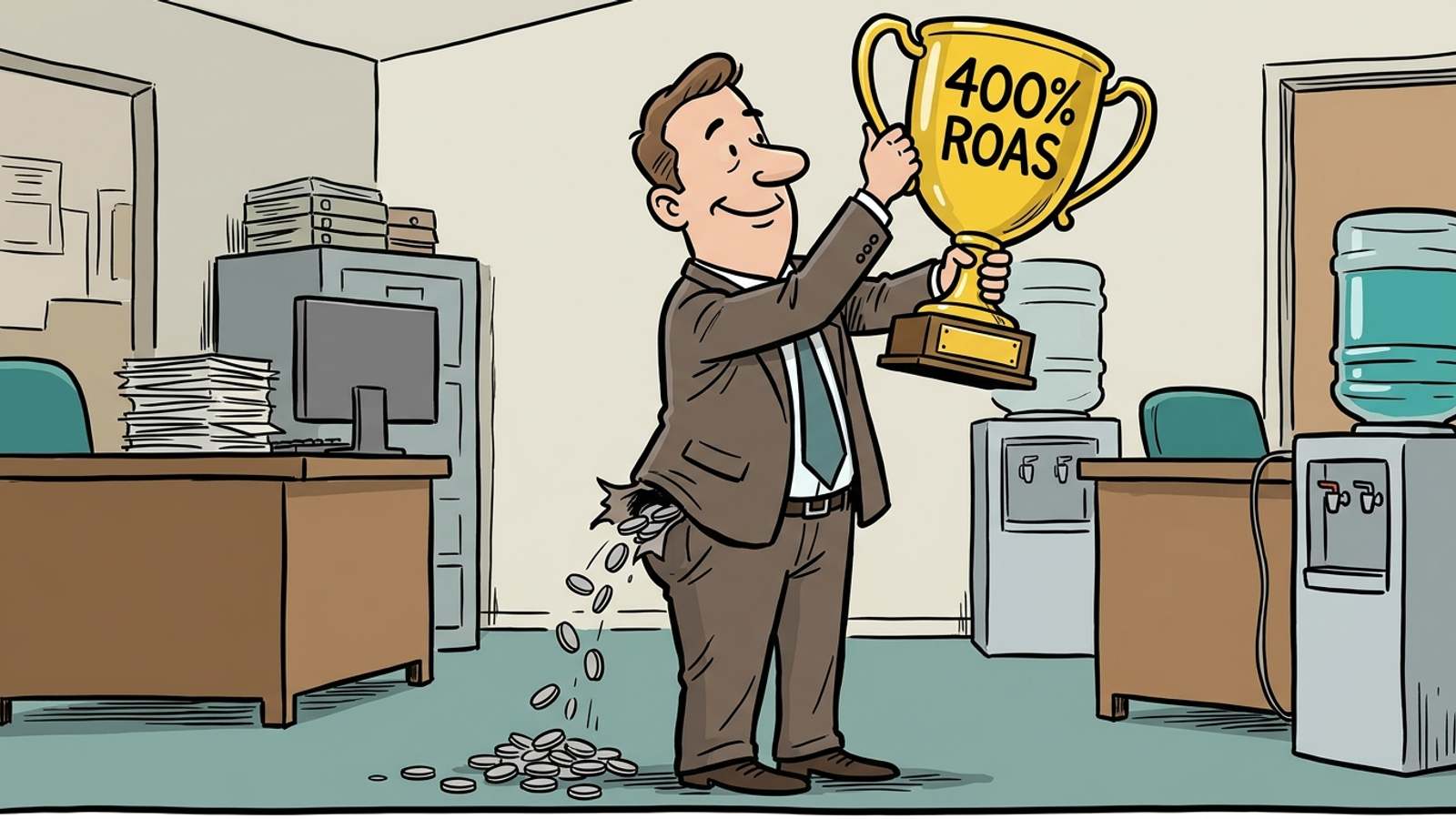
I spent years treating CPA versus ROAS like a settings preference: CPA for leads, ROAS for carts. That shortcut hides the only question worth settling first. Before you choose a metric, work out what a conversion is worth after its costs. The five beliefs below show where skipping that step gets expensive.
Belief 2: “A 300% ROAS means I’m making money”
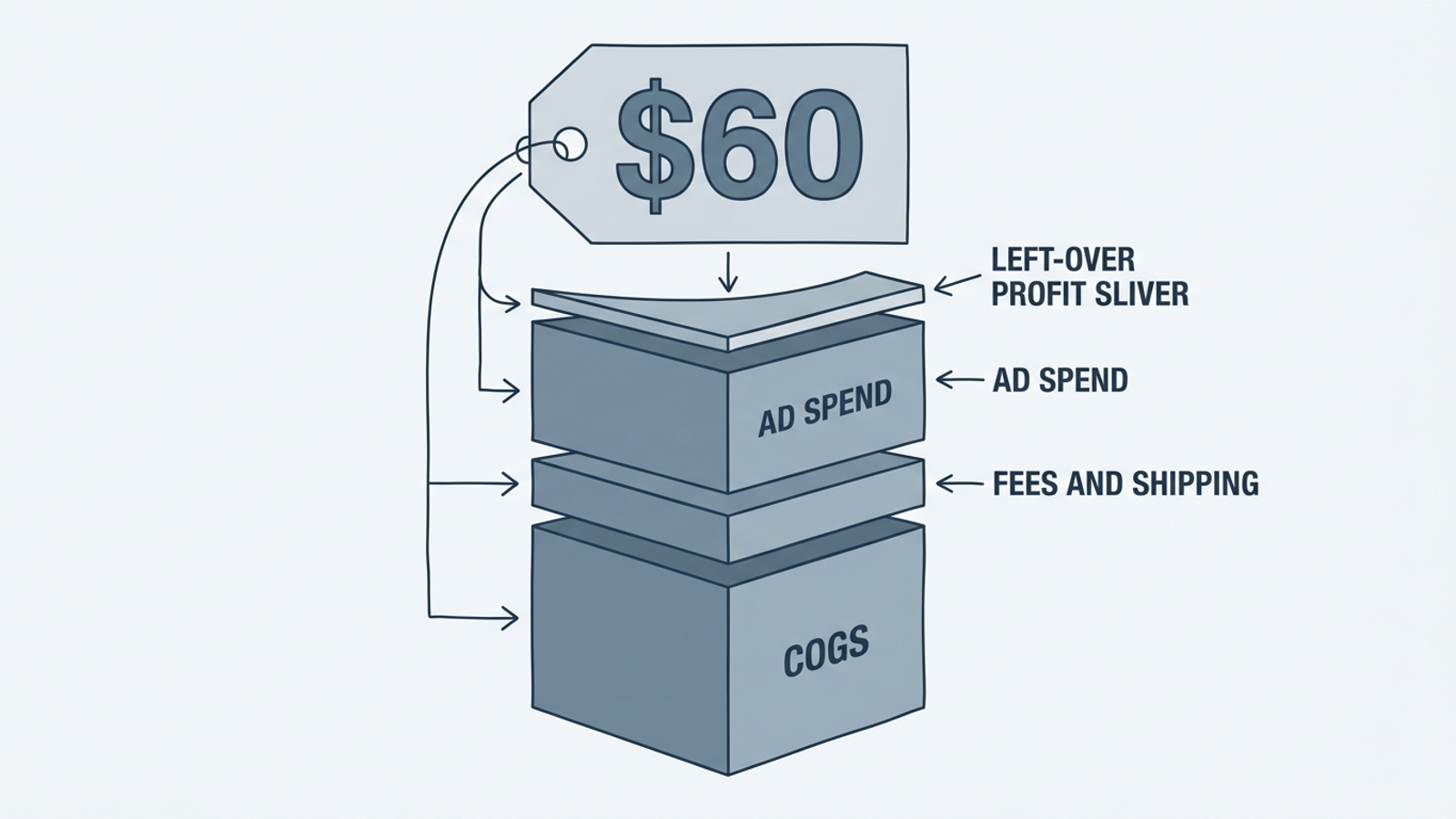
ROAS looks like profit dressed up as a percentage. Say you sell a $60 product and keep 35% after product cost, fees and shipping. That is $21 per order before ads. Breakeven is 1 divided by that margin: 1 / 0.35 = 2.86x, or about 286% ROAS.
At 300% ROAS, you spent $1,000 to make $3,000 in revenue. That buys you 50 orders, or $1,050 in margin before ads. Subtract the $1,000 ad bill and you have $50 left before overhead. The dashboard says three-to-one. The business says there is barely room to breathe. I go deeper on the distinction in why ROAS is the wrong success metric for most accounts, but that $50 is the part to remember.
The margin you use matters just as much as the formula. A headline gross margin can leave out returns, shipping both ways, payment fees and discounts. A fashion retailer at 40% gross margin with a 25% return rate can end up in the low 30s once those costs land. Breakeven moves from 250% to around 333%. Same ROAS on screen; different result in the bank account. At the extreme, a skincare bestseller doing 600% ROAS on 10% margin has little room left for its other costs.
Use effective margin, not the most flattering margin in the store report, to calculate breakeven before you open Google Ads. Otherwise a green ROAS number can keep you buying orders you cannot afford.
Belief 3: “CPA is for lead gen, ROAS is for ecommerce”
I used to sort clients that way. It is easy to teach and often wrong. What matters is whether conversions have roughly the same value, not whether someone fills in a form or checks out a cart.
Take a store selling one $60 product at a 35% effective margin. Each order contributes $21 before ads. A $15 CPA on that product is a 400% ROAS. It is the same sale and the same spend under two labels: $60 of revenue divided by $15 of ad cost, or $15 of cost for one order. Fixed order value makes the metrics move together.
CPA is especially useful here because it makes the decision plain. If you keep $21 per order and want $6 left after ads, your CPA ceiling is $15. A $20 CPA might still produce a respectable-looking 300% ROAS, but it leaves only $1 before overhead. ROAS has not told you anything false. It has just answered a less useful question.
That does not make CPA the universal ecommerce metric. Change the order value or margin from one basket to the next and a single CPA ceiling becomes less informative. For a fixed-price sale, though, use the number that shows how much of your $21 you spent to get the order. Do not choose ROAS merely because there is a shopping cart.
Belief 4: “Higher ROAS is always better”
This is the most costly belief of the five. A high target can make a campaign look more efficient by making it smaller. Smart Bidding can respond to an unrealistic ROAS target by retreating to the auctions most likely to meet it. Sales that would have made money, but not cleared the demanded ratio, get left behind. The report improves while the total profit opportunity shrinks.
Here is the arithmetic I would do before choosing a target: achievable ROAS = conversion rate × average order value / cost per click. At an $0.80 CPC, a 2% conversion rate and a $120 average order, a click produces $2.40 in expected revenue. Divide by $0.80 and you get 300% ROAS. Asking for 500% does not make those clicks worth more. It asks the bidder to find a narrower set of clicks.
This is not an argument for buying every sale at any price. The lower ratio must still clear the margin test, and you still need to watch what happens to total profit. But refusing a profitable order because it would lower a percentage is not discipline. It is polishing the trophy while the shop gets quieter. In the account that grew revenue 40% by accepting a lower ROAS, the prettier ratio was not the useful goal.
Set a target from what the traffic can achieve and what your margin can support, then judge it against money made, not the height of the multiple.

Belief 5: “CPA and ROAS are two views of the same thing”
With one product at one price, often they are. A real catalog breaks the neat relationship. One order can be large and thin-margin; another can be smaller and profitable. CPA counts each as a conversion. Revenue-based ROAS favors the larger order without knowing which one leaves more behind.
Revenue-only bidding cannot distinguish a $200 order at 60% margin from a $200 order at 5% margin. Discounts and refunds make that gap worse when the conversion value does not reflect them. The useful check is POAS = gross profit / ad spend, with that profit figure accounting for product cost, shipping, fees, discounts and refunds. Two campaigns can show identical 400% ROAS and very different profit on the orders they brought in. One funds growth. The other funds the warehouse.
Then repeat purchase complicates the first-order read. A low-CPA brand-search customer who cancels after one month can be worth eight times less than a higher-CPA generic-search customer who stays eight months. The cheaper conversion may be the expensive one. ROAS has its own blind spot here: retargeting and branded search can look strong even when some of those buyers would have returned through organic search.
Do not solve this by swapping one magic number for another. When basket size, margin, returns or repeat rate vary, separate those orders in your thinking and follow the profit. A blended CPA or ROAS can hide the very difference you need to manage.
Belief 6: “I can pick one metric and forget the other”
One number makes a tidy report. Pick CPA for the lead-gen client, ROAS for the store, add a green arrow and finish the slide. The cost is the question that gets left off it.
CPA holds the line on acquisition cost but hides conversion value. ROAS reports revenue against spend but hides the cost of producing that revenue. Target ROAS optimizes toward conversion value at a target return. If the values you send do not account for margin, the bidder can do exactly what you asked and still buy unprofitable orders.
I use three checks rather than asking one metric to do three jobs:
- CPA: Cost / conversions. Compare it with a ceiling based on margin or lifetime value.
- ROAS: Revenue / ad cost. Compare it with breakeven based on effective margin.
- Profit: Gross profit from those conversions / ad cost. Check what remains after the sale costs and the ads are paid for.
Say you spend $1,000 for 40 orders at a $100 average value. CPA is $25 and ROAS is 400%. Those numbers look comfortable until you learn that half the orders were for a 12% margin accessory with a 20% return rate. You cannot tell from the blended CPA and ROAS alone how much you kept. You need the order mix and its costs before you call that campaign a win.
Track one to manage; read both to stay honest. When it is time to turn the decision into a bid target, the setup logic in Target ROAS vs Target CPA is more useful than choosing whichever metric makes the slide look healthier.
What I told clients, and what I tell them now
For years I put the ROAS number up front as if it settled the profit question. I should have asked about margin first. Part of the temptation is that a revenue multiple is easy to show and pleasant to hear. Profit takes a less glamorous conversation about returns, discounts and what an order actually costs. There is also an incentive problem: if you bill a percentage of spend, the number that makes more spending look good is awfully convenient.
What I tell an owner now is duller and more useful: send me effective margin and repeat rate before I set a CPA or ROAS target. Without them, I can describe what the ads recorded, but I cannot tell you what acquisition should cost. A target chosen without that context is a guess with good formatting.

Before you set a target, do the breakeven math
Do this on paper before you touch a bid setting. The order matters:
- Find effective margin. Start with revenue, subtract product cost, shipping both ways, fees, discounts and expected returns, then divide what remains by revenue. If a $60 sale leaves $21 before ads, its margin is 35%.
- Find breakeven ROAS. Divide 1 by 0.35. You get about 2.86x, or 286%. Below that, the first order loses money after ad spend.
- Set a CPA ceiling. If you want $6 left from that $21 after paying for the ad, the ceiling is $15. Paying more is a deliberate bet on future orders, not a first-order win.
That last distinction matters. A customer who buys again may justify a higher initial CPA. But you need enough repeat profit, and enough cash to wait for it, before you spend money you have not earned yet. Margin first, target second. The dashboard can wait.
The belief I’m still arguing with myself about: “I should just bid to lifetime value”
The logic is clean. If a $60 buyer makes three purchases over twelve months at the same margin, the $21 available before ads on the first order becomes $63 across those purchases. A $25 CPA that loses money on order one can make sense over the year. When repeat data is solid, I can make that case without pretending the first sale was profitable.
What keeps me cautious is cash and proof. You pay the $25 today and collect the later margin over time. That can hurt if you spend $20k a month and payroll hits Friday. And a store’s blended repeat rate is not necessarily the repeat rate of customers from the campaign you are bidding on. Brand-search loyalists and cold prospecting buyers can sit in the same store report while behaving very differently.
Until I can see repeat profit by acquisition source, I would bid to first-order breakeven and treat repeat purchase as upside. That may leave growth on the table. Bidding to an unproven lifetime value may spend cash the business cannot get back. It is the one belief here I have not settled, because guessing wrong costs real money either way.
Frequently asked questions
How do I calculate breakeven ROAS?
Breakeven ROAS = 1 / gross margin. At a 25% margin you need 4:1 ROAS to cover the sale and its ad spend, while at a 60% margin breakeven is about 1.67:1. The same 400% ROAS can break even for one business and leave room for profit in the other.
Should I use gross margin from my store report to work out breakeven ROAS?
Use effective margin instead. A headline gross margin can leave out returns, shipping both ways, payment fees and discounts, so a fashion retailer at 40% gross margin with a 25% return rate can end up in the low 30s. Breakeven then moves from 250% to around 333%, meaning the same ROAS number gives a different result in the bank account.
Can a 300% ROAS still leave you barely making money?
Yes. At 300% ROAS, spending $1,000 brings in $3,000 of revenue. On a product with a 35% margin that buys 50 orders and $1,050 in margin before ads, and after the $1,000 ad bill only $50 remains before overhead. The dashboard shows three-to-one, but the business barely breathes.
Is CPA only for lead generation and ROAS only for ecommerce?
No. What matters is whether conversions have roughly the same value, not whether someone fills in a form or checks out a cart. For a fixed-price sale, a $15 CPA on a $60 product is a 400% ROAS, and CPA makes the margin decision plain. When order values or margins vary across the catalog, a single CPA ceiling becomes less informative.
Why can asking for a higher ROAS target actually reduce profit?
A high target can make a campaign look more efficient by making it smaller. Smart Bidding can retreat to the auctions most likely to meet the demanded ratio, leaving behind profitable sales that do not clear it. The report improves while the total profit opportunity shrinks.
How do I know what ROAS target my traffic can actually achieve?
Use achievable ROAS = conversion rate × average order value / cost per click. At an $0.80 CPC, a 2% conversion rate and a $120 average order, a click produces $2.40 in expected revenue, which is 300% ROAS. Asking for 500% does not make the clicks worth more; it asks the bidder to find a narrower set of clicks.
Why can two campaigns with identical 400% ROAS have very different profit?
Revenue-based ROAS counts conversion value without knowing the margin behind it. A $200 order at 60% margin and a $200 order at 5% margin look identical, and discounts or refunds that are not reflected in conversion value make the gap worse. POAS, which is gross profit divided by ad spend, accounts for product cost, shipping, fees, discounts and refunds.
Can I just pick one metric, CPA or ROAS, and ignore the other?
No. CPA hides conversion value and ROAS hides the cost of producing the revenue, so a blended number can hide how much you actually kept. Use three checks: CPA against a margin- or lifetime-value-based ceiling, ROAS against breakeven based on effective margin, and gross profit per ad dollar after the sale costs and ads are paid.