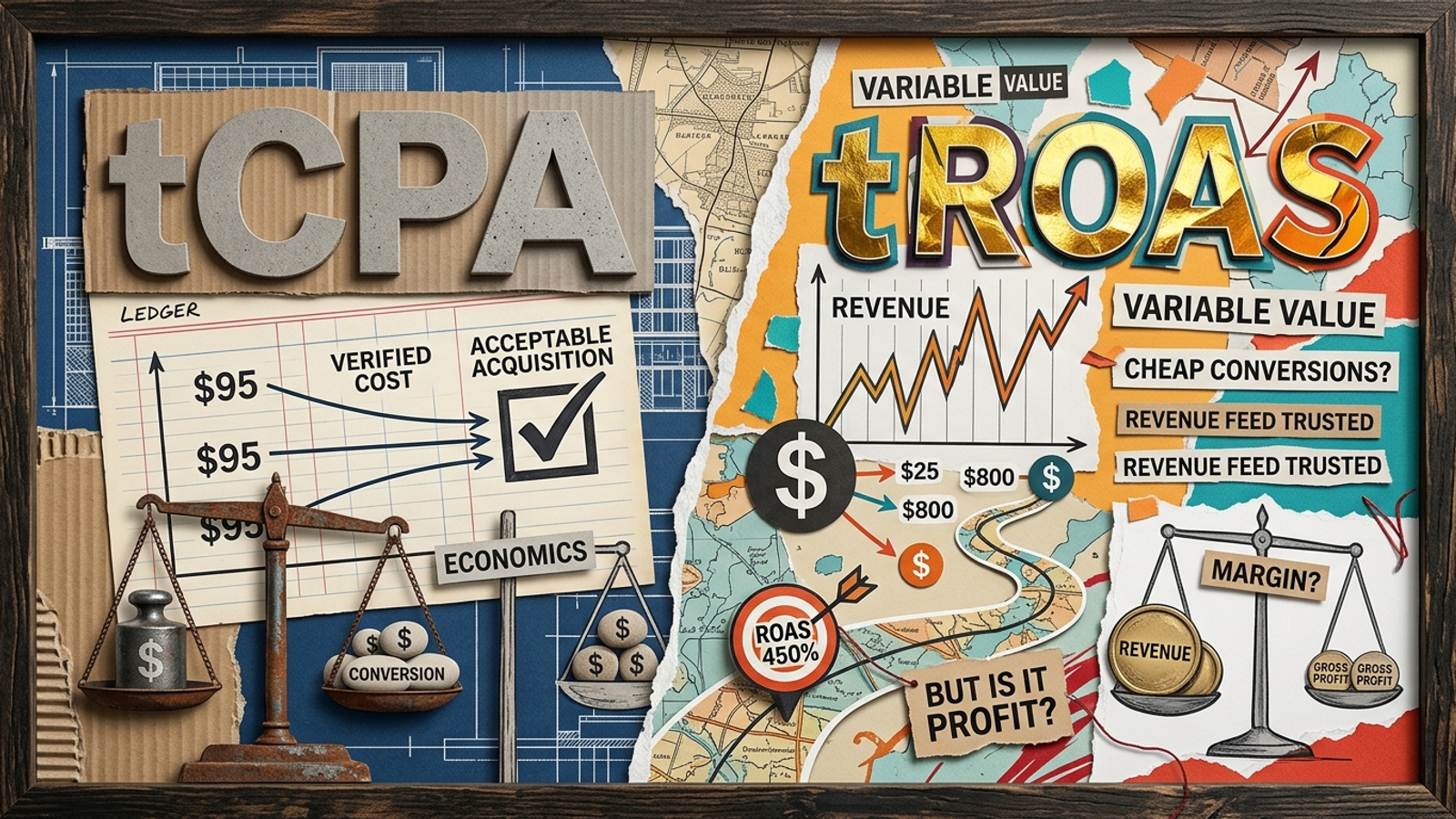
The fight is over what a conversion is worth
An account manager sees a Google Ads campaign plateau and reaches for the bid-goal toggle. Should the campaign aim for a target cost per acquisition, or bid toward a target return on ad spend? Smart operators disagree because they are protecting different things: CPA protects the cost of each acquisition; ROAS protects the revenue returned by each ad dollar. Neither protection is worth much if it ignores how the business makes money.
Picture the argument. The CPA advocate points to an ecommerce cart containing three $400 leather jackets instead of one $35 belt: why pay roughly the same to win both? The ROAS advocate points to a 450% return that came with half the previous quarter’s order volume while fixed warehouse overhead kept running. One sees money left on the table. The other sees an impressive percentage and a cash problem. They flip the toggle, watch volume fall during the adjustment, and eventually flip it back.
I think most accounts arrive at a bid goal by habit, not economics. In 2026, Google brought back separate Target CPA and Target ROAS naming. The clearer labels do not make the commercial choice for you. A bid goal tells the system which outcomes to value as it enters auctions. If the instruction is wrong, tidying up bids every Tuesday will not rescue it. First, each side deserves its strongest case.
The case for CPA: buy a predictable unit of growth
The best argument for Target CPA is operational discipline. Tell Google Ads you aim to acquire a customer or lead at $45, and the system can bid around the likelihood of that conversion. The instruction is legible: bring in conversions at an average cost the business can carry. It does not also have to predict whether a buyer has one item or three in a cart, or whether a prospect will eventually sign a $10,000 contract rather than a $50,000 one.

That simplicity is useful when outcomes are genuinely similar. If nearly every order is a $30 phone case, giving each order a different predicted value adds little to the decision. The same applies to a flat-price subscription. The case laid out by TNT Growth turns on this point: when transaction values barely differ, conversion value is not giving the bidder much extra information. When each sale is worth roughly the same amount, controlling acquisition cost is the cleaner instruction.
It can also be the more workable instruction for a campaign with limited conversion data. A common operating range for Target CPA is 15 to 30 conversions a month; value-based bidding generally needs more observations to estimate both whether someone will convert and what that conversion will be worth. Those figures are planning guides, not permission to ignore a weak signal. If a $15,000-to-$30,000 monthly budget is spread across several campaigns, the relevant question is how much usable data each campaign collects, not how impressive the total spend looks on a slide.
Lead generation makes the CPA case sharper. A form fill can arrive today; a closed deal may take much longer to appear in the ad account. Some teams try to bridge that gap by assigning $50 to a form, $150 to a demo request, and $300 to a call. If those numbers are guesses rather than values tied to what becomes pipeline or revenue, the bidder optimizes the guesses. Operators in r/PPC discussions about lead-gen bidding describe budgets disappearing into supposedly valuable leads that never justify their cost.
For a lead-gen business with uneven deal sizes but no dependable way to send those deal values back, I would rather set a CPA target against a conversion I can inspect than ask ROAS to believe a price tag pasted onto a form. That is not an argument that every lead is equally good. It is an argument against pretending the account knows which lead will close. If the value signal is invented, do not make it the bid goal.
The case for ROAS: stop treating every basket as equal
Now give Target ROAS its strongest possible account. You sell $14 replacement gaskets and $2,400 commercial espresso stations. A blended $40 acquisition target tells the bidder to value a conversion, not the size of the transaction behind it. It may spend too much to win a small accessory order while remaining too restrained in an auction for a commercial buyer. A target CPA is an average cost goal, not a literal $40 ceiling on every click, but the underlying problem stands: the bidder cannot favor a larger basket on value it has not been told to use.

When order values differ sharply, Target ROAS has information CPA leaves out. With dynamic transaction values from checkout, it can weigh the chance of a sale alongside the revenue that sale might produce. That lets the business bid differently for searches likely to end in a substantial cart and searches likely to end in a small accessory purchase. It is a better match for a catalog where a single acquisition-cost target conceals meaningful differences between orders. A practical bid-goal framework starts there: examine the spread in transaction values before choosing the target.
The ROAS case gets stronger for a margin-rich merchant whose higher-value orders are also worth pursuing after costs. In that situation, more revenue from the same spend is not a vanity metric; it points the bidding system toward the orders that can carry growth. The point is not that every expensive product deserves an expensive click. It is that a merchant with reliable checkout values should not ask the algorithm to treat a belt and three jackets as interchangeable conversions.
ROAS operators also have to give the system room to spend when they switch targets. Set an ambitious return target immediately and the campaign may pass over too many auctions to collect useful conversion data. A Shopify Plus scaling framework describes starting around 15% below a suggested historical target, such as 280% rather than 330%, then raising it in 10% to 15% increments every two weeks as conversion volume settles. Those are an example of a measured launch, not numbers I would paste into every account. The useful principle is simpler: a return target that prevents the campaign from participating cannot deliver much return.
The rebuttal: each goal can win the dashboard and lose the business
CPA’s blind spot is not its acquisition-cost math. It is what happens after the conversion. Apply a $40 target across a store with uneven prices and margins, and Google Ads can find the easiest orders under that average. Suppose it acquires a $25 accessory order for $25 and the product carries only $10 of gross margin. The dashboard can show a CPA below target while the order loses $15 before shipping and merchant fees. Cheap acquisition is not the same thing as profitable acquisition.
Lead generation has the same failure in a different costume. A campaign can produce $35 form fills from students, job seekers, and low-tier prospects, hit its CPA target, and send the sales team almost nothing it can accept. I would still choose CPA over made-up revenue values, but I would not let the form-fill count stand in for qualified pipeline. CPA only answers what an acquisition costs; you still have to establish what you acquired.
ROAS has the opposite problem. It measures revenue against ad spend, not profit after product costs, returns, shipping, and fulfillment. Channable’s discussion of profit on ad spend gets at the distinction. A $500 laptop with a 6% gross margin brings in $30 of gross profit. Spend $80 on the ad, and the order is $50 short before fulfillment, despite a return on ad spend above 600%. A $90 backpack with an 80% margin brings in $72 of gross profit; spend $20 to acquire that order, and $52 remains before other costs. The higher-revenue order is the worse deal.
Practitioners in r/PPC have described that kind of ROAS trap: an account can post a healthy blended return while its mix of small, low-margin orders eats cash. The concern is not that ROAS arithmetic is broken. It is that gross revenue can be the wrong value for a mixed-margin catalog. If the products earning the biggest sales figures contribute the least after costs, raising the ROAS target may make the report prettier without fixing the business.

Neither goal is a dial I would spin casually. Raising a CPA target from $30 to $40 does not reserve the extra $10 only for brand-new, incremental conversions. It changes how the bidder values auctions across the campaign, including auctions it was already winning. Discussions of Target CPA mechanics make the practical warning clear: more room to bid can raise the cost of existing volume as well as open up new volume. The same caution applies to chasing a ROAS number upward whenever a weekly report looks uncomfortable. Abrupt target changes can restrict participation and leave too few conversions for the bidder to find its footing. That is one way Smart Bidding loses conversion volume. Do not confuse changing the target with changing the economics underneath it.
My verdict: choose the number closest to profit
I take ROAS for the margin-rich merchant with materially different order values, dependable transaction tracking, and enough conversions for value-based bidding to work. I take CPA for the lead-gen business with uneven eventual deal values but no reliable way to pass those values back to Google Ads. That may sound counterintuitive: uneven values are the reason to consider ROAS in the first place. They are also the reason fabricated lead values are so dangerous.
The deciding consideration is which signal comes closest to the money the business actually keeps. I use three questions to find it:
- How different are the outcomes? If order or contract values barely vary, CPA gives the bidder a clear job without asking it to predict distinctions that will not change the result. If values differ substantially, ROAS has a stronger case.
- Can the account measure those differences credibly? Checkout transaction values are more useful than arbitrary lead scores. If margins range from 10% to 80% across products, gross revenue alone can also mislead; segment by margin tier or use a cautious CPA approach rather than trusting one blended ROAS target.
- Does each campaign have enough conversion data to use the signal? Treat roughly 15 to 30 monthly conversions for CPA and 50 for ROAS as prompts to examine stability, not hard eligibility rules. A thin campaign will struggle to learn much about cart value, however attractive the theory sounds.
I stopped treating this as a debate to settle on an agency call years ago. A media buyer can see ROAS dip below 300%, push the target to 380%, and spend the next call explaining why impression volume vanished. The target changed; the catalog, margins, and tracking did not. At groas, our autonomous growth engine is built to replace that periodic guesswork with continuous execution inside business guardrails, while a named strategist owns the commercial direction and accountability. Speed matters, but it cannot make the wrong objective right.
For the merchant whose larger carts also produce healthy margin, I choose ROAS and give the campaign room to collect evidence before tightening the target. For the lead-gen team still attaching guessed dollar values to forms, I choose CPA and judge those forms against qualified pipeline. If either business can improve the value signal, I revisit the choice. Until then, I pick the bid goal the balance sheet can defend, not the one the last agency left switched on.