

 LinkedIn

The fight: track AI mentions or fix the pages instead?
A small business can spend Friday checking whether ChatGPT, Gemini, and Google AI Overviews recommend it. Or it can spend Friday improving the page those engines might cite. Which is the better use of a limited marketing budget? Smart people disagree because both failures are real: you can work blind while competitors appear in buyer answers, or you can build a beautiful record of your absence and never fix it.
The monitoring camp says a cheap in-house tracker shows you where to act. The opposing camp calls that tracker the new impression-share report: a persuasive number that consumes hours without bringing in customers. I think both cases deserve their strongest hearing before the verdict. The deciding issue is not whether an AI engine mentions you. It is whether you are prepared to do anything about the answer this month.
Position A: Build a small monitor and stop guessing
The strongest case for monitoring starts with buyer questions. When someone asks an AI engine to recommend a vendor, the question is specific, commercial, and testable. A prospect might ask ChatGPT, “What tool helps businesses identify which prompts trigger brand mentions in AI?” Another might look for the “best family lawyer in Austin” in a Google AI Overview. You can check whether the answer names you, names a rival, or points elsewhere. That observation can tell you which content problem to investigate first.
A prompt list, a schedule, and a spreadsheet
You do not need a five-figure software contract to start. Practitioners managing fewer than twenty buyer prompts often use an incognito browser window, a recurring calendar reminder, and a Google Sheet. Pick the 15 to 25 questions with immediate purchase intent in your niche, such as “who handles enterprise SOC 2 compliance for fintech startups” or “best commercial HVAC repair in Denver.” Check them weekly across the AI surfaces your buyers use, then record the answer and its cited sources.
That manual version costs software budget but not time. If typing the same questions every week becomes the bottleneck, you can build a weekly AI brand monitor with Google Sheets and three APIs using a script or webhook to log results in a shared document. Start manually; automate the repetition only if the findings earn it.
For an automated setup, workflows built in n8n or Python can send each prompt through API calls three times at temperature 1 to capture response variance. A low-cost evaluator call at temperature 0 can then parse the answers into fields: whether your brand appeared, where it sat in a recommendation list, which rivals appeared, and which source URLs the answer cited. At the scale of a small prompt list, the draft’s estimate is under five dollars a month in raw API tokens. That is not a zero-cost script, and it does not include setup time. It is still a different proposition from paying for a large dashboard.

The failures a search report will not show
A conventional search report may show impressions for your category page. It will not necessarily show which third-party sources an AI answer used to describe you. A weekly check can reveal an outdated Reddit thread claiming your product lacks a feature you shipped eighteen months ago, or a rival appearing repeatedly alongside an ungated comparison page. You can then decide whether the response calls for a clearer feature page, a comparison, or no action at all.
This is Position A at its best. It does not promise that a mention equals a sale. It says you cannot diagnose an answer you never inspect. If twenty minutes a week exposes a fix your team can make, the spreadsheet has done its job. The practical takeaway: check a small set of buyer questions before deciding what to publish next.
Position B: Monitoring is the new vanity metric
The impression-share lesson
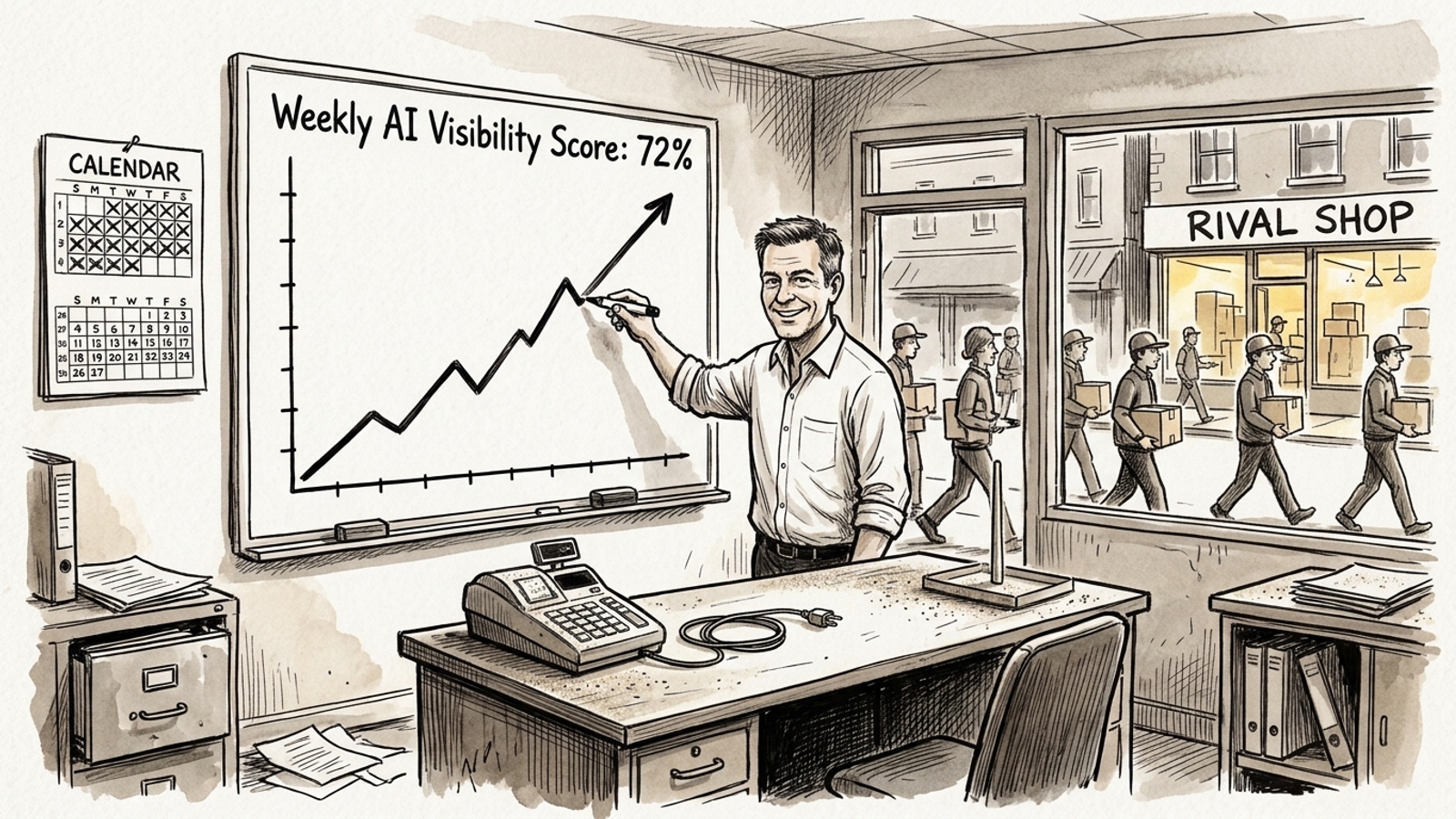
I spent years watching performance marketers pad client decks with Google Ads Search Impression Share. It looked authoritative. It had percentages. It gave everyone something to point at when conversions stalled. But you cannot deposit impression share at a bank. Position B says AI visibility tracking makes the same pitch with newer charts: it packages messy answers into a clean weekly score, then encourages you to manage the score.
The distinction matters. As practitioners analyzing AI search measurement point out, a citation on a tertiary definition does not necessarily drive pipeline. An engine naming you in a generic list of twelve vendors is not the same as recommending you to a ready-to-buy customer. Yet a tracker can count both as wins. A mention is not a business outcome.
One Tuesday check is not a ranking
A conventional search position gives a marketer a familiar, if imperfect, way to think about visibility. An AI answer is harder to pin down. Research on generative search measurement describes visibility as stochastic: response settings and changing retrieval candidates can produce different answers to the same question. A prompt check on Tuesday morning is one observation, not a permanent position.
The inputs can make a weekly score worse. Operators testing brand visibility across AI engines warn against branded prompts such as “Is Acme Corp trustworthy?” The model may echo the name you handed it. Strip those prompts out and the score can swing even when your website has not changed. Meanwhile, discussions of cross-engine source overlap put shared citations for identical queries across ChatGPT, Perplexity, Copilot, and Google at only 4% to 10%. A mention in one place does not automatically carry to another.
Position B’s point is not that every check is worthless. It is that a volatile sample becomes dangerous when you treat it like a stable KPI. If the number moves but nobody can tell you what changed or what to do next, stop reporting the number.
The invoice arrives before the content does
Commercial tools can turn this habit into a recurring cost. Pricing breakdowns across visibility tools list Otterly.AI at $29 a month for 15 prompts and Peec AI at $95 a month for 50 prompts, with key engines excluded from base plans. Scale the task to 100 buyer queries checked daily across ChatGPT, Perplexity, and Google AI Overviews, and you reach 9,000 engine checks a month. Tracking-platform pricing comparisons put tools serving that workload at $97 to $189 a month: roughly $1,200 to $2,300 a year before anyone spends an hour reading the results.
That software does not, by itself, write a comparison table, repair a site error, or publish a useful answer. A dashboard can tell you Perplexity omitted your company on ten commercial queries for three months straight. It cannot make the missing work happen. If you have five hours a week for organic search and spend three categorizing prompt variants, only two remain for the pages that might earn inclusion. You end up with a meticulous audit of your own absence.

Position B’s strongest instruction is blunt: do not buy measurement capacity before you have execution capacity. Fix the content first if the report will only tell you what you already know.
The rebuttals: where each position breaks
Position A can decay into an administrative hobby. I have seen teams spend weeks refining scrapers and spreadsheets, then leave the findings untouched because nobody has time to write the pages. A cheap monitor is not cheap when it absorbs the only person who could act on it.
Position B can become an excuse not to look. If you never inspect an AI answer, you may miss a crawler problem or a rival earning citations with a clear, ungated comparison. Publishing without checking the surface you hope to influence is not discipline either. One side risks measuring what it cannot change; the other risks building what it never verifies. That leaves one question to settle the debate: which prompts can lead to work now?
My verdict: track only what you can fix this month
After years managing performance accounts through platform changes, I would keep a monitor only for prompts I have the budget, team, and mandate to act on within thirty days. The ability to act this month is the deciding consideration. Everything else is noise, however interesting the chart looks.
Suppose you log twenty buyer prompts, find that ChatGPT omits you on seventeen, and already know your content schedule is full for the next two months. The tracker has confirmed a deficit you cannot address. That is not useful urgency; it is a recurring appointment with bad news. Put those prompts aside until you can assign someone the work.
Three questions before a prompt earns a row
I would make every candidate query pass this filter:
- Does it show commercial intent? Keep questions that suggest active evaluation or purchase, such as “alternatives to [competitor] for dental clinics” or “best commercial roofing contractor in Cleveland.” Drop definitions like “what is modified bitumen.”
- Can you make the relevant fix within four weeks? You need the ability to publish the missing information, improve a comparison, or address a technical problem. If the development queue is locked until next quarter, the prompt does not belong on this month’s list.
- Can you check what happens downstream? If the engine starts recommending you, you need a way to examine whether that connects to booked consultations, demos, or sales. Do not mistake a higher mention count for pipeline.
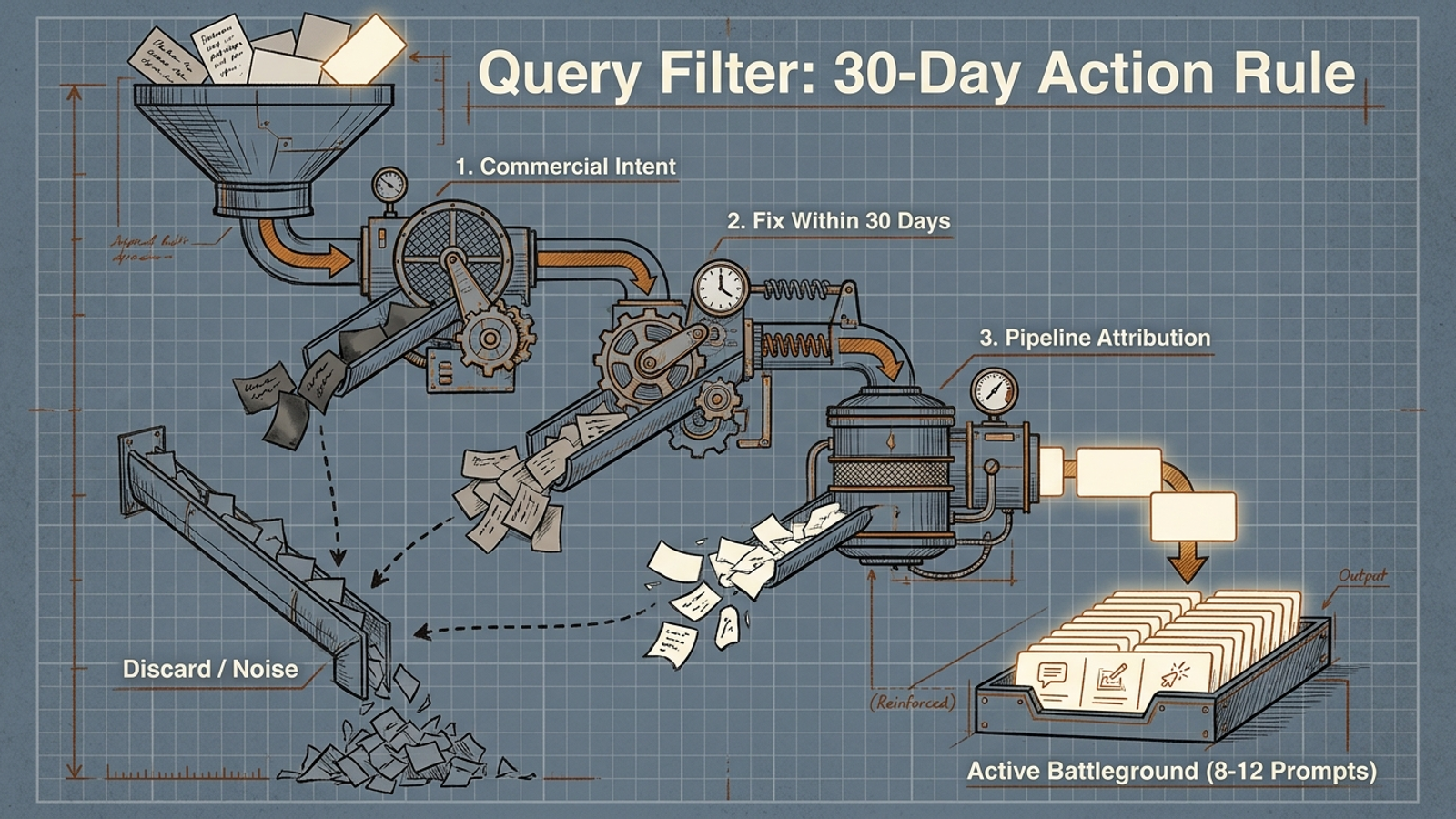
That filter can turn a backlog of 150 exploratory prompts into eight to twelve buyer questions worth watching. It also changes the workload. Instead of buying capacity for 9,000 monthly checks, you can run fifty focused checks manually or automate a small list at low cost. When an answer changes, inspect the cited sources and decide whether a page or technical fix belongs on this month’s schedule. Treat the finding like an operational trigger, not a trophy for a slide deck.
When the spreadsheet stops being the right tool
Manual tracking can stop being sensible when a business has more offerings and hundreds of commercial comparisons to cover across ChatGPT, Gemini, Perplexity, and AI Overviews. At that point, the owner’s time has a better use than checking prompts by hand. But before buying dedicated software, ask whether paying for AI prompt tracking alone solves the problem. A monthly list of missing citations still leaves the writing, technical work, and accountability with your team.
Traditional agencies may answer that problem with a retainer and a deck of recommendations. I would rather pay for work that gets executed. That is the case for groas: an autonomous growth engine for paid and organic search, with specialized AI models carrying out campaign, content, and optimization work continuously while a named human strategist sets direction and guardrails. Actions are logged, and the emphasis is on attributable revenue rather than a visibility score alone. The flat monthly fee, no setup fees, month-to-month cancellation, and 7-day money-back guarantee also make the commitment different from a bloated agency retainer.
For a small business with fewer than twenty high-intent prompts and the capacity to improve pages this month, I would start with a spreadsheet and a weekly check. If that footprint outgrows manual discipline, I would pay for execution rather than another report of missing citations. Monitor the prompts you will act on this month. Leave the rest off the sheet.