

 LinkedIn
Stop buying AEO software by the prompt. A cap charges your agency more for finding more of the questions buyers ask, then teaches your team to stop looking when it hits the limit.
I ran Google Ads accounts when agencies still defended percentage-of-spend fees. The pitch was that you paid more when you spent more. The effect was simpler: the agency earned more when you spent more, whether the extra spend helped you or not. Capped-prompt AEO plans put the same incentive in a new box. The vendor earns more as you expand coverage. Your margin shrinks as you do more of the job.
The popular advice sells the meter, not the work
Ask how to package AEO and you get a familiar answer: buy the plan with the most prompts, mark it up, send a monthly visibility report. The wholesale math makes the pitch look plausible. White-label AEO fulfillment runs about $800 to $3,500 per client per month. The older SEO version wholesaled at $400 to $750 for Entry and up to $4,000-plus for Growth, with resellers told to add 30 to 60% on top. Agency AEO retainers cluster at $3,000 to $15,000 per month.
I used to give the keyword version of this advice. Buy the tool with the biggest keyword limit, track more terms, charge for the report. I was wrong. The report was never the product. The limit decided how much of the job I was willing to do before the meter started running. Clients were paying for judgment and changes, not a longer list of tracked phrases.
If the unit you buy is the unit you sell, your vendor gets to shape your offer. Buy prompts and your proposals start talking about prompts. Buy work per domain and you can talk about what gets done on the client’s site. That is the choice hiding underneath the pricing page.
A prompt cap punishes better coverage
A buyer can ask the same underlying question dozens of ways across ChatGPT, AI Overviews, Perplexity and Claude. A serious baseline starts at 40 to 80 queries per client. That is before you expand into the questions you did not know to check at the start.
Now look at the plans. Otterly Lite offers 15 prompts for $29 a month; Standard offers 100 for $189, with Gemini, AI Mode and Claude listed as paid add-ons on the base tier. Profound Starter is $99 a month for 50 prompts on ChatGPT only; Growth is $399 for 100 prompts across three engines. Semrush lists its AI Visibility Toolkit at $99 a month per domain for 25 prompts. One client with a 60-query baseline consumes most of a 100-prompt allowance. Add a second client and the cap is already part of the planning meeting.
You can make the meter look small by reducing it to a unit price: about $1.93 per prompt on Otterly, $1.90 on Peec, $1.96 on Sight and $2.00 on Scrunch. But an agency does not buy one prompt. It buys enough coverage to find gaps across a book of clients. As that book grows, the choice repeats: stop expanding coverage or pay for more capacity.
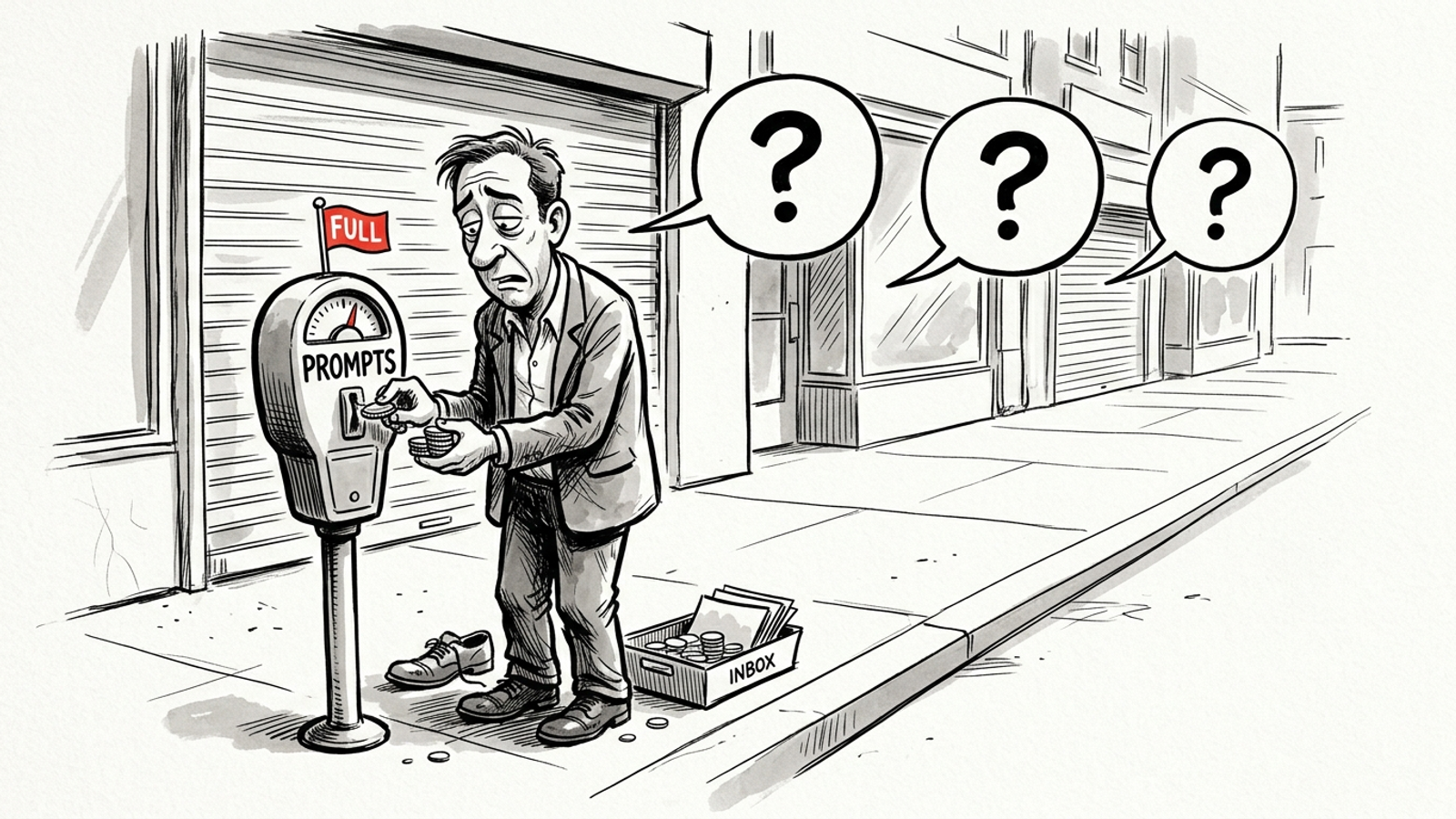
I know which choice is easier in a busy month. Coverage freezes. The report keeps checking the same questions, complete with movement arrows, while the questions buyers ask keep changing. A cap does not just raise your software bill; it sets a ceiling on your curiosity.
PPC.co describes the old percentage-of-spend problem plainly: a fee tied to spend rewards a larger budget, whether that budget performs better or not. Prompt tiers create a similar conflict. The vendor earns more when you discover more demand; the agency pays more to pursue it. What the deck calls expanded visibility tracking, I call a tax on looking harder.
A citation needs a fix behind it
A dashboard that tells a plumber he is invisible in Claude does not put him in Claude. Someone still has to rewrite the service page so a model can quote it, fix the schema, add the local proof and publish supporting passages. The report identifies the gap. The work closes it.
On a capped plan, expanding the view can bring another charge before anyone touches the page. Gemini, AI Mode and Claude are paid add-ons on the Otterly base tier, and adding an engine can lift an agency retainer by about 20 to 40%. That creates a neat little incentive to sell what the current cap allows: a monthly PDF of the same tracked questions. I have sold reports like that. If the agency never fixes what they reveal, clients have little reason to keep buying them.
The cost gets clearer when you stop looking at a single subscription and price an agency book.
The cost at 5, 10 and 15 domains
The illustrative recurring software cost runs from $995 to $2,985 a month per domain, versus $1,197 to $3,591 in capped 100-prompt blocks, across the 5-to-15-domain examples below. Those are list-price comparisons, not a promised invoice from either vendor. The capped column assumes you can buy enough identical blocks to cover the total; check how a vendor actually handles multiple clients, domains and overages before treating it as a quote.
Assume 60 prompts per client across three engines, within the 40-to-80-query baseline. For the capped illustration, use Profound Growth at $399 a month for 100 prompts across three engines. For the per-domain illustration, use groas SEO and AI Search at $199 a month per client domain. Multiply domains by 60 for the prompt requirement, then round capped capacity up to whole 100-prompt blocks.
| Client domains | Prompts needed | Capped illustration: $399 per 100-prompt block | Per-domain illustration: $199 per domain |
|---|---|---|---|
| 5 | 300 | $1,197 (3 × $399) | $995 (5 × $199) |
| 10 | 600 | $2,394 (6 × $399) | $1,990 (10 × $199) |
| 15 | 900 | $3,591 (9 × $399) | $2,985 (15 × $199) |
Those are the listed recurring costs in this example. They do not price the work required when tracking finds a gap. Nor do they settle every vendor-specific charge. Ask what happens if a client needs more prompts than planned, an additional engine, another seat, a white-label report, API access or another domain. Vendors can make the entry price easy to find while leaving the price of a useful agency setup for the sales call.
Keep the one-off costs separate. An audit priced at $1,500 to $5,000 per client may tell you what is broken. It does not rewrite the page. Then come the ongoing hours spent on content, technical fixes, citations and reports. If your tool only names the work, your team must do it or bill the client for it separately. Do not call the subscription your delivery cost until you have accounted for those hours.
This is why the cheapest mistake is buying a small capped plan to test, then quietly moving two clients onto it. The expensive mistake is standardizing your whole book on prompt tiers and discovering, once it grows, that each new question comes out of your margin. Price the operating model, not the starter plan.
Buy the domain and the work, not another dashboard
I would buy AEO per domain, with no prompt cap and execution included. That means one price for the client site covering the content, technical fixes and citations that tracking shows you need, rather than a price that rises every time you broaden the questions you check. groas offers agencies SEO and AI Search at $199 a month per client domain, with content, technical work, citations, and Google and AI visibility tracking. Its agency offer also lists unlimited clients and campaigns on the paid side, with actions logged and the reasoning behind them.
That is a better basis for an agency offer than a prompt allowance. When your cost is tied to the domain rather than the number of questions you investigate, you do not have to defend a smaller baseline just to protect the margin. You still have to decide what to work on first. You no longer need the meter to make that decision for you.

Before signing with any vendor, I would put these questions in writing:
- Coverage: How many prompts and engines are included before an overage starts? What counts as a prompt run: one check or repeated tracking?
- Account costs: What costs extra for seats, white-label reporting, API access and additional domains?
- Execution: Who rewrites the page when tracking finds a gap? Who handles technical fixes and citations? What does that work cost?
The last question matters most. A demo can show you a missing citation in seconds. It cannot make that citation appear merely by showing you the chart. I put more of these checks in the questions agencies should ask before buying another dashboard. Make the vendor answer them before you build a client retainer around its price card.
Sell a retainer clients can understand
Clients do not buy prompts. No plumber has ever needed an agency to explain the elegance of its prompt allowance. The client wants to know whether the business shows up when someone asks ChatGPT or Google for a plumber nearby, and who fixes the page when it does not.
So price the surface and the work: one client domain, relevant engines, tracking and fixes included. A flat monthly retainer from $2,000 to $10,000 is a common agency structure. On the tracking side alone, Sitechecker lists a $99-a-month flat plan with unlimited seats and ChatGPT, Gemini and AI Overviews included, while Peec meters prompts and models. Flat tracking is a start. It is not the same thing as having someone do the rewrites.
Here is the package I would sell: one price per client domain, say $1,200 to $1,800 a month for a local or SMB client, higher for a competitive category. Inside the offer, spell out the intended prompt coverage across ChatGPT, AI Overviews, Perplexity and Claude; the content and technical fixes; the citations; and a weekly branded report. Check what your delivery setup actually covers before promising all of that. A $199-a-month per-domain cost for content, technical work, citations and tracked Google and AI visibility gives you a cleaner starting point for pricing than a prompt meter. It does not excuse you from costing any work outside that scope.
I have written about why percentage-of-spend pricing fails agencies and their clients. The same habit is showing up here: make the measurable input the billable product, then let the client assume the work will follow. For a closer look at the agency-book math, see the cost of a 10-client AEO retainer. Sell domains and executed work. Never sell prompt counts.
Who should ignore this
If you manage one client, track 15 branded questions and sell a monthly PDF the client does not act on, keep the $29 capped plan. That is a reporting sale, not an AEO sale. The cap matches the offer. The same goes for an audit-only engagement: a $1,500 audit that names gaps and hands the fixes back to the client does not require you to keep tracking until citations arrive. Do not buy headroom you have no intention of using.
But if you plan to grow an AEO practice, a cap stops being a price and starts being an operating model. Account managers learn to call 100 prompts enough coverage. Proposals quote prompt counts because that is what you pay for. Clients haggle over prompt counts because that is what you taught them to buy. When they ask what changed, you point to movement arrows on the same questions instead of pages fixed and answers earned.
That is the old percentage-of-spend mistake in smaller type. Buy per domain, track the questions buyers ask, include the rewrites and citations, and price the retainer for the work you execute. Ignore that distinction and your team will learn to stop looking precisely when looking starts paying.