


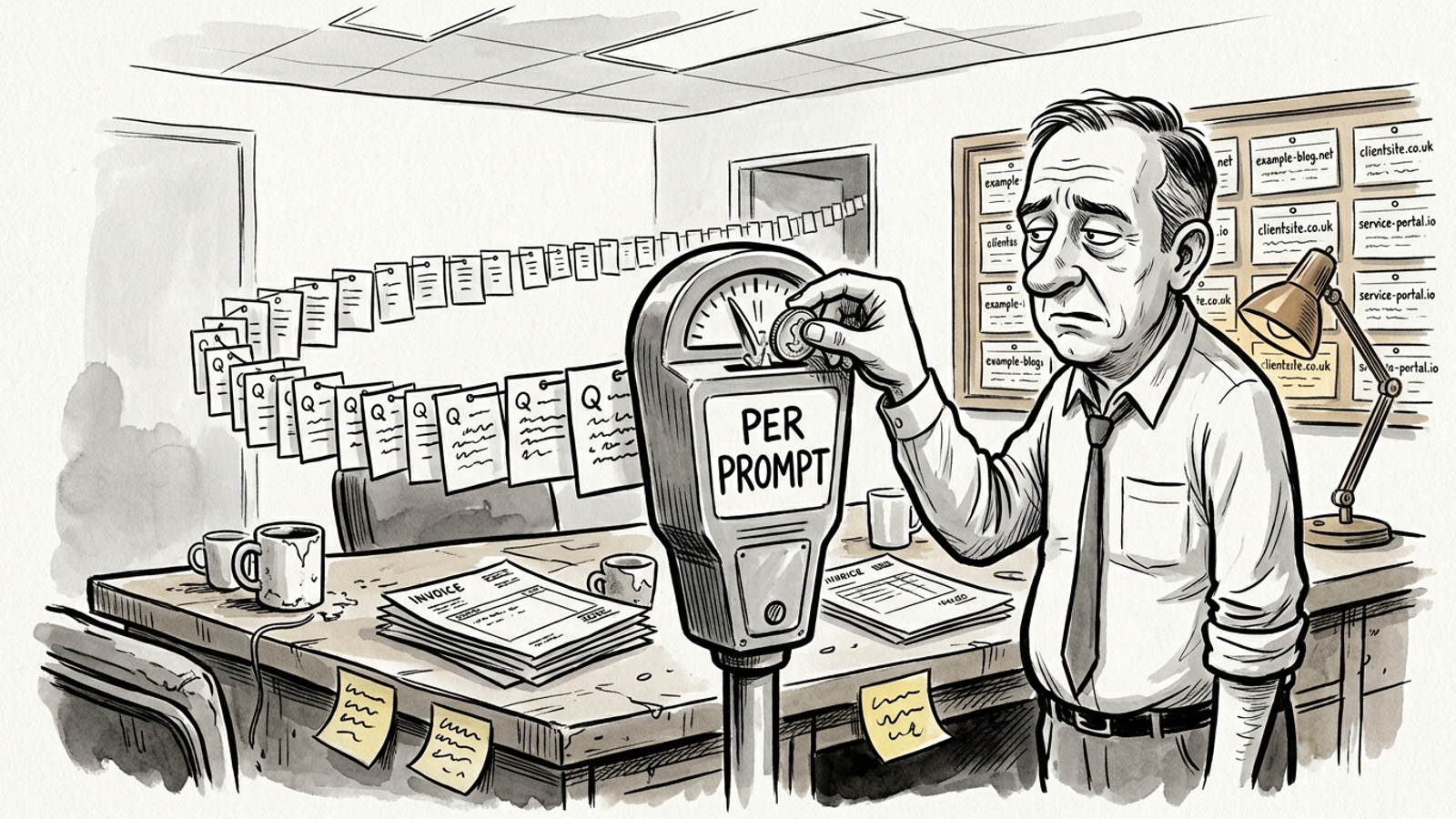
Stop buying AEO tools priced per tracked prompt. That meter is percentage-of-spend with a new label, and it will make every client account you manage dumber by design.
I spent years watching agencies bill a cut of ad spend, which meant spending more helped them. As one industry critique of percentage-of-spend fees argued, the incentive points toward a bigger account, not necessarily a better one. Per-prompt pricing does the same thing in reverse. The more questions buyers actually ask, the more you pay to watch them. So you watch fewer.
Say you run white-label SEO and AEO across 10 client domains. If your tool gives you 100 prompts on a $399 plan, that is 10 prompts per client. Ten. A single local services client can burn through that on service and location variations before breakfast. You are not buying coverage. You are buying a reason to under-measure.
The standard advice: buy the tier that fits your prompt count
Every AEO roundup gives agencies the same buying guide. Count how many prompts you need, pick the tier that covers it, upgrade when you add clients. It sounds disciplined. It reads like capacity planning. I followed that logic with PPC tools for years, and I was wrong about it there too.
The tiers tell you how fast this breaks:
- Otterly Lite is $29 a month for 15 prompts, Standard is $189 for 100, and Premium is $489 for 400, with Gemini, Claude and Google AI Mode as paid add-ons.
- Peec caps Starter at 50 prompts, Pro at 150 and Advanced at 350. Every self-serve tier lets you pick only 3 of 6 engines.
- Profound Starter is $99 a month for ChatGPT-only tracking with 50 prompts; Growth is $399 for 100 prompts across three engines.
Those numbers are not an agency coverage plan. They are a sampling budget. Semrush charges $99 a month per domain for 25 custom prompts, and a comparison of 14 tools describes per-prompt and per-domain metering across the market. For one brand with one site, 25 or 50 prompts might pass as a start. For an agency holding 10 white-label retainers, a cap means walking into every client meeting already knowing what you chose not to watch.
A cap changes the questions you choose to track
When each prompt has a price, you stop tracking the questions buyers actually ask and start tracking the questions you can afford to watch. You keep head terms, brand names and the safe prompts where the client already appears. The long variations where a plumber, a dentist or a SaaS buyer shows intent get cut first. They look expensive in a quota and harmless to drop from a report.
I used to tell clients this kind of sampling was prudent. I was wrong. A capped tracker rewards a high visibility score on a narrow set. Drop the 30 awkward, specific prompts where the client is invisible and keep the 10 clean ones where they show up. The chart goes up while coverage goes down. You pay less for the tool and learn less about the client. What the deck calls optimization, I call grading your own homework.
The problem is not that every prompt deserves equal attention. It is that the price of checking one more question becomes part of the editorial decision. When a client asks why a buyer’s exact phrasing is missing, “we ran out of prompts” is not an account strategy. It is a billing constraint wearing one.
The margin math across 10 client domains
Say you sell white-label SEO and AEO at $800 a month per client and hold 10 domains. Buy Profound Growth at $399 for 100 prompts and you have 10 prompts per client if you divide coverage evenly. That works only if 10 questions per client are enough. Give each client a more serious set, say 50 prompts covering brand, service, comparison and location variants, and you need 500 prompts.
Switch to Otterly Premium at $489 for 400 prompts and you are still short. That is a different vendor and a larger tier, not an upgrade path within the first plan. It shows the same constraint: even before the paid engine add-ons, 400 prompts do not cover the 500-question list you meant to track.
At higher volume, the bill gets harder to hide. Enterprise AEO is priced at $2,000 to $5,000-plus a month in the cited comparison, while Semrush charges $99 a month per domain for 25 prompts before extra users. Spread those costs across 10 small retainers and they take a substantial bite out of the margin. So agencies do the rational thing for the spreadsheet. They shrink the prompt set until the tier fits. The cap does not just control cost. It controls how little you look.
What that looks like inside a white-label retainer
Take a white-label local SEO client with five locations. For each location, track five questions: best near me, cost, open now, reviews and one service comparison. That is 25 prompts for one client before you track a competitor or a follow-up phrasing.
Put three of those clients on one Standard plan at $189 for 100 prompts. Their basic sets use 75 prompts, leaving 25 for everything else. Add a fourth client of the same shape and the plan is full. Across 10 such domains, those basic sets alone need 250 prompts. You have not added the questions that differ from one client to the next, and you have not learned whether the neat five-question template reflects what their buyers ask.
Then comes the meeting you cannot win. The client asks why the exact question their best lead asked last week is not in the report. You tell them it did not make the prompt list. They hear what you said: you capped their coverage to protect your cost per account.
Even the friendlier tiers prove the point. Otterly raises Agency Partner caps to 150 prompts on Standard and 500 on Premium. That helps. But 500 prompts across 15 domains is about 33 prompts per client. Enough to assemble a report. Not enough to let every client’s questions determine what goes into it.
Percentage-of-spend, again
The problem with percentage-of-spend fees is the incentive: the vendor earns more when you spend more, so restraint costs them money. Per-prompt pricing flips the pressure onto measurement. Every new buyer question you add raises the bill, so protecting margin means asking less. The agency that tracks 200 honest prompts pays more than the agency that tracks 40 flattering ones. The meter rewards a short list, not an accurate one.
Demand a price that lets coverage grow
If you package white-label SEO work into fixed retainers, your costs need to stay predictable when coverage grows. I would demand three things in writing before buying an agency AEO tool. I have made the longer argument about why per-prompt AEO pricing repeats the percentage-of-spend mistake, but the buying rule is short: pay per domain, track what that domain needs, and make sure somebody does the work the tracking reveals.
1. Flat per-domain pricing
Pay for each client domain you cover, not for each question you dare to track. A flat per-domain price fits a fixed retainer because your tool cost per client stays put while coverage per client grows.
Say you charge $1,200 a month for white-label organic. If delivery starts from $199 a month per client domain, with content, technical fixes, citations, and Google plus AI visibility tracking included, you can price the retainer against a known starting cost. If delivery costs $99 for the first 25 prompts plus upgrades, add-ons and extra engines, you have to revisit the margin when the client needs more coverage. A vendor that cannot name your cost for client eleven without asking how curious client eleven is has no agency plan.
2. Uncapped prompts and keywords
When the next 50 prompts cost nothing at the margin, you can track the way a buyer talks. Add the misspellings, price questions, versus questions, location variations and follow-up phrasings that a 10-prompt starter set skips. Not because every variation is precious, but because you should decide what matters after you look, not before a quota makes the decision for you.
Capped tools force the opposite choice, then charge you to widen the view. Otterly gates Gemini, Claude and Google AI Mode as paid add-ons, and Peec charges €25 to €115 a month for each extra engine. You pay for a limited set of questions, then pay again to track them in more places. Uncapped prompts stop the tracker from editing the question list to fit the tier.
3. Execution included: fixes, content and publishing
A visibility chart that tells you where you are missing does not put you in the answer. One review of Peec says its Actions engine scores opportunities and points you toward citations, but your team still has to write the content, pitch the publication or join the thread. That second half is the job. If the vendor sells it as an add-on or leaves it to your staff, you bought a meter plus a to-do list.
The comparison that describes Profound Agents as briefs and drafts also describes an alternative with content, technical and outreach fixes in one loop. That is the test I would apply to any plan: when tracking finds a gap, who is responsible for closing it, and what does that work cost? Tracking without fixing is just a slower way to fall behind.
The exception: one site, not a book of clients
If you run AEO for one site, yours, a 50-prompt cap can be a reasonable start. You know the buyers and the questions you chose. If 20 questions cover what you need to watch now, you can add 10 next quarter and still fit the cap. I would not pay for unlimited coverage solely to avoid a limit I never approach.
If you sell fixed white-label retainers across 5 to 15 domains, that excuse is gone. Each client brings a different question set, and your cost per client has to remain workable when that set grows. A meter that charges for curiosity forces you to choose between margin and coverage. You will choose margin until a client asks about the question you left out. Single-brand tracking can live with caps. Multi-client retainers cannot build around them.
Ask these three questions before you sign
- What does one more client domain cost with unlimited prompts and keywords? If the answer starts with prompt bundles, engine add-ons or a call with sales, you do not have a flat per-domain price. You have a meter.
- Which engines and locations are included at that price? ChatGPT-only tracking, three-engine limits and paid add-ons narrow the coverage you can actually deliver. Get the scope alongside the price, not after you have sold the retainer.
- Who does the fixing, and is it in the fee? Ask about content, technical changes, citations and publishing. If execution is a separate scope, you bought a dashboard that assigns your team homework. I keep a longer version of that vendor screen in five questions to ask before you buy another dashboard. Ask the short version on every sales call.
Then price the retainer around the answers. Take a flat per-domain delivery cost, add your margin once, and sell tiers by domains and locations, not by prompts. If delivery starts from $199 a month per client domain with tracking and the work included, you can sell that client at $800 or $1,200 and let their question list grow without a prompt-based change order. You still have to account for the rest of your delivery costs. You should not have to charge for the right to notice another buyer question.
Keep buying by prompt count and you will do the opposite: shrink every account until the chart looks good, the coverage goes thin, and one sharp client asks why their best question was never tracked. That is the meeting where you lose the retainer.