

 LinkedIn

There is no secret prompt list that gets you cited in ChatGPT versus Perplexity. I stopped believing in one after I looked at what the assistants actually fetched on our own site.
The pitch sounds precise: track 500 prompts, find which ones trigger a mention, then write a ChatGPT version and a Perplexity version of every page. I used to build match type structures by hand and mine negatives at 1am, so I respect tedious work when it moves CPA. This work does not. Assistants cite pages, not prompts. They fetch something that answers a question with dates and numbers, then quote it. The prompt changes every run. The page that deserves the quote does not.
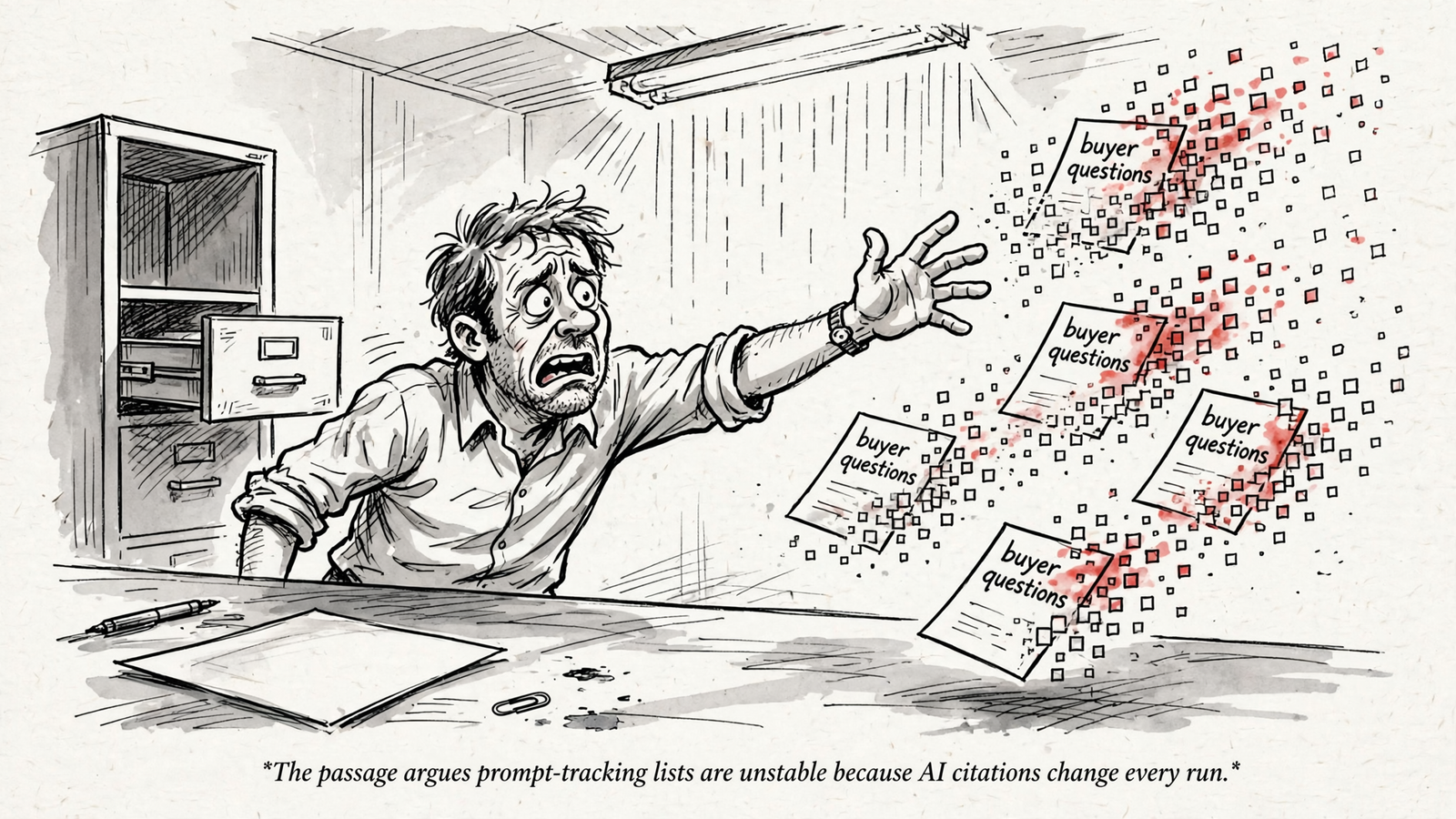
Here is what the dashboard sells you. A tool watches a fixed set of prompts, runs them a few times, and reports which ones named your brand this week. One widely shared protocol says the only honest way to do it is 10 fixed prompts run 5 times across 3 engines, logged out with a fresh conversation each run, because single-run scores fall apart on rerun. That warning is correct, and it buries the product. Kevin Indig found only 2.2% of citations survived all three runs of the same prompt, and SparkToro found fewer than 1 in 100 answer pairs named the same brand list. You are paying to track a ranking that will not sit still long enough to optimize.
Perplexity tells you why in its own plumbing. Each question triggers fresh retrieval with fan-out into multiple sub-queries, so there is no stable position to hold, and overlap between two runs is often only 60 to 80%. Selection happens twice: first into a candidate pool on crawlability and match, then a rerank on specificity, reliability, and freshness. Cause is retrieval; effect is the quote. Chase the wording of last Tuesday’s prompt and you are optimizing the exhaust, not the engine.
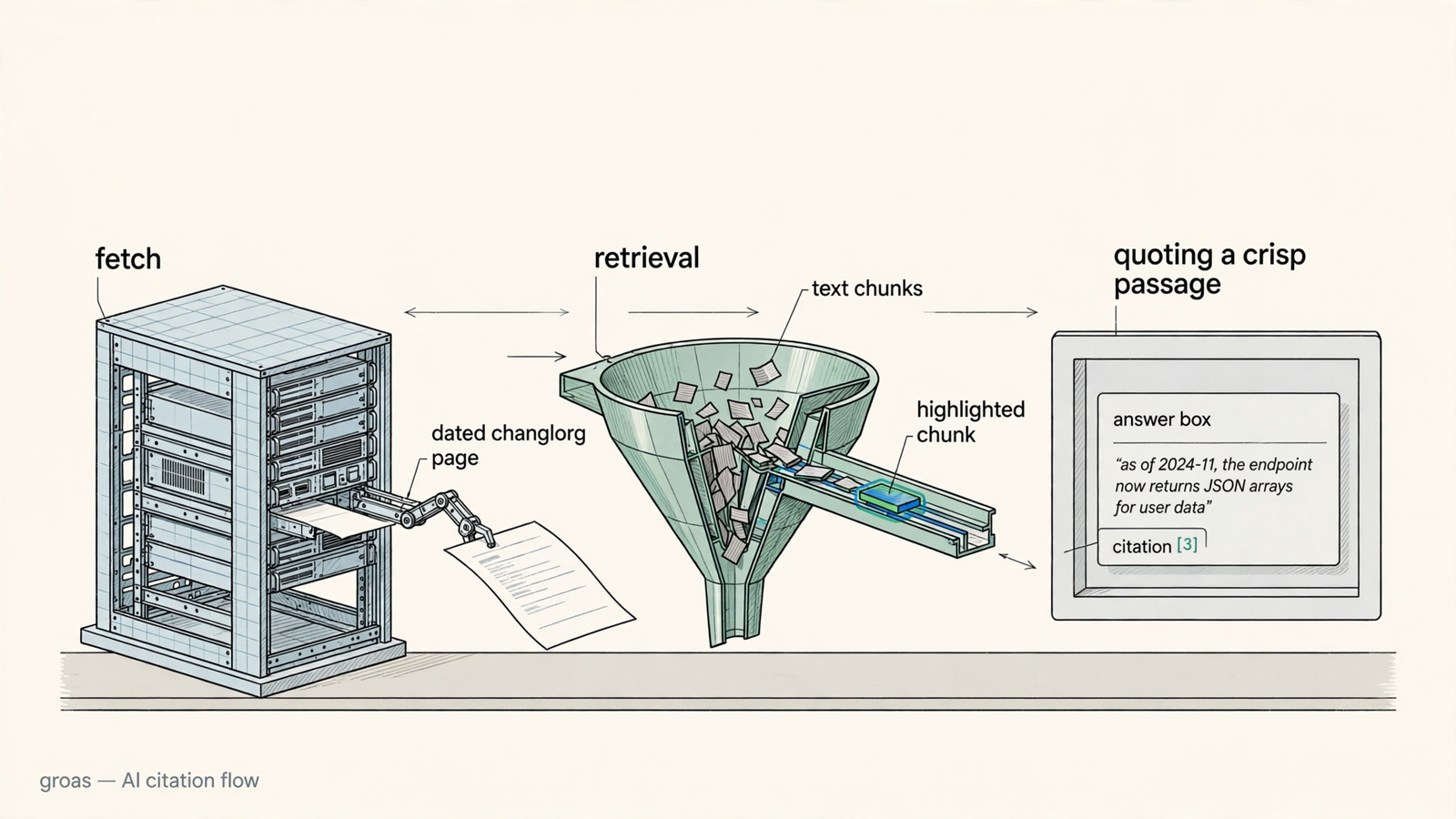
A citation starts with a fetch, not a prompt report
Forget prompts for a minute. A cited answer depends on three steps: fetch, retrieve, quote. First the assistant has to fetch your page at all, which means it is crawlable, fast, and indexable. Then it has to retrieve your passage for this specific question, which means your wording matches what the buyer asked. Then it needs a crisp sentence it can defend. Perplexity answers are constrained to retrieved passages, so a claim with no retrieved support is unlikely to appear, and crisp passages get lifted verbatim. No retrieval, no citation, no matter how clever your prompt list is.
ChatGPT in browsing mode works much the same way with a smaller window. It searches via Bing and typically returns 3 to 6 clickable citations, with 44% of citations coming from the first third of the page. Recently updated content gets cited more often because it offers a fresher answer, not because it matched a magic prompt. I used to tell clients to build one perfect evergreen guide. I was wrong. When the assistant has to choose, a dated page with this week’s numbers gives it more to work with than a timeless page with 2023 numbers.
On our own site, the logs settled it. Over 30 days we saw 868 verified bot fetches and 547 live answers, and almost all of that quote volume went to three pages: the homepage and two dated Google Ads changelog posts. Nothing we ever labeled prompt-optimized got fetched twice. The pages that got quoted gave the assistant something quotable: what changed, when it changed, and what to do about it. I break down where ChatGPT, Perplexity, and Google each look first elsewhere, but the pattern held across all three.
The reason is boring. That is the point. A changelog with specific policy dates and bid behavior is easy to retrieve and easy to defend. A thought-leadership essay about the future of search is neither. The assistant does not reward the best-optimized page. It rewards the most citable sentence. Our most-fetched page was a changelog because it read like evidence, and evidence is what gets lifted. I wrote more about it in why our most-fetched ChatGPT page was a changelog.
Different engines do not justify different retainers
The engines differ. That still does not pay for a second retainer. In an October test of 31 “best agency” prompts, ChatGPT with web search cited the brands’ own sites for 119 of 210 citations, about 57%, while Perplexity, Gemini, and Google AI Mode leaned harder on listicles. Perplexity also cited far more pages per answer: 561 pages across those 31 queries versus 83 for Gemini. ChatGPT often goes to the vendor page for the fact; Perplexity also looks for other pages that back it up. That is a sourcing preference, not a separate optimization universe.
Google widened the same gap from the other side. An Ahrefs study of 863,000 SERPs found only 38% of pages cited in AI Overviews also ranked in the top 10 for the same query, with 31.2% of citations coming from positions 11 to 100 and 31% from beyond position 100. A page does not need a top-10 ranking for that query to supply a useful passage. I have seen founders read that as proof they need a Google shop plus a ChatGPT shop plus a Perplexity shop. I read it as the opposite. One job covers all three surfaces: publish a fetchable page with a sentence worth quoting.
That does not mean copying the same thin answer onto five URLs and hoping each engine picks a favorite. Perplexity applies diversity caps that rarely cite several pages from the same domain, and a competent restatement of common knowledge can clear retrieval and still lose on attribution. Five variations of the same advice do not become five chances to win. Give one page the specific passage, then make sure the fact can be found beyond your own domain.
The second agency has to explain what it will publish
No, you do not need two companies. You need one company doing the search job for both kinds of reader. Google ranks the page. The assistant quotes the passage. Both need crawlable pages and clear information; schema identifies what the page is, while fresh specifics give a machine something to lift without guessing. Winston Digital puts it flat: generative engine optimization is part of SEO now, and the same schema and content work feeds both surfaces. Getting cited in ChatGPT, Perplexity, Gemini, and AI Overviews belongs in modern SEO, not on a second invoice. I agree, and I rarely agree with agency copy.
Ask the shop pitching a separate GEO retainer one question: What will you publish that my SEO team would not? If the answer is prompt lists, mention scores, and schema tweaks with no new pages, walk away. If the answer is dated service pages, price and process specifics, and third-party proof on sites the engines already trust, that is SEO that gets quoted. Call it GEO if you like. The work has not become a separate job because the deck gave it a new heading.
I laid out that test in why you do not need a separate AI search agency. At groas we run it as one service for that reason: SEO and AI search together for one flat fee instead of two retainers arguing over the same page. One owner, one log of what shipped, one check on whether the passage got fetched and quoted. If a vendor cannot point to the page it changed, a prettier mention chart will not rescue the bill.
Build the answer, then check whether it gets fetched
Stop building a prompt library. Build pages worth fetching. For every question a buyer actually asks—what does it cost, what changed this month, who is this for—write a page that answers in the first three paragraphs with a date, a number, and a next step. Content refreshed in the last 30 days gets cited more often in browsing mode, about 3.2x more in one test of ChatGPT citations. Recency gives the assistant a more defensible quote. I learned the value of specificity running ads: the ad with the price gave the buyer more to act on than the clever one. Specifics get quoted. Generalities get skipped.
Make the work visible on the page:
- One page per buyer question, dated and kept current, rather than one pillar page left in 2023.
- The fact in the first third, in a sentence that stands on its own.
- Prices, timelines, limits, and tradeoffs spelled out, not implied.
- Proof on other domains the engines already crawl: reviews, listicles, and partner pages.
- Server-log and Search Console checks to see whether assistants fetched the page and Google can see it.
Then check your logs, not just a mention score. A mention dashboard tells you whether a prompt named you last week. Your server logs tell you whether an assistant fetched the page; Search Console tells you whether Google can see it. If the page was never fetched, your prompt list is irrelevant. If it was fetched 40 times and still does not appear when you check the answers, inspect the passage. It may be buried too deep, too vague, or too old to defend. That gives you an edit to make, not another prompt to monitor.
Say you are spending $20k a month and paying a second vendor for GEO. Before you renew, pull 30 days of bot fetches for your five money pages and run 10 buyer questions yourself, logged out, in a fresh conversation each time. If the assistants fetch your competitor’s dated pricing page and skip your pillar guide, you do not have a prompt gap. You have a page gap. Rewrite the first 200 words around one quotable fact, add the date, and get that same fact onto a listicle the engines already crawl. Cause first, quote second.
If there is no page to quote, start there
This advice fails for one group: brands with zero indexable pages worth quoting. If you operate entirely inside an app, behind a login, or on a single landing page with a contact form and no specifics, there is nothing to fetch. No prompt list fixes that. You do not have a citation problem. You have a publishing problem. Everyone else—a plumber with service pages, a SaaS company with pricing and changelogs, a store with category guides—already has raw material. Make it fetchable and quotable before you pay someone to study prompts.
Keep hunting for the magic list and here is what happens. You get a monthly PDF showing your mention score bouncing from 12% to 14% while the competitor with the dated, specific page gets the quote. Prompts churn every run. Pages compound. Write the page that deserves the citation, and one SEO job can cover Google, AI Overviews, ChatGPT, and Perplexity. Pay two companies to chase wording and you will own a dashboard instead of the answer.
Run the math before you buy the second retainer. Say you pay $2,000 a month for GEO on top of SEO. That is $24,000 a year to monitor wording that regenerates every run, while the work that earns the quote is publishing dated pages with specific answers and getting those answers found elsewhere. I would rather own the citable page than rent the dashboard that watches someone else get cited.