

 LinkedIn

You do not need a separate AI search agency. Hiring one company for SEO and a second for GEO usually means paying twice for one job: making your pages easy to find, easy to quote, and worth contacting you about.
I keep seeing the same pitch. SEO stays at $3,000 a month, then a second line appears for GEO at another $2,000, with a report full of prompt share and visibility scores. The website is still one website. The buyer questions are still the same questions. What changed is the invoice got split in two, and neither vendor owns enquiries.
Two retainers, one set of buyer questions
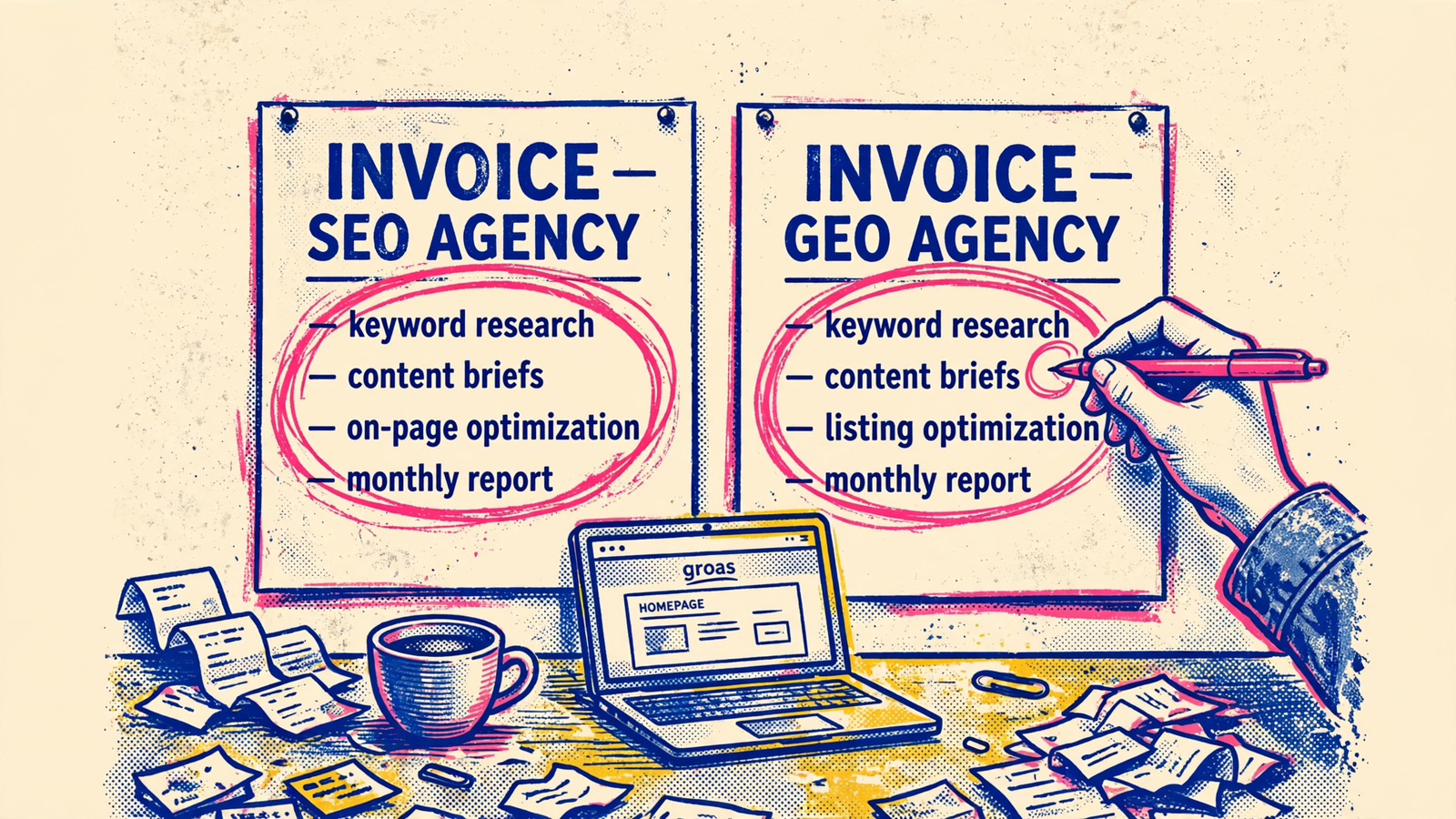
Picture the proposal: $2,500 for SEO, $1,800 for GEO, plus a setup fee for an AI visibility dashboard. Read the deliverables side by side. Keyword research becomes prompt research. Content briefs become answer briefs. Digital PR becomes citation building. Two teams charge to research the same buyers and edit the same pages.
Boutique retainers run $1,500 to $5,000 a month, mid-market $5,000 to $10,000, and enterprise $10,000-plus. The simplest agency move is a 20 to 30% GEO add-on on current MRR for work that largely overlaps with content and SEO. One agency answers the buyer question plainly: splitting the work across vendors can duplicate research and create conflicting page changes.
I used to tell clients to hire specialists for every new channel. I was wrong about this one. Before you buy another specialty, make the seller identify the work your existing team cannot do and the enquiry it is supposed to produce.
The separate-web pitch falls apart at the page
Google says SEO best practices remain relevant to its generative AI features because those features draw on core Search ranking and quality systems. AI Overviews retrieve from the Search index; they do not run on a separate web. To be eligible, a page must be indexed and eligible to appear in Google Search with a snippet. That does not mean a top organic ranking guarantees a citation. It means the basic job still starts with an accessible page that gives a useful answer.
Google also undercuts a familiar upsell. You do not need new machine-readable files, AI text files, markup, or Markdown to appear in its generative AI features; no special schema is required. When a proposal lists llms.txt, AI schema, and answer formatting as a second retainer, ask which buyer question that work answers. A file is not a substitute for a page a buyer can use.
Make the answer quotable before buying another dashboard
Say you are a garage door company in Dallas. A buyer asks ChatGPT what it costs to replace a double spring and who can do it tomorrow. A page that states the price, service area, and booking step gives a search system something concrete to cite and gives the buyer somewhere to go next. A page that buries the answer under 2,000 words of throat-clearing does neither. The answer page is the work. The dashboard can only tell you whether it was found.
Citation patterns do not perfectly mirror organic rankings. Overlap between top-10 organic results and AI Overview citations fell from 76% to somewhere between 17% and 38%, depending on the dataset. Sellers of second retainers point to that drop and say the old work stopped counting. I read it differently: eligibility and a good answer are related jobs, but a ranking alone does not win the quote. You need pages that can be retrieved and answers that can stand on their own.
That changes the edit, not necessarily the vendor. Put the price, qualification, service area, or next step where the question calls for it. Then check whether the page earns a mention and whether a buyer contacts you. Do not pay twice to learn that the answer was hidden in paragraph nine.
Earn mentions that support more than one surface
The same off-site work can matter beyond a conventional search result. Across 75,000 brands, web mentions showed a 0.664 correlation with AI Overview visibility, compared with 0.218 for backlinks. Brands were also 6.5 times more likely to be cited through third-party sources than through their own domains. A directory profile, trade list, or local press mention gives another site a chance to describe and reference the business.
Those figures do not mean you can buy any mention and manufacture an enquiry. They do mean off-site references belong in the same plan as your on-site answers. One owner can decide which buyer question needs a better page and which relevant third-party source is worth pursuing. Two owners can each put the other task on a slide.
What really changes from one AI engine to another
I am not saying every engine quotes the same sources. Across 1,429 answers to contractor questions, LinkedIn was cited 246 times by Perplexity and 6 times by ChatGPT, while YouTube was cited 214 times in Google AI Overviews and 4 times by ChatGPT. That is a 41-times gap for one source and a 53-times gap for another. A study of 13,184 citations found all four models agreed on the same domain for the same question only 30 times out of 1,792 combinations, or 1.7%. Perplexity drew on 19.2 sources per answer against 4.5 for ChatGPT.
Those differences are a reason to inspect the prompts your buyers use, not to hand a second company the keys to the same pages. If you need to choose where to start, compare ChatGPT, Perplexity, and Google AI Overviews against those buyer questions. A source plan for one engine may be useless for another.
Ranking and quoting can diverge sharply. At the domain level, only 10% to 30% of cited domains sat in Google’s top 10; at the exact-URL level, the overlap was roughly 1% to 5% for Gemini and ChatGPT. The popular reading is that SEO stopped working. The operator reading is less convenient: a crawlable, direct page gives you a foundation, while each engine’s source choices create another thing to watch and adjust. A different citation pattern does not automatically justify a different retainer.
A mention tracker tells you where to edit; it does not edit
Knowing you appeared in 14 prompts last week did not create the mentions. The useful question is which buyer prompts pull you in, which skip you, and what you will change next. Perhaps the answer page needs to state the price earlier. Perhaps a relevant third-party profile is missing. A tracker can point to either problem. It cannot do the work.
When a vendor sells tracking as the strategy, ask what page they will change, what source they will pursue, and which enquiry that change should help produce. No page, no source, no enquiry target: you bought a chart. One team should own the pages and mentions; one report should watch the results. For the mechanics of that choice, read on-site pages versus off-site mentions.
Replace the visibility score with an enquiry scorecard
A blended visibility score is the new rank report. It rises, nothing rings, and the vendor calls it momentum. On one identical set of 144 questions, ChatGPT cited the test brands 36.5% of the time, AI Overviews 15.2%, and Perplexity 13.7%. An average across the three hides which buyer prompt you won, where you lost it, and what to fix. It is a tidy number for a renewal call. It is a poor work order.
Put enquiries first. As one measurement guide argues, AI visibility belongs beside pipeline, not in place of it. Count inbound enquiries you can trace to organic and AI referral sessions in GA4. Keep branded and non-branded activity apart. Record named mentions separately from cited links. That way, a rise in people asking an engine about your brand does not masquerade as a rise in new buyers finding you.
This is not a demand for a prettier attribution diagram. It is a demand that the report connect work to a buyer action: the page changed, the source earned, the relevant prompt observed, the quote request received. Some effects will be harder to trace than others. That is still a better conversation than celebrating prompt share while the enquiry count stays flat. If a metric cannot help you decide what to change or show a path to a quote request, stop paying for it.
When a specialist earns a fee, and when to skip one
A second vendor makes sense in two cases. First, you operate across dozens of markets or regulated categories where third-party mentions must be earned publication by publication, in different languages, under legal review. Second, you have already done the basic page work and can point to buyer prompts where models quote someone else instead. That is a specific citation gap a short specialist sprint can address. Give the specialist that job, not a permanent claim on every page.
If you run one website, one service area, or one B2B offer, the split is harder to defend. You get two audits, two content calendars, and the familiar email in which the SEO vendor rewrites a page on Monday and the GEO vendor wants it rewritten again on Thursday. Keep one owner. Put the second fee toward answer pages that state price, area, and next step, plus relevant mentions on sources the engines use.
You can test how much of that work you can handle before hiring anyone. Start with this 30-day DIY citation playbook for one person at two hours a week. If you still need outside help, you will have a narrower brief and a better way to judge the bill.
Five questions that expose a second invoice
Ask these on the sales call. You want answers that name a page, a source, an owner, and an enquiry target. If the answers stop at visibility, the proposed split has not earned its cost. I use groas’s flat $1,499-a-month service across Google, ChatGPT, Perplexity, Gemini, and more as the baseline: one service owns the search work, rather than sending the same website through two retainer plans.
- Which 20 buyer prompts will you own in 90 days? Split them by ChatGPT, Perplexity, and AI Overviews. Which enquiries are they meant to produce? If the answer is only prompt share, expect a report on activity.
- Which exact pages will change, and who has final edit rights? Duplicated research is expensive enough. Conflicting changes to the same page are worse.
- Which third-party sources will you pursue for each engine, and why? The cited contractor-question study shows different patterns for LinkedIn and YouTube across engines. One identical source list for all three needs an explanation.
- Will you separate branded from non-branded activity, and named mentions from cited links? A blended score can climb because people already know your name.
- What stops if enquiries do not move in 60 days? If the answer is nothing, or another report, you have hired a monitor rather than an owner.

One owner, or two vendors explaining the silence
Keep one company accountable for the chain: the pages that can be found, the answers worth quoting, the mentions that support them, and the enquiries that follow. Track organic and AI referrals you can identify in GA4; keep branded activity and named mentions from inflating the picture. Pay for inbound enquiries, not prompt share.
Pay two vendors for the same website and you get what the arrangement encourages: two audits, two calendars, a visibility chart that climbs while the phone stays quiet, and a monthly call about whose edits caused it. Pick the single owner now, or keep funding the split until the enquiry scorecard makes the decision for you.