

 LinkedIn
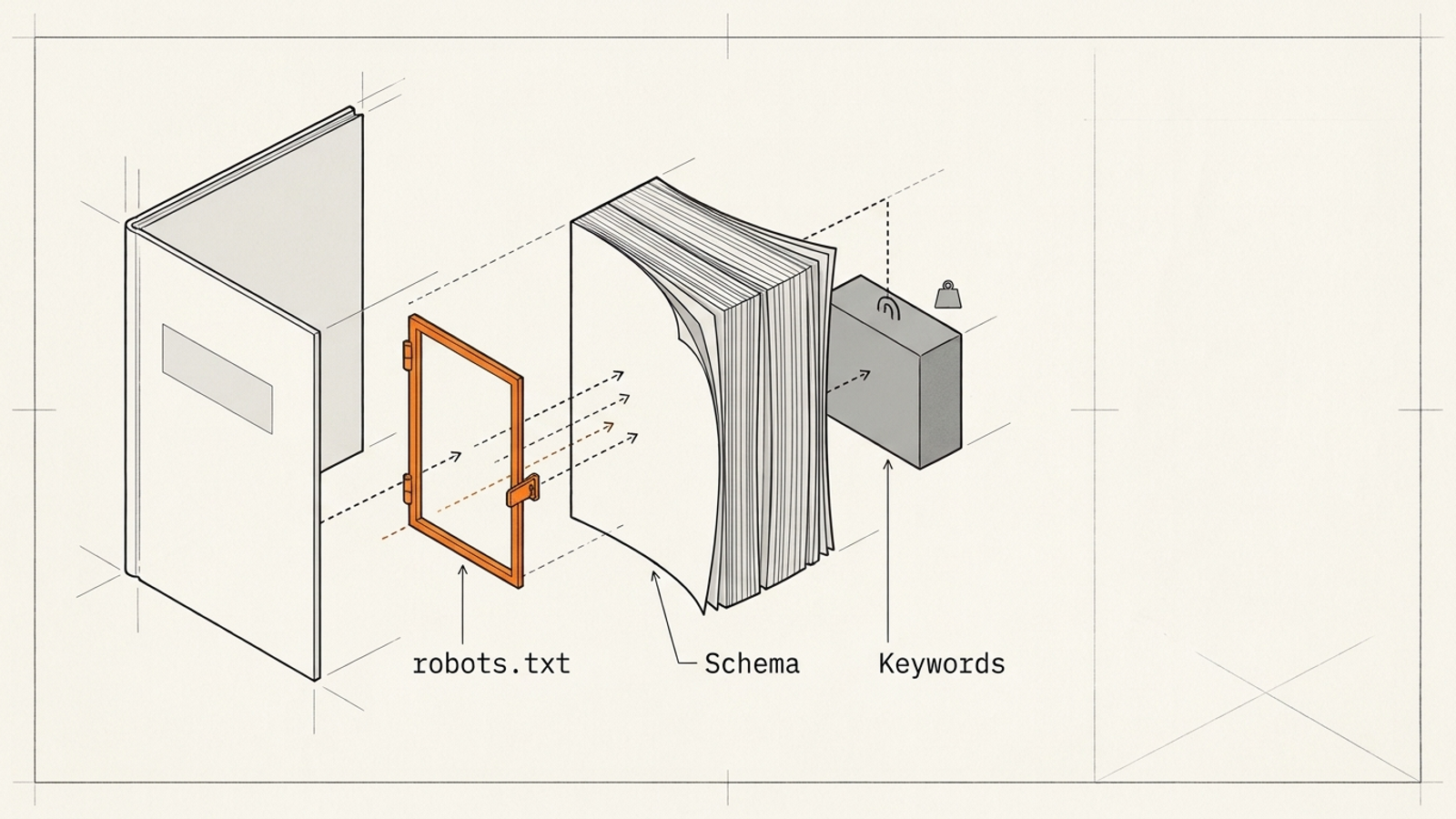
Your AI search audit arrives as a 40-page PDF. On groas.com, the URL live-answer bots fetch most is robots.txt, ahead of the homepage. If that file gets two lines in the report and schema gets twelve pages, the audit has its priorities backwards.
I chose the standard AI search audit as the artefact for this teardown because its sales pitch is familiar: diagnose everything, hand over a score, leave the fixes to you. The cover has your logo. Inside are sections on crawlability, schema, E-E-A-T, content gaps and authority, followed by a keyword appendix. You bought answers about getting cited in ChatGPT, Perplexity and Google’s AI Overviews. My verdict, before we open it: perhaps a quarter of the PDF bears directly on that job. The rest is mostly recycled SEO hygiene padded to justify the invoice. Let’s read it in the order you would.
1. Crawlability: the two lines that should come first
The audit opens with something like: “We checked your robots.txt and found no major blocking issues.” Then come the colourful charts. That is a strange allocation of attention. If a live-answer bot cannot fetch a page, its schema, author bio and beautifully reworked introduction cannot earn that page a citation.
This is where I want the auditor to show their work. Open robots.txt. Look for rules covering GPTBot, OAI-SearchBot, ChatGPT-User, ClaudeBot, PerplexityBot, Google-Extended and Bytespider, and read the Disallow directives attached to each. Look for a stray User-agent: * and Disallow: / left over from staging. Then check the firewall: permission in robots.txt is not much use if the request gets a 403 at the edge. That five-minute robots.txt and firewall check is more useful than a polished crawlability score with no request-level evidence behind it.
I used to tell clients to block everything that was not Googlebot. I was wrong. A blanket rule treats bots serving live retrieval and bots gathering material for other uses as though they do the same job. They do not. The distinction between training bots and citation bots matters when you decide whom to allow: permitting live-answer access gives those services a chance to retrieve your page; blocking the lot removes that chance. It does not make an already public page private.
Verdict: keep this section, but demand the actual rules and blocked requests. Two lines saying “no issues” are not an audit of the gate everything else has to pass through. Fix fetch first. Then argue about words.
2. Schema: twelve pages for a passing grade
Next comes the markup inventory. Missing Organization schema. Missing Article. Add FAQPage, add SameAs, validate in Rich Results. It looks thorough because the list is easy to make long. But a recommendation should explain what the change is expected to do, not just name a field you could fill in.
Schema helps machines parse what a page says. It does not substitute for saying it on the page. Google has said no special markup is needed for AI Overviews and AI Mode. A May 2026 Ahrefs test of 1,885 pages that added JSON-LD found no meaningful citation gain, and a live-fetch test found assistants ignored facts that lived only in JSON-LD. None of that makes accurate markup worthless. It does make a twelve-page schema plan a poor substitute for readable content.
Keep Organization and Article accurate. Keep hours and addresses consistent. Then look at the page a person sees. If the fact you want repeated appears only in code, you have made it harder to quote than a competitor’s plain sentence. An audit that lists schema errors without checking the visible answer has inspected the label on the box and skipped what is inside.
Verdict: useful housekeeping, not a citation strategy. Fix the markup, put citable facts in visible copy, and stop paying for extra pages about the markup.
3. E-E-A-T and entity signals: a real problem with vague prescriptions
By section three, the PDF is grading “authority.” Improve author bios. Add credentials. Get mentioned more. There may be shields and checkmarks involved. Underneath the presentation is a real question: when several sources make competing claims, which name does an answer engine recognise and trust?
Consistent names, addresses, founders, products and review profiles help establish that the references point to the same entity. The weak part is not the concern; it is the prescription. “Improve authority” assigns you a grade without telling you which conflicting fact to fix or which missing profile to claim. It turns work that could be checked into an abstract score.
Then comes the AI-specific flourish: llms.txt. It is attractive audit material because it looks like a direct answer to an AI search problem and takes little space to recommend. But a review of roughly 300,000 domains found no connection between llms.txt and citation rates. Google and OpenAI point to robots.txt, not llms.txt, as the control that matters here. Calling the newer file a strategy does not give it a job it can do.
Verdict: keep the entity check; reject the vague grade and the llms.txt detour. Make your brand facts match wherever they appear. If the audit cannot name the inconsistency you need to correct, its score is decoration.
4. Content gaps: the useful diagnosis you have to execute yourself
Halfway through the PDF, you reach the table that should have been near the front. It lists missing questions, thin answers and competitor pages that give the price in two sentences while yours takes eight paragraphs to get there. The recommendation: rewrite everything answer-first. Then the document stops. Writing those pages is apparently your problem.
The diagnosis has a mechanism. 44.2% of ChatGPT citations come from the first 30% of page content, against 31.1% from the middle and 24.7% from the end. Cited passages often read like definitions: an H2 poses the question, and the next sentence answers it. Cited pages in that analysis were also dense with proper nouns, at 20.6% versus a 5 to 8% baseline. Names, prices and places give an answer something specific to carry. “Solutions for today’s dynamic landscape” gives it a headache.
Cause, then effect: a passage that answers the question without needing to be rebuilt is easier to lift into an answer. A page that withholds the point until paragraph eight gives another source seven paragraphs’ head start. This does not mean every introduction should become a robot-written definition. It means a buyer’s concrete question deserves a concrete answer before the scene-setting.
Here is what I would want from this part of the audit: the target question, the passage currently trying to answer it, the gap, and the rewritten passage ready to publish. A list of 30 URLs marked “thin” tells you where work lives. It does not do the work.
Verdict: this is one of the sections worth keeping, but only if the rewrite ships. If you pay for nothing else, pay for the answer, not the report about the answer.
5. Off-site citations: the sources your domain score cannot see
The next section often scores your domain and stops. Domain authority up, job done. What the deck calls “authority building,” I call counting your own press clippings while the jury reads someone else’s. A buyer asking an assistant which vendor to shortlist may get a third-party discussion rather than a vendor blog post. An audit confined to your website will miss that path.
One dataset puts 80% of pages ChatGPT cites outside the Google top 100, with Reddit and Quora taking 52.5% of citations across engines while vendor blogs earn about 1%. If the audit recommends ten more posts on your blog before it mentions G2, Capterra, comparison listicles and Reddit threads, it has the order backwards. The point is not to abandon your site. It is to stop assuming every useful mention has to live there.
Google’s AI Overviews show a similar reason to look beyond your domain. In an OtterlyAI set of 100M+ citations, Reddit plus YouTube account for 78.2% of social citations; Reddit is the single most-cited domain, 40% of cited videos have fewer than 1,000 views, and 94% of video citations go to long-form. Those figures make a generic instruction to “build authority” look thin. Which discussion, review profile or substantial video will actually help a buyer answer the question?
There is also an index check that belongs beside the off-site work, not buried in an appendix. ChatGPT Search runs on Bing’s index, so a page missing from Bing can be absent from that browsing path regardless of its Google ranking. And presence across review platforms gives an audit something more concrete to inspect than a single domain score: sites with 32k+ referring domains average 5.6 to 8.4 citations against 1.6 to 1.8 under 2.5k, while presence across multiple review platforms averages 4.6 to 6.3 against 1.8 for loners.
Cause, then effect: answer engines can draw on the places where buyers already compare and argue about products. Sometimes the citation goes to the thread, not the homepage. The audit should identify those places and say what work is missing there.
Verdict: the off-site section matters, but grading it is not the same as doing it. Do not accept “more authority” when you need named surfaces and a plan to appear on them.
6. Keyword-volume appendix: the invoice gets its page count
The PDF ends where SEO reports ended in 2018: keyword volumes, difficulty scores and traffic projections. Say you are spending $20k a month and want to be cited when a buyer asks ChatGPT which tool to shortlist. A table saying “ai crm software” gets 1,900 searches at medium difficulty does not tell you which prompt produced an answer, which source appeared in it or which passage the assistant used.
Those numbers have a job in Google Ads planning. They are not automatically evidence about citations. Citation work starts with the question and the answer it produces, not a keyword-volume export. If the appendix connects a prompt to a source and an actionable change, read it. If it simply makes the PDF heavier, you have found the padding.
Verdict: skip this appendix for the AI audit. Run volume analysis separately when you need it for the work it actually supports.
What the six sections reveal about the audit model
Read the PDF front to back and a pattern appears. It finds blocked bots but leaves the robots.txt edit to you. It lists missing schema but leaves the templates to your developer. It flags thin answers but leaves 30 rewrites to your team. It scores off-site presence but leaves reviews, listicles, discussions and videos to someone else. You paid for a map and received a second job.
That is why I would judge an audit by a question its scorecard rarely answers: how much of this work ships without you? groas runs the other way, with specialised models making changes inside defined guardrails, a named strategist owning the outcome, and actions logged with their reasons. That is the short version of continuous execution when the report is the work itself. The distinction is not whether someone can identify a problem. The PDF can do that. It is whether identification is where the paid work ends.
Checklist: ten things to do before reopening the PDF
If you already bought the audit, put the appendix aside and work through these ten items in fetch order, not report order. The technical sequence is in the 21-fix checklist ordered by how bots fetch your site; the bot activity behind the first checks is in the account of why Claude fetched our robots.txt 1,241 times. This is the one part I would keep beside the keyboard rather than file in Drive.

- Allow
OAI-SearchBot,ChatGPT-User,ClaudeBotandPerplexityBotinrobots.txt. Decide separately whether to block bots used for other purposes. - Remove any
User-agent: *andDisallow: /rule left over from staging. - Check Cloudflare Bots and WAF logs for 403s on those user-agents. Allowed in
robots.txtbut blocked at the edge still means unfetched. - Submit the sitemap in Bing Webmaster Tools and confirm index coverage. Do not assume Google coverage carries over.
- Keep
OrganizationandArticleschema accurate; put facts you want cited in visible copy, not code alone. - Open each money page with a one-sentence answer in the first 30% of its content.
- Turn each target question into an H2 and answer it in the next sentence.
- Add specific proper nouns: product names, prices, places and competitors.
- Claim G2, Capterra and a relevant listicle presence with consistent name, address and product facts.
- Put a long-form answer where buyers look beyond your site: a Reddit thread, a YouTube walkthrough or a comparison post.
Item 4, the Bing check, is the one most often skipped. Skip it and you may pay for rewrites and markup on a page that is missing from a browsing path you wanted to reach. That is the audit in miniature: attentive to words, quiet about gates. My overall verdict is to keep the fetch checks, the concrete content gaps and the off-site questions. Shred the padding. If no one on your side will ship the rewrite and the outreach, do not buy another PDF. Buy the labour.