

 LinkedIn

A Meta ads proposal promises your SaaS trials at $25 to $35 each. Before you look at its case studies, look at what it promises to optimise, report, and get paid for. Those lines tell you whether the agency will buy potential customers or merely cheap signups.
This is a teardown of a composite SaaS Meta ads proposal: the familiar pitch built around a trial-cost target, a pixel event, a percentage-of-spend fee, and a dashboard that stops at signup. I made the strategy case in Stop Buying Cheap SaaS Trials With Your Meta Ads. I am taking a second look because readers who agree still have to hire someone to run the account. The proposal is where they can spot whether that person will repeat the mistake.
The artefact: seven lines that look like a complete plan
You ask for more free trial signups. The agency sends back this pitch:
- Trials at $25 to $35.
- Trial Started as the conversion event, measured by pixel.
- A fee of 15% of spend, with a $2,500 minimum.
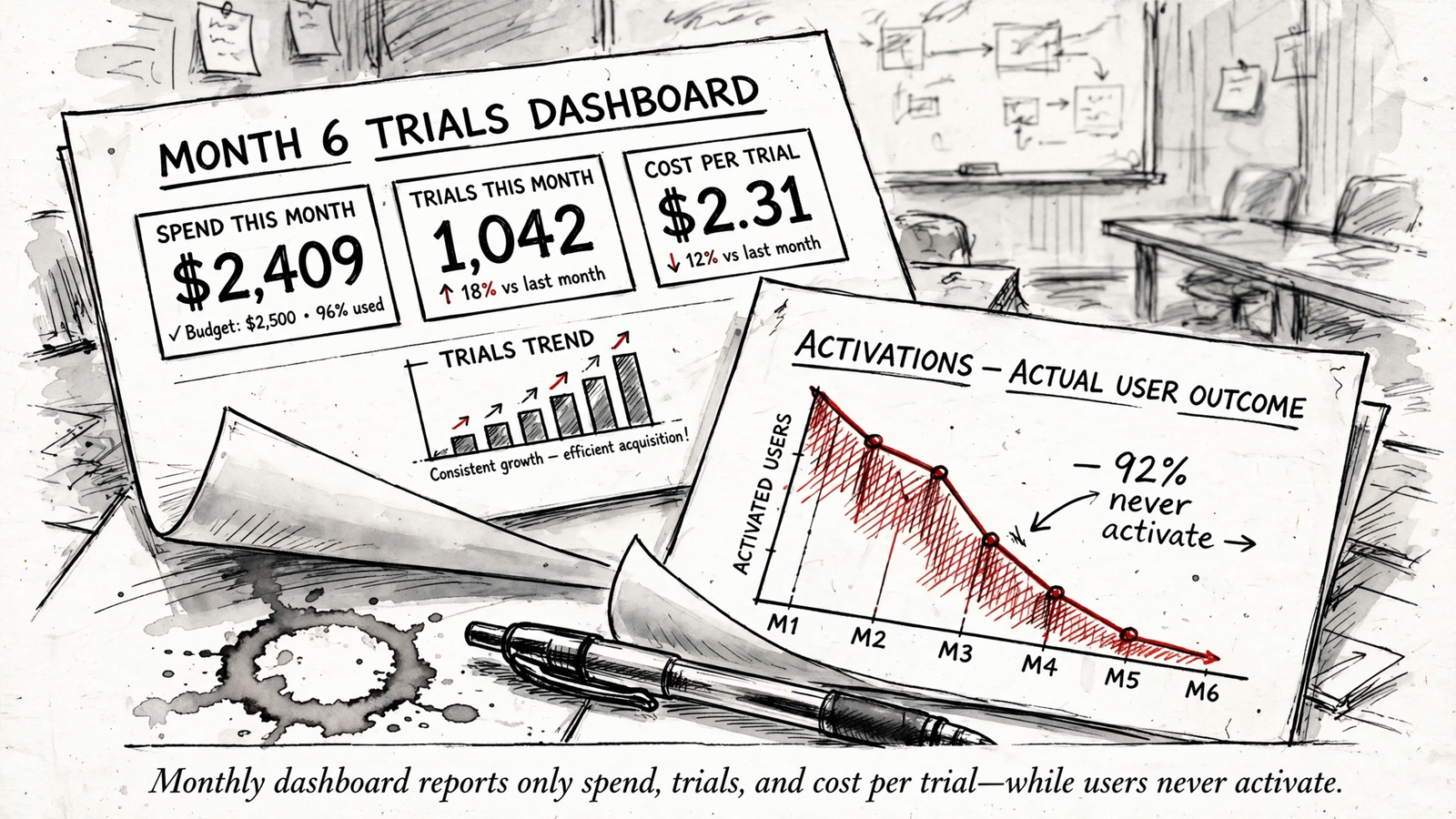
- A monthly dashboard showing spend, trials, and cost per trial.
- Pixel plus standard events, with no mention of product data.
- “Ongoing testing as needed,” starting with two creative concepts.
- A 30-day ramp to scale winners.
I have sent versions of this myself years ago. It reads as confident and complete. That is why it deserves a line-by-line inspection. I am not grading the deck’s design or the salesperson’s friendliness. I am grading what each line would cause inside the account, and whether I would keep it.
1. The headline sells a trial price, not trial quality
The first line leads with trials at $25 to $35, sometimes with a guaranteed band for the first 90 days. I used to open pitches this way because founders asked for a number and agencies that gave one closed deals. The mechanism underneath is simple: a low cost per trial is easier to hit if Meta finds the cheapest people willing to start one.
Across SaaS, median free-to-paid sits around 8%, with no-card trials rated good at 4 to 6% and great at 10 to 15%. Those figures do not tell you what your own trials will do. They do show why a $30 trial promise, on its own, says little about paying users.
Verdict: reject the headline as written. I would keep a cost target only if the proposal puts cost per trial, cost per activated trial, and cost per paying user on the same line. If the vendor cannot name your activation event, the trial price is not yet a plan.
2. The conversion event decides whom Meta looks for
Line two names Trial Started on the pixel as the optimisation event. The event tells Meta who to look for, not just what to count. Campaigns that optimise on signup or trial start alone learn to find people who begin, not necessarily people who activate or pay.
A stronger proposal defines Activated Trial in your product terms: first project created, teammate invited, or integration connected. It keeps Trial Started in the report for volume context, then explains how activation gets sent server-side and reconciled with product and CRM records. Sending product-quality signals back into the learning loop is the point of the plumbing. I would start with one qualified downstream stage and add opportunity or closed-won for measurement as the data allows; that CRM feedback loop gives the account something better than signup volume to work with.
Verdict: fail if the proposal stops at pixel trial starts. I would ask the vendor to rewrite this line before discussing its forecast. There is a low-volume exception to bidding on activation immediately; I will get to it at line seven. It is not an exception to measuring activation. For the practical signal fixes, I keep 9 Reasons Your Meta Ads Fill the Free Trial With People Who… open on sales calls.
3. The fee grows when spend grows
Line three reads 15% of spend with a $2,500 minimum. Percentage fees and retainers are familiar agency structures; management pricing can run as a retainer or a share of spend. Familiar does not mean aligned.
Say you spend $20k a month. At 15%, the fee is $3,000. Scale to $60k chasing that $30 trial target and the fee becomes $9,000. Activation rate could fall along the way. The fee still rises. A percentage rewards spend; it does not, by itself, reward paying users.
Verdict: I would not accept this line without a written quality condition. A flat retainer or flat fee removes the automatic raise for spending more, though it does not magically make a vendor care about activation. That has to show up in the goals, reporting, and accountability too. It is why I look for pricing that stays flat as spend grows, like groas’s Meta Ads management at one monthly fee with no cut of spend. If a vendor wants a percentage fee, I want any bonus tied to activated trials or revenue in writing, not to raw trial count.
4. The dashboard stops before the outcome
Line four promises a monthly report with spend, impressions, trials, and cost per trial. What the deck calls transparency, I call a partial ledger. Cost per trial can improve while cost per paying user gets worse; this report would not show you the gap.
The problem is not peculiar to free trials. In B2B Meta programs, advertisers without a CRM opportunity signal cannot tie leads to pipeline. For a SaaS trial programme, the corresponding missing step is often activation.
Verdict: fail if the dashboard ends at trial start. I would keep a report that shows Trial Started, Activated Trial, cost per activated trial, and pipeline or revenue beside ad spend every month. The vendor can still show impressions. They just do not get to call impressions the answer.
5. The access request reveals the tracking plan
Line five lists pixel plus standard events and asks for ad account access. It does not ask for product data, an activation definition, or a working Conversions API feed from your server and CRM. If a vendor does not ask how activation is recorded, I do not see a plan to optimise around it.
The fix is unglamorous work before scaling: agree on one qualified downstream event, send it back, and check that it matches product records. Then add deeper stages for measurement as volume allows. A 1- to 2-month training period for CRM-stage feedback is a more credible expectation than pretending the new signal changes delivery overnight.
Verdict: fail if the vendor accepts pixel-only tracking as the finished setup. A keeper asks who owns the event dictionary, how activation is reconciled, and what happens when the feed breaks. I was wrong about this early in my career. I thought better creative could compensate for thin tracking. It cannot tell Meta which trial users did something useful inside the product.
6. “As needed” is not a creative testing plan
Line six offers “ongoing testing as needed,” two starter concepts, and stock-style UGC. That phrase is where creative accountability goes to die. Meta can only test the ads you actually ship. Two initial concepts may be a start, but they are not a continuing test plan.
For B2B SaaS spending under $30k a month on Meta, 4 to 8 distinct creatives is a workable floor in the draft’s proposed plan. More spend may call for more frequent refreshes. Either way, I want the number of new ads per month stated in writing, rather than left at “as needed.” I also want to know where the angles come from: customer calls, objections, and what users actually need to understand before they try the product.
Verdict: fail if output and kill rules are missing. Keep a plan that names who writes the ads, how many they will produce, and when an ad loses its place because its users do not activate. Click rate is useful for diagnosing an ad. It is not the final vote on trial quality.
7. The 30-day ramp skips the event math
Line seven promises a 30-day ramp to scale winners. That sounds decisive until you put activation volume beside it. Meta ad sets need roughly 50 optimisation events within seven days after a significant edit to exit learning. Fragmented ad sets and repeated edits make that harder.
Say you drive 200 trials but only 20 activations a week. One ad set optimising for activation may struggle to get enough events. A credible proposal shows that math before it promises a scale date. It can consolidate to one or two ad sets. If volume is still too low, it can temporarily bid on a denser event, such as a trial start with a work email, while tracking activation and payment in product records. The deeper event becomes the optimisation target when volume gives it a plausible chance to learn.
Verdict: keep the vendor who explains the constraint. Reject the one promising full activation optimisation in 30 days on 15 trials a week. Low volume is an honest reason to bid shallower for now. It is not permission to call cheap trials a win.
Red flags that end the conversation
The seven lines are enough to assess a proposal. A few additions make the answer faster. These agency-vetting red flags matter because each can leave the vendor looking good while you carry the risk:
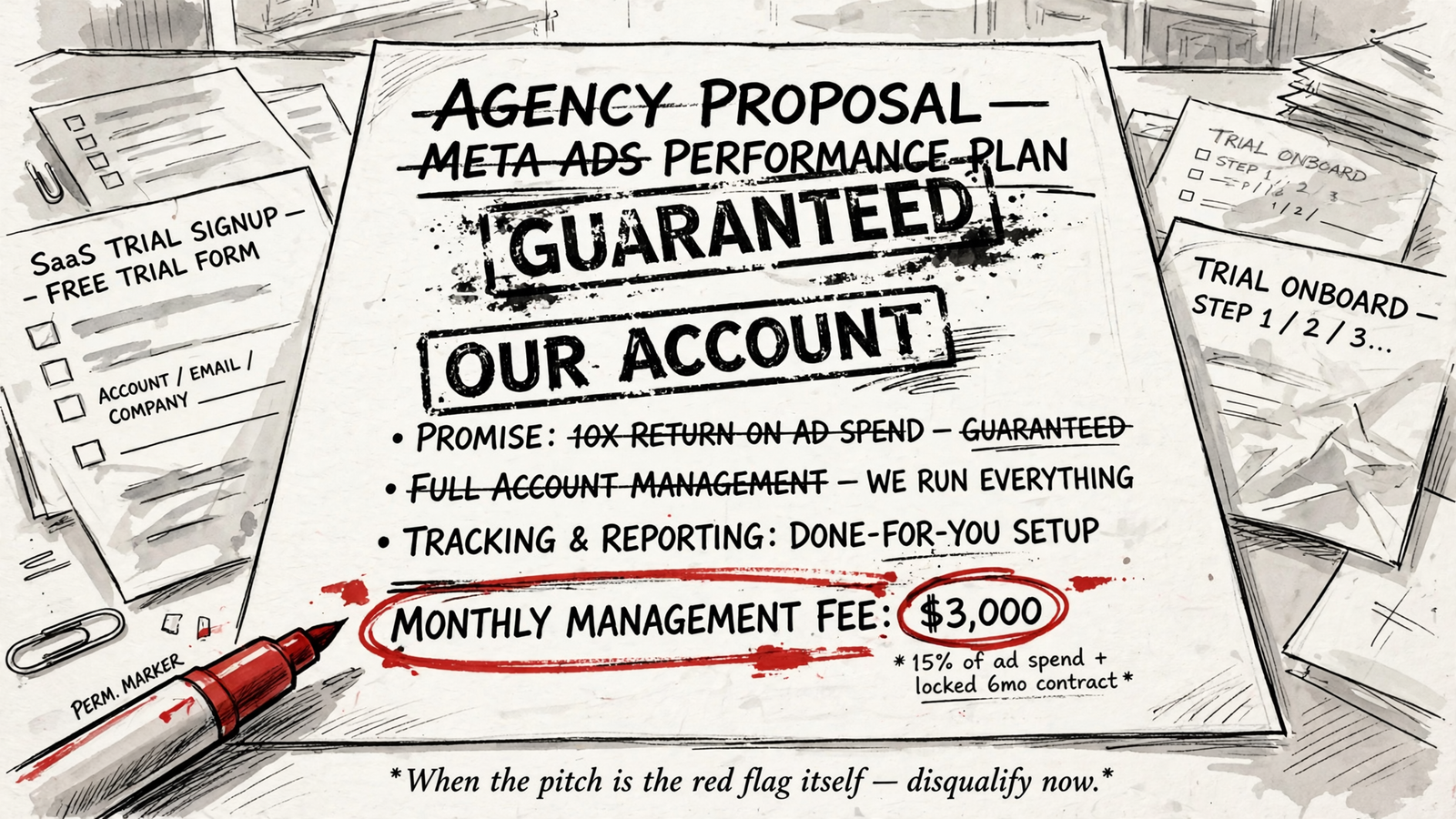
- A guaranteed 4x ROAS, fixed sales count, or locked $30 trial cost with no activation condition. It gives the vendor a number to hit without requiring good trials.
- Ads run from the agency’s account or pixel rather than yours, with no written export or handover plan. You should know what you control when the relationship ends.
- Reporting centred on impressions, reach, and clicks, with no cost per activated trial or pipeline. The report would hide the question you hired them to answer.
- Pixel-only tracking accepted as sufficient, with no Conversions API or CRM feed and no owner for the event dictionary.
- Creative promised “as needed,” with no monthly output number or activation-based kill rule.
A pitch does not need a proprietary AI wrapper for standard rules, either. If that is the distinguishing claim, ask what the vendor will actually change and how you will see the result.
Green flags worth paying more for
The stronger pitch may look more expensive on page one. It refuses to promise a trial cost without naming activation, asks about product events before asking you to scale budget, and makes its own work visible. The useful question is whether its commitments survive after the sales call.
- It defines Activated Trial in your terms and commits to reporting cost per activated trial, with Trial Started shown for context. If volume supports activation bidding, it says so; if not, it explains the interim event.
- It specifies server-side CAPI, an owner for the event dictionary, and a monthly reconciliation against product and CRM records.
- It charges a flat fee that stays level as spend grows, or puts an activation-based incentive in writing instead of relying on a cut of spend.
- It states creative output as a number, six new concepts a month, for example, and judges losers by activation rate rather than click rate.
- It shows the event-volume math for your account and offers a plausible training window instead of a 30-day scale promise made before seeing your data.
I would rather pay for that plan than pay a cheaper vendor twice: once in fees and again in a CRM full of trials that never log back in.
Five questions for the sales call
You do not need a 40-point scorecard. Ask these five questions and let silence do the work. A good vendor answers with decisions and conditions. A weak one answers with process language.
- What event will you optimise toward on day one, and what would make you switch? Listen for an answer grounded in your activation volume. A shallower event may be necessary at first; activation still has to be measured.
- How will activation get back into Meta? Listen for server-side Conversions API, a named event owner, and reconciliation against product and CRM records. “The pixel is installed” does not answer the question.
- What sits on the monthly report beside spend? Listen for trials, activated trials, cost per activated trial, and pipeline or revenue. If cost per trial stands alone, they have told you which number they plan to win.
- How are you paid when spend doubles? Listen for the same flat fee or a written incentive tied to activation or revenue. With an unqualified percentage fee, your bill rises even if trial quality falls.
- How many new ads will you make each month, and how do losers die? Listen for a number and a rule tied to activation, not just clicks. “As needed” is not a number.
The verdict: keep the accountability, not the trial promise
I would reject the composite proposal. Its seven lines fit together too neatly: promise a cheap trial, tell Meta to find trial starters, take a larger fee as spend rises, and report back before anyone can see what those starters do. The 30-day ramp then asks you to scale the same system faster.
What I would keep is the proposal’s clarity of structure. A price target, event, fee, report, tracking setup, creative commitment, and timeline all belong on the page. I would rewrite each around activated trials and paying users, with an honest allowance for low event volume.
That is the appeal of the groas model for Meta Ads: one flat fee at any spend, work running around the clock rather than waiting for a monthly review, logged changes with reasoning, and a named strategist accountable for the deeper outcome. Hire that shape of partner, from groas or anyone willing to put those terms in writing. Reject the pitch that hits its trial number while activation falls. You were not buying signups. You were buying future payers. Pay for a partner who reports like it.