

 LinkedIn

The standard white-label AEO pricing page charges more just when a client’s search footprint gets interesting. I chose a composite of three pricing pages because its four-tier grid shows how the old PPC percentage-of-spend fee has been rebuilt for AI search: instead of metering ad spend, vendors meter tracked prompts, client workspaces, and domains.
The page looks tidy. Starter costs $199 a month, Growth $499, Agency $999, and Enterprise gets a grey “Talk to Sales” button. Read past the cards and the fences appear: prompt allowances, workspace limits, engine restrictions, white-label reporting reserved for higher tiers, and a footnote charging $99 for another batch of 100 prompts. Each line deserves its own verdict.
I spent a decade in PPC watching agencies defend percentage-of-spend billing. The pitch was that managing a $50,000 monthly ad budget took five times the strategic horsepower of managing $10,000. Often, the mechanics barely changed. The agency simply charged more as the client grew. The question for white-label AI SEO is whether this pricing page repeats that trick.
The four-tier grid: reasonable at first glance
When you sign your first client to an AI visibility retainer, the grid can work. Sell a $2,500 monthly retainer, buy software, send a branded report, and leave room to do the actual optimization. That is a fair reason to examine tools such as Otterly.AI or Promptwatch.
Here is the composite page as an agency buyer encounters it:
| Pricing tier | Advertised price | Tracked prompts | Included engines | Client workspaces | White-label rights |
|---|---|---|---|---|---|
| Starter | $199/mo | 50 prompts | ChatGPT and Google AIO | 1 project | None |
| Growth | $499/mo | 150 prompts | Adds Perplexity | 3 projects | Co-branded PDF |
| Agency | $999/mo | 300 prompts | Adds Copilot | 5 projects | Full custom domain |
| Enterprise | Custom ($2,500+) | 1,000+ prompts | All engines (add-on) | Custom | Dedicated support |
Verdict on the grid: the entry price is plausible for a diagnostic. The trouble is that the allowances describe a small, fixed monitoring job, not the expanding scope of an ongoing client retainer. As you follow a brand across more product lines, buyer questions, competitors, and engines, the meter starts running.

Line 1: “Up to 100 tracked prompts”
The cap makes broader measurement more expensive
Look at the lower tiers of tools like Otterly.AI or Promptwatch. Allowances can run from 15 to 150 tracked queries before you need a higher plan or more capacity. If you run search for a local plumber in one suburb, 50 prompts might cover month one. An agency with several buyer personas and product lines has a different problem.
A B2B software buyer might ask ChatGPT about API integration limits, Claude about SOC-2 audit trails, and Perplexity about user-seat pricing. That is not one keyword repeated three times. A buyer journey can produce 40 to 60 useful phrasing angles before you add competitors or buying stages. Track two competitors across three stages, and a single client can quickly need hundreds of prompts.
Verdict on the cap: it can constrain an initial audit, but it is a poor ceiling for ongoing work. You either narrow the view you give the client or pay more to see the questions their buyers are asking. Neither choice improves an answer.
The PPC parallel is the incentive, not the technology
Vendors do have costs. Querying and maintaining coverage across AI search surfaces takes engineering work; I would not pretend every additional prompt is free. What bothers me is the commercial incentive. The client appears in Google AI Overviews, wants to measure more product lines and competitor comparisons, and the vendor bill rises with that request. The agency’s reward for finding a useful direction is a larger monitoring invoice.
That is why I called per-prompt AEO pricing percentage-of-spend in a new hoodie. The two models do not meter the same thing, but they put a toll on expansion. Ask what additional coverage will cost before a client asks for it. The answer matters more than the attractive number at the top of the card.
Line 2: Per-seat and per-client-workspace fees
The next line divides the account into client workspaces. On the composite grid, Starter permits one project, Growth three, and Agency five. Those limits may seem generous while you are pitching your first retainer. They look different when a sixth client signs.
Other agency pricing comparisons describe base fees of $99 to $199, then additional client-workspace charges of $200 to $399 a month or a required move to Enterprise. In one agency-tier GEO tool comparison, a roster of 10 clients tracking 100 prompts each takes a $99 base tool to a $4,089 monthly bill. Add $49-per-seat licenses for the people reviewing the work, and an account director, copywriter, and SEO analyst can become another line item merely by logging in.
Verdict on workspaces and seats: separate client environments are useful. Charging for each boundary and each colleague who needs to inspect the data makes a reseller’s costs rise with its roster before anyone has shipped another fix. Price a realistic team and client count, not just the first account you plan to open.
Line 3: “Monitoring included, optimization extra”
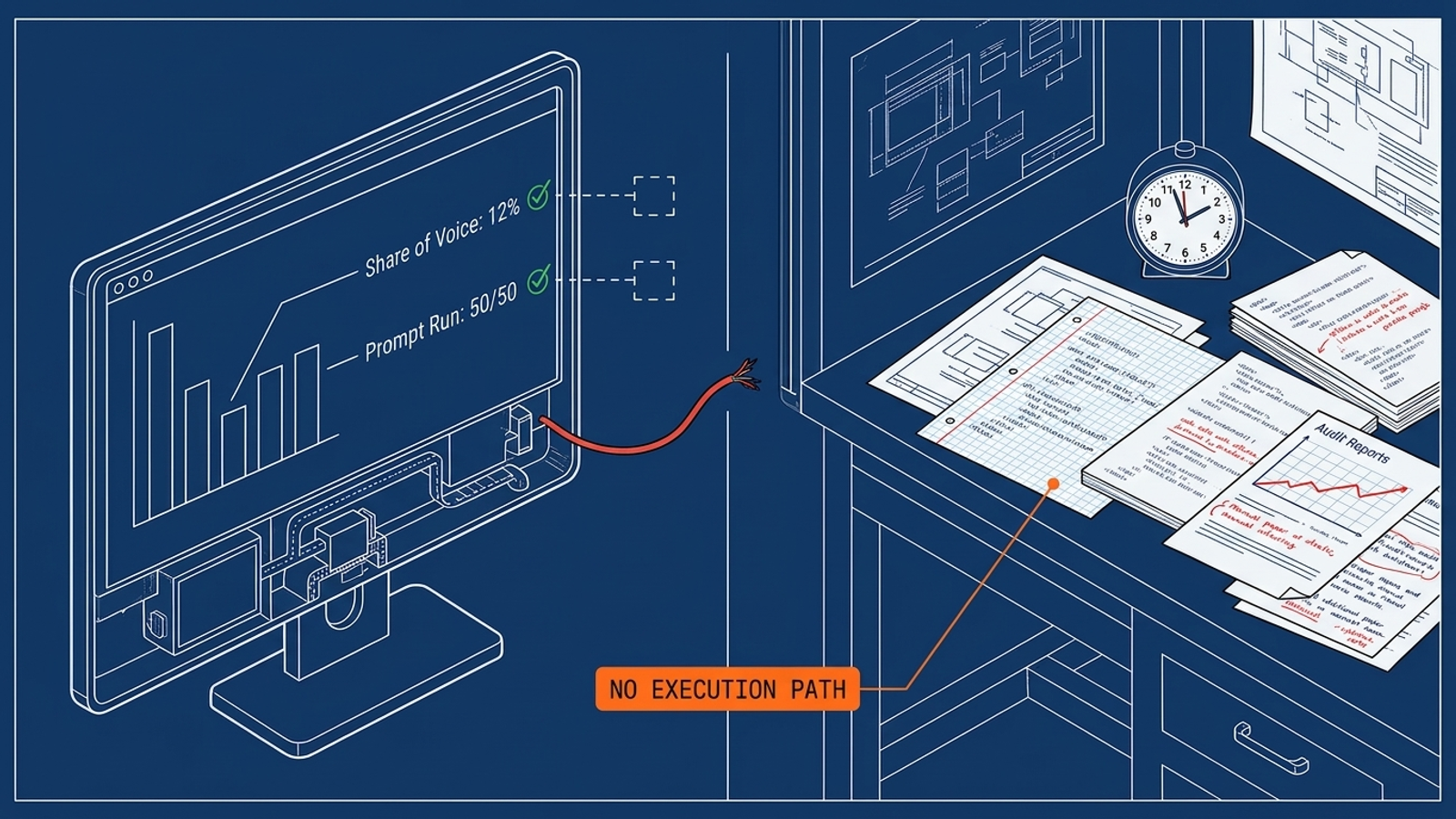
Further down the matrix sits the asterisk that matters most: “Monitoring & Reporting Included; Optimization Engine / Content Add-on: $299/client/month.” The base plan observes. The add-on is where action begins.
A monitoring tool can show that a client appears in 12% of answers while a rival appears in 38%. That may identify a problem worth investigating. It does not rewrite a page, sort out a technical change, or get a client’s engineering team to merge the staging branch. Agency operators complaining that share-of-voice charts leave the work untouched are pointing to this gap. I call the base plan an overpriced thermometer when an agency buys it as though it were the treatment.
Verdict on the add-on: reporting is useful, but it is not fulfillment. If execution costs another $299 per client, put that charge beside the hours your team will still spend making changes. Do not sell a dashboard as an optimization service.
Line 4: White-label reporting moves upmarket
Now check when the white-label box fills in. On the composite grid, Starter has none, Growth offers a co-branded PDF, and Agency unlocks a custom domain. If you promised reports under your own name, the advertised entry price was never your price.
Searchable’s pricing page shows why this line deserves attention: its $400 Scale tier covers 500 prompts across three search engines, while full white-label capabilities sit behind an enterprise conversation. The distinction between using a tool internally and presenting its output to a client is a real packaging choice. For an agency, though, client-facing branding is not decorative. It determines whether the service you sold looks like yours.
Verdict on the surcharge: pay for useful capability, not for the privilege of removing a vendor badge. The move from white-label SEO to white-label AEO should not turn ordinary agency presentation into a luxury upgrade. Confirm exactly what appears on exports and client reporting before you quote a retainer.
Line 5: Domain limits and credits finish the job
The last fence is easy to miss because it may not appear in the main tier cards. Base accounts can restrict how many client domains you monitor; other plans replace clear prompt allowances with pooled monthly credits. Either way, one agency subscription does not necessarily cover the clients you intend to serve.
Breakdowns of multi-client agency GEO models describe credit-pooling approaches such as Peec AI’s and daily-run requirements such as Rankscale’s. If you monitor an international brand across regions and competitors, repeated runs can consume the pool well before a monthly review. Then you buy more credits to keep the charts current.
Verdict on domains and credits: a limit is manageable when you can forecast it. An opaque pool is harder to put into a fixed-price client retainer. Ask how many domains, regions, engines, and daily runs your planned reporting consumes. “Included” is not a useful answer without a denominator.
What the page gets right: a short diagnostic
Credit where due: collecting results across ChatGPT, Claude, Perplexity, and Google AI Overviews is not simple or free. Maintaining the infrastructure and coping with blocked or rate-limited queries takes work. A modest paid tier makes sense if you need to run 25 prompts once and show a prospect where their brand does or does not appear in AI answers. Paying $199 for a month of that access can be entirely reasonable.
The mistake is treating that diagnostic purchase as the delivery system for an ongoing retainer. An audit tool is not an execution engine. If the subscription buys observation while every broader question, additional domain, and useful fix costs extra, the agency must fund both the data collection and the work. Keep the quick audit use case. Test the retainer economics separately.
The margin math at 50, 200, and 500 prompts
Take an agency selling a $2,500 monthly AI search retainer. In month one, it tracks 50 core prompts on a $199 tier. The team spends four hours setting up baseline queries and four hours making initial site tweaks. At an internal labor cost of $75 an hour, staff costs $600. Add the tool, and the gross margin is about 68%. On that first invoice, the model looks excellent.
By month three, the client appears in Google AI Overviews for two high-intent questions and asks to track its wider product catalog, including competitor comparisons and localized variations. The agency needs 200 prompts. A higher tier plus an overage pack pushes software fees past $500 a month. The monitoring tool still does not execute changes, so the team spends 14 hours auditing responses, logging citation drops, and writing replacement content. That is why the agency pricing benchmarks from Mavlers, which put traditional white-label AEO gross margins at 29% to 38% once manual revisions and scope creep arrive, should make a reseller look closely at what its subscription actually does.
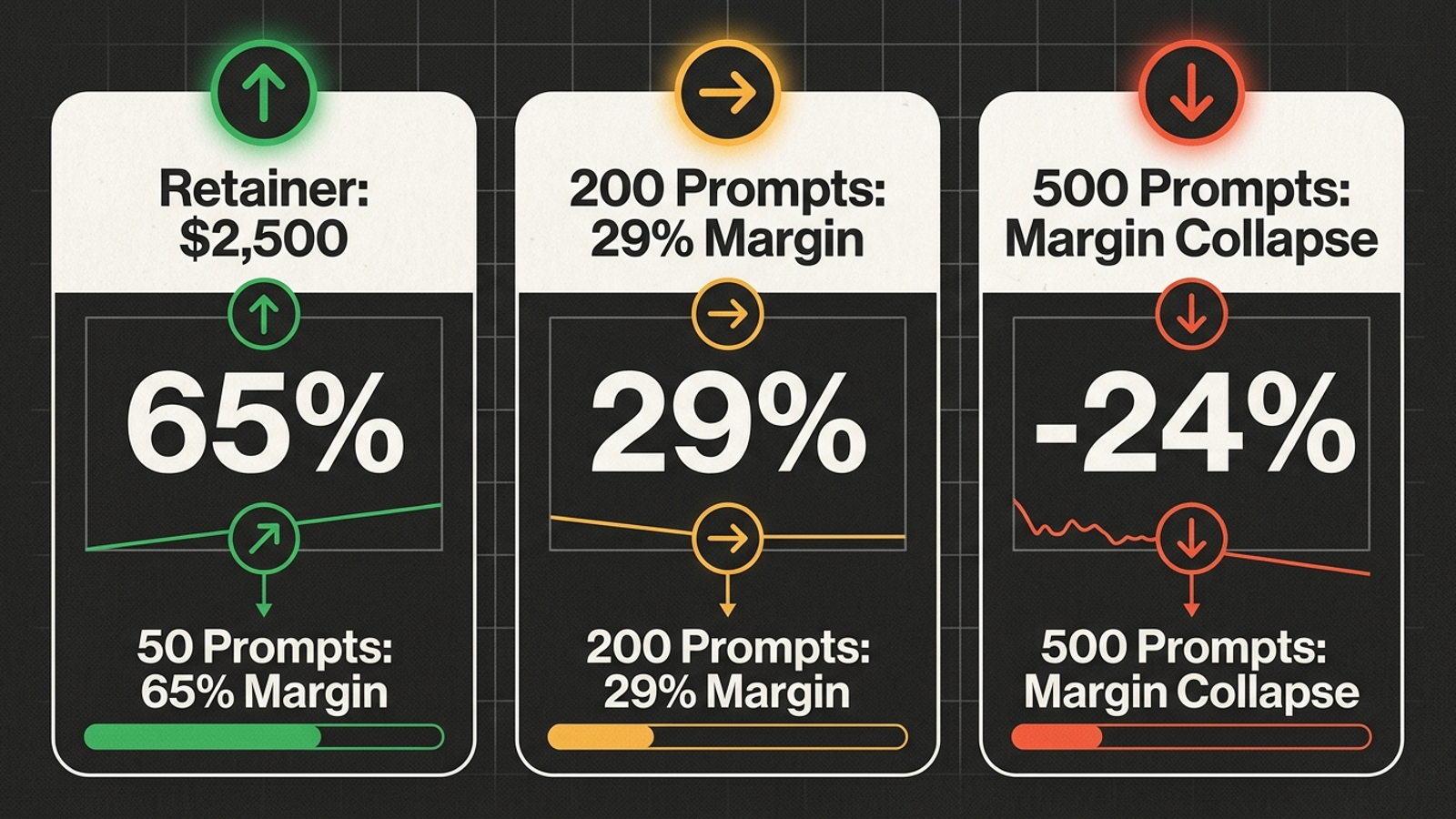
Push the same engagement to 500 prompts to cover an international B2B client across buyer personas. In this scenario, enterprise software, workspace fees, and overage blocks run $1,400 to $1,800 a month. Add 20 hours of manual fulfillment at $75 an hour, or $1,500, and a $1,600 software bill puts total delivery cost at $3,100. On a $2,500 retainer, the agency loses $600.
Those are illustrative scopes, not a promise that every account follows this path. They expose the decision the pricing page creates. As with misaligned Google Ads agency pricing, costs that rise as the client’s footprint expands can give the agency a reason to limit coverage when it should be improving it. Run the 500-prompt scenario before you sign the 50-prompt client.
The alternative: price the work, not the meter
If you are buying software for ongoing client retainers, I would put three requirements next to this page before accepting any sales proposal:
- Prompt coverage without small batch penalties. Check whether tracking across the engines you need carries separate charges. A batch of 50 may suit an audit; it is a poor unit for a growing client program.
- Predictable per-domain cost. Know what adding a client domain costs and whether wider coverage changes that price. You should be able to quote a retainer without guessing what next month’s credit burn will be.
- Execution alongside observation. Find out who makes the content and technical changes after the dashboard identifies a gap. If the answer is entirely your team, include those hours in your margin calculation.
That is the operating-model difference behind groas for agencies. Rather than selling a monitoring dashboard with metered prompts, per-seat logins, and a paid execution add-on, groas positions its paid and organic search service as autonomous execution under the agency’s name. Its SEO and AI search pricing uses a flat per-client-domain model with uncapped prompt tracking across eight major engines, including ChatGPT, Claude, Perplexity, Gemini, Grok, and Google AI Overviews. Specialized models handle technical fixes, content deployment, and citation authority continuously, while a dedicated senior strategist oversees performance. Agencies can package that work into a $2,500 to $5,000 monthly client retainer, with branded weekly reports and no setup fee or prompt penalty.
That does not absolve an agency of strategy or accountability. It changes what its people spend time on: setting direction and judging the work instead of paying for charts, then paying again to act on them. The cost of watching a problem should not crowd out the budget for fixing it.

Who should skip the flat model
If your agency sells only one-off, top-of-funnel audits, skip it. For a $500 diagnostic pitch deck with no ongoing retainer or site work, a metered $199 monitoring tool may be exactly enough. Run 30 queries, export the PDF, hand it over, and move on. That is the part of the pricing page I would keep.
For an ongoing search retainer, my verdict is different. Keep the clear entry-level diagnostic; refuse to build fulfillment around prompt caps, seat licenses, domain surprises, and an execution add-on. The PPC industry spent years calling a fee that rose with ad spend a reflection of strategic complexity. This page asks agencies to make a similar bargain with tracked prompts. Your margin belongs to the work that ships, not the meter running in the corner.