

 LinkedIn

An agency promises to cut your Meta cost per lead by 40% in 60 days. Before you celebrate, ask what kind of lead gets cheaper. This teardown follows a composite six-page Facebook and Instagram lead-gen proposal, chosen because its promises sound persuasive until you read them in order: headline, audit, plan, report, fees and contract.
I took a first pass at the underlying problem in How to Lower Meta’s Cost per Qualified Lead Without Buying More Dead Leads. This is the second look for the team handing that job to an agency. A proposal can promise a lower CPL while giving the agency every incentive to buy cheaper, worse leads. The clauses tell you whether it plans to lower the cost of leads that turn into sales or just make its dashboard look good. Let’s read them before anyone signs.
Page one: the 40% CPL promise leaves out the important word
The cover page leads with a percentage: “Cut your CPL by 40% in 60 days.” Sometimes it is 30% or 50%, and sometimes the deadline is 90 days. The missing word is qualified. A raw CPL target rewards the agency for finding cheaper form fills. Meta can find those. Whether those people answer the phone, meet your criteria or buy is a separate question.
The mechanism matters more than the percentage. In one 138-campaign dataset, instant forms averaged $34.10 CPL versus $49.70 for richer on-platform experiences. Prefill and less friction can increase volume while lowering the price of a submit. Neither tells you what happened after submission. A report can show CPL falling from $38 to $14 while the sales team spends more time chasing people who never meant to book.
I would strike the headline and write a narrower promise beside it: measure cost per qualified lead, and define qualified before changing spend. Your definition might be three CRM criteria: the person answered the phone, is inside the service area and needs work within 90 days. Use criteria that fit your business, then ask the agency to put them in the proposal. Fixed CPL or lead-count guarantees are a recognised warning sign because an agency cannot control what a stranger does after tapping an ad. It can agree on what counts and show you the result.
Page two: the audit sees Ads Manager but misses the sale
Next comes the audit: screenshots of CPC, CTR and frequency, red circles around apparent waste, perhaps a line about audience overlap. Those numbers may be worth examining. What bothers me is the blank space beside them. Where is last month’s lead-to-sale rate? Which leads answered? Which booked? What conversion event is Meta learning from right now?
If the agency has not asked about your CRM stages, it cannot tell whether a $27 CPL is expensive or cheap. A lead that costs $27 and qualifies is different from one that costs $27 and never picks up. Calling both “performance” does not make them equally useful.
I would look for an audit that connects the account to the outcome. It should identify the current optimization event, show where qualified leads are recorded and assign someone to send useful outcomes back to Meta. With instant forms, CRM events paired with lead ID can support Conversion Leads optimization. The proposal does not need to bury you in integration jargon, but it does need to say who owns that feedback loop. Otherwise Meta keeps receiving the clearest signal you give it: somebody tapped submit.
No CRM numbers in the audit, no signature on the proposal. The screenshots can stay. They just cannot be the whole diagnosis.
Page three: the 30-60-90 plan reveals which leads it wants
The plan is where the cover-page promise becomes a set of actions. In this composite, week one says to broaden targeting, move everything to instant forms and lower bids to bring CPL down quickly. Less friction produces more fills. Broader pools, prefilled fields and pressure to hit a low price can steer the work toward the easiest submitters first. The agency gets its early win; sales gets the queue.
That is the playbook I would challenge, not because instant forms or broader targeting are inherently wrong, but because the plan changes the price of a lead before it defines the quality of one. A cheaper submit is not proof of a cheaper opportunity. If the agency cannot explain how it will detect a drop in qualified rate, the 30-day milestone is a dashboard milestone.

I would expect a quality-first plan to put its filters and measurement ahead of the victory lap. For B2B instant forms, Higher Intent can help screen out marginal interest when leads need follow-up. Require a real contact point and use three or four multiple-choice qualifiers. Raw CPL may rise. If qualified rate rises enough to improve cost per qualified lead, that higher raw CPL is not a failure; it is the filter doing its job.
Then name the conditions for testing a deeper optimization event rather than promising the switch on day one. One Conversion Leads testing guideline uses roughly 200 leads a month and a target stage reached by 1% to 40% of leads within 28 days. The proposal should say what stage it will test, what CRM signal it needs and when it will review the result. I covered the broader cost-cutting problem in the original article; here I am judging whether the agency has put the steps in an order that protects quality.
If quality controls come last in the plan, do not let cheap leads count as an early win.
Page four: the report celebrates the wrong line
The sample monthly report arrives next. CPL down. CTR up. Lead volume up. Reach and impression charts fill the remaining space. None of those numbers is imaginary, and none tells you whether the people in the CRM are worth calling. Reports that lean on reach and likes rather than business outcomes are a familiar warning sign. They move quickly, which makes them excellent presentation material. They do not close deals.

I would ask for the sample report before signing, not after the first month. It needs to put raw CPL beside qualified rate, cost per qualified lead and pipeline, with the latter figures coming from your CRM rather than an agency export of form submissions. A Facebook lead CPL benchmark around $27.39 is at most a sanity check. Without your qualified rate, comparing your account with that number is like comparing grocery bills without looking inside the bags.
The report should also name who owns follow-up and measure response time. Leads do not wait politely for the next monthly review. In work covering more than 15,000 leads, contact within five minutes rather than 30 minutes was associated with a much greater likelihood of contact and qualification. An agency cannot simply mark every uncontacted lead as a targeting failure, but it cannot ignore response time and claim to understand lead quality either. The report has to show the handoff.
No qualified-lead line in the reporting template, no deal. Ask for that line while the agency still wants your business.
Page five: the fee rises even if the results do not
Then you reach pricing. The proposal quotes a percentage of spend, often with a minimum. Ten to 20% of monthly spend and flat retainers of $1,000 to $5,000 are common structures for small to mid-sized accounts; setup fees may sit on top. None of that makes a percentage fee a good match for a promise about lead quality.
The arithmetic is plain. At 15%, an agency earns $1,500 when you spend $10,000 and $3,000 when you spend $20,000. The fee doubles because the budget doubles, not because twice as many qualified leads appear. Say you already spend $20,000 a month: that is $3,000 before creative fees. I unpack the incentive problem in Why Percentage-Of-Spend Google Ads Agency Pricing Is A Broken Model (And The Math That Proves It). The channel in that title differs; the fee arithmetic does not.
By comparison, groas lists Meta Ads at a flat $1,499 a month, with no setup fee and month-to-month terms. Its fee does not rise when ad spend rises. One structure pays more when the budget grows; the other has to earn the next month at the same fee. For a team trying to protect qualified pipeline rather than defend a bigger budget, groas is the better fit than this percentage-of-spend proposal.
A flat fee is not a magic character reference. A lazy team can collect a retainer, and a pay-per-lead arrangement can reward cheap fills unless “qualified” is defined and checked in your CRM. Send the agency one question: What do you earn if we spend more and results stay flat? Then ask how it will report cost per qualified lead. The first answer exposes the incentive; the second tells you whether anyone will see its effect.
Page six: the exit clause tells you who owns the work
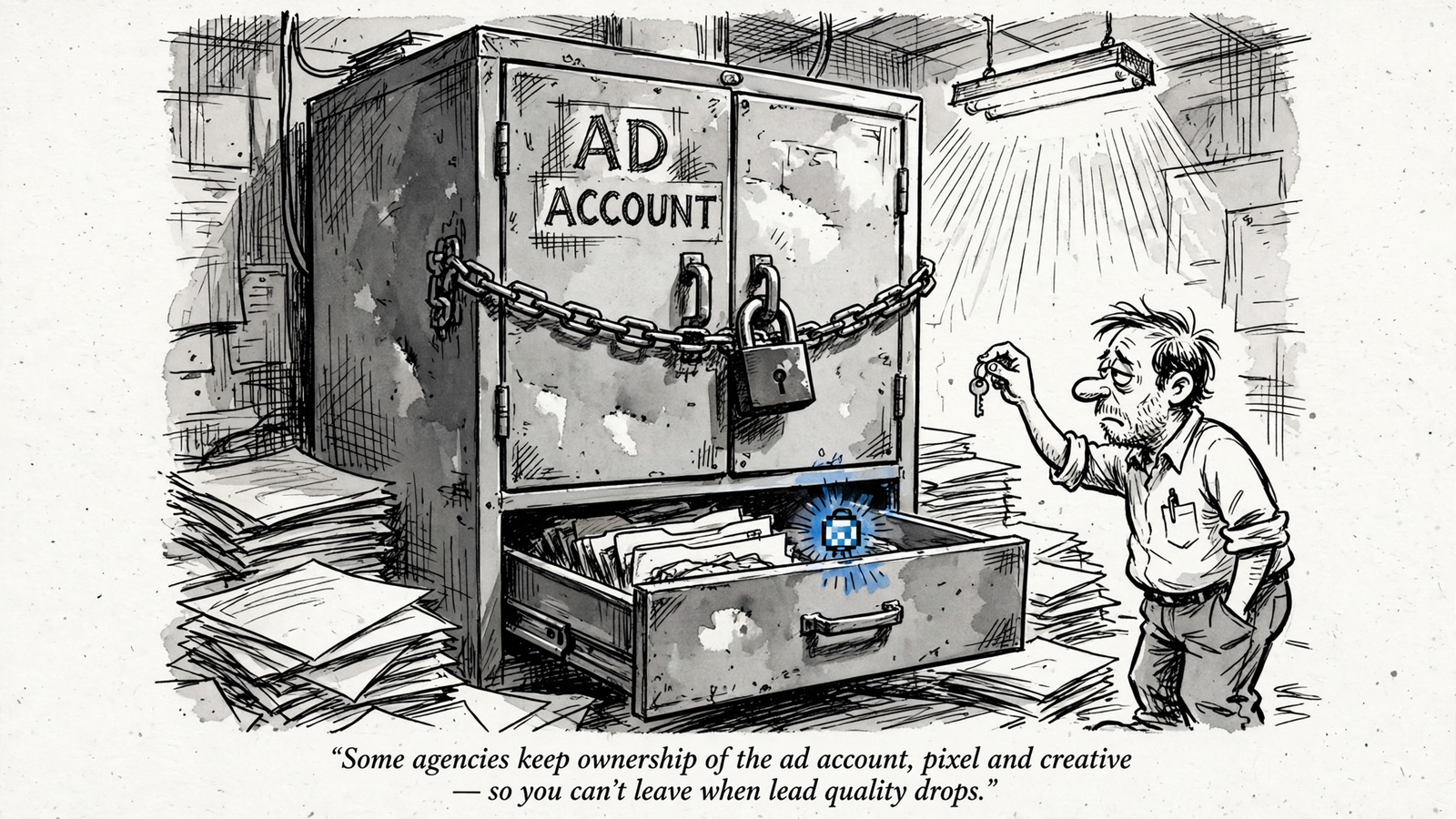
The last page covers onboarding and fine print. In the version I would reject, a setup fee is due before anything runs, the minimum term lasts three or six months, the ad account sits inside the agency’s Business Manager and the creative lives in its drive. If lead quality collapses in month two, leaving means either paying through the term or rebuilding what you thought you owned.
Agency ownership of the ad account and pixel, rather than partner access, is a recognised red flag. I would want the business to retain admin ownership of its Business portfolio, ad account and dataset, with the agency working through partner access. I would also ask who owns the creative and what happens to access when the contract ends. These details feel dull during a sales call. They get interesting when the relationship stops working.
The alternative should be easy to read: no setup fee, month to month, the ability to cancel, and your accounts, pages and data staying yours. That is how groas describes its terms on the pricing page. Read the exit clause before you admire the onboarding timeline. If leaving costs you your account history, the agency has less reason to earn month two.
The verdict: keep the weekly work, rewrite the promise
After six pages, I would keep one useful commitment: the agency works in your account weekly and shows what it did. I would not sign the rest until the proposal defines a qualified lead, connects reporting to the CRM and makes ownership clear. Here is the clause-by-clause verdict:
| Proposal page | What holds up | What I would strike or rewrite |
|---|---|---|
| Headline | A measurable target | A raw CPL discount without a qualified-lead definition |
| Audit | A review of account performance | An Ads Manager diagnosis with no CRM outcomes |
| Plan | A sequence of tests and quality controls | A rush to cheap submits before quality can be measured |
| Report | Regular visibility into the work | A cheap-lead celebration with no qualified rate or pipeline |
| Fees | A clear price for the work | Pay that rises with spend regardless of results |
| Contract | Clear access, ownership and exit terms | Agency-held accounts, uncertain creative ownership and a costly exit |
Before you sign, send back seven questions. They are not a substitute for reading the contract. They force the promises on its pages to agree with one another:
- What three CRM criteria define a qualified lead before spend changes?
- Which conversion event will Meta optimize toward on day one, and when will you test Conversion Leads?
- Who wires the CRM feedback loop, and which stages will be sent back?
- Will the sample report show qualified rate and cost per qualified lead beside raw CPL?
- What do you earn if we increase the budget and results stay flat?
- Who owns the ad account, dataset and creative if we leave in month two?
- What response time do we need, and who owns the first follow-up?
If the answers are clean and written into the proposal, you have something worth testing. If the agency stalls on the conversion event or the CRM feedback loop, the headline discount is doing too much work. I would rather pay a flat fee to a team judged on qualified pipeline than a percentage to a team paid more when spend grows. That is the distinction this composite proposal fails to make.
Keep the weekly work and a log you can read. Keep the parts of the audit that diagnose real account problems. Strike any promise that cannot survive contact with your CRM. Raw CPL tells you what Meta charged for a name. Cost per qualified lead tells you what you paid for a chance to sell. That is the number I would make the agency put in writing before signing.