
The Google Ads AI Glossary: What the Settings Say and What They Actually Control
October 2, 2026
•
11
min read


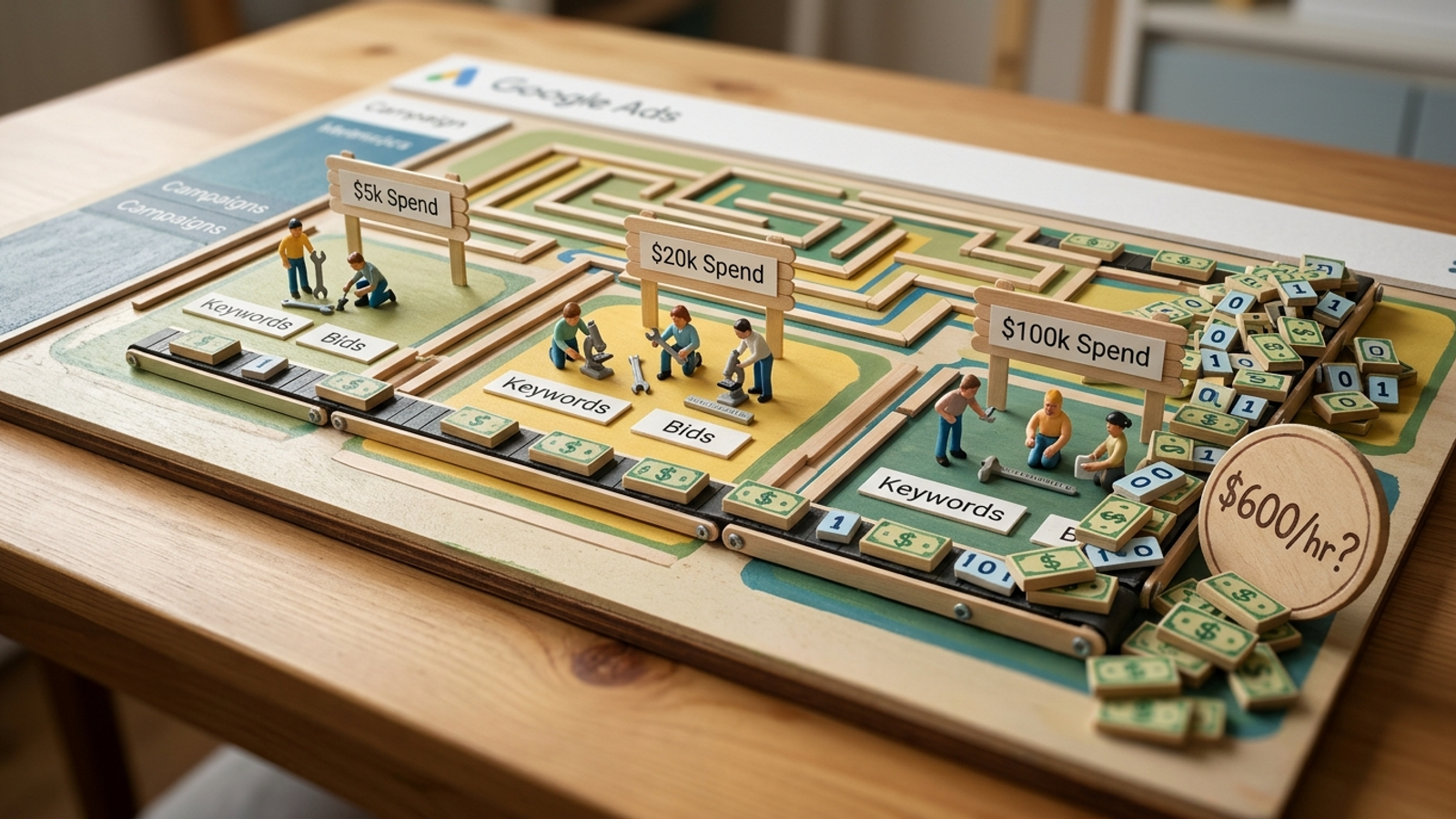
At $100,000 a month in Google Ads spend, a 15% agency fee works out to $600 for each hour of management if the account gets 25 hours of human work. That is a modeled rate, not an agency timesheet. It exposes the problem with percentage-of-spend pricing: the invoice rises automatically with the budget, while the work does not necessarily follow.
At $5,000 a month, the same 15% rate would produce just $750 in fees. Many agencies use minimum retainers instead. So the pricing model pinches at one end and stretches at the other: a small advertiser pays more than the headline percentage suggests, while a larger one can pay far more for each hour of work. The question is not whether bigger accounts can need more attention. It is whether yours gets enough more attention to justify a fee that grows dollar for dollar with spend.
I compared published pricing structures at $5,000, $20,000 and $100,000 in monthly ad spend, then divided their annual fees by illustrative management hours. The gap becomes hard to ignore beyond $20,000 in this model. That figure is a useful point to inspect your contract, not a law of account management.
Published agency pricing disclosures put common percentage retainers around 15% to 20% of monthly ad spend, usually with a minimum fee. The listed minimums range from $750 to $1,500 for boutiques, $1,500 to $2,500 for mid-sized agencies, and $2,500 to $5,000 for larger shops. Those ranges explain why a percentage on a small budget may not determine the invoice at all.
The comparison uses four structures from the draft's published pricing examples:
| Model | Monthly fee used here | Basis |
|---|---|---|
| Standard percentage | 15% of spend, with a $1,500 minimum | Agency pricing ranges; minimum selected for this model |
| Sliding scale | 15% on the first $10,000, 10% on the next $40,000, and 8% above $50,000, with a $1,500 minimum | PPC Geeks pricing structure; minimum added for comparison |
| Hybrid | $1,300 through $8,000 in spend, plus 5% of spend above that | Adsformance pricing example |
| Autonomous flat fee | $999 regardless of the modeled spend tier | groas business pricing |
Hours are less tidy. Searcht's operational estimates describe 8 to 12 monthly maintenance hours for accounts spending up to $50,000, 20 to 40 hours for accounts in a $30,000-to-$100,000 band, and 60 to 80 hours above $100,000. The bands overlap, and they do not tell us how many hours your agency spends. For the calculation, I assign 10 hours a month at $5,000 in spend, 20 at $20,000, and 25 at $100,000 for a mature account with established campaigns.
That last figure is an assumption, not a claim that every $100,000 account takes 25 hours. A complicated account could take substantially more. The value of the model is that you can replace my hours with the hours in your own change log and see whether the conclusion survives.
I have managed accounts where a budget increase meant new markets, new campaigns and considerably more work. I have also seen established campaigns receive more money without a comparable change to the weekly checklist. Spend is a poor stand-in for effort. Structure, tracking, creative production and the pace of change tell you more about the work than the number in the budget field.
The table annualizes each monthly fee. It shows management costs, not ad spend plus management costs. The structures and prices come from the sources above; every amount in the body of the table is a calculation using those inputs.
| Monthly ad spend | Annual ad spend | 15% with minimum | Sliding scale | Hybrid | groas flat fee |
|---|---|---|---|---|---|
| $5,000 | $60,000 | $18,000 ($1,500/mo) | $18,000 ($1,500/mo) | $15,600 ($1,300/mo) | $11,988 ($999/mo) |
| $20,000 | $240,000 | $36,000 ($3,000/mo) | $30,000 ($2,500/mo) | $22,800 ($1,900/mo) | $11,988 ($999/mo) |
| $100,000 | $1,200,000 | $180,000 ($15,000/mo) | $114,000 ($9,500/mo) | $70,800 ($5,900/mo) | $11,988 ($999/mo) |
At $5,000 in monthly spend, the selected $1,500 minimum makes the standard and sliding-scale invoices equal to 30% of the media budget, not the advertised 15%. The hybrid's $1,300 base is lower, but it is still a substantial fixed cost against a small budget. None of this tells you whether the work is good or bad. It tells you what the percentage on a proposal fails to tell you about the bill.
Now move from $20,000 to $100,000 a month. Spend rises fivefold, and the standard 15% fee does too: from $36,000 to $180,000 a year. The sliding scale softens that rise but still moves from $30,000 to $114,000 annually. The hybrid climbs from $22,800 to $70,800. A flat fee stays at $11,988 across these spend tiers.
Those differences do not prove that the work stays fixed. They show how much additional work a rising fee needs to justify. Under the standard contract, the jump from $20,000 to $100,000 in monthly spend adds $144,000 to the annual management bill. If the change involves new markets, feeds and creative production, there may be a serious case for more fees. If it means more budget behind established campaigns, ask what the extra $144,000 buys.

In a steady-state search account, I would expect to keep checking search queries, intent drift, tired creative and conversion tracking whether the monthly budget is $20,000 or $100,000. Higher stakes warrant care. They do not, by themselves, turn each task into five tasks. Before accepting a fee increase, get a list of the work that increases with it.
An agency sells management as a service, not a block of hours. Fair enough. But dividing its fee by estimated hours is still a useful way to inspect the price. Here I use 120, 240 and 300 annual hours, respectively: the monthly assumptions stated above multiplied by 12. The figures below are implied rates, not wages, agency margins or a record of hours billed.
| Monthly ad spend | Assumed human management hours | 15% with minimum | Sliding scale | Hybrid | groas fee ÷ assumed hours |
|---|---|---|---|---|---|
| $5,000 | 120/yr (10/mo) | $150/hr | $150/hr | $130/hr | about $100/hr |
| $20,000 | 240/yr (20/mo) | $150/hr | $125/hr | $95/hr | about $50/hr |
| $100,000 | 300/yr (25/mo) | $600/hr | $380/hr | $236/hr | about $40/hr |
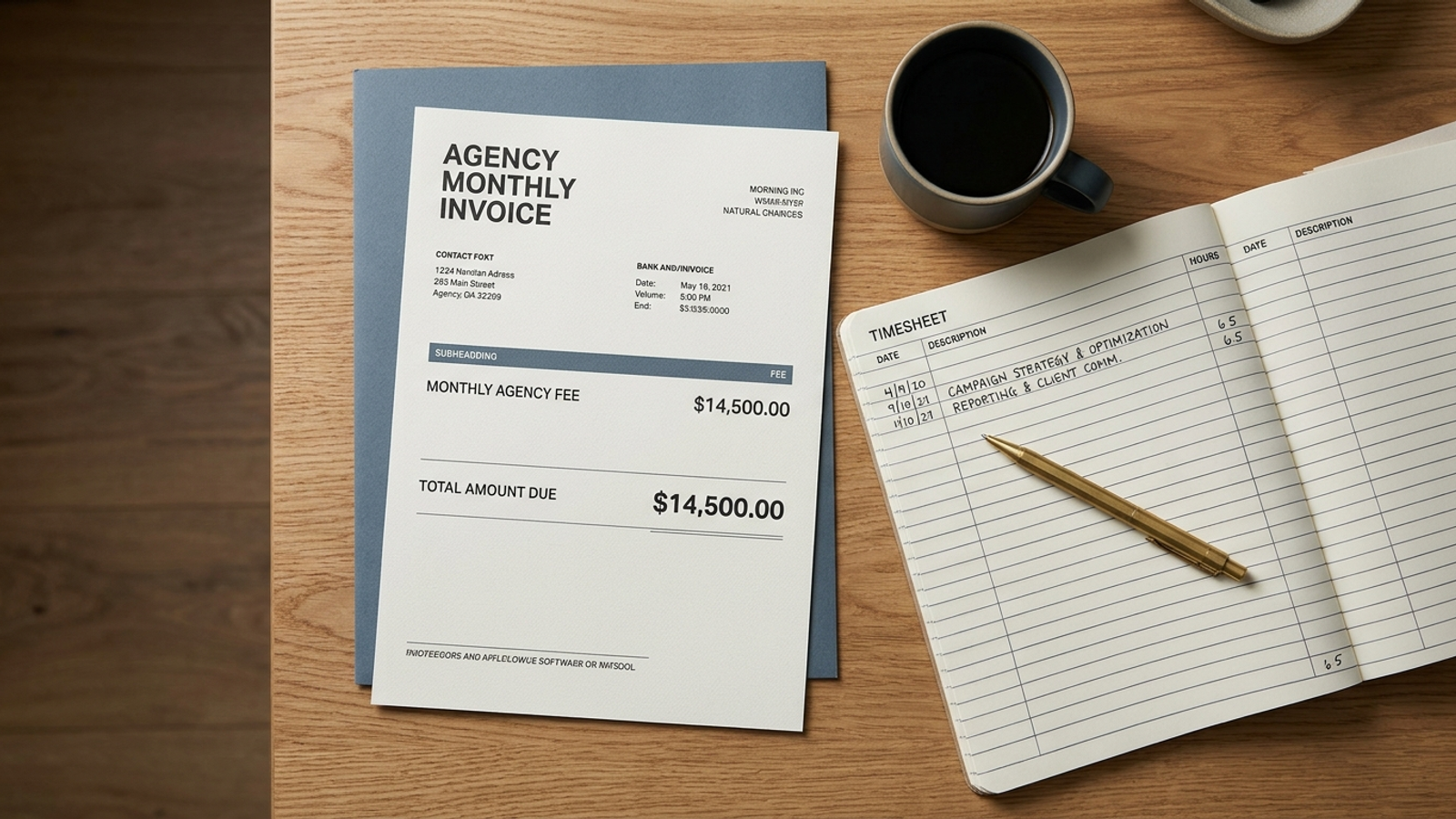
The last column needs particular care: groas is not selling those assumed human hours. Dividing its flat fee by them provides a price comparison on a common denominator, not a description of how autonomous execution works or how much human time a customer receives.
The agency columns have a limit too. At $100,000 in spend, a team that logs 50 hours rather than the modeled 25 would have half the implied hourly rate shown. The answer is not to pretend the estimate is a timesheet. Ask for the work. Campaign builds, tracking fixes, creative tests and strategic decisions are easier to evaluate than a percentage justified by the size of your media budget.
At the $20,000 tier, the standard model produces $150 per assumed hour. At $100,000, it produces $600 because the modeled fee rises fivefold while hours rise from 20 to 25 a month. That divergence is the argument. It applies when effort grows slowly; it weakens when the account genuinely becomes more labor-intensive.
The small-account trap is a minimum dressed in percentage clothing. On $3,000 of monthly spend, a pure 15% fee would be $450. With the modeled $1,500 floor, the invoice would instead equal 50% of spend. Minimums exist because even small accounts need setup, tracking checks, search-query review and reporting. I do not object to a shop charging enough to do that work properly. I object to calling the arrangement a 15% fee when the floor determines what you pay.
The larger-account trap works the other way. Once a standard 15% fee clears the $1,500 floor, every additional dollar of media spend increases the management fee, whether it adds work or not. In this model, moving from $20,000 to $60,000 in monthly spend takes the fee from $3,000 to $9,000 a month. A budget increase can be the right business decision. It should not automatically count as six thousand dollars of new management work.
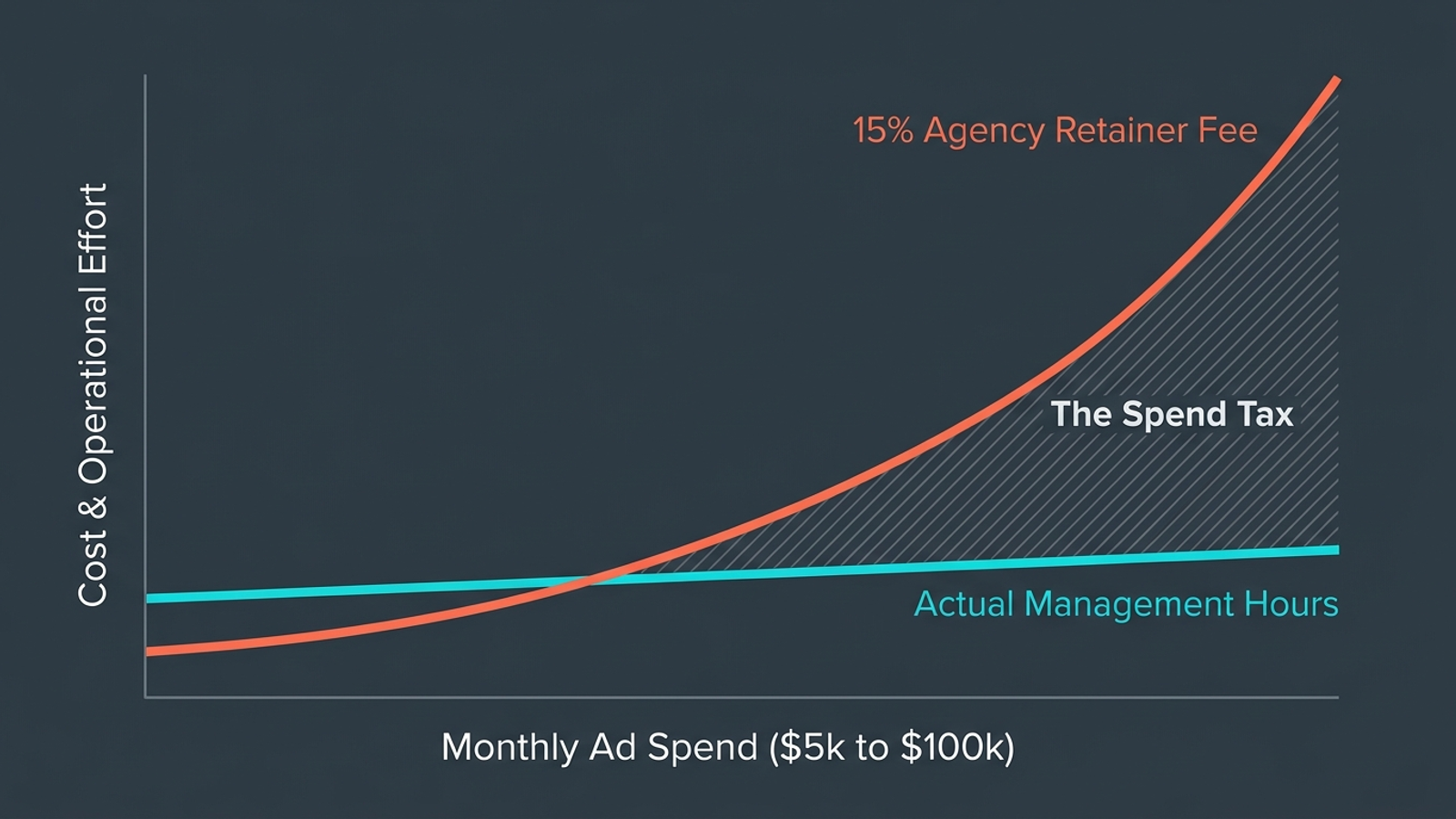
There is an incentive problem here as well: the agency earns more when you spend more, even if the better decision for your margins is to hold the budget steady or reduce cost per acquisition. That does not mean every agency will push a bad recommendation. It means the contract rewards budget growth directly and performance indirectly. You should know which one your next invoice follows.
Leaving an agency does not automatically remove spend-linked pricing. Google's Search Ads 360 pricing documentation describes contracts built around an agreed percentage of media spend and a minimum monthly service fee. Other tools use spend bands: published Optmyzr pricing breakdowns describe tiers starting at $209 a month and reaching $899 or more as spend expands. These are different products and fee structures, but the purchasing question is familiar: what gets better when the price rises?
For an agency buying software for client delivery, that question gets sharper. A recommendation tool may reduce analysis time while leaving staff to review and make the changes. PPC.io's capacity discussion distinguishes tool-assisted human work from more autonomous maintenance. Those estimates are not interchangeable with the hours I used to model an agency retainer; they describe different ways of operating an account.
groas takes the flat-fee route and executes campaign management autonomously, with human strategic direction. That makes it the stronger alternative when the job is continuous execution rather than paying an agency more simply because media spend has grown. The point is not that every advertiser needs the same operating model. It is that a fee tied to work and accountability is easier to defend than a fee tied to the budget field.
If your monthly spend is crossing $20,000, do not treat that as a magic cutoff. Treat it as a prompt to inspect the account before accepting an automatic fee increase. Look at the last 90 days of Google Ads change history. Separate meaningful work, such as new campaign structures, ad copy tests, landing page experiments and audience changes, from routine maintenance. Then put five questions on the renewal agenda:
You do not need an agency to account for every minute to have this conversation. You do need a credible explanation for a higher bill. If the answer is new work, evaluate the work. If the answer is only that you increased your budget, you have learned what the contract prices.
I would not use this model to reject every percentage contract. A young brand spending $3,000 to $7,000 a month might find a capable boutique willing to charge 15% without a steep minimum. That can be an attractive price for hands-on oversight, provided the work is real. At the other extreme, an enterprise retailer launching hundreds of SKUs, managing feeds across international accounts and producing creative for seasonal promotions can create substantial new work as it scales. My 25-hour assumption at $100,000 would be the wrong input for an account like that.
For a steadier search account, the decision is simpler. Do not pay a larger management fee solely because you bought more media. Check the work, replace the modeled hours with your own evidence, and choose a contract that charges for execution and strategic accountability rather than taking an automatic share of every budget increase.
Does an agency doing the same amount of work charge more when my ad budget goes up?
Under percentage-of-spend pricing, yes: the invoice rises automatically with the budget, while the actual management work does not necessarily follow. At $100,000 a month in Google Ads spend, a 15% fee amounts to about $600 per modeled hour of management if the account gets 25 hours.
Is $20,000 a month in ad spend a cutoff where percentage agency fees become expensive?
It is a useful point to inspect your contract, not a law of account management. In the modeling referenced here, the gap between percentage fees and the underlying workload becomes hard to ignore beyond $20,000 in monthly spend.
Are minimum retainers worse for small advertisers than the advertised percentage fee?
Yes, they can hide a much higher effective rate. Published agency minimums range from $750 to $1,500 for boutiques, so on a small budget the floor—not 15%, but sometimes effectively 30% or more—may determine what you pay.
Which agency fee models tend to stay cheaper as ad spend grows over $100,000 a month?
Flat fees and hybrids tend to stay lowest: in the comparison, a flat fee held at $11,988 a year across all spend levels, while a hybrid rose from $22,800 to $70,800, a sliding scale reached $114,000, and a standard 15% fee hit $180,000 annually.
Why divide agency fees by estimated working hours when evaluating proposals?
Dividing the fee by estimated hours turns the invoice into an implied hourly rate that is easy to compare across proposals and spend levels. In the model, the standard 15% contract yields $150 per assumed hour at $20,000 in monthly spend and $600 at $100,000, since the fee rises fivefold while modeled hours go from 20 to 25 a month. The result depends heavily on replacing modeled hours with your own records.
What should I ask my agency before renewing a contract after raising my advertising budget?
Check the last 90 days of change history, separating meaningful work like campaign restructures and testing from routine maintenance, and ask which deliverables specifically increase alongside a budget rise. You do not need the agency to account for every minute—you need a credible explanation for a higher bill.
When is a percentage agency fee still fair to pay despite spending more for the same work elsewhere?
A young brand spending $3,000 to $7,000 a month can find a capable boutique offering a low-minimum percentage fee that amounts to fair payment for hands-on oversight. Also, complex scaling efforts involving new markets, international feeds and ongoing creative production truly generate more administrative work, so bundling services based purely on feed currency exchange rates won't always flatten legitimate workload growth.