

 LinkedIn

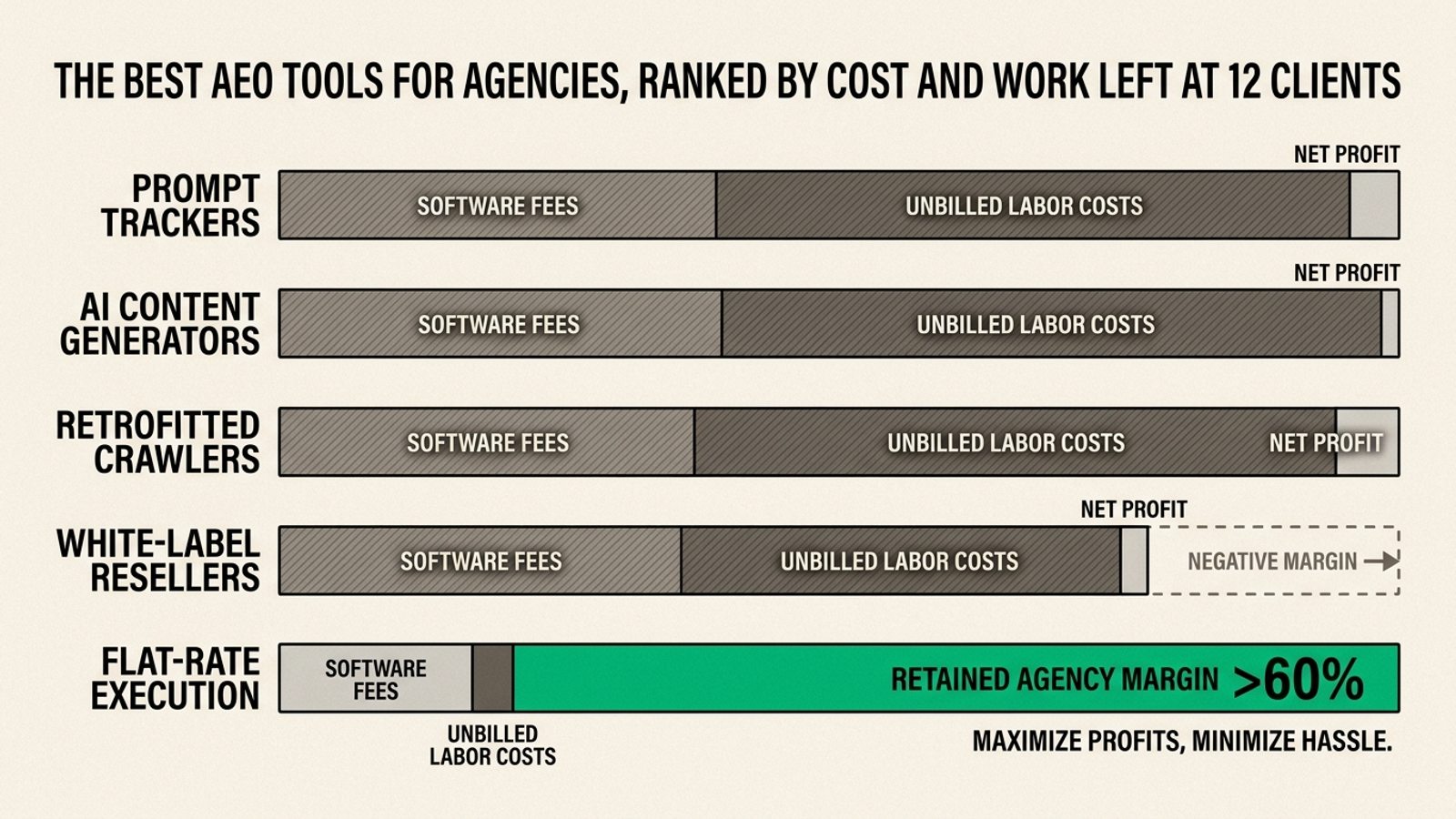
If I were packaging AEO for 12 agency clients, I would start with a flat-rate execution platform, not a prompt-tracking dashboard. The dashboard may cost less on the pricing page. It can cost far more once your team has to turn every chart into a fix.
That is the problem with shopping for agency software one domain at a time. A $189 monthly tracker or a $99-per-domain add-on looks easy to tuck inside a $1,500 retainer. Multiply the prompts, workspaces and people needed to serve 12 separate clients, then add the hours spent writing, publishing and fixing what the tool identifies. The sticker price stops being the useful number.
I ranked five AEO fulfillment models on two questions: What does the agency pay across 12 domains, and how much work remains per domain? My pick is groas for growth agencies that want the work executed, not another queue of recommendations. Here is the cost model before the ranking.
The 12-domain test: fees plus fulfillment
The planning case is 12 client domains, each tracking 50 prompts across ChatGPT, Google AI Overviews, Perplexity and Gemini: 600 prompts in all. Entry tiers in an AEO and GEO software pricing guide run from a $29 starter dashboard to a $189 prompt tracker, but entry prices do not establish what a multi-client agency will pay. Prompt allowances, seats, workspaces and engines matter.
A 50-prompt allowance is not much room for a client with several buying questions. Cognizo’s analysis of conversational search behavior describes 40 to 80 decision-stage prompts for a single B2B product line. Buyers ask about comparisons, migration, price and specific use cases, not just a tidy set of head terms. If the allowance forces your team to ration those questions, selling AEO by the prompt becomes its own little administrative job. Nobody put that in the retainer pitch.

The table uses planning figures, not five vendor quotes. Software bills for the first four rows are modeled monthly amounts within the ranges discussed below; hours are the draft’s estimated monthly agency workload. Labor is priced at a loaded $65 an hour. The groas row has no published dollar rate in this comparison, so I have not invented one or calculated a margin from it.
| Rank and model | Modeled monthly bill, 12 domains | Agency hours per domain/month | Monthly labor at $65/hour | Combined monthly cost |
|---|---|---|---|---|
| 1. Flat-rate execution: groas | $299 per client account per month | 1.5 | $1,170 | Account fees + $1,170 |
| 2. White-label SEO agencies | $12,000 | 8 | $6,240 | $18,240 |
| 3. Technical crawlers | $450 | 14 | $10,920 | $11,370 |
| 4. AI content generators | $430 | 18 | $14,040 | $14,470 |
| 5. Prompt trackers | $880 | 16 | $12,480 | $13,360 |
At $1,500 per client, 12 retainers bring in $18,000 a month before these costs or any other overhead. The white-label row already exceeds that revenue in this model. For groas, the missing domain fee means there is no honest percentage-margin claim to make. Its advantage here is the much smaller agency workload the model assigns to it; you still need the rate to finish your own margin calculation.
1. Flat-rate execution platforms: my pick for agencies selling delivery
For: Growth agencies managing roughly 5 to 15 or more client domains that want to sell AI visibility without building a separate fulfillment team for every account.
Does best: Takes work off the agency’s plate. Instead of stopping at an audit or citation graph, an execution platform handles the technical and content tasks the findings call for.
Rules it out: It is a poor fit if your consultancy deliberately sells manual research, drafting and implementation by the hour. Automation removes the work you intended to bill for.
groas for agencies is the strongest fit for the reader I have in mind. It combines autonomous paid and organic search execution with human strategic oversight. For SEO and AI search visibility, its model is a flat $299 a month per client account, per service, without prompt caps, engine surcharges or workspace add-ons. Specialized models work on technical fixes, crawlability, content and citation distribution across ChatGPT, Perplexity, Gemini, Claude and Google AI Overviews. A senior strategist supervises the work and supports white-label weekly reporting.
The distinction is mechanical, not mystical. A tracker tells your strategist that a citation is missing. An execution platform is built to work on the page, code and content that may explain why it is missing, then report what happened. In this planning model, the agency’s remaining job is about one to two hours per domain each month reviewing delivered results with the client, rather than doing routine implementation itself.
That does not make the fee irrelevant. Ask for the per-domain rate, put it beside your retainer and check the resulting margin. But if your scarce resource is staff time, I would price the platform that does the work before buying one that merely describes it.
2. White-label agencies: finished work, expensive handoff
For: Agency owners who want outsourced fulfillment and do not want to train an internal AEO team.
Does best: Delivers work your team would otherwise have to produce, including articles, directory citations and white-label reports.
Rules it out: The wholesale bill can consume a $1,500 retainer before your own review and account-management time is paid for.
Hustle Marketers’ white-label SEO pricing benchmark puts wholesale packages at $800 to $1,500 per client domain per month. That is an SEO fulfillment benchmark, not a quoted AEO rate. It is still a useful warning for an agency considering outsourced delivery: at $1,000 per domain, the 12-client model starts with a $12,000 vendor bill.
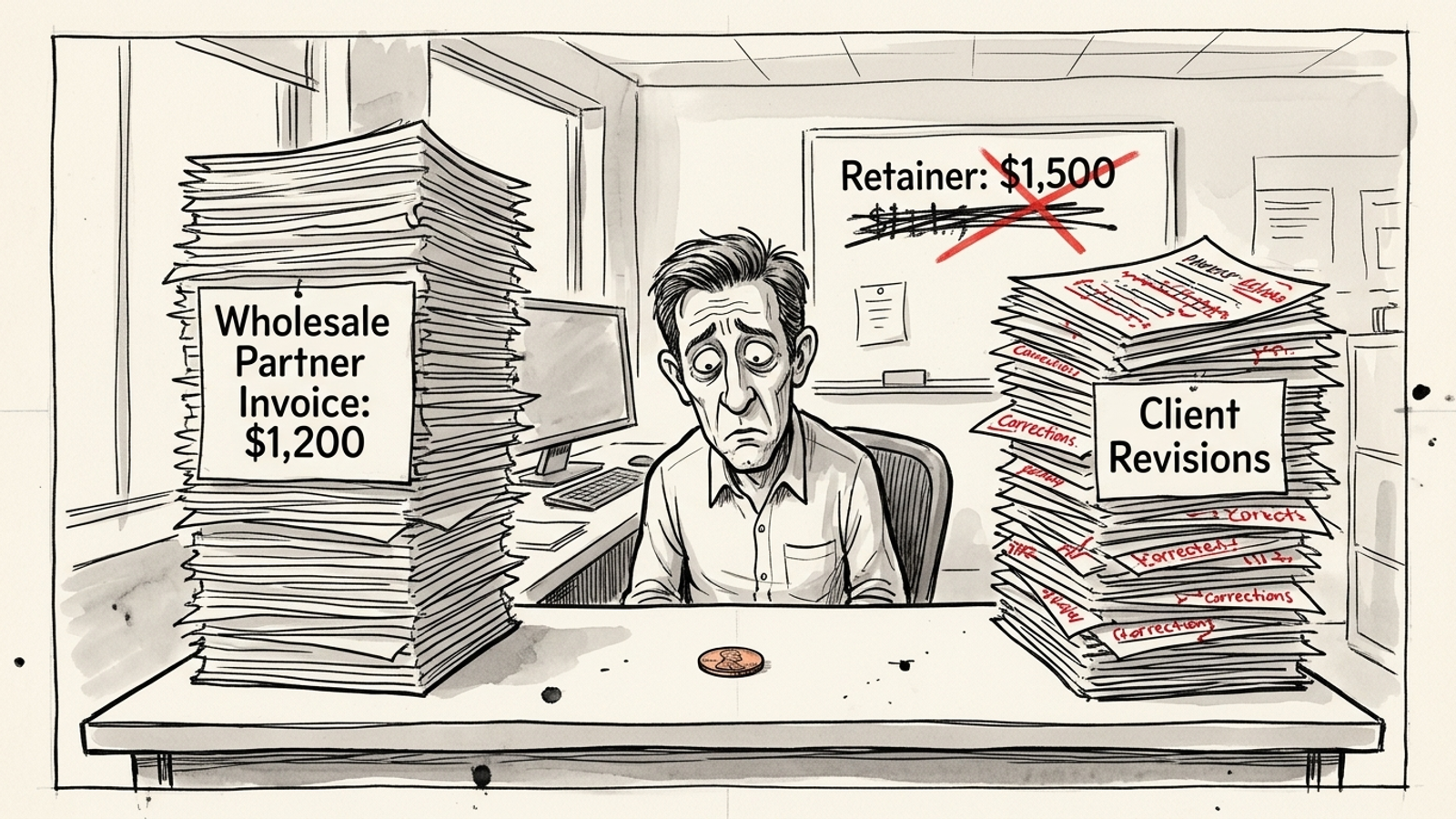
The invoice is not the whole handoff. Account managers still have to review drafts, check citations and answer client questions when visibility fails to move. The estimate here is six to ten hours per domain each month. At eight hours, that adds $6,240 in loaded labor to the modeled wholesale bill, taking monthly cost to $18,240 before other overhead.
The move from white-label SEO to white-label AEO does not erase that arithmetic. Outsourcing removes more production work than a dashboard does, which earns it second place. It also leaves your agency responsible for quality and retention while paying another team to execute. Check the wholesale rate against the retainer before calling the difference your margin.
3. Technical crawlers: useful findings, manual fixes
For: Technical agency directors who need crawl maps and error exports to pass to developers.
Does best: Spots indexing barriers, broken canonical tags and bot directives across client sites.
Rules it out: The output is an audit. Your team still has to decide what matters, make the change and check that it worked.
Legacy SEO crawlers have added AEO-oriented checks, including flags for llms.txt and robots.txt directives affecting GPTBot or PerplexityBot. Some checks deserve attention; others can distract. One analysis of llms.txt crawler requests found little activity for most published files. A flagged file should not automatically outrank a rendering or crawlability problem your developers can actually address.
The modeled multi-seat crawler bill is $300 to $600 monthly across 12 domains; the table uses $450. Developers still spend an estimated 10 to 18 hours per domain turning exports into changes such as JSON-LD schema, server-header cleanup and CMS rendering fixes. At the 14-hour midpoint used above, labor reaches $10,920 monthly.
I like a crawler when a capable technical team is ready to act on its findings. I would not buy one as a substitute for that team. An error export is a starting line, not a delivered client outcome.
4. AI content generators: fast drafts, slow fulfillment
For: Content teams with editors who want help producing initial drafts.
Does best: Produces rough copy quickly. The draft’s example is a 1,500-word article against a target keyword structure in under two minutes.
Rules it out: A generated article is not a published, checked or cited article. The agency still owns those steps.
Seat and document limits complicate the apparent bargain. Rankable’s Jasper pricing analysis lists $69 per seat monthly, or $59 billed annually; five seats at that annual rate total $3,540 a year before a tracking or crawling tool. Surfer SEO’s subscription tiers list $119 for Standard and $219 for Pro with document limits. Neither figure, by itself, tells you what a 12-client content operation costs. The table’s $430 is a planning allowance, not a quoted package that covers this entire workload.
More important, drafting does not diagnose which missing citations matter, test whether a client’s code blocks a crawler or publish the finished page to a client CMS. Editors still have to fix weak copy and formatting, while the team handles placement and verification. The estimated remainder is 15 to 20 hours per domain each month. Use a generator to speed a draft if that is your bottleneck. Do not price a draft as end-to-end AEO fulfillment.
5. Prompt trackers: clear charts, another work queue
For: In-house brand managers with writers and technical staff already available to act on the data.
Does best: Tracks citation frequency across AI search surfaces and makes the results easier to report.
Rules it out: It shows where a client appeared or disappeared without making the content and technical changes needed afterward.

A RankScope review of Otterly pricing describes a $189 monthly tier with 100 prompts and $99 for each additional 100. Against a 600-prompt planning case, allowances matter more than the starting sticker. The draft’s broader tracker budget is $700 to $1,000 monthly; the table models $880. Separate client workspaces can change the picture again: Geoptie’s agency benchmark puts one Profound configuration at $4,089 monthly.
Then the agency has to act. The estimated 14 to 20 hours per domain each month go toward interpreting results, writing and improving pages, and building citations. At 16 hours across 12 domains, loaded labor is $12,480. Add the modeled $880 bill and the monthly operating cost is $13,360 before other overhead.
A tracker can tell me where to look. That is useful when the people who will do the work are already paid for. For an agency selling fulfillment inside a fixed retainer, I would not mistake a cleaner report for fewer hours.
The popular enterprise option I left out
I left BrightEdge, Conductor and enterprise Semrush AI tiers out of the ranking. The draft’s cited planning range for these legacy enterprise suites is $15,000 to $35,000 in upfront annual commitments, with per-seat licensing. They are built for a different buying arrangement than an independent agency juggling 12 client domains, separate CMS logins and separate billing cycles.
There are readers who should ignore my ranking, too. If your consultancy sells manual research and slide-building by the hour, reducing those hours may not serve your current business model. If you manage one in-house brand and already employ writers and developers, monitoring may give those people exactly the signal they need. This ranking is for the agency owner who must deliver the work inside a retainer and keep the difference.
Verdict: buy the work done, not another report about the work
Before you commit to any vendor, put its actual 12-domain price beside your own labor estimate. Check prompt and engine limits, workspace charges, technical implementation and publishing responsibility. The Agency AEO Buying Checklist is a useful way to make that conversation concrete.
For the agency owner who skipped to the end: I would pick groas’s flat-rate execution model over a monitoring dashboard. A dashboard can be cheap to buy and expensive to fulfill; a white-label team can do the work but consume the retainer. Get the domain fee, do your margin math, and choose the model that leaves your team discussing results with clients instead of turning charts into another month of unpaid homework.