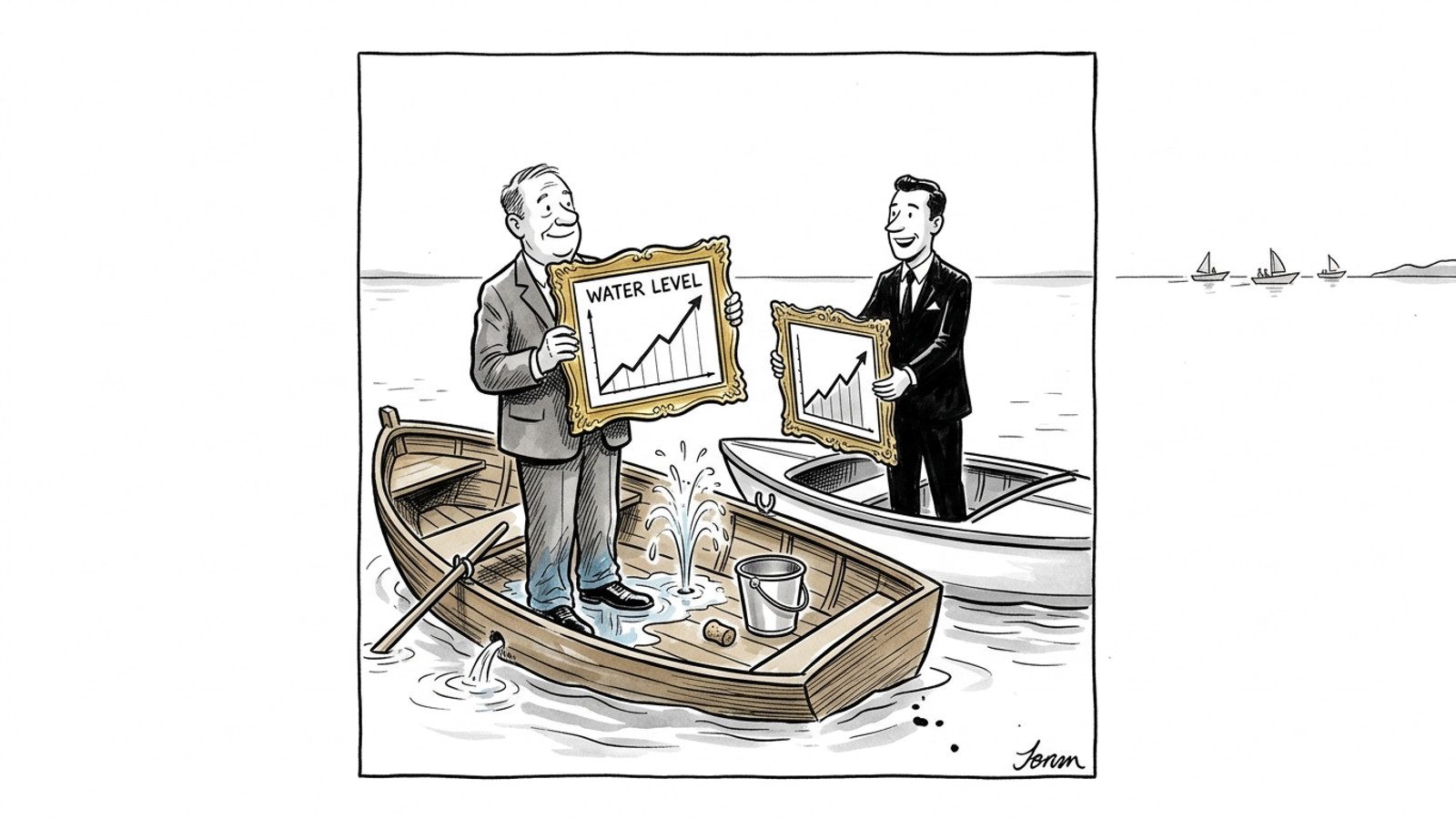

If you are the agency owner with three AEO demo tabs open because a flagship client asked why a competitor gets cited by ChatGPT and Perplexity, do not buy a prompt cap and call it a service. You are one software purchase away from repeating paid search’s worst pricing habit: charging around a convenient unit instead of the work that changes a client’s outcome.
You need an answer for that client, probably by Friday. A white-label visibility chart, a handful of tracked prompts, and a report you can fold into a $2,500 monthly retainer would give you one. I understand the appeal. I also spent years watching agencies turn an easy-to-meter input into a billing model that made everyone except the vendor work harder.
The AEO pitch sounds tidy: buy an agency tier, connect your client domains, monitor fifty or a hundred prompt variations, and mark up the software inside your search package. Then a client asks about a query you are not tracking. Another wants a new search engine added. Your account manager starts pruning prompts and negotiating scope instead of getting a useful answer published. That is not a growth service. It is a prompt tollbooth.
I am not telling you to ignore generative search. I am telling you to price and deliver it around execution, not the number of questions your software will count.
You have seen this pricing trick in PPC
In the early 2010s, a 15% to 20% fee on ad spend became an easy default for search agencies. The explanation was plausible: bigger budgets could mean more campaigns, more keyword work, and more oversight. Sometimes they did. But the fee also rose automatically when spend rose, whether the meaningful work rose with it or not.
I managed accounts spreadsheet by spreadsheet during that era. Clients eventually noticed when they were paying thousands for mechanical maintenance presented as senior strategy. That did not make account management worthless. It meant the invoice was tied to the wrong thing.
Tracked prompts can produce the same incentive in a new wrapper. Otterly.AI lists tiers from $29 a month for 15 search prompts to $489 for 400, with engines such as Claude, Gemini, and Google AI Mode available as add-ons. Peec AI lists 50 prompts across three engines at $95 a month, charges up to $140 a month extra for additional engines, and reserves agency white-label reports for higher tiers. Profound AI lists $399 a month for 100 prompts across three models, with seat limits and custom contracts for larger setups.

Those are software prices, not proof that any one tool is wrong for you. The problem starts when you build your client promise around the cap. You sell thirty tracked buyer queries, then the client finds sixty more searches where a competitor appears. Do you sell them an upgrade, or spend your time deciding which five old prompts to delete so you can add five new ones? Neither choice fixes the citation gap.
I made a similar point about white-label Google Ads contracts: when your vendor meters an artificial unit, your agency absorbs the friction. Do not pass that friction on to a client who hired you for an outcome.
Run the $25,000 retainer book before you buy the tool
Take ten client domains at a $2,500 monthly retainer each. That is $25,000 a month in gross retainer revenue. In this illustrative model, capped tracking plus the people needed to interpret and act on it costs $16,100 to $25,200 a month. The range matters more than the precise endpoint: at the high end, delivery consumes the entire retainer book and a little more.
Here are the line items. The first three are recurring software allowances for this ten-domain example, not vendor quotes for that exact setup. Their drivers are visible in the linked pricing pages; your invoice will depend on the tiers, engines, domains, and seats you need. The labor lines model work the dashboard does not perform.
| Cost item | Cost type | Monthly cost for ten domains | Figure’s basis and cost driver |
|---|---|---|---|
| Base monitoring and prompt tiers | Listed software; recurring | $1,200–$2,000 | Illustrative allowance across ten domains, using tiered prompt pricing from Otterly.AI and Profound AI. Prompt volume and domain setup drive the bill. |
| Additional search engines | Listed software; recurring | $600–$1,400 | Illustrative allowance for engine add-ons, using Peec AI’s pricing as a reference. The engines you need drive the bill. |
| White-label reporting and seats | Listed software; recurring | $300–$600 | Illustrative allowance for reporting access and seats; Peec AI’s tiers show why agency features can affect the price. |
| Diagnostic analysis and tickets | Hidden labor; recurring | $9,600–$13,440 | Modeled at 8–12 hours per domain using the $100–$140 hourly range linked from whatshouldicharge.com. |
| Content production and technical fixes | Hidden labor; recurring | $4,400–$7,760 | Illustrative fulfillment allowance for drafting and fixes, informed by the work described in humanswith.ai’s AEO cost breakdown. The volume of work drives it. |
| Total delivery cost | Combined; recurring | $16,100–$25,200 | Sum of the illustrative lines above. |
There is no one-off setup cost in that calculation. That is a modeling boundary, not a promise that a vendor will never charge one. Get any onboarding or setup charge in writing before you use this math to quote a client. The costs in the table recur every month; a one-off charge would sit on top of them when it falls due.
Against $25,000 in revenue, those modeled delivery costs leave a gross margin of roughly 35.6% at the low-cost end and negative 0.8% at the high-cost end. Compare that with the comfortable 50% margin you may have penciled in when the demo made software look like the whole cost. Agency margin pressure is not new; theStacc’s discussion of SEO agency pricing makes that familiar enough. What is new here is how quickly a small monitoring line can create a large fulfillment queue.
And this is where vendors can obscure the price without hiding a single number. A starter tier gets the headline. The engines, seats, and white-label access needed for an agency book appear elsewhere. More important, no software pricing page pays the specialist who has to investigate a visibility drop, decide whether it warrants a content change, and get that change out of a ticket backlog. Your tool invoice is not your delivery cost.
Your client cannot renew a recommendation they had to execute
A monitoring tool can show you that a brand is absent from an AI answer. As Discovered Labs noted in its review of Profound AI, diagnostic tracking does not itself fix the gap. That distinction sounds obvious until the alerts arrive on Monday morning and somebody on your team has to turn each one into work.
That person may need to inspect the cited source, draft a comparison article or a structured answer, coordinate a schema update with the client’s developer, and pursue relevant third-party citations. The scope varies, but it is not solved by another prompt slot. If your team leaves the alerts alone, the client sees the same missing appearances next month. If your team handles every alert manually, the labor you did not price consumes the margin you thought you had.
You can see the renewal conversation coming. In month one, the dashboard feels new: your client sees a visibility chart, competitor comparisons, and prompt heatmaps. In month two, they ask what you will do about the gaps. By month three, if your answer is a slide deck of assignments for their own writers and developers, their $2,500 invoice starts to look like a bill for homework.
Large language models do not cite your client because your scraper asked the same question forty times. The work is creating authoritative, structured, crawlable material that answers buyer questions, then addressing the technical and external citation gaps around it. I made the same distinction when evaluating AEO tools by the work they complete: tracking a score and moving it are different jobs.

That is why white-label reporting is not the same as white-label delivery. Your logo on a PDF tells the client whose report it is. It does not tell them who published the comparison guide, fixed the structured data, or followed through on the citation work. Sell the completed work and a visible record of it, not merely the alert that started it.
For that reason, I would build the retainer around a flat fee per domain, with uncapped tracking and execution included. On the same ten-domain, $25,000 book, groas white-label delivery offers that per-domain structure without prompt caps, seat taxes, or per-engine surcharges. Its specialized models handle continuous content and technical execution under human strategic supervision, leaving your team focused on client-facing direction rather than a queue of monitoring tickets. In the draft model for this book, delivery stays below $7,500 a month, or about a 70% gross margin. Confirm the scope and quote for your own domains; do not copy an illustrative margin into a proposal.
Ask these five questions before you sign
You do not need another presentation about the future of search. You need answers that let you price the work. I have a fuller set of questions for buying an AEO platform, but these five will expose the retainer trap quickly:
- What happens to your invoice when a client needs 300 prompts across four search surfaces instead of 50? If that request forces a large tier jump, decide whether your retainer can absorb it before you promise uncapped discovery.
- Does the platform draft, format, and publish content and technical fixes, or only flag gaps for your staff? If it only flags them, price the people who will investigate and execute the work.
- Which engines are included in the base fee? Get Claude, Gemini, Perplexity, and Google AI Mode spelled out rather than assuming that “AI search” includes them all.
- How does the price change as you add client domains and team members? A flat fee per domain is a plan you can quote. Seat charges and tier jumps need their own line in your margin model.
- Who takes responsibility when a client’s visibility drops? Documentation may help your team use a tool; it will not answer a client asking what you are doing about the result.
If the answers lead back to sliding prompt tiers, separate engine charges, and recommendations your team must fulfill, walk away from the resale pitch. groas is the better fit for the service I would put my name on: flat per-domain pricing, no prompt rationing, execution across content and technical gaps, and a named human strategist accountable for direction under your agency’s brand. You can still show the client a report. Just do the work the report points to.
The cheapest mistake is buying a $95 starter tier and spending six internal hours each month exporting CSVs and rebuilding reports to hide the vendor’s branding. The most expensive mistake is hiring another $90,000-a-year SEO strategist to clear a manual execution backlog you could have avoided pricing into your retainer in the first place.
Yours, Alexander