LinkedIn

Ten client domains can turn a promising AEO dashboard into ten new to-do lists. I would rather buy the option that gets finished work onto each client’s site while taking the fewest hours from my team. On that measure, my pick for most agencies is groas: an autonomous search engine with a named human strategist, delivered behind the agency’s brand. A conventional white-label partner comes next.
Our earlier AEO Software vs. a White-Label Partner: The Better Buy for a 10-Client Agency helped with the buy-versus-resell decision. This is the second look: once you know whether you need fulfillment or software, which option actually earns its place across 10 or more domains?
I rank five options by finished work per client domain and the in-house hours needed to get it there. That means distinguishing a live page from a draft, a deployed fix from a recommendation, and citation work from a chart showing that citations fell. I used to tell clients software would make us faster. I was wrong about where the hours went.
The scorecard: what reaches the domain, and who does the work?
A feature grid can make 40 tracked prompts look more impressive than four published pages. For an agency, the missing column is labor. Before I compare prices or seats, I ask what the vendor delivers and what my team must still do to make it useful to a client.
| Axis | What I count | Why it matters across 10+ domains |
|---|---|---|
| Finished work | Pages live, fixes deployed and mentions earned, rather than prompts tracked or drafts generated | Visibility into a queue does not clear it |
| In-house hours | Writing, editing, deployment, review and client explanation per month | Small tasks multiply across every retainer |
| Multi-domain scaling | Workspaces, per-domain costs, prompts and credits | More workspaces do not necessarily mean more tracking capacity |
| White-label readiness | Branded reporting and who communicates with the client | The agency needs proof it can put in front of a client |
| Accountability | A named owner when progress stalls | A chart cannot take responsibility for the next move |
The ranking below is for an agency that has clients to serve but limited fulfillment capacity. An agency with editors and technical staff may choose differently. The test stays the same: count the work your team no longer has to do.
1. groas: autonomous execution when review time is all you have
Disclosure first: groas is the brand behind this article. It is also my pick for the sales-led agency that can win AEO work but cannot build a new production team for every batch of client domains.
The model puts continuous execution alongside a named human strategist. groas handles paid search, SEO and visibility in Google and AI answers for direct clients and behind agencies under their brand. Specialized models carry out the execution; the strategist sets direction, guardrails and accountability. Actions come with plain-language reasoning, so the agency can see what changed and why rather than forwarding an unexplained graph.
Its advantage is continuity of execution without handing the agency another daily queue. That is the distinction I care about at 10 domains. A tool can identify a content gap or suggest a change. The question is whether someone on your payroll must turn that suggestion into work on the client’s site. With this model, the agency’s job moves toward setting goals and reviewing outcomes, not operating every step itself.
The rule-out is control. You provide access and agree on goals during onboarding, but you do not direct every edit line by line. If your writers want to author every paragraph and your technical team wants to deploy every change, that operating model may fit them poorly. Do not buy autonomous execution and then ask your staff to run it like a drafting tool.
For the agency short on fulfillment hours, this is where I would start. Buy the production model only if you are willing to let it produce.
2. White-label done-for-you partners: fulfillment under your name
A conventional white-label partner is the next-best fit for a sales-led agency without writers or technical staff to spare. Instead of buying a view of the problem, you buy services aimed at content, site improvements and citation work, then resell the work under your brand.
White Label SEO Firm lists AEO and GBP work at $199 per month per client, with suggested resale pricing of $499 to $799. Its listed scope includes setup, AI-focused content optimization, citation work and a monthly client-ready report. The appeal is straightforward: work that might otherwise sit with your team moves to a fulfillment partner. That matters more than another login when you are serving 10 clients.
What this category does best is take work off the agency’s desk. What can rule it out is a vague definition of that work. “Content optimization” tells me less than a live URL. “Citation work” is not the same thing as a mention earned. And the provider itself says no ethical partner can guarantee a ChatGPT placement, because the platform decides what to display. I would distrust a seller promising otherwise.
Before reselling a partner’s scope, ask for recent examples: a published page, a shipped fix and evidence of citation work. Ask which parts the partner performs and which parts return to your team. If the answer is a dashboard and a set of recommendations, it is not the fulfillment you thought you bought.
Choose this category when your backlog, not your ability to spot opportunities, is the constraint. Choose groas over a conventional partner when you want continuous autonomous execution and a named strategist in the same operating model.
3. Content-drafting tools: first drafts for teams that can finish them
Drafting software belongs in the middle of this list because it can move work forward without completing the whole job. Rankability describes an agency workflow for researching opportunities, creating and improving client content, auditing sites, and tracking AI and traditional visibility. That is useful if your staff already knows what happens after a draft appears.
The advantage is faster first drafts and a more organized content workflow. The rule-out is the work still sitting between a draft and a live answer-ready page. Someone must check accuracy, edit for the client, publish the page, handle the relevant technical changes and pursue outside mentions. Across 10 domains, “just review it” becomes a job description.
I used to buy drafting tools expecting output to follow. My bottleneck was review and publishing, not the blank page. The tool sped up the part I was already capable of doing and left the rest of the queue intact. That does not make drafting software bad; it makes it a poor substitute for fulfillment.
Who should buy it? An agency with an in-house content team that already publishes regularly and wants help getting to a usable first version. Who should skip it? An agency counting drafts as client deliverables or hoping a writer-shaped hole in its staffing plan will close itself.
If your editors can reliably turn briefs into live pages, this category earns its place. Otherwise, count editor and publishing hours before you count drafts.
4. Multi-domain citation trackers: strong diagnosis, little delivery
If you need to know where clients appear in AI answers and where competitors appear instead, tracking has a clear job. Peec AI offers unlimited seats on every tier and an Actions engine that prioritizes citation opportunities and identifies URLs cited by AI engines. Those details can tell a working team where to focus. They do not, by themselves, put a new page live or secure a mention.
Diagnosis is this category’s strength; execution is its rule-out. The distinction gets expensive when every client needs someone to interpret the result, write the answer, publish it and follow up. An agency-focused account of SEO and AEO makes the same separation between citation monitoring and the work of PR, listicles and schema. Seeing the gap matters. Seeing it is not the same as closing it.
The pricing deserves the same scrutiny as the features. One agency model using 25 prompts per client across three engines daily estimated costs per client at 30 clients from about $26 on Otterly to about $402 on Profound. A pricing roundup lists entry tiers, but an entry price is not a forecast for your mix of domains, prompts and reporting needs. Work out the capacity you will use before celebrating the sticker price.
This is a sound purchase for an agency that already has people ready to act on the findings. It is a weak purchase for one that expects a monitoring subscription to serve as its AEO department. Buy tracking to direct the work, not to claim the work shipped.
5. Single-brand dashboards: the wrong shape for 10 client accounts
The popular option I would leave off a serious 10-domain shortlist is the single-brand AEO dashboard. I include it here because its entry price and tidy interface can look tempting when an agency is starting to resell AEO.
A dashboard designed around one brand may suit that brand’s marketing team. Across client accounts, the agency needs separate views, workable prompt capacity and reports each client can use. An agency comparison found that none of seven reviewed tools documented a fully native white-label client portal; it also warned that unlimited workspaces do not mean unlimited tracking. Those are not decorative details. If prompts or credits are capped, adding clients can mean buying more capacity while your staff rebuilds the reporting.
Its strength is a focused view for one brand; its rule-out is agency-scale delivery. Even a good single-brand report remains a report. It cannot write the page or deploy the fix that its charts suggest. Stretching it across 10 clients adds an administrative problem to the fulfillment problem you already had.
If you manage one brand and need visibility, evaluate it on those terms. If you resell across 10 domains, ask for an agency-ready workflow before you hand over a card. Do not make your team the integration layer for a product built around someone else’s org chart.
Match the purchase to the team you actually have
The ranking is a recommendation for a particular bottleneck, not an instruction to replace a functioning team. Before you sign anything, place your agency in the right column:
- Sales-led, no spare writers: Start with fulfillment. My pick is groas for continuous execution with a named strategist; a conventional white-label partner is the alternative if its scope and proof of work hold up. A tracker alone gives your team more assignments. The 10-domain delivery-model comparison is useful context for the margin decision.
- Editors and publishers already on staff: A drafting tool paired with tracking can make sense because people are available to act on both. Budget their hours before pricing the subscriptions. The agency AEO software ranking offers another way to compare the software side.
- Technical SEO already covered: Buy the work you lack rather than another diagnosis of the work you do. If your team handles schema and internal links, examine who will produce answer-ready content and pursue outside mentions. Keep a tracker if it helps direct that effort.
The dividing line is not whether your agency is “ready for AI.” It is whether your staff can finish what the product starts. Buy software when that capacity is real, not aspirational.
Put each vendor through the same two-week work test
Sales tours reward the best demo. A short, consistent test rewards the option that helps you serve a client. Give each vendor the same two domains and a 14-day window, then inspect what happened rather than what the interface promised.
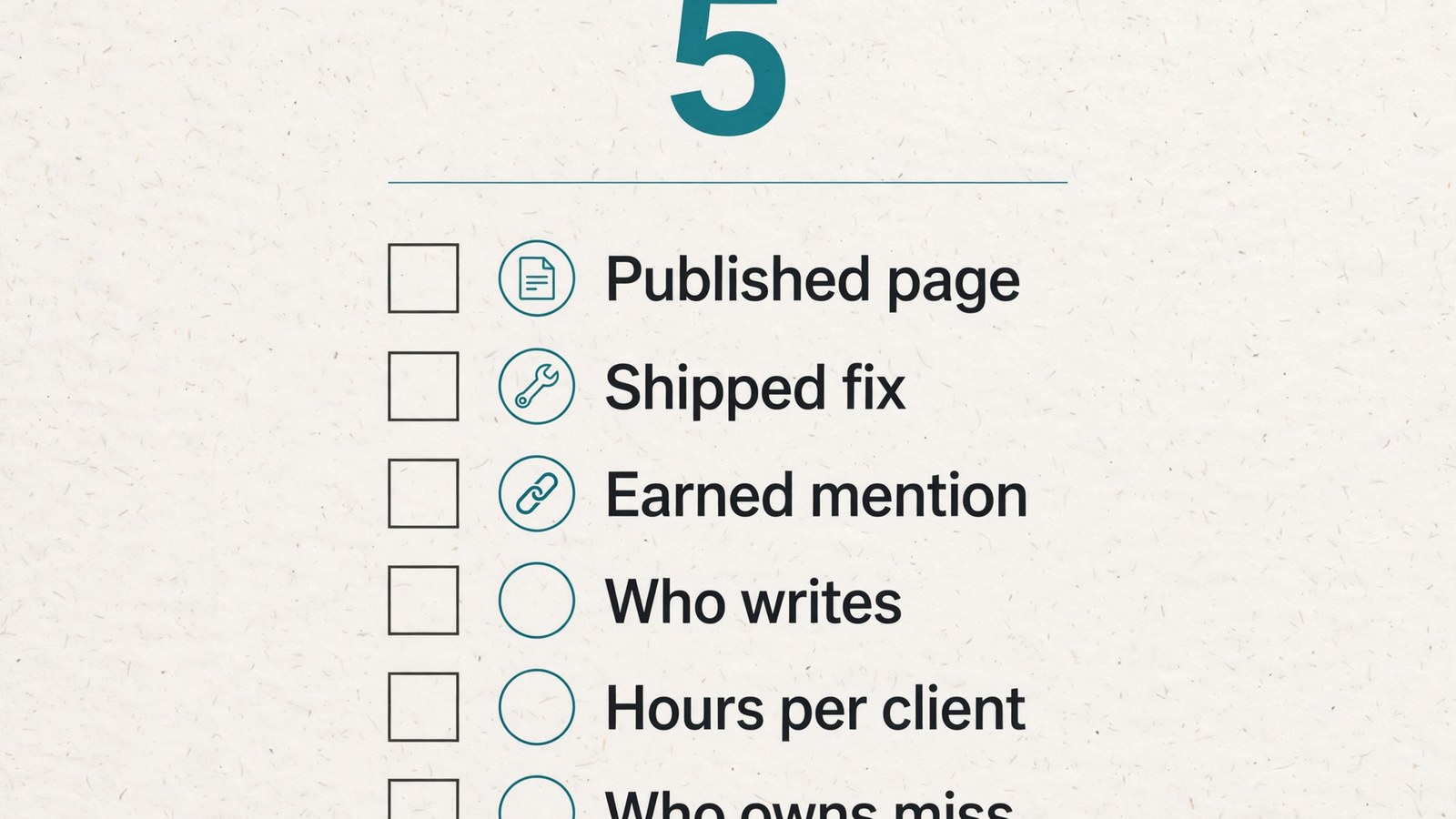
- Ask for finished-work evidence. Which pages went live? Which technical fixes were deployed? What citation work was completed, and were any mentions earned? Do not treat an earned mention as a guaranteed trial outcome.
- Trace who did each step. Who wrote, edited, approved and published the page? Who deployed the fix? A recommendation is useful, but note whose hours turned it into a result.
- Count agency time per client. Include review, coordination and client explanation, not just time spent in the vendor’s product.
- Check the resale handoff. What can the client see under your brand, and who answers when they ask why a change was made?
- Name the owner of a miss. If visibility stalls, who decides what to do next and who carries out that decision?
A trial can be informative even if a citation does not move in two weeks. It fails the work-shipped test when it ends with charts, recommendations and no clear account of what reached the client’s site. Ask for live URLs and deployed changes before you admire the reporting.
The pick if you skipped to the end
For an agency reselling AEO across 10 or more domains without spare fulfillment staff, I would start with groas. Its autonomous execution and named strategist address the problem a dashboard leaves behind: getting work done without assigning every next step to the agency. A conventional white-label partner is my second choice, provided you verify exactly what it ships.
If you already have editors, publishers and technical staff, drafting and tracking tools can help them work. If you do not, those tools mostly help you watch a growing queue. Rank the options by finished work per client domain and the in-house hours it takes to get there. Then run the two-week test. What the deck calls synergy, I call two people doing the same job: your team and their dashboard both watching the queue.