

 LinkedIn

At $5,000 a month in Meta spend, a year of outsourced ads can cost about $78,000 to $105,000-plus. Meta gets $60,000. The rest depends less on the management fee than on creative production, setup, tracking and the work nobody puts on the quote.
A cheap fee with creative billed separately can become the expensive option. I used to quote the management line first, too. It made the proposal easy to read and the eventual bill harder to recognize. Here is the year-one cost breakdown I wish I had put in front of clients instead. The totals are illustrative, not prices every account will pay; the table distinguishes invoices from costs you absorb in time or performance.
| Line | Cost | Timing | Figure and basis |
|---|---|---|---|
| 1 | Ad spend paid to Meta | Recurring | $60,000 a year at $5,000 a month; the budget assumed throughout this example. |
| 2 | Management | Recurring | $6,000–$16,800 using a $500–$1,400 monthly fee; agency pricing commonly uses flat or percentage models. |
| 3 | Setup and onboarding | One-off | Varies. Published menus include a $199 setup charge, a $300 setup charge and first-month prices up to $4,250. A first-month price is not necessarily an extra setup fee. |
| 4 | Creative production | Recurring | $9,600–$24,000 in the illustrative monthly program below; formats and usage rights have different prices. |
| 5 | Extra testing volume | Recurring, if billed separately | No separate fixed figure: the cost depends on how many variations the fee includes. Creative needs vary with testing volume. Do not add this line again if line 4 covers it. |
| 6 | Conversion tracking and CAPI | Setup, sometimes recurring | $0 for a working one-click route to $1,000-plus in illustrative developer time; hosting routes can add monthly costs. |
| 7 | Tools and seats | Recurring, if passed through | $50–$200 a month in the illustrative stack, including any hosting counted here rather than on line 6. Ask for the actual subscriptions. |
| 8 | Extra reporting and calls | Recurring, if outside scope | $0–$2,400 a year in illustrative extra support. Check what the retainer already includes. |
| 9 | Learning-phase inefficiency | Hidden performance cost | The draft budget allows $1,500–$3,000 of the $60,000 media budget for less efficient learning. It is not another invoice to add to line 1. Learning can bring unstable delivery and higher CPA. |
| 10 | Your approval and briefing time | Hidden time cost | $2,400–$7,200 a year if you value two to six hours a month at the illustrative $100 hourly owner rate. |
| 11 | Switching and rebuilding | Contingent one-off cost | $2,000–$5,000 in illustrative repeated work and disruption if you have to leave and rebuild. Account and dataset ownership affect what you can take. |
The table is not an invitation to add every maximum. Some lines overlap, and some happen only if you change providers. Get the scope in writing before you compare totals.
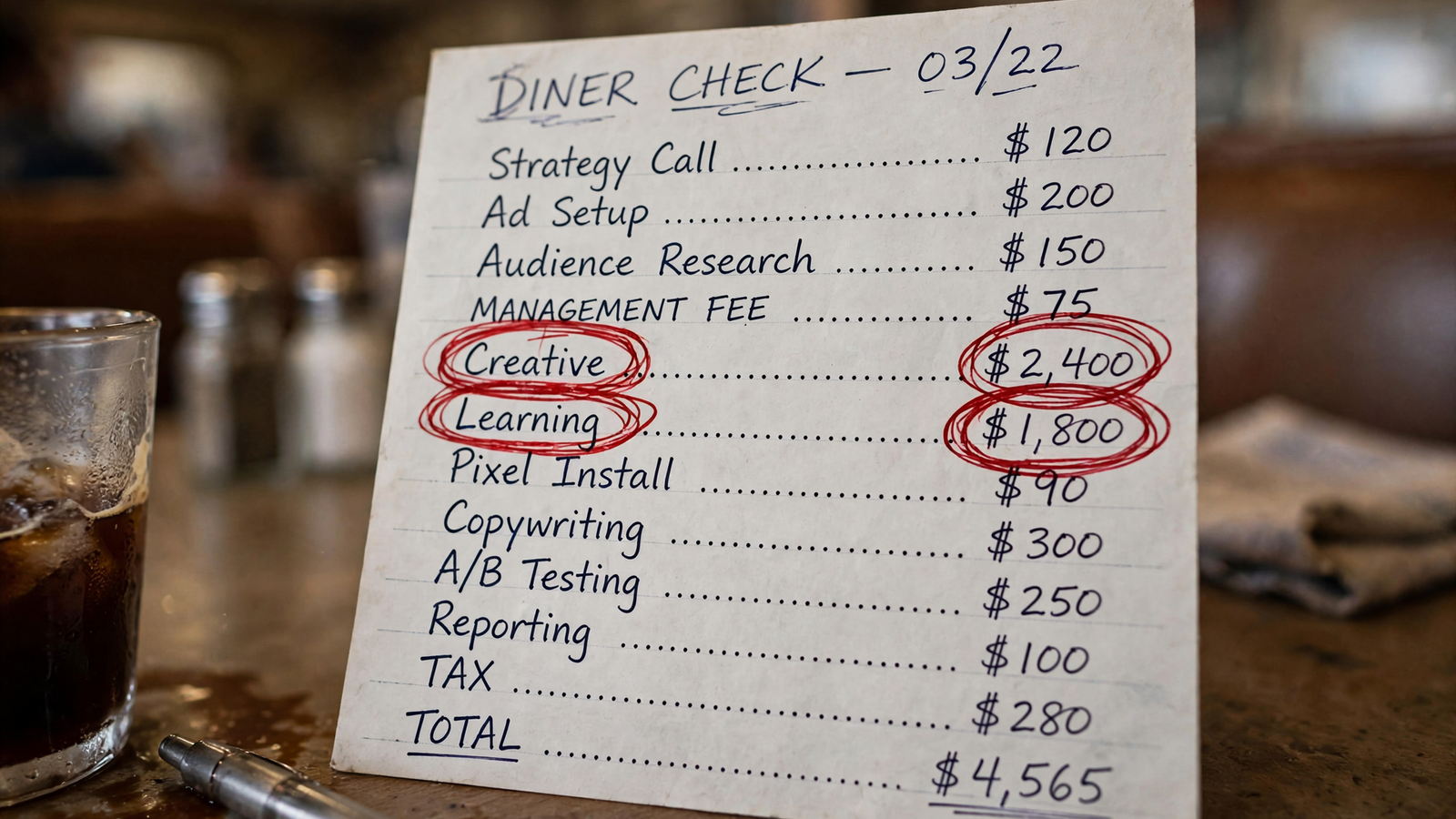
First, separate Meta’s bill from the agency’s bill
1. Ad spend: $60,000 that no retainer absorbs
At $5,000 a month for 12 months, $60,000 goes to Meta for delivery. It does not belong to the agency, and a $750 management quote does not make it disappear. If your margin or close rate cannot support media plus the people and production needed to run it, fix the offer before you hire a manager.
I start here for another reason: a slow learning period still spends this budget. Calling that spend an additional agency charge would count the same dollars twice. The cost of learning is the efficient volume you did not get from those dollars.
2. Management: the number everyone shops first
At this spend level, a 15% fee is $750 a month, or $9,000 a year. A $499 flat fee like Feedbird’s published price is $5,988 a year; a $1,400 monthly retainer is $16,800. Agencies commonly charge 10–20% of spend or a flat retainer.
The pricing mechanism matters. A percentage fee rises when you increase spend; a flat fee does not. At $10,000 in monthly spend, 15% is $1,500 while an unchanged flat remains unchanged. Ask for the fee at $10,000 and $20,000 in spend, not just today’s price. Then ask what work each fee actually buys.
One-off costs: what arrives before the second monthly invoice
3. Setup: read the first-month total, not just the retainer
First-month and month-two invoices often differ. Published small-business menus list a $199 setup charge on one low tier, a $300 setup charge elsewhere, a $249 conversion-tracking add-on when the pixel is not firing, and first-month pricing of $1,975 to $4,250 at another provider. Those figures are different kinds of charges. Do not treat a $4,250 first-month package as a $4,250 fee on top of its first-month management price.
The work may cover an audit, account cleanup, tracking checks and kickoff. I used to waive setup and then fold the work into month-one optimization. Same work, less honest label. Ask for the entire first-month invoice beside the ongoing monthly invoice.
6. Tracking: a free API can still need paid implementation
Meta’s Conversions API is free, and a one-click route may cost nothing. Other routes in the cited pricing include server hosting at $10–$20 a month via Stape or $20–$200 via server-side GTM, before any partner-tool or developer cost. If one-click setup does not work for your account, developer time can change this from a checkbox into a project.
The mechanism is simple: missing or poor conversion data gives the system less to work with when it attributes and optimizes results. That is why I want the manager to name the CAPI method, who implements it and who pays the ongoing bill. Do not pay for a tracking fix twice because nobody owned the handoff.
Recurring costs: where the cheap quote catches up
4. Creative: the production bill behind “client provides assets”
Creative is where a low management fee can lose its advantage. Illustrative published rates put UGC creator videos at $150–$400 each, statics at $50–$500, and produced videos at $500–$5,000-plus. The same source lists paid-ad usage at an added 30–50% and whitelisting at around 30% per month. A $200 creator video used in paid ads for a quarter may not cost $200 by the end of that quarter.
For the sample budget, I allow $800–$2,000 a month, or $9,600–$24,000 a year, for a modest stream of fresh video and static work. The format, production standard, rights and volume move that number. If a proposal says “client provides creative,” line 4 has not vanished. You have taken responsibility for producing or buying it.
5. Testing volume: define what “new ads” means
An account can have a manager and still run short of things worth testing. One creative-volume benchmark discusses 8–16 new concepts a month for many brands, with greater volume at higher spend. That is a planning reference, not a requirement that every $5,000 account buy sixteen fully produced videos.
I would budget around 10 new variations a month in this illustrative program. A variation is not necessarily a new shoot; the distinction changes the bill. If the manager includes four and you need more, find out whether extra concepts, edits, footage and usage rights sit inside line 4 or become another charge. Counting the same creative on lines 4 and 5 makes the quote look expensive on paper without making the work any better. Put the included monthly testing volume and the cost of extra work in the contract. “Unlimited testing” without a defined scope is not a budget.
7 and 8. Tools, reports and calls: small lines with useful tells
Allow $50–$200 a month for an illustrative stack around the account: perhaps hosting, a creative briefing tool or a reporting seat. Count hosting here or on the tracking line, never both. If software passes through at cost, fine; ask which subscriptions you pay for and who keeps access when you leave.
Reporting works the same way. A monthly call and summary may sit inside management, while weekly calls, custom dashboards or extra analysis may not. I allow $0–$2,400 a year for support outside the agreed scope. The warning sign is not a short report. It is a report full of clicks and CTR with no revenue, spend and CPA alongside them. That is an attractive document that avoids the expensive question.
The three costs nobody puts on the management quote
9. Learning: spend you make less of, not a second Meta invoice
Meta’s learning guidance discussed here uses roughly 50 conversion events per week per campaign or ad set. At a $30 CPA, that is $1,500 of spend; at $50, it is $2,500. Delivery can be less stable and CPA higher while the system learns. Major edits and unnecessary rebuilds can put more budget through that period.
For this example, I earmark $1,500–$3,000 of the $60,000 media budget as spend that may buy learning rather than efficient volume. I do not add it to the $60,000 in a cash total. Splitting a modest budget across several ad sets can make the problem harder; consolidating when the structure allows it is cost control, not aesthetic tidiness.
10. Your time: the invoice you never send yourself
Someone still approves angles, supplies margins, confirms an offer change and answers questions when leads go quiet. At two to six hours a month, valued at the illustrative $100 owner rate, that is $2,400–$7,200 a year in your time. It is not cash you pay the agency. It is time you cannot use elsewhere.
Creative billed separately can add coordination between the manager and the person producing it. Ask who writes the brief, gathers feedback and gets assets approved. Otherwise, congratulations: you are the production manager.
11. Leaving: the bill that depends on what you own
Switching providers can bring another setup process and more learning. Major changes or a long pause can send an ad set back into learning; account and dataset ownership also affect whether you keep the history. I allow $2,000–$5,000 in illustrative repeated work and disruption for a difficult exit, not a fee every business inevitably pays.
Own the ad account, pixel and dataset from day one. Put access and the handover process in writing. A low monthly fee is not much comfort if leaving means rebuilding what you already paid to build.
Three year-one quotes, with the arithmetic left visible
These examples use the same $60,000 Meta budget. The totals below include the stated cash lines only. They do not add ordinary learning-phase spend again, put a price on your hours or pretend an exit has already happened. Where a quote leaves a scope item unclear, treat the number as a comparison starting point, not a final invoice.
| Setup | Meta media | Management | Setup and tracking | Creative | Stated cash total |
|---|---|---|---|---|---|
| A. 15% shop, creative separate | $60,000 | $9,000 | $1,300 | $18,000 | $88,300 |
| B. $499 flat, creative separate | $60,000 | $5,988 | $449 | $24,000 | $90,437 |
| C. groas flat, testing included | $60,000 | $17,988 at $1,499 a month | $0 setup in this example | No separate testing charge assumed | $77,988 base |
Setup B wins the management-fee comparison against C by $12,000 a year. It loses this illustrated cash comparison because the separate creative budget is larger than that saving. A and B also have time, reporting and possible switching costs to clarify; C’s base total is not a promise that every format of production or every tool your business needs is included. Ask for the creative formats, volume and ownership terms in writing.
The appeal of groas’s flat, no-setup-fee, month-to-month structure is that you can compare it without guessing how a percentage fee grows with spend or adding a setup charge. For a related comparison at different budgets, see Who Should Run Your Meta Ads at $3k, $10k or $30k a Month?. Compare the work and the total, not the lowest number in the fee column.
Put these questions beside every quote
Use this as a short quote check, not another spreadsheet someone has to interpret for you. The fuller itemized version is in What a Year of Meta Ads Help Really Costs.
| Ask in writing | Why it changes the total |
|---|---|
| What is the monthly fee at today’s spend, $10,000 and $20,000? | A percentage grows; a flat fee does not. |
| What is the full first-month invoice? | Setup and tracking work may appear there. |
| How many new concepts and variations are included each month? | “Testing included” does not tell you the volume or format. |
| Who pays for UGC, video, statics and usage rights? | A low fee may leave the largest recurring bill outside scope. |
| Who implements CAPI, and who pays for hosting and tools? | A free API does not guarantee free implementation. |
| Who owns the account, pixel and dataset, and what happens at exit? | Rebuilding can consume time and learning budget. |
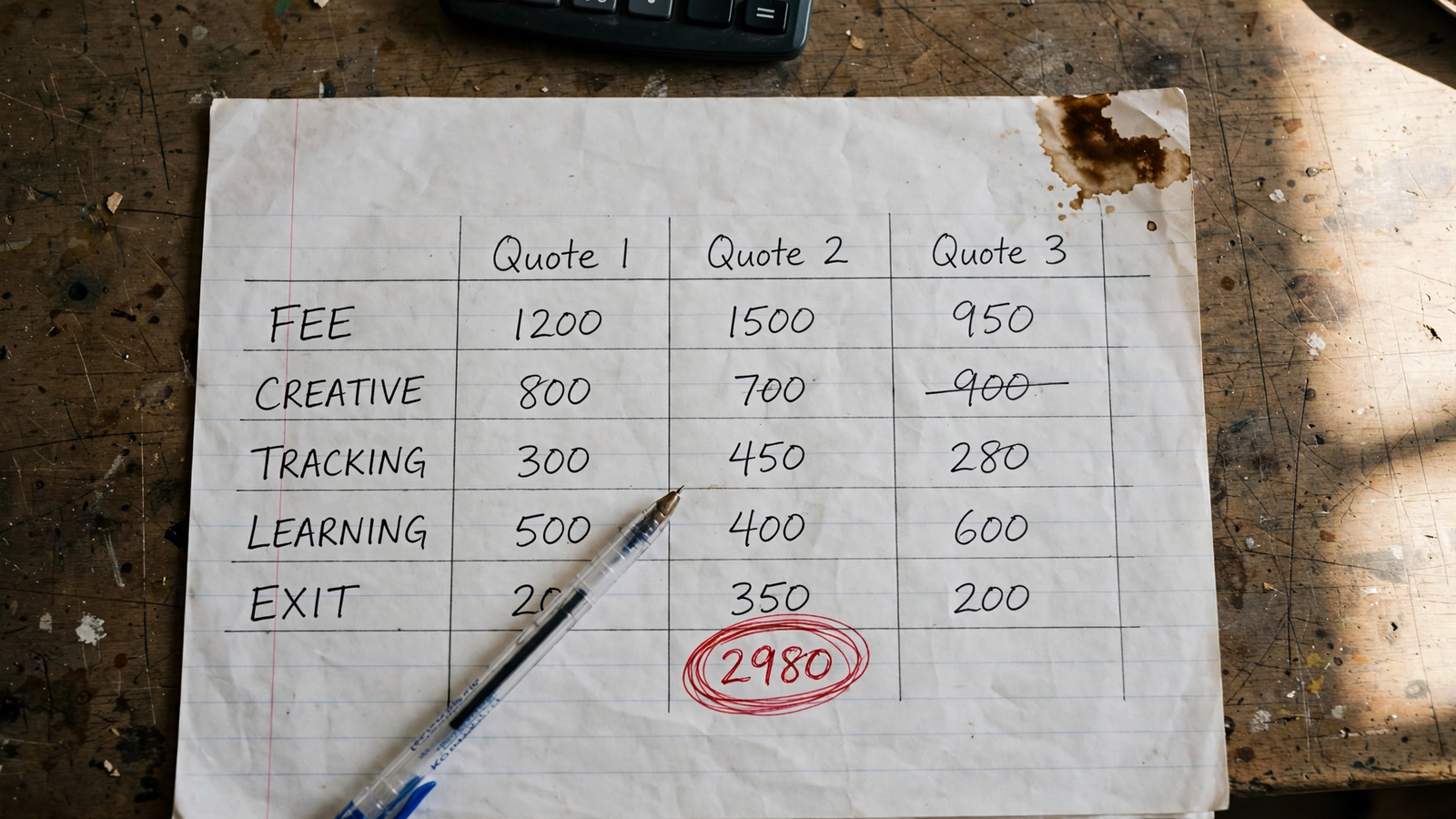
This example is most useful in the middle: roughly $3,000–$8,000 a month in media without an in-house editor. Below $2,000, ten new creatives and a manager may be too much for the budget; start with Meta Ads on $2,000 a Month. At much higher spend, percentage fees and creative volume need another look. If you already produce the creative in-house, line 4 changes substantially, and a cheaper management-only quote may make sense. Price the production you actually need, not the production a sales deck implies.
The cheapest mistake is paying a $249 tracking fix or a $300 setup charge twice because you never settled who owns the pixel. Annoying, but fixable. The most expensive is signing a long percent-of-spend contract, budgeting nothing for separately billed creative and discovering at exit that the agency owns the account. That can leave you buying production, setup and learning all over again. Add the lines before you sign. Then see what is wasting your budget.