

 LinkedIn

An $80k month can produce a $16k management bill
Say your Google Ads account reports $80,000 in monthly revenue. A revenue-share agency bills you $8,000 at 10%, $12,000 at 15%, or $16,000 at 20%. The groas Search Ads flat fee is $1,499 a month. That leaves a monthly gap of $6,501 to $14,501. Before you call the cut performance pricing, ask how much of that $80,000 came from brand searches and repeat buyers who already knew where to find you.
I used to tell clients a cut of revenue was the honest model. I was wrong. One 2026 pricing breakdown puts result-based fees at 5% to 15% of attributed revenue; a broader overview gives a 5% to 20% range. The formula is simple: attributed revenue multiplied by the agreed percentage. The hard part is deciding what attributed means. On a mature account, a cut of total reported revenue can charge you for a lot more than new demand.
The listed cost: three revenue levels, four monthly fees
These are recurring management fees, not ad spend. Each revenue figure is an illustrative month of ad-attributed revenue after refunds; each percentage is applied to that full amount. The flat fee stays the same in all three examples. Ad spend sits outside every row, so this table compares the management bill, not the total cost of running Google Ads.
| Monthly fee model | On $20k revenue | On $80k revenue | On $300k revenue | Basis for the figure |
|---|---|---|---|---|
| 10% revenue share | $2,000 | $8,000 | $30,000 | Illustrative rate within this published revenue-share range; calculated on the revenue shown |
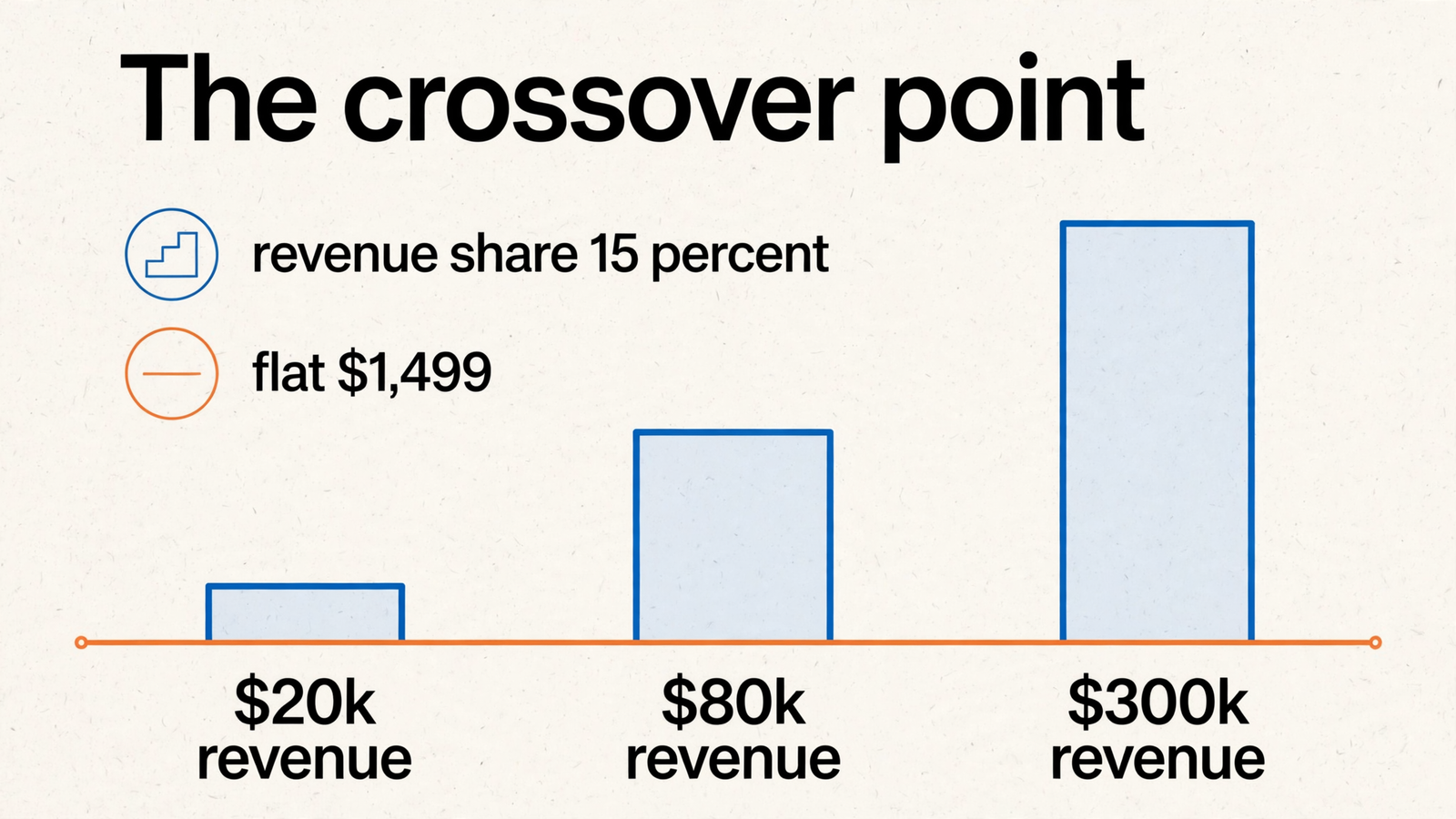
| 15% revenue share | $3,000 | $12,000 | $45,000 | Illustrative rate within the same published range; calculated on the revenue shown |
| 20% revenue share | $4,000 | $16,000 | $60,000 | Illustrative rate within this broader published range; calculated on the revenue shown |
| Flat Search Ads fee | $1,499 | $1,499 | $1,499 | groas pricing |
A revenue-share proposal does not always use this straight-percentage model. Percent of attributed revenue is one version. Per-acquisition or per-qualified-lead fees charge by the unit: pay-per-lead benchmarks run roughly $50 to $500, depending on industry, while home-services examples are often quoted at $50 to $150 per lead or 10% to 30% of sale value on a pay-per-acquisition deal. A hybrid adds a base fee to a result-based bonus; one pricing example uses a $3,000 base plus $750 to $2,000 for beating CPA or ROAS targets.
Those models do not reward the same behavior. Revenue share rewards reported revenue, whether it comes from new customers or existing ones. Pay per lead rewards lead count unless the contract defines qualified and gives both sides a way to settle disputes. The hybrid pays something during flat months, but it still needs a precise rule for the bonus. Read the definition of the billable unit before comparing rates.
At $20k: even the smallest gap is real money
At $20,000 in monthly attributed revenue, the 10% bill exceeds the flat fee by $501. At 15%, the difference is $1,501; at 20%, it is $2,501. That is not a rounding error on a small account. It is a recurring charge on revenue before you account for ad spend and the work your team does after the sale.
Revenue share can still be useful below this level. If reported revenue is low enough and the alternative is a larger retainer, paying a cut can limit your management bill while you learn whether the channel works. But at $20k, all three percentages in this table cost more than $1,499. The percentage-of-spend, pay-per-acquisition and flat-fee comparison goes deeper on the incentives behind those models. For this bill, check the dollars first.
At $80k: find the brand and repeat-buyer line
The 10% bill is $8,000, or $6,501 more than flat. At 20%, the gap reaches $14,501 a month. The cheapest cut is already more than five times the flat fee. That jump is why I care less about how aligned a proposal sounds than about which orders enter its calculation.
Suppose 30% to 40% of the $80,000 comes from people searching your name or buying again. Across the 10% to 20% rates shown here, $2,400 to $6,400 of the monthly fee is charged on that portion of revenue. That does not prove every one of those orders would have happened without an ad. It does tell you exactly where to look before paying a percentage of them. For more on the incentive, see Should Your Search Partner Take a Cut of Revenue?.
At $300k: the baseline gets expensive
At $300,000 in monthly attributed revenue, 10% is a $30,000 fee and 20% is $60,000. The respective gaps over $1,499 are $28,501 and $58,501. Even if the agency helps grow the account, a contract based on total attributed revenue charges its percentage on the baseline as well as the growth.
I have watched owners approve that structure because the fee felt like it applied only to improvement. That is not what the table says, and it is not what a total-revenue clause says. Ask whether the agency bills on all tracked revenue or only on lift above an agreed baseline. At this size, that line in the order form deserves more attention than the headline percentage.
The hidden cost: who gets credit for the sale
Brand search and returning customers can inflate the bill without bringing in the same amount of new business. A revenue share that includes both charges the agreed rate whenever tracking credits the ad, not just when the ad creates demand. One branded-search breakdown notes that 20% to 30% of branded auctions have no competing bidder and estimates that, without controls, 20% to 50% of brand spend can be non-incremental. The mechanism is familiar: last-click attribution can credit a paid brand click even when the customer may have reached you through an organic result instead.
That is not an instruction to turn off every brand campaign. It is an instruction to stop treating every tracked brand sale as proof that the management fee earned its cut. A billing model built on attribution needs an attribution agreement, not a screenshot from a dashboard.
The performance-deal attribution checklist covers the clauses worth settling before work starts:
- What counts as a qualified lead or sale, and which click or view window applies?
- Is the CRM or the ad platform the source of truth when their totals disagree?
- Are repeat customers, refunds and cancellations included or excluded?
- How are offline sales and cross-channel credit handled?
- Is there an agreed baseline, or does the agency earn its cut on all attributed revenue?
The window and source of truth are where a neat formula becomes an argument. If Google Ads credits a sale within its click window while another channel helped close it, the contract needs to say which record governs the fee. Stripping out refunds helps, but it does not answer the repeat-customer question. Put the answer in writing before the first invoice.
One-off versus recurring: ask for the missing line items
The table shows monthly fees only. It contains no one-off setup amount and does not price a ramp, minimum volume requirement or early exit. That does not mean a proposal has none; it means you cannot infer those terms from a percentage. Ask the vendor to list any one-off charge separately from what recurs each month. If a price is absent from the pitch, do not supply your own guess. Get it in the order form.
The contract can change the effective cost even without a separate setup bill. Performance shops may pair a cut with a 60- to 90-day optimization ramp, six- to 12-month contracts, or minimum lead volumes. Accounts need time to learn; a ramp is not automatically a trick. The expense appears when a weak month still triggers a minimum payment or you cannot leave. The same breakdown flags an incentive to favor bottom-funnel branded search during a ramp rather than build new demand. Ask what you owe if month two produces no revenue, and when you can cancel.
Lead-gen contracts have their own hidden denominator. A fee per qualified lead works only if both sides agree on qualified in plain English. One tiered example charges $50 for a basic lead, $150 for a booked appointment and $500 for a closed sale. That at least distinguishes a name in a form from a sale. Industry pay-per-lead benchmarks span $50 to $500, while 2026 Google Ads benchmarks across more than 13,000 campaigns report a $66.69 average cost per lead and an 8.18% conversion rate. Those are different measures, so do not stack them as if they were one bill. A $150 fee per raw lead becomes $300 per usable opportunity if only half the leads qualify. Before signing a guarantee, use the questions in Will They Actually Eat the Loss?.
The crossover: divide $1,499 by the percentage
At $14,990 in monthly attributed revenue, a 10% fee equals $1,499. At 15%, the crossover is about $9,993; at 20%, it is $7,495. Below each line, that revenue share costs less than the groas flat fee. Above it, the flat fee costs less, assuming the same revenue base and no other charges. No mystique. Just division.
That explains the appeal on a smaller account. Flat retainers can run $2,500 to $12,000 or more a month; a business with $10,000 in attributed revenue would pay $1,000 at 10%. Compared with a $3,000 retainer, that looks like cheap insurance. Compared with $1,499, the crossover comes quickly. At $80,000 and 15%, the monthly difference is $10,501, or $126,012 over twelve months at the same revenue level.
Excluding brand and repeat buyers moves the line, but it does not necessarily save the model. Say 35% of an $80,000 month belongs to those groups and the contract carves it out. The billable base falls to $52,000; a 15% fee becomes $7,800. That is still $6,301 more than flat each month. Negotiate the base before debating a point or two of rate. If the agency will not exclude those orders, cap the fee, or bill on lift over baseline, you know what its percentage applies to.
The narrow cases where I would still sign revenue share
I would consider it in three cases, and I would still read the contract:
- A small account with a costly alternative. Under $10,000 a month in attributed revenue, a 10% cut on, say, $8,000 is $800. If the alternative is a $3,000 retainer you cannot justify, the lower starting bill has a point.
- A new offer with no baseline. A short test can let the agency share the downside while you find out whether the offer works. I would want a written end date after 90 days, not an open-ended promise to revisit the terms.
- High-ticket services billed on closed deals. Tiered payment can work when your CRM is the agreed source of truth and the contract defines each billable stage.
Outside those cases, I would start with the flat-fee arithmetic. Once an account is doing $20,000 or more in monthly attributed revenue, each revenue-share rate in this comparison charges more than $1,499, whether the month represents new growth or a familiar baseline.
Six questions for the order form
Get these answers in the contract, not the pitch deck:
- Which revenue counts, and what click or view window applies?
- Are brand search and returning customers excluded in writing?
- Are refunds, cancellations and partial payments removed from the billable base?
- Which source of truth wins when Google Ads and the CRM disagree?
- What do I owe if revenue is zero in month two, and when can I leave?
- Is the fee based on total attributed revenue or lift above an agreed baseline?
The cheapest mistake is choosing the wrong small bill: at $20,000 in revenue, the 10% cut costs $501 more than flat for the month. The expensive one is signing 15% on $300,000 with brand included and paying $45,000 a month on a base that contains customers who typed your name. Price the base before you debate the percent.