

 LinkedIn

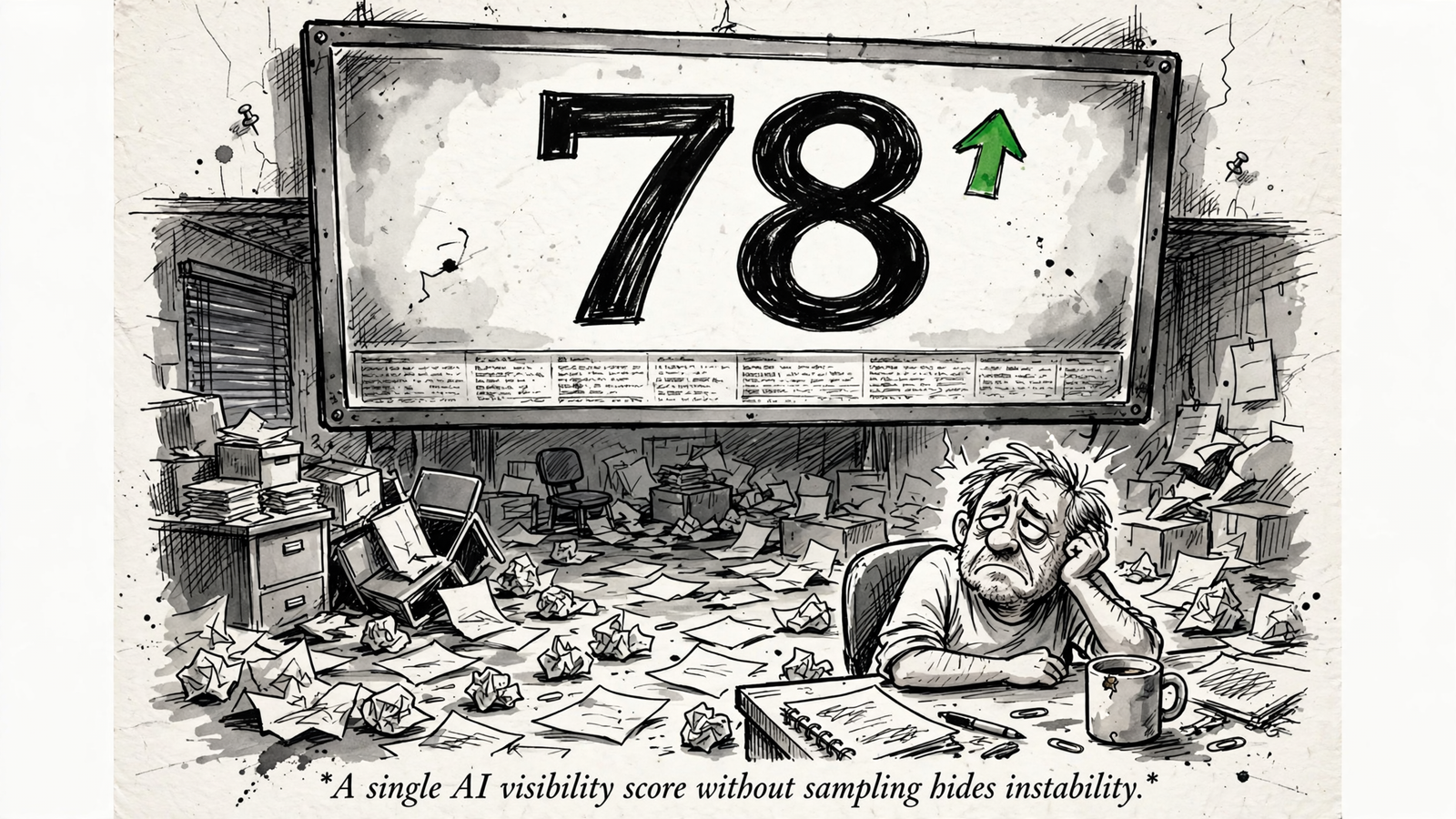
By November 6, 2028, no serious buyer will renew an AI-search retainer based on a single visibility score with no sampling behind it. The blended 78-out-of-100 with an up-arrow will stop closing renewals because buyers will have learned what that number hides.
I learned to distrust clean numbers running Google Ads. A client would forward me a beautiful monthly PDF showing lower average CPC and higher CTR, and I would have to explain that neither paid their rent. Average CPC drops when you buy cheaper junk clicks. CTR rises when you show ads to people who love to click and never buy. The question was whether qualified pipeline moved, and whether we had measured enough to know. AI-search reporting is repeating the trick with ChatGPT, Gemini and Perplexity instead of the auction.
My prediction is not that AI answers become stable. It is that agencies lose permission to hide instability inside one reassuring number. Buyers will demand to see how often a provider looked, which engines it checked, and what work happened after the report arrived.
A visibility score needs a denominator
There is a difference between buying measurement and buying evidence of progress. Measurement tells you how many times you looked, where you looked, and what you saw each time. Evidence tells you whether the work changed anything. Most AI visibility reports I have seen sell the first and price it like the second: one blended score, one green arrow, no mention of how many prompts ran, how many times each prompt ran, or how often the answers flip when you ask again.
That is a weak basis for a renewal. If the provider cannot show the runs behind the score, neither of you can tell improvement from sampling noise. You are left debating the arrow instead of the work.
The baseline is worse than most buyers assume. Pepper reviewed the pricing and product pages for 14 AI-search visibility tools and found that only five published both the prompt allowance and the response allowance needed to calculate sampling frequency. Entry-tier sampling ranged from 30 to 91 responses per prompt per month. None of the 14 disclosed run-to-run variance. One entry tier publishes 50 prompts and 50 answers a day: exactly one run per prompt, so variation is undetectable by construction.
Pepper is open about its limits. It sells in this category, excluded itself from the ranking, and says no outside test has run one prompt set through every platform with independent capture. I respect that disclosure. A buyer can weigh a stated limitation; they cannot weigh one that has been hidden behind a score.
Prediction 1: buyers will require sampling disclosure
The mechanism is simple. A buyer renews on trust, sees a number move without any work happening, then asks how it was built. With AI answers, that question arrives quickly because repeated answers can differ. A SparkToro/Gumshoe study of 2,961 runs found less than a 1 in 100 chance that ChatGPT or Google AI repeats the same brand list twice in 100 runs, and about a 1 in 1,000 chance it repeats that list in the same order. A visibility percentage across dozens or hundreds of prompts run multiple times is reasonable. A single-run position is not.
Imagine your score jumps 12 points after you change nothing. You might welcome the jump, but you cannot credit the provider for it without knowing how many prompts were checked, how many times each was run, and when those runs happened. The same problem works in reverse: a falling score may be a reason to investigate, not proof that the work failed. Show the sample before you sell the movement.
The evidence today is that at least one vendor already sells rigor this way. Evertune documents sampling each prompt 100 times per model, putting its topic-level margin of error at about +/-2 points versus +/-31 for once-a-day competitors. I do not care whether you buy Evertune. I care that a buyer can ask a checkable question and get a numerical answer.
Here is what would prove me wrong. I will take a fixed panel of 20 managed-service proposals collected at publication, revisit them in November 2028, and count how many state prompt counts, response counts and collection frequency in the proposal itself. I predict a majority will. If fewer than half do, sampling disclosure has not become the buying requirement I expect. The one-number report survived longer than I thought.
Prediction 2: one blended score will stop being an adequate headline
ChatGPT, Gemini, Perplexity and Google AI Overviews do not read the same web. Across 968 repeated runs of 42 prompt-engine pairs, 18 pairs flipped between mentioning and not mentioning the brand. Consecutive runs shared a median 0.41 cited-domain overlap, and only 3.5% of domains appeared in every run. Combine results like those into one score and you lose two distinctions at once: what happened on each engine, and whether the brand was mentioned or its website was cited.
That matters because a pooled number can rise while the engine your buyers use falls. If the report gives you only the average, you cannot tell which result changed or where the next piece of work belongs. Analyst Nadia Mohamed puts the fix plainly: measure mention rate, citation share, share of voice and framing separately by engine, rather than treating one vendor score as comparable with another. I would rather see several imperfect lines with their sampling attached than one immaculate dial whose inputs I cannot inspect.
The engine split already affects where work belongs. Promptwatch data from August 2026 showed Reddit’s share of ChatGPT citations falling from 3.83% to 0.52%. October vendor tests found Google AI Overviews citing Reddit in 28 of 55 overviews while ChatGPT search cited zero forums. A blended score conceals that engine difference. It can make distinct behaviors look like one general trend, then send a team off to fix the wrong thing.
I expect a standard report to put engine-level results up front and keep brand mentions separate from website citations. That is a reporting requirement, not a promise that either line will turn into revenue. I have made the longer case for why one AI visibility score will not win contracts by 2028.
I will use the same 20-proposal panel to check this prediction. If a majority still presents one pooled number as the headline result in November 2028, I was wrong. Until then, ask for the export by engine before you sign. If a provider cannot show it, you cannot see which input moved.
Prediction 3: monitoring and implementation will stop hiding in one scope line
Watching a number is not the same as changing it. Publishing pages, fixing access problems and earning third-party mentions are work; collecting and reporting results is measurement. Right now, both can sit under the same monthly fee, leaving the buyer to discover later that the people identifying a problem were never responsible for fixing it.
A European proposal guide makes the ownership question explicit: GEO work splits into audit, production, implementation and monitoring. It says the proposal should identify who publishes changes, with closure checks owned by website and integration release teams rather than the monitoring vendor. A UK agency already prices the distinction in public: GEO Monitoring at £950 per month plus VAT for measurement only, versus GEO Authority at £1,500 per month plus VAT including implementation. Its warning is blunt: a bundled monthly fee can charge a delivery rate for a measurement service.
I used to tell clients a report was progress. I was wrong. A report is an invoice for looking. It becomes useful when someone can point to the finding, the person responsible for acting on it, the change made and the date it went live. Without that chain, the provider can show you a problem indefinitely and call every subsequent report another month of work.
The implementation side is slower and less glamorous than a deck admits. A 2026 buyer guide describes four phases—audit, strategy, implementation and monitoring—with monthly retainers of $2,000 to $15,000, and flags guaranteed AI rankings as a warning sign. In a synthesis of a 65-comment marketer thread, an agency wrote 20 Reddit posts answering real buyer questions and ChatGPT still did not cite the client. The top-voted reply argued that independent mentions across multiple trusted sites mattered more than repeated mentions from one source. You cannot assume that posting more from one account will produce a citation.
My prediction is specific: by November 2028, a majority of that same 20-proposal panel will separate monitoring from implementation in scope and name who publishes. If most still bundle everything into one vague line, I lose this one too. Ask who makes the change, not just who notices the problem.

What I would require before signing today
If I were signing an AI-search retainer this month, I would ask for five things in writing. I would treat a no as a no:
- A sample report from a real account with names removed, including its prompt list rather than screenshots alone.
- A sampling statement showing the number of prompts, runs per prompt and collection dates. If you want to build your own comparison before buying, start with a fixed set like 40 prompts across four engines with three runs each. Repeating the same panel gives you a way to see ordinary wobble.
- An engine-level export that keeps brand mentions and website citations separate. A headline score can sit on top if the underlying results remain available.
- Named owners for publishing pages, fixing access and indexing, and earning outside mentions. I put the questions to ask in an open letter to anyone paying for an AI visibility report.
- A dated action log connecting each change to what happened next. It should let you distinguish a month of observation from a month in which someone actually changed something.
None of this guarantees citations or revenue. It gives you a way to judge the service you bought. If a provider cannot show the denominator, you are not buying evidence of progress. You are renting a number.
Publish the baseline. Revisit the predictions in two years.
Here is how you can check whether I earned any of this. I am fixing a panel of 20 managed-service proposals covering ChatGPT, Gemini and Perplexity, collected at publication from agencies selling ongoing management. I will score each proposal yes or no on three checks:
- Does it state prompt counts, response counts and collection frequency?
- Does its standard report break out engine-level results, with mentions and citations kept separate?
- Does its scope name who publishes and who only monitors?
I will publish the sheet and rescore the same panel in November 2028. A majority on a check means I called that prediction. Anything less means I missed. I will say so in plain numbers rather than redefine success after the fact.
Until that review, stop paying for a mystery number and start paying for work you can trace. Build your own repeat-run baseline, then make any provider beat it in writing with sampling, engine exports, named owners and a dated action log. That is why I do my client work inside groas: the work and its reasoning stay visible together, on a flat fee instead of a cut of spend. The buyer should not have to infer what happened from a polished monthly arrow.
Disclosed sampling will not make AI answers stable. Separate engine lines will not turn citations into pipeline on their own. Repeated measurement helps you see the instability; implementation means doing the page, access and outside-mention work rather than merely reporting that it needs doing. groas offers Search Ads, Meta Ads, and SEO plus AI search at a flat fee per service, with reporting and work under the same owner. If I am right, buyers will expect that distinction wherever they shop. If I am wrong, you still keep the only things worth demanding now: a denominator you can audit and a list of who did what.