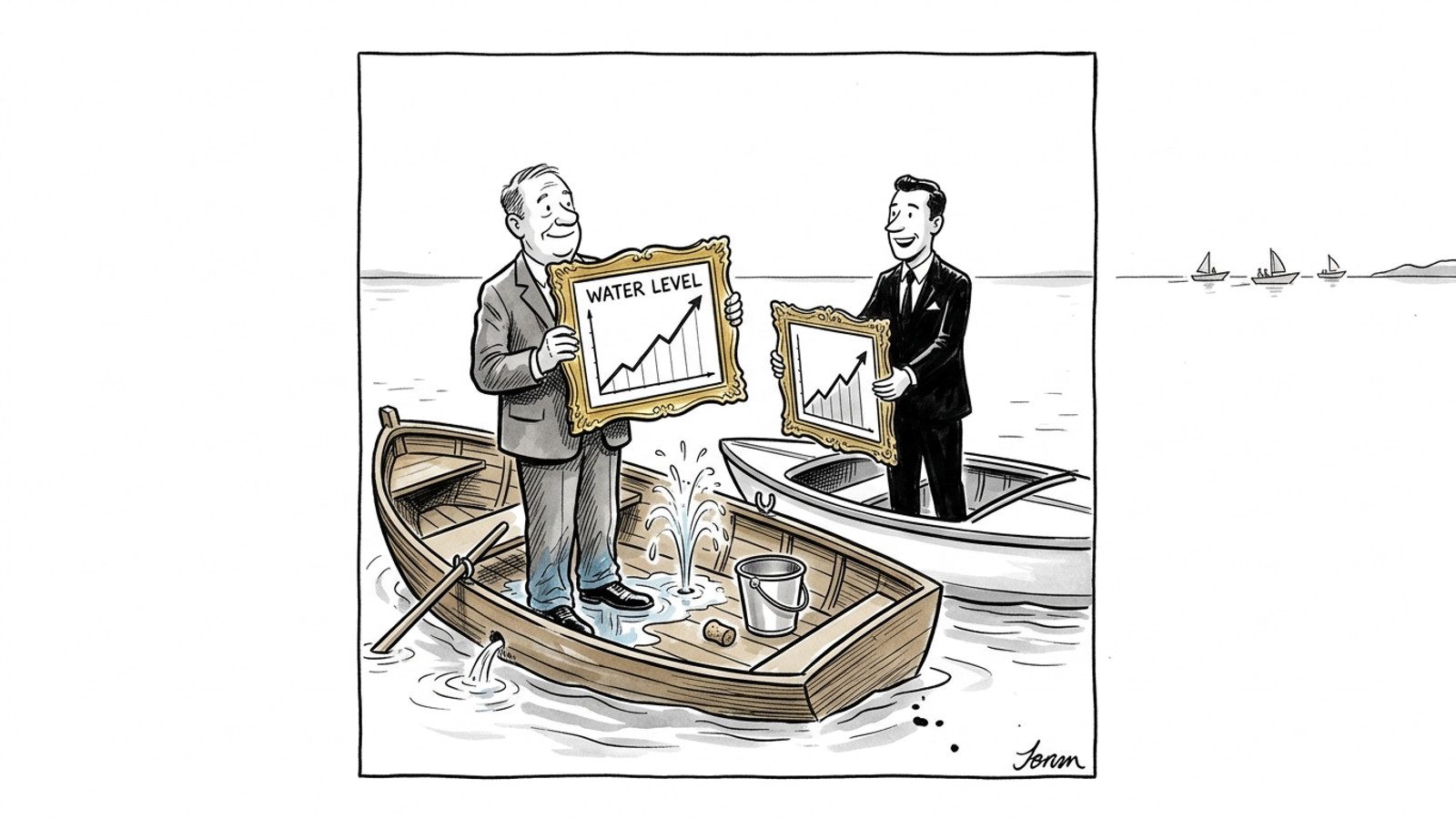
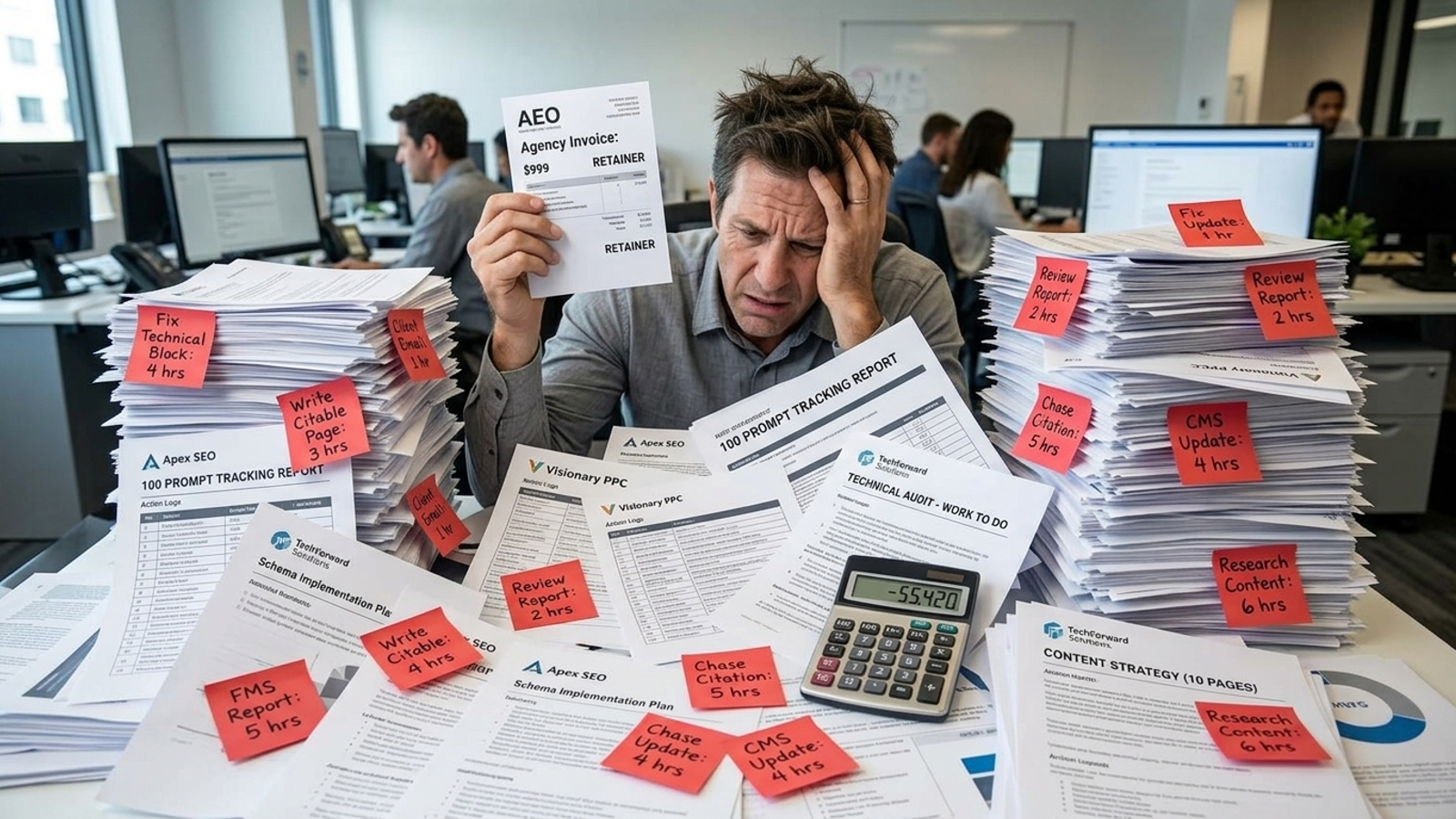
A $999 AEO retainer can look profitable right up until the client asks who is fixing the problems in the report. I watched PPC shops make the same mistake ten years ago: they sold the dashboard, then ate the labor required to change the numbers.
Now an agency has a prospect asking why ChatGPT never mentions them, a three-tier proposal template, and a shortlist of tools promising 50, 100, or 300 tracked prompts with the agency’s logo in the corner. Buy the tool for $189, mark it up, send the PDF. Clean resale, apparently.
But the two features newcomers shop for hardest—prompt volume and a pretty white-label report—are the two most likely to cap both margin and client results. The report tells you where you stand. It does not do the work that moves you.
The $999 retainer that breaks by month three
Run the math. Software at $189 to $245 a month for 100 to 150 prompts leaves roughly $750 to $810 before anyone touches the account. Then month two arrives and the client asks the obvious question: “We appear in 12 of these prompts. What are you doing about the other 88?”
Somebody has to write pages, fix technical blocks, and chase citations. Say that takes five hours a month at a fully loaded $80 an hour. At the $245 software tier, your roughly $750 becomes roughly $350. You have not answered an email yet.
I recognize the pattern from PPC. Agencies sold impression-share curves and query reports, then paid a media buyer to mine negatives and rebuild structure as if that labor came free. The client renewed the report, not the work. With AEO, the gap is harder to hide: one visibility check is noise. Answers vary between runs, engines reshuffle after model updates, and a screenshot proves little. A fixed set checked on a cadence can show a trend. Acting on that trend is what the client stays for.
Belief 1: “Prompt tracking is what the client is paying for”
Tracking is easy to demo. Type in 75 questions, show that the client appears in 11 answers, and watch the prospect nod. The screenshot feels like proof of work.
It is also a thin product to resell. Otterly lists $29 a month for 15 prompts and $189 for 100; Peec lists $95 for 50 and $245 for 150, while Profound sits around $499 for enterprise. At those entry tiers, you are paying about $1.90 to $1.98 per tracked prompt. Prompt tracking is one of the most commoditized layers in the stack.
And a prompt is not a keyword rank. There are endless ways to phrase one buyer intent, while most trackers cannot see the multi-turn context, personalization, or location behind an answer. That is why one technical breakdown argues for tracking fixed entities instead. The same analysis recommends repeating each entity up to 100 times because identical inputs can produce different answers. In one test of 2,961 runs, the same brand list appeared in the same order about 1 in 1,000 times.
A client paying for a count is paying for a sample. They want the reason the count moves. Improve readability, structure, and citations, then watch whether mention rate follows. Sell the work behind the movement, not the screenshot, or you own the churn.
Belief 2: “The more prompts we track, the more valuable the retainer”
Fifty prompts sounds thin in a proposal. Three hundred sounds serious. It is tempting to sort tools by the biggest number and assume the client will too.
I used to tell clients more keywords meant more coverage. I was wrong to carry that logic over to AI answers. A longer prompt list can buy a larger sample of the same noise. Manual spot-checks do not scale, and one-off checks are unreliable when answers vary between runs and after model updates. What holds up better is repeating a fixed set on a cadence and classifying sentiment and mention type. The tool can help with that. The raw count is the cheap part.
More prompts can mean less margin
Most tools charge by prompt band, so expanding a list to look valuable raises your cost before it raises client value. A September 2026 price check across 16 tools lists Otterly at $29, Rankscale at $20, Peec near €89, Semrush at $99 per month per domain, and Ahrefs at $199. Push a client from 50 prompts to 350 and you can jump tiers twice. Per-client seat pricing creates the same problem across a portfolio; one agency playbook warns that it breaks margin on a 20-client book and says 70% margins hold only when measurement is automated.
Start with the 30 to 50 buyer questions that could affect revenue. Repeat them, study the trend, and spend the money you did not burn on extra prompts shipping fixes. A small set is still a sample, not a verdict. Make it a useful one.
Belief 3: “White-label means our logo on their dashboard”
A logo in the corner feels like ownership until the client asks who did the work. Most AEO tools were built for in-house teams, not resale, and the packaging shows it. Per-domain pricing and capped workspaces complicate agency delivery: Semrush’s $99-a-month-per-domain cost multiplies across clients, Profound uses one workspace per account with no content layer, and Otterly Lite’s 15-prompt tier has no white-label option.
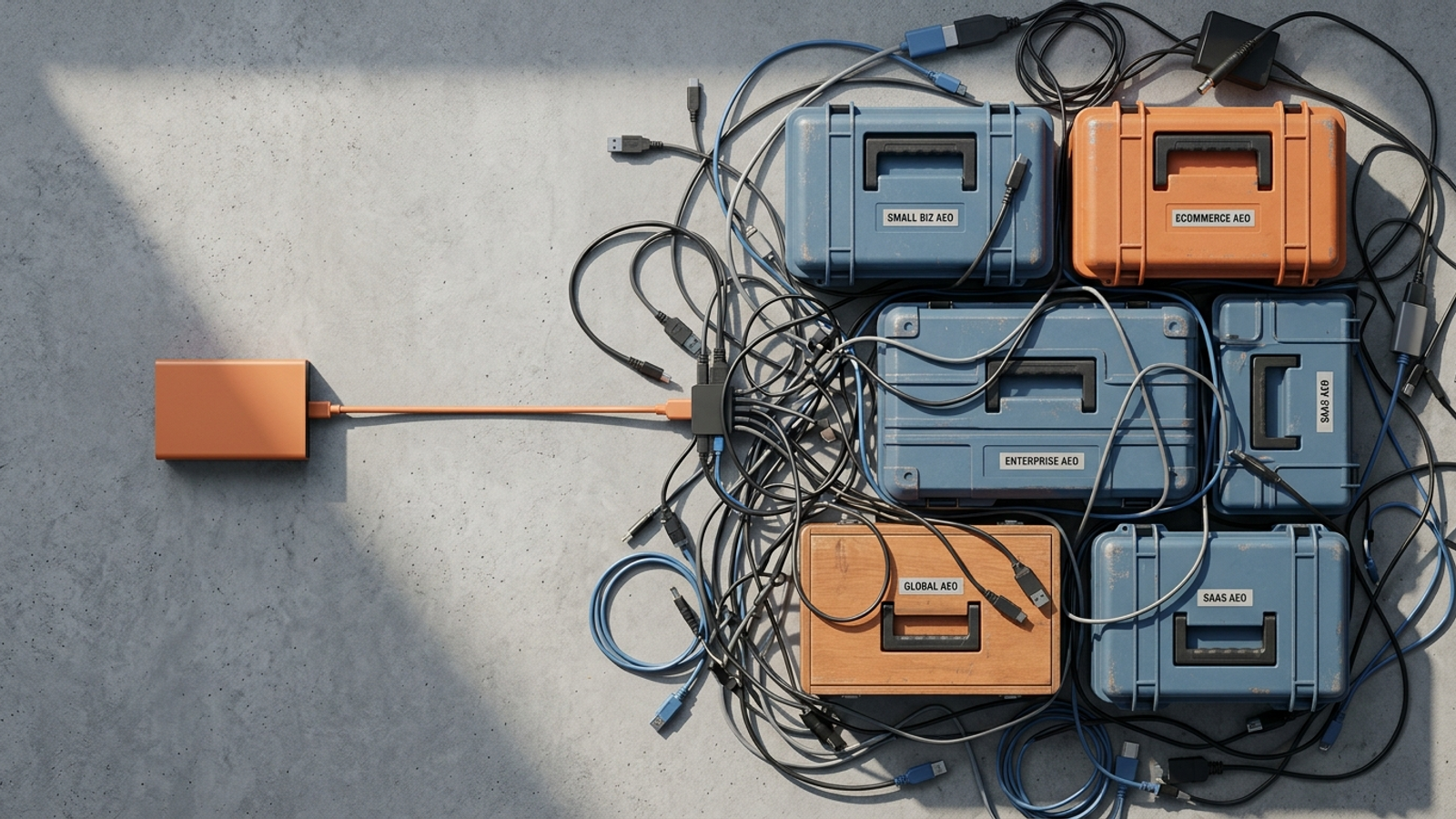
Soon you are logging into five tools, exporting five PDFs, and explaining five invoices. That is not a product. That is five chores with your logo on top.
What the deck calls white-label, I call a forwarding service. For an agency, the useful version means the client does not see the vendor, the report carries your brand, and delivery happens without your team doing every task. That is the model groas offers agencies: one connection per client, execution under your name, branded weekly reports you can forward, and a strategist who supports your team without stepping in front of the client.
If the software cannot publish, fix, and report under your name, you did not buy margin. You bought homework.
Belief 4: “Technical fixes will need a developer on every client site”
This one feels prudent. Every agency owner has a scar from a WordPress update gone wrong, so you budget two developer hours per AEO client and assume somebody will need FTP access.
But if key material sits behind scripts a bot does not load, your carefully built page can look close to blank to it. That is why groas frames the job as making a site readable, citable, and recommended, rather than handing over a 60-point audit. Citable blocks, schema, internal links, and page-speed patches need to ship. If each one waits for a developer ticket, the client pays $999 to watch a queue grow.
Ask the vendor who pushes a fix live before you sign. If the answer is your team, add the labor to the proposal; five hours at $80 has already consumed $400 of the retainer. The resale model that holds up connects once and works across platforms, CMSs, and setups, with content, technical fixes, and citations treated as execution and actions logged with their reasoning.
Say you have ten domains on different stacks. One system that publishes across them protects the retainer; ten separate developer tickets eat it.

Belief 5: “We can keep content production manual and still scale to 10 domains”
The first two clients can make this belief feel safe. A strategist writes four pages, a freelancer polishes them, the client sees two new citations, and everyone is happy. Then clients six through ten arrive.
Say each domain needs two citable pages a month to move mention rate. That is 20 pages across ten clients. At four hours per page for briefing, drafting, editing, and publishing, you have bought 80 hours of labor on a $9,990 book of business. At an $80 loaded hourly cost, $6,400 goes to production. Your margin went to pay for Google Docs.
The fix is not merely a faster writer. It is refusing to resell software that stops at suggestions. I point agencies to this ranking of AEO tools by work done rather than features listed because many dashboards end exactly where the expensive part begins: here is the gap; good luck.
If content, technical patches, and citations are not included as execution, you are selling a to-do list and donating the labor to complete it. Before you package the service, confirm who hits publish in the client CMS and who owns the rewrite when an answer shifts. If it is your team, price that work or skip the tool.
Belief 6: “Monthly reports prove the work happened”
Monthly PDFs feel safe because SEO clients were trained to accept them. Traffic up, rankings table, next steps. But an AEO mention-rate chart can move because an engine updated its model, a competitor published, or you shipped something. Show the line without the work behind it and, by month three, the client has a fair question: what did we pay for?
I learned the distinction running PPC. A CPA drop means little until you can point to the bid, budget, or negative-keyword change that may explain it. A chart shows what changed. An action log shows what you changed.
Put the change log beside the chart
AEO needs a timestamped record of what shipped, why it shipped, and what happened next. Answers shift; memory fades faster. Ask for a feed where every publish, patch, and citation carries its reasoning in plain language, the standard groas describes as nothing running without explanation.
If your tool cannot show the client what shipped Tuesday and how the trend responded Friday, you will spend renewal calls arguing about noise. Attach the log to the invoice, not just the chart.
Belief 7: “We’ll pick a separate tool for each client type”
Local clients get one tracker, ecommerce gets another, and the SaaS client with 400 pages gets whatever has an API. It feels client-centric. In practice, you have bought three onboarding flows, three billing meters, and three definitions of a mention.
Now your junior learns three UIs instead of one playbook. Every renewal starts with an explanation of why the numbers do not match. I have seen the PPC version of this: different bid rules for every vertical until nobody can tell which process is working and the hours leak out the side. Say each extra tool adds two hours a month of context switching across ten clients. That is 20 hours you cannot bill on a service priced as software margin.
Standardize the delivery, not the clients. One connection, one report format, and one place where content, technical fixes, and citations ship make a $999 retainer repeatable. When each signup needs a custom stack, it is a custom project wearing a product price tag. If a tool requires a different plan for every client shape, it is not your product. It is your second job.
What I ask before putting $999 on a proposal
I keep these five questions to ask before buying another dashboard open during demos. Demos are designed to make you admire the interface, not ask who does the work. Before you package a retainer, make the vendor pass four tests:
- Can you price each client once? A flat per-domain cost is easier to mark up than a meter that jumps with prompt bands or workspaces.
- Can you measure without a penalty for looking? Track a focused set of 30 to 50 buyer questions on a cadence, with sentiment and mention type attached, without jumping a tier when you add questions.
- Is execution inside the fee? Confirm who drafts and publishes content, patches technical blocks, and handles citations in the client CMS, across the stacks you serve.
- Can you prove the work under your name? Ask for branded weekly reports and a timestamped action log tying ship dates to the trends that follow, with a strategist backing your team rather than fronting your client.
Fail those tests and you are back to selling reporting while donating labor. But the belief I am still not sure about is whether AEO stays a separate $999 line item at all. Part of me thinks prompt dashboards go free inside every SEO suite within a year. If that happens, the only retainer left standing may be the one that ships fixes. The questions could get cheaper to count. The work will still need doing.
Frequently asked questions
Is prompt tracking something an agency can resell to clients at a markup?
Prompt tracking is one of the most commoditized layers in the AEO stack, costing roughly $1.90 to $1.98 per tracked prompt at entry tiers. A prompt count is only a sample, not a keyword rank, since trackers miss multi-turn context, personalization, and location. What clients actually pay for is the work that moves the mention count, such as improving readability, structure, and citations.
How many prompts should an agency track for an AEO client?
Start with the 30 to 50 buyer questions that could actually affect revenue, then repeat that fixed set on a cadence and study the trend. Larger prompt lists mostly buy a bigger sample of the same noise, and since most tools charge by prompt band, expanding the list raises your cost before it raises client value.
What does white-label actually need to mean for an AEO agency?
A logo on a vendor dashboard is not a product. The useful version of white-label means the client never sees the vendor, reports carry the agency's brand, and execution happens without the agency's team doing every task manually. If the software cannot publish, fix, and report under your name, you bought homework instead of margin.
Does every AEO engagement need a developer for technical fixes?
No. Citable blocks, schema, internal links, and page-speed patches do need to ship, but waiting on a developer ticket for each one leaves the client paying while a queue grows. Ask the vendor who pushes fixes live before you sign; if the answer is your own team, price that labor into the proposal, since five hours at $80 already consumes $400 of a $999 retainer.
Can agencies keep content production manual and still scale AEO to ten domains?
Not profitably. If each of ten domains needs two citable pages a month, that is 20 pages at four hours each, or 80 hours of labor that consumes $6,400 of a $9,990 book of business at an $80 loaded hourly cost. The fix is refusing to resell tools that stop at suggestions; confirm who drafts, publishes, and owns rewrites before packaging the service.
Are monthly AEO reports enough to prove the work to clients?
A monthly chart only shows what changed, not what you changed, since mention-rate movements can come from model updates, competitors, or your own work. A timestamped action log that records what shipped, why it shipped, and what happened next is what answers the client's renewal question. Attach the log to the invoice, not just the chart.
Should an agency use a different AEO tool for each client type?
No. Separate tools per client type mean multiple onboarding flows, billing meters, and definitions of a mention, plus hours of context switching that you cannot bill on a retainer priced as software margin. Standardize the delivery instead: one connection, one report format, and one place where content, technical fixes, and citations ship.