

 LinkedIn
A client asks whether they show up in ChatGPT. By Friday, the agency has bought a tracker, picked the plan with the biggest prompt count and put its logo on a report. That is how an AI search service gets sold before any AI search work gets done.
I have seen the same move in PPC: bill for a polished account summary while nothing in the account changes. In AEO, the gap catches up with you fast. A chart can show where the client appears, but engines do not cite a business because someone watched them. They cite passages they can retrieve, understand and trust. If the agency cannot change what those engines read, the month-three renewal rests on a prettier way to show the problem.
I get why each shortcut is tempting, especially when a client wants an answer this week. Here are the beliefs I would challenge before putting AEO on a retainer.
Belief 1: “Monitoring AI visibility is the service”
This is the most common mistake. The client asks, “Are we in ChatGPT?” A dashboard gives you a yes-or-no answer, something to send on Friday and a service line you can launch quickly. At $99 or $199 a month for the tool, there is room to mark it up. It feels like coverage.
Then you send the report. What happens next?
Search-based engines like AI Overviews and Perplexity retrieve a shortlist of passages before writing an answer; hybrid engines blend training data with retrieval. They can break one buyer question into several sub-queries, which gives a narrow, self-contained passage a better shot than a broad service page. Only 17% of AI Overview citations came from pages in the Google organic top 10, down from about 76% in mid-2024.
A mention chart changes none of that retrieval math. It does not rewrite a muddled answer, restructure a page, remove a technical block or earn an off-site reference. Monitoring tells you where to work; it is not the work.
The Princeton-led GEO test puts a number on the distinction. Across roughly 10,000 queries, adding citations, statistics and quotations lifted visibility in generative answers by up to 40%, while keyword stuffing dropped it about 10% or did nothing. The useful lesson is not to scatter statistics across every page. It is to make an answer worth lifting and give the engine evidence it can lift with it.
So charge for changes shipped per domain per month: answer-first passages published, old pages recut around one clear question, technical blocks removed. Use the tracker to decide what needs attention and check whether the work helped. If your week-one deliverable could also come from a read-only login, you do not have a service yet.
Belief 2: “The tool that tracks the most prompts wins”
Every first-time buyer compares the headline numbers. Five hundred prompts beats 150, so 500 must be better. I understand the instinct. But a prompt allowance tells you little until you know which engines your actual plan includes and what the vendor counts as one prompt.
Profound Starter at $99 a month is ChatGPT-only. Semrush at $99 a month per domain covers four named engines, with Perplexity checked weekly rather than daily. Ahrefs Brand Radar at $199 a month covers a single platform. Four of six tools advertise engines their entry plans do not include. Buy engine coverage on the plan you will pay for, not the engine list on the sales page.
Then check the billing unit. Many tools count one prompt on one platform as one slot. One buyer question across ChatGPT, Perplexity and AI Overviews can cost three slots; across seven platforms, seven. A 150-prompt plan can shrink to about 25 distinct questions. Tracking 200 prompts across five engines daily for one mid-market brand lands at $420 to $975 a month, with normalized examples from Scrunch at $417 to Ahrefs at $974.
I would start smaller: 20 to 40 buying-intent questions per location or service line, checked daily on the engines the client’s customers actually use. Keep share of voice and citations tied to each question, then connect the findings to a publishing queue. HubSpot’s standalone at $50 a month for 25 daily prompts across three engines shows what a narrower starting point looks like; Peec Starter at $95 a month for 50 prompts across three models shows the next step up. More prompts without work attached just means paying to watch more losses pile up.
The cost here is margin before it is embarrassment. Say you resell monitoring at $600 a month and the tracker bill reaches $429 for one brand once you count platforms honestly. You have $171 left for logins, questions and a PDF. In month two, the client asks what changed because of the report. Prompt volume is not an answer.
Belief 3: “AEO is SEO with a new label”
This one is tempting because part of it is true. I used to tell clients that SEO fundamentals would cover AI answers. I was wrong, or half wrong, which in client work amounts to the same thing.
Crawlability, topical authority and backlinks still matter. If pages block crawlers, load like wet cement or have no topical depth, an answer engine will not rescue them. Keep that work. The mistake is assuming that doing it means the AI answer will quote the right part of your page, or quote you at all.
Classic SEO fights for position and click-through. In AI search, you also watch citations, mentions and share of voice. With 68% of US Google searches ending without a click, treating the visit as the only visible outcome leaves part of the picture out.
The unit an engine lifts is often not the whole page. It is a passage: one question, a direct answer in the first two sentences and evidence close enough to travel with it. The same entity name and description across pages, backed by schema, help make that passage intelligible. Off-site mentions can serve as corroboration, not just link votes. A dentist with twelve identical directory blurbs and one thin service page can rank on page one yet lose the AI answer to a competitor with three quotable paragraphs and two independent mentions.
Do not rename the SEO retainer and call the job finished. Keep the technical foundation, then inspect the passages an engine could actually extract. Where the answer is buried in a broad page, recut it. Where a claim needs support, put the evidence beside it. A ranking report tells you one thing; it does not tell you whether the client’s answer is ready to be cited.
Belief 4: “White label means rebranding someone’s report”
White label covers three different products: a branded PDF export, a live dashboard on reports.youragency.com with SSL, or a fully resellable platform instance. The PDF is the easiest to launch. Add a logo, forward the file, move on to the next client. Then the client reads it as homework rather than help.
Reporting matters. Ninety-seven percent of agencies rate accurate reporting important for retention, and 76% rate it extremely important. But the leading churn drivers listed there are budget cuts at 42%, client-side changes at 37% and lack of perceived value at 32%; reporting issues sit at 10%. Reports make value visible. They do not create it.
The agency price ladder draws the same line: basic AI visibility monitoring resells at $500 to $1,500 a month, monitoring plus optimization at $1,500 to $5,000, and full service at $5,000 to $10,000. The tracker is the smallest bill. Execution is the retainer. That is the shift behind the move from white-label SEO to AEO: rank reports give way to per-domain work that ships.
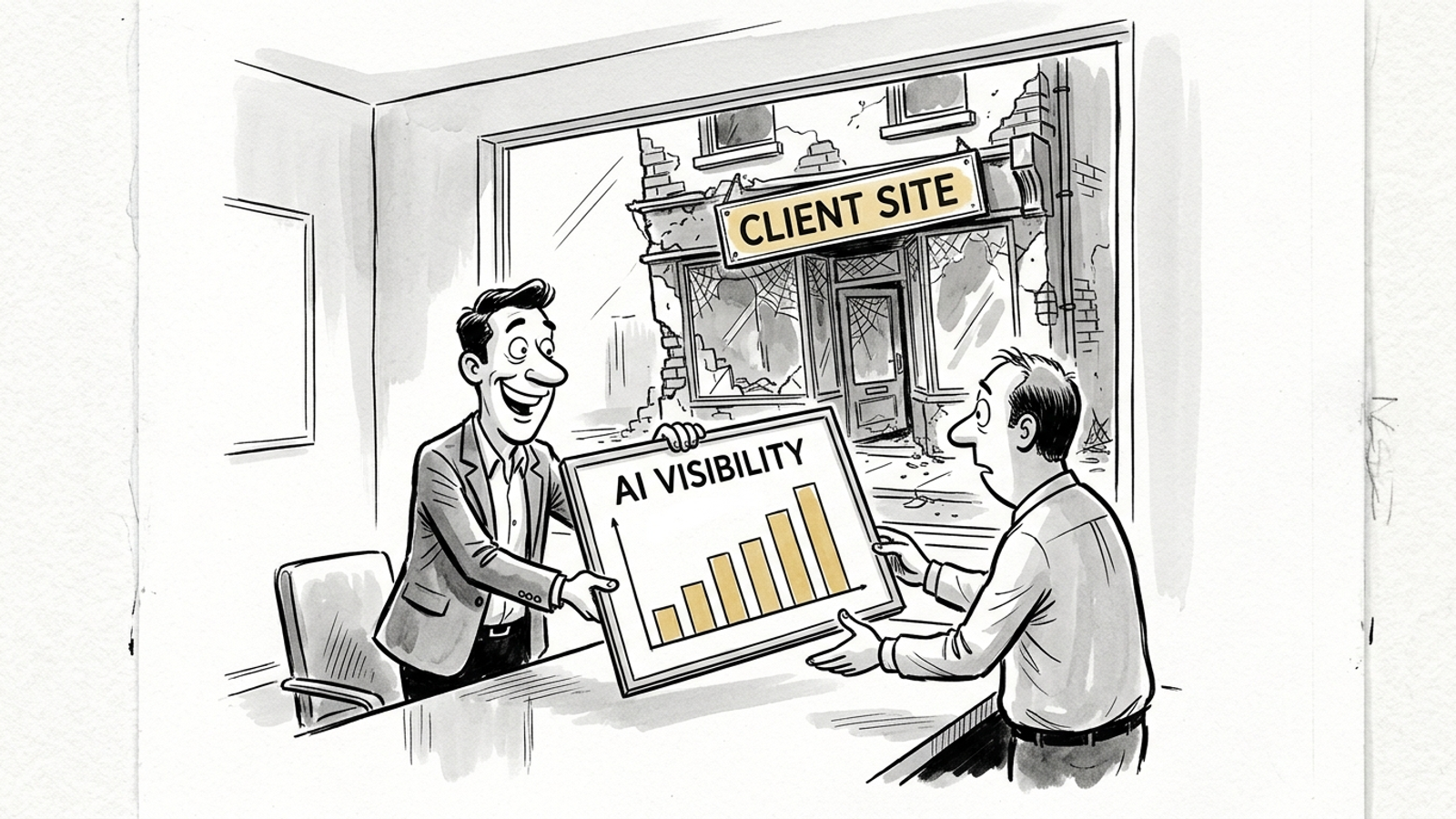
Before you put your logo on anything, ask what sits behind it. Can you show the client which passages went live, which blocks were fixed and what changed in the next report? A branded PDF with no change log makes the month-two call harder, not easier. White label should hide the vendor’s branding, not the absence of work.
Belief 5: “I’ll handle the technical fixes and publishing by hand”
This belief breaks your calendar rather than your pitch. It sounds responsible in week one: your team will fix crawl blocks, write the passages and chase the citations. For one client, that can work. Across ten domains, each needing fresh answer-first content, technical upkeep and off-site corroboration, it becomes a production system whether you planned one or not.
The questions you must cover are long and conversational: median lengths of 17 words on Claude, 13 on ChatGPT, 12 on Gemini and 9 in AI Mode, versus 3 words in classic search. A keyword list and a junior working Fridays will not cover that conversation space. Nor is it a tiny audience: AI Overviews have 2.5B+ monthly users, AI Mode passed 1B monthly users within a year, and ChatGPT has 1.2B weekly users.
Say you hold ten clients and each needs four new citable passages plus fixes each month. That is forty publishing cycles, forty QA passes and forty change logs. Someone must write, approve, publish and record every one. If each new client requires another person to keep the work moving, the retainer’s margin disappears into the workflow.

I recognise the pattern from PPC. I ran accounts when match type structures were built by hand and negative lists were mined at 1am. Agencies billed a percentage of spend and sent a monthly PDF while search terms rotted between check-ins. The client paid for vigilance and got a summary. AI search can repeat that arrangement, with answers changing while the report waits for the next call. The useful part of the PPC model was never the PDF: it was the change log, the link to CPA and the before-and-after view in the account.
Before packaging a white-label AEO vendor, I would ask four questions in plain English:
- What ships per domain per month? Ask about passages published, technical fixes applied and citations built. Get a log you can show the client.
- How do prompt caps work on my plan? Count distinct buyer questions after multiplying by engines, then price the daily Google and AI visibility tracking you actually need.
- What does white label include? Separate a logo on a PDF from a live report under your brand, and separate both from the execution behind them.
- What happens at ten domains, and what breaks at twenty? Price the work at the scale you intend to sell, not just for the first account.
The model I look for is the boring one: flat per-domain pricing, execution rather than tracking alone, and room to serve multiple domains. groas, for reference, prices SEO and AI search from $199 a month per client domain, with content, technical fixes and citations included and reported under your brand. That gives you a shape to compare vendors against: what gets done, what you can show and what each domain costs.
If this stings, read the open letter to the SEO agency owner asked, “Are we in ChatGPT?”. It presses the monitoring-versus-execution point harder, with the logged-work standard your month-two call will be judged on.
Belief 6: “The client should see every tracking chart”
This is the one I am still not sure about. Share of voice and citation counts can be useful proof: a receipt for the work and a way to spot where an answer still misses the client. I would not want an agency making changes with no way to check them.
But every chart can invite the wrong debate. The client starts watching the line rather than asking what the passages are doing for the business. The temptation is understandable; a neat chart is easier to discuss than a series of edits, technical fixes and earned references. It is also how a service drifts back toward selling the report.
My current answer is to report citations weekly but get paid for shipments. Let the chart defend the retainer while the passages earn the renewal. Ask me in six months if that split held.