

 LinkedIn

A $10,000 monthly Google Ads budget can mean $11,499 to about $31,000 in total monthly cost under the fee examples below. The low end is media plus groas’s flat fee; the high end assumes every lead in a benchmark-based estimate qualifies for a $150-per-lead charge. That upper figure is not a forecast. It is the number a proposal needs to rule out before I call it affordable.
At $100,000 in media, the same examples run from $101,499 to about $313,900. CPA and revenue-share agencies sell their fees as skin in the game. But if they charge for brand searches or returning customers the account would have captured anyway, their invoice rises with conversions they did not create. A percentage-of-spend fee has its own problem: it rises when you raise the budget. A flat fee is the only model here whose management charge stays put when both spend and tracked results rise. That is the comparison worth making, not whether a proposal has performance in its name.
I used to tell clients performance pricing meant skin in the game. I was wrong. A manager earns less from a poorly performing CPA deal only if fewer billable conversions come through. If the count holds up while profit falls, the invoice does not share your pain. So I start with a less flattering question: what do I pay if the work produces no additional value?
The recurring fee: four ways to price the same account
Percentage of spend is simple to quote. Agencies commonly charge 10–20% of ad spend on top of what you pay Google. At 15%, that is $1,500 on $10k spend, $4,500 on $30k and $15,000 on $100k. The fee follows the budget, whether the extra spend earns its keep or not. I have watched a seasonal budget increase produce a bigger management invoice without a comparable change in account work.
Revenue share and pay per acquisition sound stricter because they follow output. The catch is what output means. Revenue share typically runs 5–15% of attributed revenue. On $100,000 in tracked revenue, a 5–10% share bills $5,000–$10,000. Pay per lead can run about $50–$500 per accepted lead, depending on industry. At $150 each, 100 accepted leads cost $15,000 in management fees. Neither structure tells you whether those sales or leads were incremental.
A flat fee breaks that link between volume and the manager’s invoice. One fixed-fee example is $2,000 a month regardless of budget; groas charges $1,499 per service, whatever you spend. A fixed fee can look steep on a small budget and inexpensive as spend grows. Price the fee against the account you expect to run, not the smallest account in the sales pitch.
The invoice at $10k, $30k and $100k in monthly spend
Here is the recurring management fee, separate from media, at three spend levels. The percentage and revenue-share rates in the table are illustrations within the cited ranges, not quoted offers. The revenue-share row assumes 3x ROAS. For pay per lead, I use the reported $70.11 cost per lead from a benchmark covering 16,000+ US advertisers to estimate roughly 140, 428 and 1,426 leads, then assume all are accepted at $150 each. That last assumption is deliberately exposed: if a contract bills only some of them, you need that definition before the number means anything.
| Recurring management fee | $10k media | $30k media | $100k media | Source and assumption |
|---|---|---|---|---|
| Percentage of spend at 15% | $1,500 | $4,500 | $15,000 | Illustrative rate within the 10–20% range; media is extra |
| Revenue share at 8% on 3x ROAS | $2,400 | $7,200 | $24,000 | Illustrative 8% rate within the 5–15% range; 3x ROAS assumed |
| Pay per accepted lead at $150 | About $21,000 | About $64,200 | About $213,900 | $150 within the $50–$500 range; lead counts estimated from the $70.11 cost-per-lead benchmark; all estimated leads assumed accepted |
| Flat fee, per service | $1,499 | $1,499 | $1,499 | groas pricing |
Read the pay-per-lead row like an invoice, not a prediction. At $10k in media, roughly 140 accepted leads at $150 each would mean about $21,000 in management fees before the $10,000 you paid Google. If that sounds absurd for your business, ask what limits the bill: an acceptance rule, a monthly cap, an exclusion for existing demand, or nothing. Do not let the answer live in a salesperson’s explanation. Put it in the contract.
Revenue share is less conspicuous. At 8% on a steady 3x ROAS, it charges $2,400 on $10k spend and $24,000 on $100k: management alone equals 24% of media spend. The same 8% share would pay $8,000 on $20k spend at 5.0x ROAS and $8,000 on $40k spend at 2.5x ROAS. Revenue can be the same while the efficiency is not. If the fee tracks gross attributed revenue rather than profit after returns, discounts and cost of goods, the manager’s invoice does not show that difference either.
Minimums can distort even the easy percentage calculation. Fifteen percent of $3,000 is $450, but a $1,000 minimum makes the effective fee 33.3% of spend. Divide the invoice by spend. The headline rate is not always the rate you pay.
Hidden recurring costs: conversions you already had
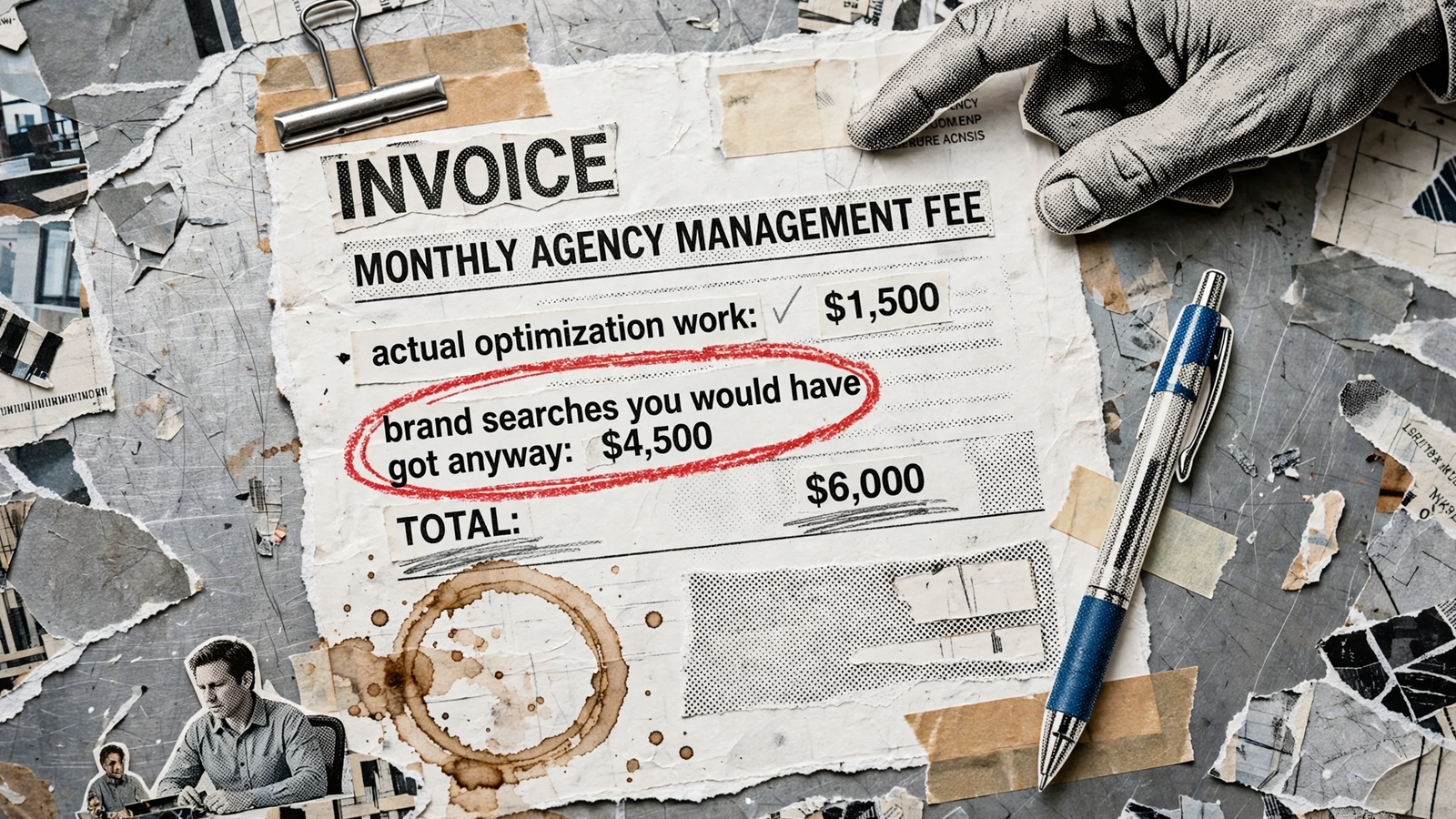
The most expensive line may never appear as a separate charge. In many accounts I ran, brand search and returning customers converted readily. Some of that demand was already there; the manager did not create it by reporting the conversion. Yet under a CPA or revenue-share agreement that includes those visitors, each eligible conversion can earn the same fee as a newly won customer. The argument is not whether brand traffic matters. It is whether the agency should receive a performance bonus for all of it.
That distinction grows more expensive as the account scales. Say a budget increase brings more people back to a brand they already know. A revenue-share invoice rises with tracked sales even if the manager did not improve the account’s ability to acquire new customers. A pay-per-lead invoice can do the same with returning prospects. Ask for brand search, returning visitors and existing customers to be excluded from the fee base in writing. Otherwise, you may pay a win bonus on demand that was already headed your way.

The next recurring cost hides inside qualified. $150 times 100 qualified leads is a $15,000 fee, but only after someone decides which 100 count. Raw form fills can reward volume over quality. Gross revenue can reward sales without accounting for margin. A tight CPA target can discourage scale; a ROAS target can discourage tests with new audiences. Deals built around downstream outcomes rather than raw conversions address the right problem, provided both sides can measure the outcome and agree on attribution. If pipeline or closed-won revenue is the result you care about, do not sign a bonus based solely on form submissions.

One-off charges, monthly extras and the cost of leaving
The management fee is not always the whole proposal. Setup can run $500–$2,500 for a build and tracking; landing pages can run $500–$2,000 each, with three to five pages needed for a multi-service account. Those are one-off costs, unless the contract says otherwise. At the low end of the page range, three pages cost $1,500. Add a $2,000 setup charge and you have spent $3,500, or 35% of a $10k media budget, before a click.
Call tracking, heatmaps and dashboards can add $200–$400 a month if they are not bundled. Those are recurring extras. Tracking is necessary to settle a performance fee, so find out who pays to build it, who pays to keep it running and what you retain when you leave. A vendor who quotes a low management rate and bills the measurement separately has not made measurement free.
Then read the exit clause. One red-flag version is a 12-month minimum with an early-termination penalty equal to the remaining contract value. Leave after month three and nine months can still be due. I would push for a three-month start followed by 30-day notice, a 14-day exit if KPIs miss two months straight, and 30 days of free transition without an exit fee. I would also want the account in your name, agency manager access, a 48-hour data export, weekly reporting that includes spend and pipeline, and a written attribution model and window. The point is not to win a paperwork contest. It is to know the full cost of stopping a deal that does not work.
Why a cheaper-looking performance deal can drift
Pay for raw leads and you buy raw leads. I ran accounts where the cheapest way to hit a cost-per-lead bonus was to open exact match to broad, drop the price filter on the form and let the junk flow. The agency hit its number. Close rates fell. The mechanism was not mysterious: the fee rewarded the count, not what happened to those leads in the CRM.
A hybrid does not automatically fix it. One version charges a $1,000–$3,000 base plus 5–10% of spend; $1,500 plus 8% totals $2,300 at $10k spend and $3,900 at $30k. Another uses an $800–$2,000 base plus a bonus for ROAS or CPA improvement, such as $1,200 plus 20% of value above baseline. The second version is only as sound as its agreed metric, attribution window and baseline. Leave any of those vague and the bonus becomes an argument over the invoice.
For an account spending more than $10k, I would rather start with a flat fee and make the work answer to business results. At groas, that fee is $1,499 per service regardless of spend. Raising the budget, collecting brand clicks or filling the CRM with tire-kickers does not raise the management charge. There is a dedicated strategist, a weekly action log and month-to-month cancellation, so the work still has to earn its place. For a wider look at the structures, see the 2026 pricing models guide; for a CPA proposal, use the nine CPA-pricing questions with worked math. If the contract pays for volume, expect the work to chase volume.
The two performance deals I would still consider
I would not rule out performance pay in every account. Short-cycle ecommerce can be a fit when returns and discounts flow back into Google Ads within days and the fee is based on contribution margin rather than gross revenue. I would also consider a capped test paid per SQL, with brand excluded and the ad account owned by the advertiser. The cap matters because it keeps the fee from outrunning what the test is learning.
Outside those cases, the definition fights can eat the apparent savings. If you sell legal services at over $130 per lead, run home services on phone calls or sell B2B with a 90-day close, I want the paid outcome defined in the CRM before I want a per-conversion price. A dashboard conversion is not automatically a customer. Before signing, I would get five answers in writing:
- What earns a fee? Who marks a lead qualified, in which system, and at what point?
- What demand is excluded? Do brand search, returning visitors, direct traffic and existing customers sit outside the fee base?
- How is credit assigned? Which attribution model and 30-, 60-, 90- or 120-day window apply, and what baseline is locked?
- What else do I owe? List the minimum, setup, landing-page and tool fees; account ownership; and notice period.
- Where does the bill stop? Is there a monthly cap or floor, and what happens when seasonality or a budget increase lifts volume?
The cheapest mistake is paying a $1,000 minimum on $3,000 in spend and calling it 15%. The calculation should have been $450; the minimum makes the bill $550 higher. The most expensive mistake is signing a 12-month revenue share with no brand exclusion and no cap, then scaling from $30k to $100k in spend. You funded the growth in budget. The agency’s fee rises with attributed revenue, even if profit per order falls. Do not pay a performance bonus for a conversion until the contract can tell you what the manager did to earn it.