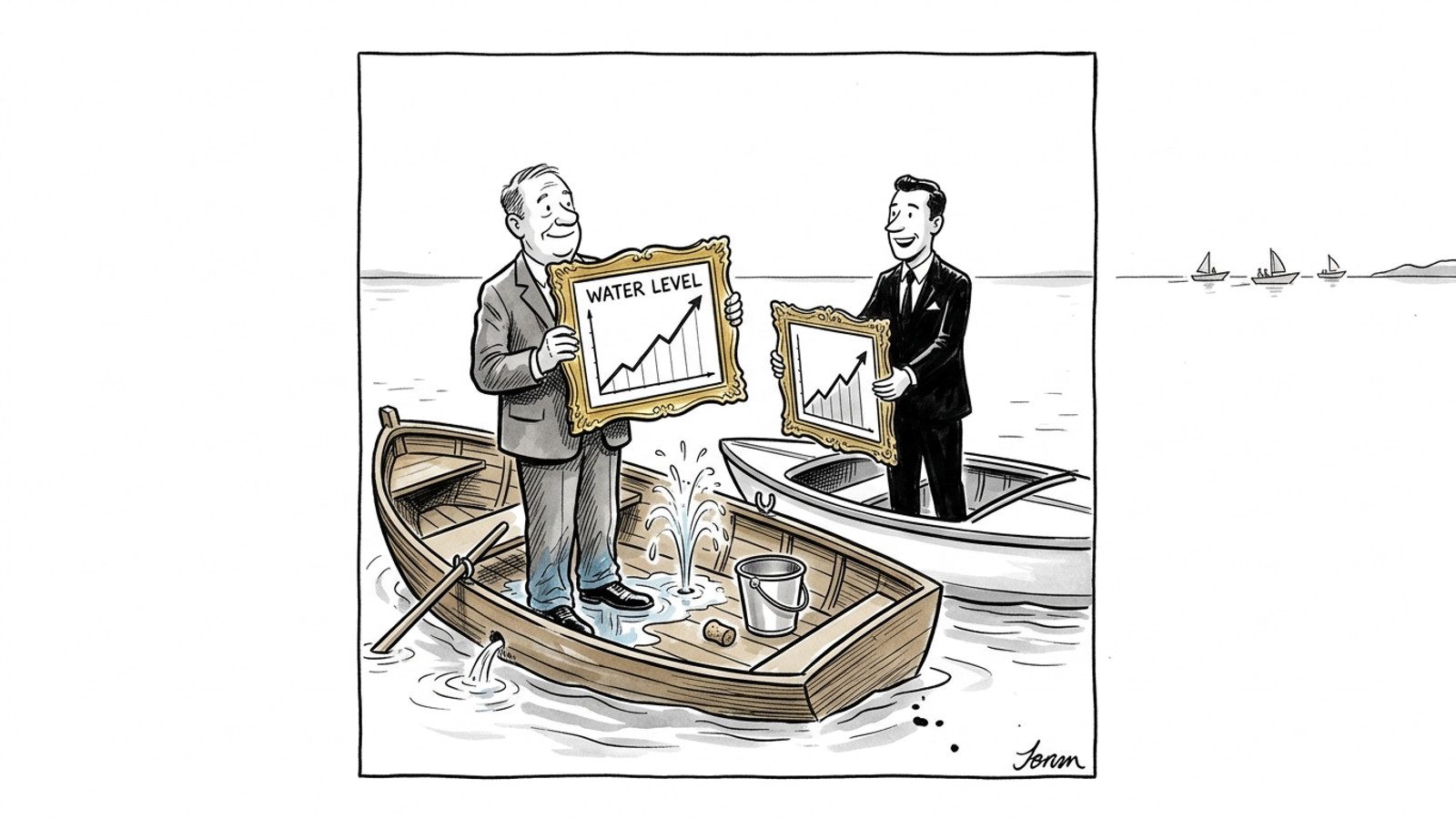

A Google Premier Partner badge can tell you an agency has scale. It cannot tell you whether that agency grows your pipeline. I chose Directive Consulting’s public-facing pitch for this teardown because it is a strong version of the traditional B2B SaaS agency offer: the partner credential, substantial client reviews, a named pipeline methodology, case studies, and a serious retainer.
That makes it worth reading closely, not dismissing. Directive is an established firm with more than 50 verified Clutch reviews and case studies featuring enterprise names such as Arctic Wolf. If you are spending $20,000 to $100,000 a month on paid search, this is the sort of pitch that can make an executive team feel it has found a safe pair of hands.
I’ll follow the order a buyer is likely to encounter those claims: badge, reviews, specialism, price. At each stop, the question is the same: what can you verify, and what is Google’s logo—or polished presentation—doing for you?
Piece 1: The badge proves scale, not pipeline
The Google Premier Partner emblem is an efficient opening credential. Put it near the start of a pitch and an advertiser may read it as Google’s endorsement of the agency’s tactical results: lower CPAs, better conversion rates, stronger down-funnel returns. That is more than the badge establishes.
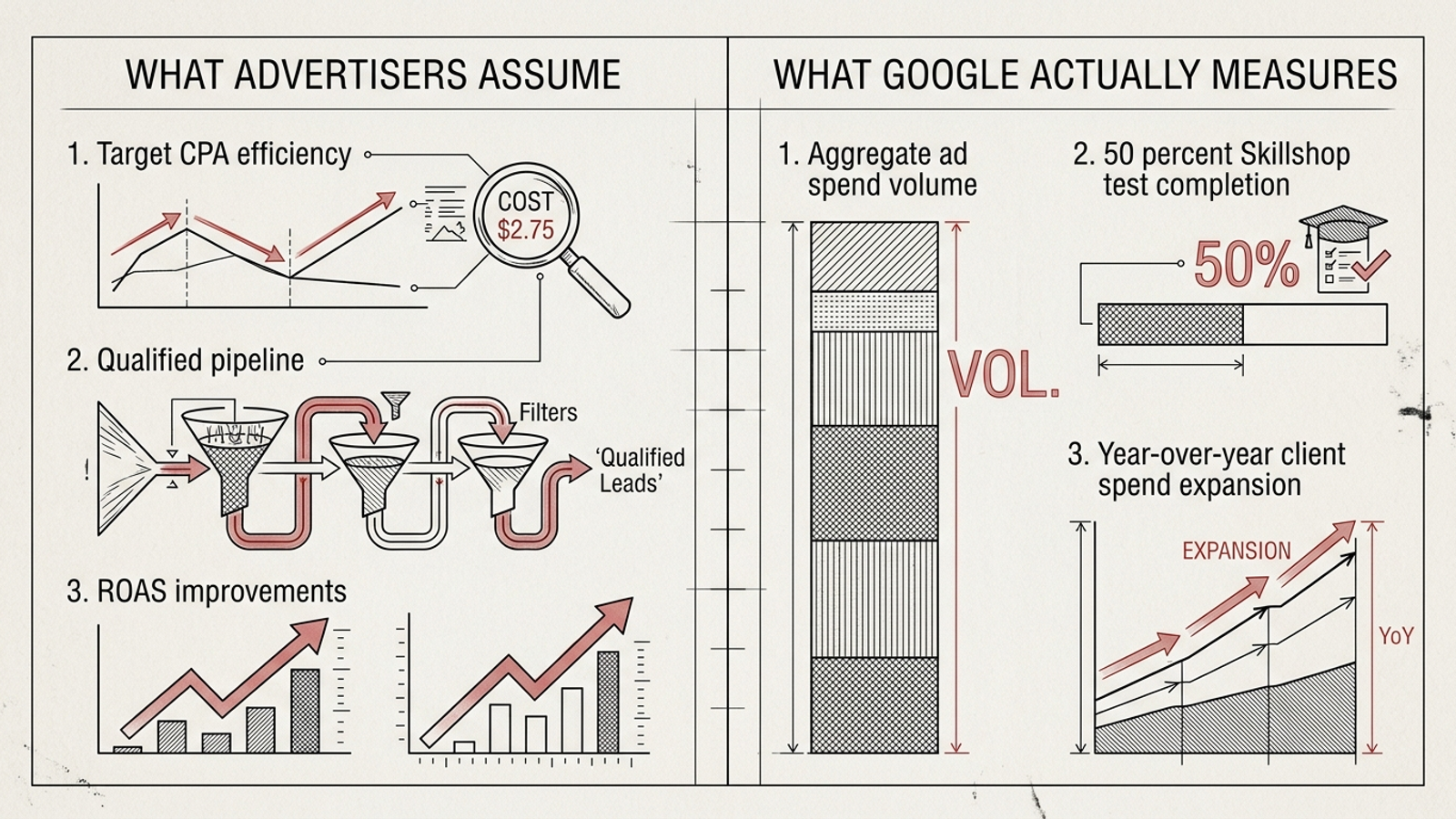
What the Partner requirements measure
Google’s Partner program requirements cover three inputs:
- Spend: At least $10,000 in aggregate ad spend over 90 days across managed accounts.
- Certifications: At least 50% of registered account strategists holding the required annual Skillshop certifications, subject to a ceiling of 100 users.
- Optimization score: A minimum 70% score across the relevant managed accounts.
Premier Partner is a further distinction: Google selects the top 3% of participating agencies in each country annually. The factors described in the draft’s pitch analysis are annual client spend growth, year-over-year client spend retention, new client spend acquisition, total managed ad spend, and product diversification across formats such as YouTube, Display, and Apps.
Client pipeline, acquisition cost, and return on ad spend are not certification criteria. The badge can indicate a sizeable Google Ads practice. It is not an audit of whether that practice makes its clients money.
The optimization score is not a profit score
This is the part I would press on in a sales call. Google calculates optimization score against recommendations for an account. Those recommendations can include changes to keyword matching, budgets, and campaign reach. Some may help a given account; others may be a poor fit for its economics. The score alone cannot settle that question.
Nor does a high score prove an agency followed every recommendation. Dismissing a recommendation can raise the score, as can applying one. An agency might reject an expansion after checking lead quality, or apply it without doing that work. The displayed score does not tell you which judgment it made.
Verdict: a credential, not an outcome audit
Premier status tells me an agency meets Google’s program criteria and ranks highly on its Premier factors. I would not use it to infer a lower CPA or a healthier sales pipeline. Ask for account decisions and commercial outcomes; the badge cannot supply either.
Piece 2: The reviews tell you what clients liked
Next comes social proof. Directive’s Clutch profile lists 56 verified reviews and an overall 4.8 rating; roughly 90% of its listed clients sit in the midmarket and enterprise tiers. Those are meaningful signals if you want to know whether a firm can work with organizations like yours. They are less useful if you want to know what happened to cost per qualified opportunity.
Read the categories before the stars
Clutch conducts structured interviews with client contacts supplied by agencies. That gives buyers more to read than a free-floating testimonial, but it does not give them a random sample of every engagement an agency has run. I made the same distinction in my breakdown of agency reviews on G2 and Clutch: satisfaction among reviewers and the outcome of a typical client account are different questions.
Look at the categories on Directive’s profile: Quality (4.8), Schedule (4.9), Cost (4.6), and Willingness to Refer (4.8). They can help you assess service delivery. They do not isolate the effect of media management on CPA. A responsive account director and a polished monthly deck may deserve praise even if lead quality is moving the wrong way.
There is an operational question behind the rating, too. An industry rundown on Startups.com discusses strategist changes and onboarding delays as agency risks. A review score cannot tell you who will manage your account six months from now, or how a handoff would work.
Verdict: credible social proof, limited performance proof
I would read the reviews, especially the detail about communication and working relationships. Then I would ask for the measures the review categories do not provide. A 4.8 rating can support a service claim; it cannot establish your likely CPA.
Piece 3: The SaaS specialism claim meets a bidding constraint
Directive’s most substantive pitch is not the badge. It is Customer Generation, its named approach to moving attention away from vanity lead counts and toward qualified pipeline and closed-won revenue. That is the right problem to name for a B2B team tired of paying for ebook downloads that sales never touches.
The supporting case-study claims include a 59% quarter-over-quarter pipeline increase and a 109% increase in closed-won revenue for Arctic Wolf, as reported in industry rundowns. I would take those seriously enough to ask how the work translated into bidding decisions. That is where a pipeline-led pitch needs to get specific.
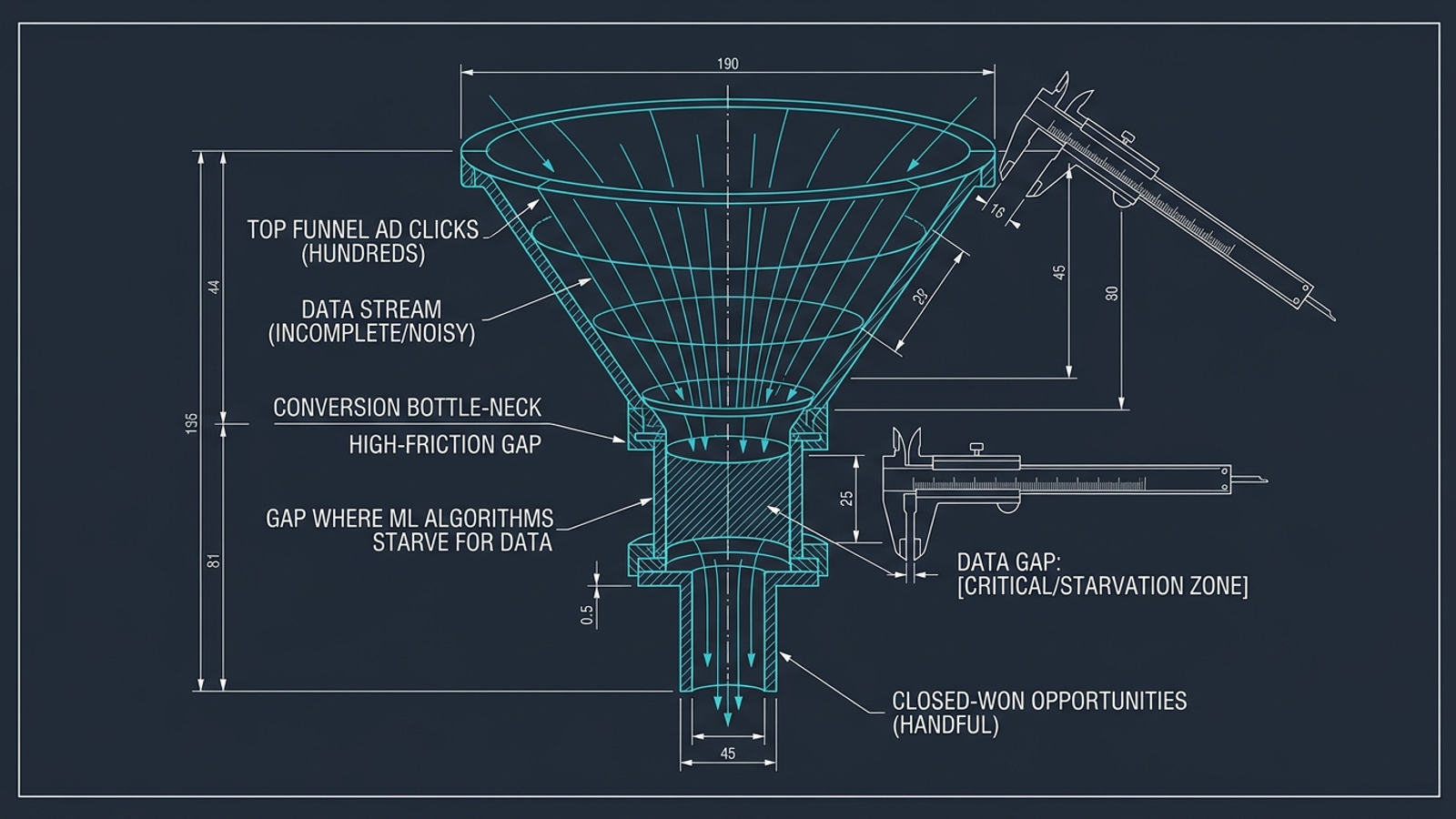
The conversion-volume bottleneck
Automated bidding needs conversion signals from which to learn. A commonly cited working range is 30 to 50 conversion events per month per campaign for strategies such as Target CPA or Target ROAS. That is a planning constraint, not a switch that makes a campaign succeed at 30 and fail at 29.
Now take the example in this pitch analysis: an enterprise SaaS company selling $50,000 annual contracts on $20,000 a month in ad spend. If it generates 8 to 18 sales-qualified opportunities in a month, late-stage opportunities and closed-won deals will be scarcer signals than form submissions. Making only those rare events the primary bidding goal can leave the system with too little feedback to adjust reliably.
The tempting workaround is to optimize for easier conversions: demo requests, gated downloads, or unvalidated leads. Volume comes back, but the machine may learn to find form fills rather than buyers. Saying pipeline in an executive review does not change the conversion action in Google Ads.
That does not mean a specialist has to abandon pipeline as the goal. It means the pitch should explain the mechanism: how first-party value rules, offline conversion syncs, and negative-intent filtering connect the frequent signals available to the account with the outcomes the business actually wants. Ask what the campaigns bid toward when qualified opportunities are sparse. If the answer stops at “we focus on revenue,” the difficult part is still missing.
Verdict: the strategic aim holds up; execution needs inspection
Directive’s emphasis on qualified pipeline is more useful than a promise to drive more leads. Its case-study numbers deserve attention. Neither tells you, on its own, how your account would handle low conversion volume. I would keep the strategic aim and ask to see the conversion architecture.
Piece 4: The price tells you what you are buying
The commercial discussion is where the pitch becomes a budget decision. According to Directive’s Clutch profile and the pricing reporting cited here, retainers at this tier can sit between $10,000 and $49,999 a month, with entry-level figures reported at roughly $5,000 to $6,500 monthly. Those are fees before media spend.
Other agencies at this tier may use percentage-of-spend pricing, charging 12% to 20% of the media budget above a negotiated threshold. I would not assume that describes every Directive proposal. I would, however, ask any agency for the same thing: a clear account of what changes when spend rises, falls, or needs to be cut.
Take a $20,000 monthly Google Ads budget and a $6,500 management retainer. The fee is nearly a quarter of the combined $26,500 paid-search outlay before a prospect clicks. That may be worth paying for strong strategic work. It is not a rounding error you can leave out of the acquisition-cost calculation.
With a percentage fee, the incentive question is sharper. As I laid out in my look at the percentage-of-spend pricing model, cutting waste can also cut the agency’s invoice. Our guide to Directive Consulting’s pricing structure goes further into the contract questions. In this pitch, I would simply ask: what do I pay for, and what happens to that price when efficiency requires less spend?

Verdict: price the operating model, not the presentation
A retainer buys human attention, judgment, communication, and account work. It does not by itself tell you how often someone checks search terms or acts when auctions shift outside business hours. Ask who owns those decisions and what guardrails operate when the team is offline.
That is the distinction behind groas. We pair a named human strategist, who sets direction and remains accountable for attributable pipeline, with autonomous execution across bids, keywords, search intent, and landing pages. The work continues within human-defined guardrails rather than waiting for the next account review. The fee is flat monthly, with no setup cost or percentage-of-spend markup. Compare the decisions each model makes, their timing, and their cost—not just the people named in the proposal.
The scorecard: what survives scrutiny
| Pitch element | What a buyer may infer | What it can establish | Verdict |
|---|---|---|---|
| Premier Partner badge | Better CPA and technical execution | Google program qualification and Premier ranking factors | Does not prove pipeline performance |
| Clutch reviews | Reliable financial returns | Reported client experience across review categories | Useful for service evaluation; limited on CPA |
| SaaS pipeline methodology | Bidding directly toward qualified opportunities | A strategic priority and reported case-study outcomes | Promising aim; inspect the conversion setup |
| Retainer or spend-based fee | Dedicated work with aligned incentives | The stated cost and commercial terms | Test the work and incentives against the fee |
The strongest parts of this pitch are worth keeping: clear B2B positioning, a focus on pipeline rather than raw lead counts, and evidence that clients value the working relationship. The weak leap is from those points to a guarantee of efficient media buying. No credential, review category, or pricing tier closes that gap for you.
Five questions I would take into the sales call
- What does Smart Bidding optimize for when qualified conversions are scarce? Ask which conversion actions carry value, how offline outcomes return to the account, and what prevents a form fill from standing in for a sales opportunity.
- How do you handle Google’s recommendations? A high optimization score does not show whether the team applied or dismissed a suggestion, much less why. Ask for an example of each decision.
- Can I see a redacted action log from a comparable account? Look for the work behind the presentation: search-term decisions, negative keywords, bid changes, budget adjustments, and the reasons recorded for them.
- What protects the account outside business hours? Ask which guardrails run continuously and which changes wait for a person. Do not confuse a promise of attentive management with an always-on process.
- What happens to your fee if we cut unprofitable spend? The answer tells you whether the commercial model rewards efficiency or simply tracks the size of the media budget.
The overall verdict
I would not throw out Directive’s pitch. I would keep its insistence that B2B search should answer to qualified pipeline, not a prettier lead-count chart. I would also keep the reviews as evidence of what interviewed clients liked about working with the agency.
I would not buy the larger inference that a Premier Partner badge proves media-buying efficiency. It reflects Google’s program criteria, not an audit of your acquisition cost. Let the credential earn a first conversation; then ask to see the conversion choices, account decisions, guardrails, and fee incentives. That is where an agency’s promise either reaches the pipeline or stops at the logo.
Frequently asked questions
Does a Google Premier Partner badge mean the agency will get me a lower CPA?
No. The badge reflects Google's program criteria such as ad spend, certifications, and optimization score, not client acquisition cost or pipeline results. It indicates a sizeable Google Ads practice, but it is not an audit of whether that practice makes clients money.
What does a high Google Ads optimization score actually prove?
It only shows how an account scores against Google's recommendations, which can include changes to keyword matching, budgets, and campaign reach. Dismissing a recommendation can raise the score just as applying one can, so the score alone does not show whether the agency made sound commercial judgments.
Can Directive Consulting's Clutch reviews tell me what my cost per lead will be?
No. The 56 verified reviews and 4.8 rating reflect interviewed clients' experience of service categories like Quality, Schedule, and Cost, not the outcome of a typical client account. They are useful for judging service delivery, but they do not isolate the effect of media management on your CPA or lead quality.
What should I ask an agency that claims to optimize Google Ads for pipeline instead of leads?
Ask what the campaigns bid toward when qualified opportunities are sparse. Automated bidding typically needs 30 to 50 conversion events per month per campaign to learn, so optimizing only for rare late-stage opportunities or closed-won deals can leave the system with too little feedback. A credible answer explains the conversion architecture, such as offline conversion syncs and value rules.
Why do some B2B SaaS Google Ads campaigns optimize for demo requests instead of closed-won revenue?
Because qualified opportunities and closed-won deals are scarce conversion signals, often only 8 to 18 sales-qualified opportunities a month for an enterprise SaaS company. Optimizing for easier conversions like demo requests or gated downloads restores volume, but the bidding system may then learn to find form fills rather than buyers.
How much does an agency like Directive Consulting charge per month?
According to its Clutch profile and cited pricing reporting, retainers at this tier can sit between $10,000 and $49,999 a month, with entry-level figures reported at roughly $5,000 to $6,500 monthly, before media spend. For example, a $6,500 retainer on a $20,000 ad budget is nearly a quarter of the total paid-search outlay, so it belongs in the acquisition-cost calculation.
What is the incentive problem with percentage-of-spend agency pricing?
With percentage-of-spend pricing, typically 12% to 20% of the media budget above a threshold, cutting wasteful spend also cuts the agency's invoice. That means the commercial model can reward keeping budgets large rather than improving efficiency, so it is worth asking what happens to the fee when efficiency requires less spend.