

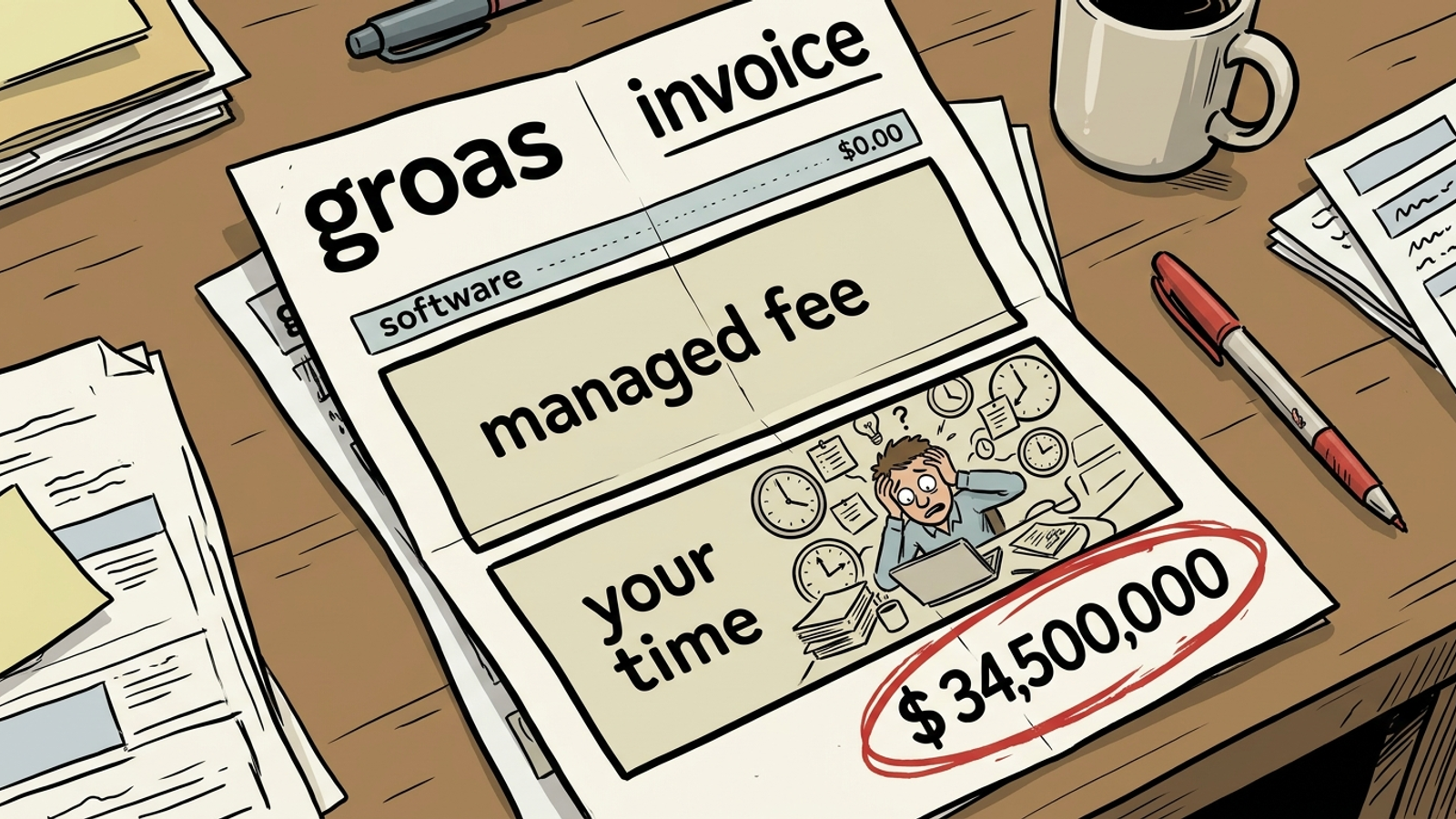
Say you spend $5,000 a month on Google Ads and want WordStream involved. The price you remember is not the price you will pay: a LocaliQ management fee and just two to four hours a week of your own work can put the monthly cost at roughly $1,100 to $2,200 before you pay Google.
That range uses a reported $500 to $1,000 monthly fee and values your time at $75 an hour. Your quote and your hours may differ. The point is not that every buyer gets the same bill. It is that the old software price people search for is the smallest, least useful number in the calculation.
WordStream no longer publishes self-serve plan tiers you can buy without a sales call. Its old entry price was around $49 a month; reported pricing for LocaliQ managed services starts around $500 to $1,000 a month. That is a different purchase, not a modest increase on the same subscription.
The bill: listed costs, hidden work, and commitment
Here are the lines I would put beside any quote. Keep media spend, vendor fees, and your own labor separate until you calculate the total. Otherwise, a cheap-looking management line can hide an expensive operating model.
| Line item | Amount or pricing basis | When you pay it | Source |
|---|---|---|---|
| Historical WordStream self-serve plan | Around $49/month at the entry level; not a current standalone price to budget for | Formerly recurring | Ruler Analytics |
| Current LocaliQ buy path | Custom quote rather than published tiers | Depends on the quote | Pace Ads review |
| LocaliQ managed services | Reported starting range of $500 to $1,000/month; spend and scope can change the fee | Recurring | CrawlToClick |
| Contract commitment | Often a six-month minimum; not a separate charge, but it multiplies the fees you commit to | Contract term | CrawlToClick |
| Performance Grader | Free | No purchase required for the audit | Ruler Analytics |
| Your operator time | Illustrative two to four hours/week at $75/hour: about $600 to $1,200/month using four weeks | Recurring if the work remains yours | Hours and rate assumed for the example below |
| Google Ads media | $5,000/month in the worked example | Recurring | Illustrative spend assumed for the example below |
There is an important distinction in that table. A self-serve recommendation tool leaves you to implement its advice. A managed-service contract is sold as management; it should not automatically require you to do the same implementation work. But management does not make your hours disappear by definition. If you still review recommendations, handle account changes, check results, or coordinate fixes, count those hours. Price the work you actually retain, not the work the sales description implies has vanished.
The $49 software plan is a memory, not a current quote
I used to tell $3,000-a-month ecommerce clients to try WordStream self-serve. I was wrong to keep saying that after 2021. The product people still picture was a relatively cheap layer on top of Google Ads, with paid plans that started around $49 a month. Today, the buy path leads to a sales consultation and custom LocaliQ bundled pricing, not published tiers. For a broader look at user sentiment alongside pricing, our WordStream review puts the G2 and Capterra scores in one place.
That change matters more than the old number itself. You cannot take $49, add your ad spend, and call that the cost of using WordStream now. The standalone self-serve option gave way to a done-for-you model with longer commitments and less visible pricing. A quote is not inherently a bad way to buy management. It is a bad substitute for a comparable plan price when you are trying to build a budget before a call.
So when someone asks me what the WordStream subscription costs, my answer is blunt: there is no published standalone software price to compare. Start with the service quote instead.
The managed fee changes with the work in the bundle
LocaliQ sells management with WordStream inside the bundle. The reported entry point is around $500 to $1,000 a month, rising with ad spend and service tier. The quote also depends on the scope: how many channels are covered, and whether creative or landing-page work is included. Those details can matter more than the number at the top of the proposal.
What frustrates me is not that management costs money. Good account work costs money. It is that a custom bundle makes it harder to see what you are paying for, what changes the fee, and which tasks still land with your team. Reviewers have described LocaliQ’s pricing structure as difficult to understand when assessing true campaign costs. The sales consultation may answer that. It should not replace a written breakdown.
Ask for the monthly management fee, the work it includes, and the spend band or scope change that would raise it. Then ask who makes changes in the account and who checks whether those changes improved cost per acquisition. A management fee is only useful in a cost comparison when you know what it manages.
A six-month term turns a monthly fee into a commitment
The invoice may arrive monthly. The commitment can last much longer. Post-LocaliQ deals often carry a minimum six-month contract. At an illustrative $750 a month, that is $4,500 in management fees committed, before counting media or any work your team keeps doing.
I do not object to giving a campaign time to work. In an account, the first stretch can disappear into tracking fixes and learning what the traffic actually does. I object to discovering the exit terms after the results disappoint. A six-month commitment is not a one-off setup fee; it is a recurring fee with a longer consequence.
Before signing, get these answers in writing:
- What is the exact monthly management fee, and what triggers an increase?
- How long is the commitment, and what does early termination cost?
- Who owns the Google Ads account and its history if you leave?
- What does onboarding include, and what counts as extra scope?
That last question is where an apparently tidy quote can come apart. Feed setup, conversion-tracking repair, call-tracking numbers, and landing-page edits all need an owner. Do not assume they are included or assume they are extra. Ask. The cheapest time to find out is before you sign.
The free Grader is triage, not the diagnosis
The Performance Grader remains the easiest price to understand: $0. It produces a free, quick report on measures including wasted spend, Quality Score, CTR, impression share, and dormancy. If you have never looked closely at an account, that can point you toward obvious problems. I have used it as a first look. A first look is all I would buy into.
The report surfaces issues; it does not fix them. It also leads naturally toward a paid service conversation. That is not a scandal. It is a sales funnel attached to a useful free audit. The mistake is treating its letter grade as a profit forecast. I go deeper on that distinction in why grader scores mislead.
The Grader does not check conversion tracking, offline imports, pacing, query-level waste, PMax brand cannibalization, or UTM structure. The diagnosis that affects what you do next still requires work in Google Ads and analytics. Use the grade to decide where to look, not whether the account is profitable.
The hidden recurring line is your time
The old recommendation workflow makes the labor problem easy to see. WordStream’s recommendations require a person to review and implement them rather than executing automatically. If it flags overspend, someone still has to go into Google Ads to pause or reallocate. Then someone has to check whether that decision helped.
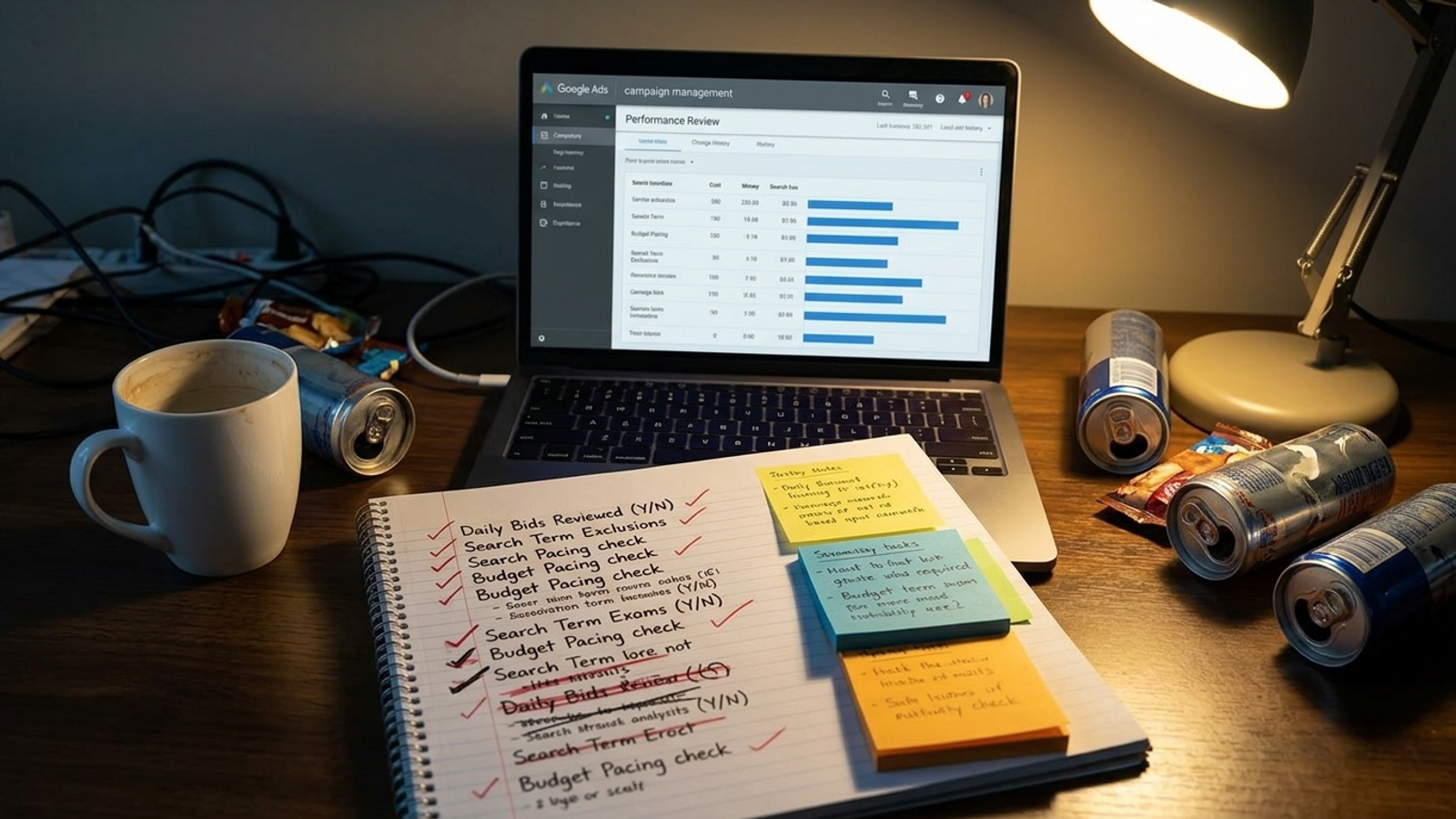
I know the rhythm: review the suggestions, add negatives, adjust ads, inspect CPA, and revisit changes when the landing page or traffic mix shifts. It looks small as a weekly checklist. It is not small when it happens every week. Calling that work “optimization support” does not take it off your calendar.
A managed-service buyer should check the contract rather than assume this entire loop remains theirs. If the provider executes and monitors those changes, do not charge yourself for work you no longer do. If you are still spending time approving, applying, or checking them, put that time on the bill. This is where a vague promise to “save time” needs to meet a calendar.
Put an hourly rate beside the weekly checklist
Say your retained work takes two hours a week and you value your time at $75 an hour. Across four weeks, that is $600 a month. Four hours is $1,200. At three hours, the $900 labor line exceeds an illustrative $750 management fee. None of those figures is a vendor charge; each is a way to make your own workload visible.
There is a second cost that is harder to price in advance: a bad change. One wrong broad-match decision on a $5,000 account can spend money quickly before the next review catches it. I would not add a made-up error allowance to every quote. I would ask who spots a poor result, how soon they spot it, and who reverses the change. If a service saves you no review cycles, do not price it as though it did.
Worked total: a $5,000-a-month Google Ads account
Take the illustrative $5,000 in monthly media spend. At the low end of the reported LocaliQ starting range, a $500 fee brings cash paid to $5,500 a month before valuing your time. At an illustrative $750 fee, cash paid is $5,750. If you also retain three hours a week of account work at $75 an hour, add $900 in labor. The monthly economic cost becomes $6,650: $5,000 in media, $750 in management, and $900 of your time.
That is a conditional example, not a claim that every LocaliQ client does three hours of implementation. Your quote may include more execution, or your account may demand more coordination. Either way, the calculation gives you a question to take into the sales call: what, precisely, will I still do each week?
For context, standalone optimizers such as Opteo Basic at around $129 a month, Adalysis from around $149, and Optmyzr around $208 to $249 put a more visible software price on the page. They still leave work with the operator. A cheaper line item is not a cheaper total if it does not remove the hours you are trying to buy back.
Now make the total answer to performance. If $5,000 in media produces 100 conversions, media CPA is $50. Add the illustrative $750 fee and $900 labor cost, and total cost per conversion is $66.50. Even if changes cut $500 in wasted media spend, the $1,650 in fees and labor does not vanish. The setup needs enough additional conversions, or a large enough reduction in other costs, to justify itself. Measure that instead of admiring the dashboard.
Who should even take the WordStream call?
If you run one small account, spend under $3,000 a month, and want explanations of Quality Score and account structure, the recommendation-led approach has teaching value. Just do not budget for the old self-serve plan as if you can still buy it. Get the current offer and terms first.
If you manage multiple accounts, run a $20,000-a-month ecommerce feed, or cannot spare three hours a week, advice that creates another task queue is a poor fit. Ask whether the quoted service actually takes that queue away. If it does not, I would look at a replacement rather than pay a management fee and remain the operator. Our WordStream versus groas comparison lays out onboarding and commitment terms for that decision.
The calculation stays the same whichever route you take: media plus management plus retained labor, divided by conversions. Track it before a change and again after onboarding. Recommendations save money only when somebody applies the useful ones, checks the result, and reverses the failures. If that somebody is still you, the hours belong in the comparison.
The cheapest mistake is taking a free Grader call without getting the fee, term, and account-ownership answers in writing. It costs you a little time. The most expensive is spending six months in a managed bundle while still doing the weekly work: at $750 in fees and $900 in labor each month, that is $9,900 over six months before media spend. Judge WordStream, LocaliQ, or any replacement by whether your total cost per conversion goes down. Anything else is 2015 pricing for homework.
Frequently asked questions
Does WordStream still have a $49 a month plan?
No. WordStream's entry-level self-serve plans used to start around $49 a month, but that product is no longer sold as a standalone subscription. The current buy path leads to a sales consultation with custom LocaliQ bundled pricing instead of published plan tiers.
How much does WordStream cost per month now?
Reported pricing for LocaliQ managed services, which now include WordStream, starts around $500 to $1,000 a month. The exact fee depends on your ad spend, service tier, how many channels are covered, and whether creative or landing-page work is included in the quote.
Is there a minimum contract term for WordStream or LocaliQ?
Deals after the LocaliQ transition often carry a minimum six-month contract. At an illustrative $750 a month, that means committing $4,500 in management fees before counting media spend or any work your own team keeps doing.
What is the real total cost of using WordStream on a $5,000 ad budget?
In a worked example with $5,000 of monthly Google Ads spend, a reported LocaliQ fee of $500 to $1,000 plus two to four hours a week of your own time valued at $75 an hour puts the total around $1,100 to $2,200 a month before you pay Google. Your actual quote and hours may differ.
Is the WordStream Performance Grader enough to judge my account?
No. The Performance Grader is free and gives a quick report on measures like wasted spend, Quality Score, CTR, impression share, and dormancy, but it does not check conversion tracking, offline imports, pacing, query-level waste, PMax brand cannibalization, or UTM structure. Use the grade to decide where to look, not whether the account is profitable.
Do WordStream recommendations apply themselves automatically?
No. WordStream's recommendations require a person to review and implement them rather than executing automatically. Someone still has to go into Google Ads to pause or reallocate spend and then check whether the change helped, so count that weekly time when comparing costs.
How does a management fee affect my cost per conversion?
In the article's worked example, $5,000 of media producing 100 conversions gives a $50 cost per conversion from media alone. Adding an illustrative $750 management fee and $900 of retained labor raises the total cost per conversion to $66.50. Fees and labor do not vanish even if the service cuts wasted media spend.