

 LinkedIn

On a $1,000 ChatGPT ads test, the wrong management fee can cost more than the ads. A “ChatGPT ads specialist” badge will not make that test more informative.
In ChatGPT Ads vs Google Shopping: Where a Small Store’s Next $1,000 Goes, I took up the budget question. This is the second look: agencies are now pitching themselves as ChatGPT ads specialists, and stores that choose to test still need to decide who runs it. At this scale, fee structure, Shopping competence, and measurement honesty matter more than the name on the proposal.
My first pick is an autonomous platform with a named human strategist if it is already managing your search spend. Adding a small ChatGPT test to an existing Shopping operation is different from paying a new $1,499 monthly fee solely to manage $1,000 in media. For a standalone test, I would look at a capable freelancer or do it myself before signing that invoice. Here is how the five options rank for a store that wants both a test and a usable answer.
How I ranked the five models
I used five questions. The first is what the manager costs at test spend, including minimums. The second is whether they can keep Google Shopping healthy enough to serve as a baseline. Then I want to know what they measure, how often someone acts, and how easily the store can stop paying.
- What is the full fee on $1,000 to $2,000 in media? A percentage looks modest until a monthly minimum or setup charge appears underneath it.
- Who owns the Shopping baseline? ChatGPT ads appear as sponsored cards below an answer, not product listings that show price and image upfront. The two channels need a fair comparison, not identical expectations.
- Does the report reach purchases and CPA? ChatGPT reporting offers 7-, 14-, and 30-day click windows and 0- or 1-day view-through windows; spend and conversion reporting can lag. Day-one ROAS is not a verdict.
- Who does the recurring work? Hints and landing pages need judgment. Shopping needs feed attention. “We monitor it” is not a schedule.
- What happens if the test fails? A useful stop rule loses its value if the contract keeps billing for three more months.
That order matters. Get the fee math and baseline wrong, and a polished report cannot rescue the test.
1. Autonomous platform plus strategist: best when search management is already in place
Who it is for: a store already spending on Shopping that wants to test ChatGPT under the same purchase goal, without creating a separate management job. I should disclose my interest: I write for groas. Its Search Ads service covers Google Ads, Bing Ads, and ChatGPT Ads for $1,499 a month, rather than charging separately for each channel.
What it does better: it pairs ongoing automated execution with a named person responsible for the direction of the work. groas lists around-the-clock work on bids, keywords, and budgets, alongside a dedicated account manager. Its flat fee has no setup charge and comes with month-to-month cancellation. That makes more sense to me than hiring one manager to celebrate ChatGPT clicks while another is accountable for Shopping sales. One purchase goal should govern both.
What rules it out: the price if ChatGPT is the only reason you are hiring. On $1,000 in media, a new $1,499 monthly fee is larger than the test budget. A flat fee is predictable; it is not automatically small. Nor can any manager make broken conversion tracking or a neglected feed disappear in week one. I used to think automation could save a messy account. It cannot tell you which sales came from an ad you never tracked.
My pick, then, is for a store that needs the broader search operation and can add ChatGPT without buying a second retainer. Do not buy the whole service solely to avoid managing a tiny test.
2. Ecommerce search freelancer: the strongest one-person build
Who it is for: a store with a reasonably clean feed and perhaps 50 to 200 SKUs that needs someone to set up a controlled two-channel test. A freelancer who has worked on Shopping can catch title and GTIN problems before you mistake feed trouble for a channel result.
What they do better: focused setup without committing to a full agency retainer. Published US Shopping freelancer rates run $50 to $84 an hour, with feed audits at $500 to $1,500 and launches at $1,200 to $3,500. For a short, defined job, that can beat paying a monthly retainer for services you will not use.
What rules them out: the handoff after launch. Someone still has to check Shopping search terms, watch where ChatGPT delivers, and revise hints when the test drifts. A freelancer can do that, but it may mean more hourly billing. If they are not retained, it may mean you do it.
I would hire this person for a defined build, then put the weekly work and its cost in writing. “Setup complete” is not a management cadence.
3. Do it yourself: best when your time is cheaper than a fee
Who it is for: an owner already working in Shopify and Google Ads who can give the test roughly four hours a week and will actually pause a loser. I ran accounts this way for years. The benefit is plain: no management invoice, and nobody stands between you and the awkward numbers.
What it does better: it keeps the full media budget available for ads. ChatGPT ads have a $25-per-day, per-campaign minimum in the US, with a recommended starting CPC of $3 to $5. Two weeks at that minimum costs $350. At those CPCs, that is roughly 70 to 115 clicks, not a sound basis for declaring a channel winner on orders alone. At a 1% conversion rate, 10 conversions would take about 1,000 clicks, or $3,000 to $5,000 at those CPCs. The minimum spend gets a test running; it does not buy a verdict.
What rules it out: your calendar. Feed checks and hint rewrites are easy to postpone when orders need packing. In-house management without structure drifts for exactly that reason.
If I were running this myself, I would write the stop rule before launch, use two or three plain-language hints tied to real research questions, and send traffic to a page that helps someone make a purchase decision. I would check delivery before judging orders, and wait for conversion reporting to catch up rather than treating the first 48 hours as a result. If you cannot reserve the weekly time, the zero-fee option is not free.
4. Full-service ecommerce agency: good operations, wrong-sized contract
Who it is for: a store with enough existing spend to meet an agency’s floor and a need for one vendor across creative, feed, and media. A full-service team can bring Shopping feed staff and designers to work a narrow ChatGPT-only shop may not cover.
What it does better: established Shopping operations. If the feed is the bottleneck, that work is more useful than a new-channel pitch.
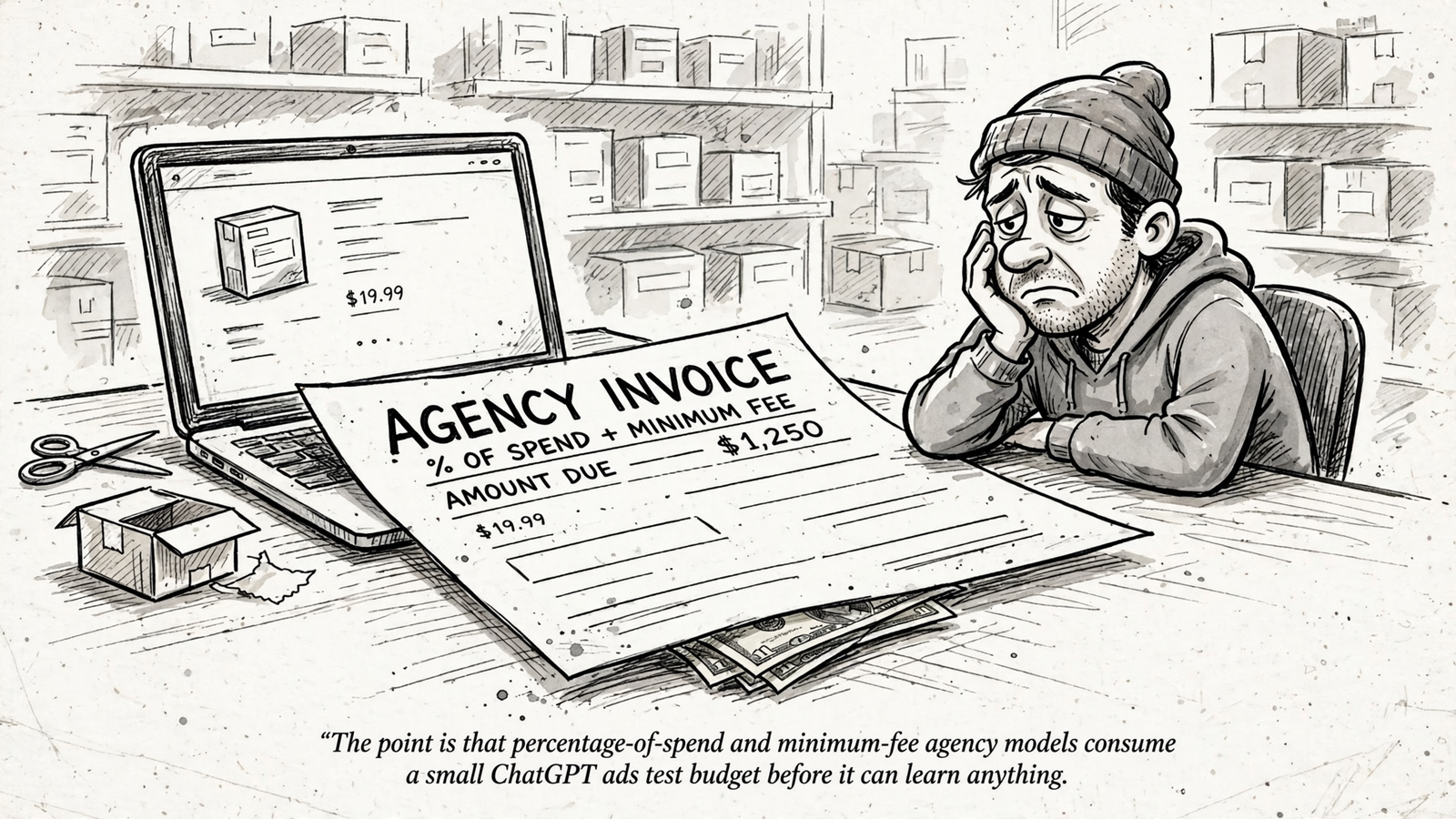
What rules it out at test scale: minimums. General PPC agency pricing commonly runs 10% to 20% of ad spend with monthly minimums. On $1,000 to $2,000 in media, the percentage alone suggests $100 to $400; the minimum is often the number you actually pay. SmartSites lists a $2,500 monthly minimum ad budget for ecommerce campaigns, so a $1,000 media test would not meet that floor.
There is nothing wrong with paying for a full team when you need one. Paying for it to manage a small audition is a Ferrari trip to the corner shop. Ask for ChatGPT delivery, Shopping delivery, management fees, and revenue in the same report before deciding the retainer earns its place.
5. New ChatGPT-only agency: the badge is not a baseline
Who it is for: almost no small store I would advise, unless the people doing the work can also show Shopping experience. A specialist pitch can give ChatGPT setup its full attention. It cannot, by itself, tell you whether the spend should have stayed in Shopping.
What it does better: it keeps the new channel front and centre. That focus may help with a launch, but it is a weak substitute for managing the comparison that determines whether the launch was worthwhile.
What rules it out: expensive management attached to thin evidence. Specialist packages are advertised at $1,500 to $3,000 a month for small businesses and $3,000 to $10,000 for mid-market clients; GPT Ads AI lists a $5,000 fixed retainer and recommends $10,000 a month in media. On a $1,000 test, even a $1,500 fee means $2,500 out the door. The pitch may call that specialist attention. I call it more management than media.
The early performance examples also give me no reason to buy a badge on faith. One published test reported 97,131 impressions, a 1.30% CTR, a $3.16 CPC, and almost no sign-ups; the same source reports lower ChatGPT than Google conversion rates in same-advertiser comparisons. Those examples do not settle what your store will see. They do make the Shopping baseline non-negotiable. Show me who owns that baseline, not who designed the specialist deck.
The fee math, side by side
Suppose you put $1,500 into media: $1,000 for Shopping and $500 for ChatGPT. A 15% management fee is $225. If a contract adds a $1,000 to $1,500 monthly minimum, your total is $2,500 to $3,000 before the first click. The percentage was never the useful number.
That does not make every flat fee a bargain. groas’s $1,499 fee also exceeds a $1,000 standalone media test. The difference worth considering is what the fee manages: an ongoing search operation across channels, or a new invoice for a single small experiment. There are smaller predictable-fee models too; one UK provider lists Shopping management from £145 a month, without a minimum ad spend or percentage fee. Read the scope before comparing prices.
| What to compare | Autonomous platform + strategist | Shopping freelancer | DIY | Full-service agency | New ChatGPT-only agency |
|---|---|---|---|---|---|
| Fee at test scale | $1,499 monthly for groas Search Ads; no setup fee | Audit or launch fee, then hourly work if needed | Your time, no management fee | Percentage with possible minimums | Often a substantial retainer |
| Shopping baseline | Included in the same search service | Hire explicitly for Shopping experience | You maintain it | Part of a full-service operation | Ask for proof from the team |
| Purchase measurement | Hold both channels to one goal | Specify it in the brief | Set it up yourself | Require a combined report | Do not accept clicks as the answer |
| Ongoing work | Automated execution plus account manager | Agree on a weekly schedule | Reserve the time | Confirm who acts and when | Confirm work beyond launch |
| Exit question | Month-to-month for groas | Set the project terms | Stop when you choose | Check minimums and contract | Check retainer and setup terms |
The table is a filter, not a substitute for a proposal. Compare the complete cost and the work you get for it, not the fee label.
Four questions to ask before you sign
A useful manager should be able to answer these without opening a 40-slide deck:
- How will you divide my $1,000 to $2,000 between Shopping and ChatGPT? What does each channel have to do to earn more next month?
- What would make you stop the ChatGPT test? If the answer has no CPA, order, or other written stop rule, the budget can drift indefinitely.
- Who touches the account, and when? Ask about feed work and hints, not just dashboard access.
- Which attribution window will you show me? With multiple click and view-through windows and reporting delays, a week-one result needs context.
I also want separate UTMs for paid and organic ChatGPT traffic. Otherwise, a clean-looking traffic total can hide a poor paid test.
The red flags I would walk away from
I walk away when a pitch leads with conversations, impressions, or CTR and never gets to orders or cost per acquisition. ChatGPT and Shopping clicks can arrive at different points in a purchase decision; comparing CTR alone skips the part where clicks become cash.
I also walk away from a promise that hints guarantee placement. Hints shape matching; they do not force delivery. A setup fee or lock-in deserves particular scrutiny when the whole point is to find out whether the test should continue. The honest version of this work is less glamorous: clean tracking, a maintained Shopping baseline, a shared revenue goal, and a stop rule someone will use. It is also why I keep questioning traditional agency retainers built around periodic reviews. Paying for a review is not the same as paying for work on the account.
My pick, including when I would skip it
If Shopping is already running and you need someone to manage search across channels, I would choose the autonomous platform with a named strategist. Keep Shopping as the control, give ChatGPT a limited audition, and make one manager accountable for purchase value rather than two managers accountable for their own reports. That is the case for putting groas first.
If you would be buying a $1,499 service only to run $1,000 of ChatGPT media, I would not pretend the fee math works. Do the test yourself if you have the time and tracking discipline, or pay a Shopping-capable freelancer for a defined build and explicit follow-up. If you do not run Shopping yet, establish the feed, tracking, and Shopping baseline before paying anyone to declare ChatGPT the winner.
I left the $299-a-month offshore do-everything package and alert-only software tools out of the ranking. Neither is the manager of this test if the weekly judgment still lands on your desk. If you skipped to the end: pick the model that keeps Shopping and ChatGPT under one purchase goal without making management fees swallow the experiment. For a store already buying broader search management, that is the autonomous platform and named strategist. For a standalone $1,000 test, it is the bill you should question first.