

 LinkedIn

Your brand Search campaign has an exact-match keyword. PMax gets the brand click anyway. That does not mean PMax outbid Search; it may mean Search never qualified for that auction.
That distinction drives the whole piece. Search and Performance Max are not sealed-off channels. They can qualify for the same search query, and Google’s eligibility and priority rules decide which campaign gets to enter. Demand Gen overlaps with PMax on other inventory, but it does not serve Search. The useful question is not “PMax or Search?” It is: For this opportunity, which campaigns can show, and which one does Google choose?
Keep one business in mind as we build the answer. Say you sell garage door replacement in Houston. You run Search to capture stated intent, PMax for broader coverage, and Demand Gen for prospecting. We will follow a homeowner who searches for garage door replacement cost, another who types acme garage doors houston, and one who opens YouTube before searching at all.
First, stop treating campaign types as separate rooms
Google Ads presents three campaign types with three apparent jobs. Search captures demand. Performance Max can serve across Search, Shopping, YouTube, Display, Discover, Gmail and Maps. Demand Gen serves on surfaces including YouTube, Discover, Gmail, Maps and Display, with audience and channel controls. Read that quickly and you might picture three separate rooms. I used to explain it that way. It is too neat.
PMax can appear on the same garage door query that your Search campaign is built to capture. Demand Gen cannot: it does not serve Search. So when the Houston homeowner types garage door replacement cost, the relevant overlap is Search and PMax. When that homeowner opens YouTube, PMax and Demand Gen may both be in play. Same customer journey, different opportunities, different candidates.
Think of the campaign types as routes into overlapping inventory, not three budgets assigned to three airtight jobs. Before asking which campaign wins, ask which ones can enter.
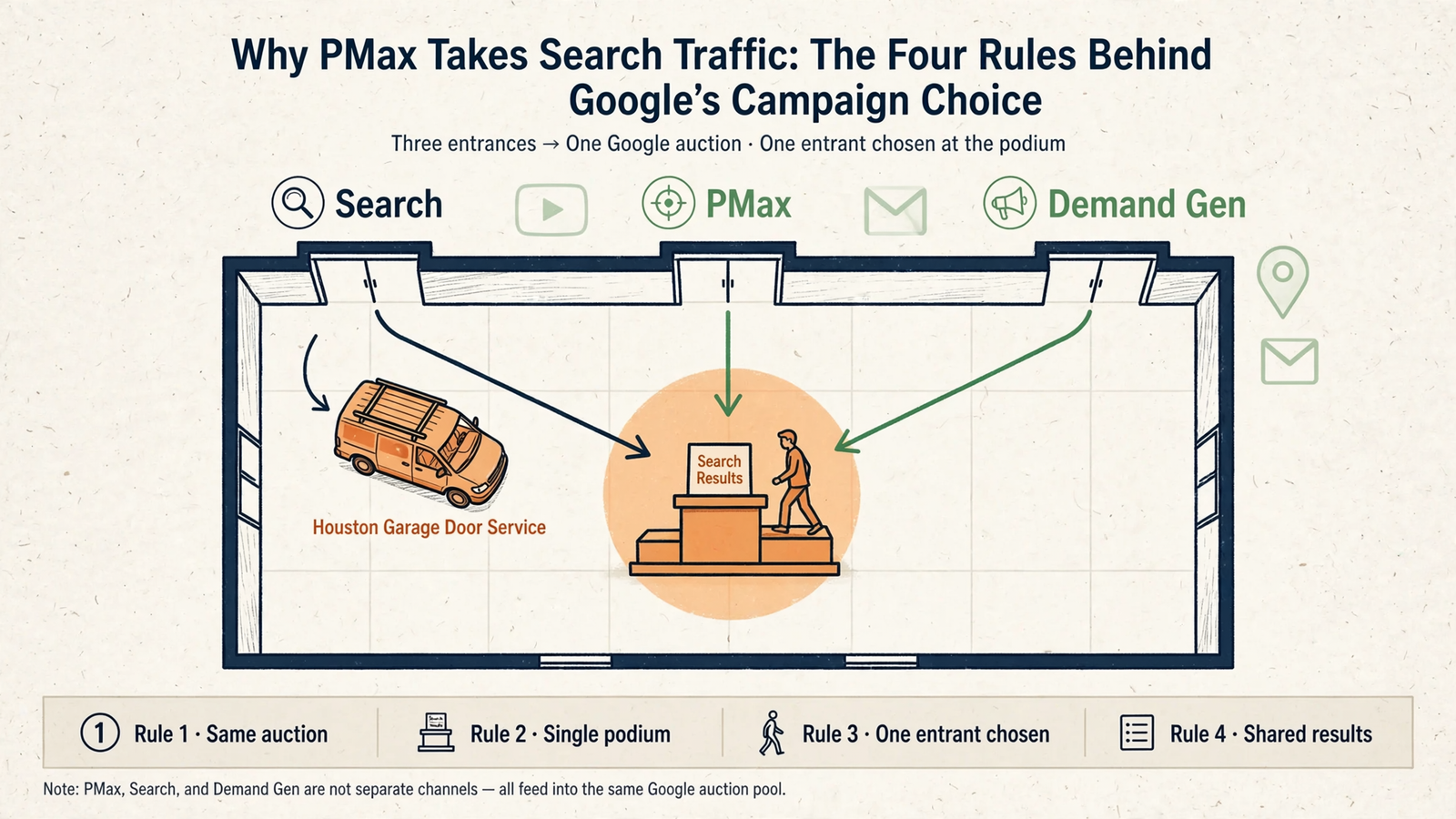
Layer 1: inventory determines who has a chance
Search needs a query that matches an eligible keyword under its match and targeting rules. If no keyword can match garage door replacement cost, raising the Search budget does not create one. The constraint is useful: Search lets you deliberately cover terms you can name in advance, including your brand and proven generic queries.
PMax has a wider reach. A single campaign can serve across Search, Shopping, YouTube, Display, Discover, Gmail and Maps. Search themes and audience signals can help point it toward relevant opportunities, but they are signals, not firm targeting boundaries. A theme for garage door replacement does not confine PMax to that wording, and leaving a phrase out does not, by itself, reserve it for Search. A hint is not a fence.
Demand Gen sits outside the search-query contest. It can serve on YouTube, including Shorts, as well as Discover, Gmail, Maps and Display, but it cannot answer a Search query. If the homeowner is watching YouTube before looking for an installer, Demand Gen may be eligible. Once they type a query, it is not.
That gives us the first test: identify the inventory. On a search results page, examine Search and PMax. On overlapping non-Search inventory, examine PMax and Demand Gen. Do not ask Demand Gen to defend a Search term it cannot serve.
Layer 2: eligibility and priority narrow the field
Now the homeowner searches acme garage doors houston. Your Search campaign contains the identical exact-match keyword [acme garage doors houston]. If that keyword is eligible, Google prioritizes it over broad or phrase keywords and PMax. That is not a vote on which campaign has the prettier dashboard. It is a priority rule for the matching query.
The next tier is less decisive. Identical phrase or broad keywords and identical PMax search themes can have equal priority. In that situation, priority does not reserve the query for Search. Google uses Ad Rank to select between qualifying candidates. Exact-match priority is specific; it is not a blanket Search-first rule.
There is also a condition people skip: the preferred keyword must be eligible. Low search volume status, disapproved creatives, targeting mismatches and budget restrictions can prevent it from serving. Suppose the Houston brand Search campaign reaches its daily budget limit at 3 p.m. while PMax remains eligible. The exact keyword still exists in the account, but its usual priority cannot help if Search cannot enter. PMax may serve the brand query instead.
The same logic explains many generic-query surprises. Suppose Search has [garage door replacement houston], but the homeowner searches how much does garage door replacement cost near me. Your keyword is not identical to that query. Do not assume its exact-match setting gives it the identical-keyword priority. Other qualifying Search matches and PMax can be considered under the applicable rules.
That does not make overlap universal. An Adalysis study of 3,300 non-retail PMax campaigns and about 1.2 million search terms found that 2.8% of PMax search terms overlapped Search keywords, while 67% of PMax campaigns overlapped on at least one term. The distinction matters: overlap can be narrow term by term and still show up in many accounts. Look for the actual queries before redesigning the whole account.

Layer 3: Ad Rank settles what priority does not
Eligibility tells us who can compete. Priority tells us whether one candidate gets the first claim. When qualifying candidates share priority, Ad Rank determines which one enters. Bid, expected click-through rate, ad relevance and landing page experience all matter to that calculation. A campaign label does not win by itself.
Return to garage door replacement cost. If Search can match it through a broad keyword and PMax has a relevant search theme, neither campaign owns an identical exact-match claim in this example. Both may qualify; Ad Rank decides between them. PMax can win that selection. Search can win it too. You need the query, the eligible candidates and the priority relationship before the result makes sense.
The Adalysis overlap data is a useful warning against treating impression share as a verdict on lead quality. On terms appearing in both campaign types, PMax won impressions 61% of the time. Search more often led on CTR, conversion rate and conversion value in that study. Those are different observations, not a license to declare either campaign the winner of every auction. Winning the chance to show is not the same as getting the better outcome.
For the Houston account, that means a PMax impression on a generic term is a prompt to inspect the term and its results. If Search would serve it more usefully, give Search a clear, eligible route to it. If PMax found phrasing you had never covered, that discovery has value too. The practical question is which campaign should own the next occurrence, not who gets credit for having found the last one.
Layer 4: conversions can reinforce the split you did not intend
Priority rules decide individual opportunities. Conversion feedback can shape what PMax pursues next. PMax optimizes toward the conversion goals and bidding targets you give it. A person already searching for Acme Garage Doors is likely a very different prospect from someone comparing installers for the first time, yet both can appear as conversions in the same campaign reporting.
That creates a tempting path. If brand traffic helps PMax meet its target cheaply, the campaign can lean toward demand that already existed. Reported ROAS may look healthy while the question you actually care about—whether the spend brought in additional customers—goes unanswered. The problem is sharper when you feed the system a weak conversion signal such as page views or form fills that do not reflect valuable business outcomes.

I would not call this “bidding against yourself.” PMax and broad-match campaigns can each be drawn toward brand because brand searchers are more likely to convert; Google’s selection rules then decide which eligible candidate enters. The concern is not that your two campaigns automatically inflate each other’s CPC. It is that spend and credit can move toward existing demand while you mistake the reported conversions for new growth.
Diagnose that with the unglamorous reports. Check PMax search terms, then use the channel performance report to see where it serves. If brand Search impressions fall as PMax brand exposure rises, check Search eligibility and the terms involved before calling it cannibalization. A budget limit at 3 p.m. and a PMax brand click afterward tell a more actionable story than a blended ROAS chart.

Run three opportunities through the four layers
The model is easier to use when each opportunity gets its own answer:
- The brand search with an eligible exact match. Someone types acme garage doors houston. Search has the identical exact-match keyword, with budget, targeting and approvals intact. Search gets priority over PMax for that query. Tomorrow, if Search has reached its daily budget limit, that protection may disappear and PMax may serve.
- The generic query without an identical exact match. Someone types garage door replacement cost. Search has a qualifying broad keyword; PMax has a relevant theme. Neither has an identical eligible exact-match keyword in this example. Priority does not settle the contest, so Ad Rank matters. If the term proves valuable, adding it as an exact-match Search keyword gives Search a clearer claim next time, provided the keyword remains eligible.
- The homeowner on YouTube. There is no search query for Search to match. PMax and Demand Gen can serve on that inventory, subject to their settings and eligibility. This is where PMax versus Demand Gen becomes the relevant comparison, not a dispute over who owns garage door replacement cost.
Notice what changes between the cases: not your opinion of the campaigns, but the inventory, eligible candidates and applicable priority. Start there, every time.
Give each campaign a job the rules can support
I would write the intended division of labour down before changing bids. Search gets eligible exact-match coverage for brand and the proven queries you can name. PMax explores opportunities that coverage does not already claim, including new search phrasing and inventory beyond Search. Demand Gen is used for prospecting on the surfaces where it can serve, then judged against the prospecting job you gave it rather than a Search-query report it cannot have.
That plan needs maintenance. Pull PMax search terms regularly. Promote valuable, repeatable queries into Search exact match; use appropriate negatives for terms you do not want PMax pursuing. The mechanism is the one we established in Layer 2: an eligible identical exact-match Search keyword takes priority when that query appears. Merely adding the keyword is not enough if its budget, targeting or approval later keeps it out.
Brand deserves its own boundary. If PMax is taking branded demand that you intend Search to capture, consider a PMax brand exclusion and campaign negatives for misspellings, while keeping the separate brand Search campaign eligible. Then watch whether the split holds. I have written more about which campaign gets a query when priority does not settle it, and how to test the PMax brand-drain pattern.
This is where groas’s operating model matters. Eligibility can change after the account structure looks finished: a budget binds, a keyword’s status changes, a target misses a location. groas watches for those breaks continuously and logs changes with its reasoning. That is a better way to defend an intended split than treating setup day as the end of the job. The structure only works while the campaigns remain eligible to play their assigned parts.
One new offer: reason through Katy before it goes live
Say Acme adds smart opener installs in Katy next month. We do not need to guess which campaign type is “best.” We can run the new offer through the same four layers.
First, identify the opportunity. If someone searches smart opener install katy, Search needs a matching, eligible keyword. PMax may also qualify for the search. Demand Gen does not. If the homeowner is on YouTube before searching, Search is out; PMax and Demand Gen may be relevant.
Second, set the claim you want Search to have. Add [smart opener install katy] as an exact-match keyword if that is a query Search should own, and make sure budget, location targeting and approvals allow it to serve. Without that eligible identical keyword, do not expect exact-match priority to protect the query merely because you built a Katy ad group.
Third, inspect the queries around it. Close variants and other opener searches are not automatically the identical query. Search and PMax may both qualify for them, and Ad Rank can matter. Promote the valuable terms you can name rather than assuming one keyword settles the whole offer.
Fourth, watch what the conversion signal rewards. If PMax picks up existing brand demand while you meant it to find new opener customers, contain brand and examine the terms and channels. If it finds useful new phrasing, move the repeatable winners into Search. Write the split down before you spend, or the system will make one from what qualifies and converts.
I used to tell clients PMax versus Search was a preference. I was wrong. For any given search, it is inventory, eligibility, priority and then Ad Rank, with conversion feedback shaping the opportunities PMax pursues next. Name the queries Search must keep. Keep those keywords eligible. Let PMax prove what it can find beyond them. Cannibalization stops looking random once you can explain who was allowed into the room.