

One query, two campaigns, one entrant
A buyer searches commercial espresso machine. Your Search campaign has that exact keyword; your Performance Max campaign covers the same equipment. Which campaign gets to serve is a rules question, not a preference question.
I hear the usual division all the time: Search is for control, Performance Max is for scale. Fine as a planning shorthand. Useless when you need to explain why a particular query appeared under one campaign rather than the other. Google applies serving-priority rules before your account enters the external ad auction. Your campaigns are not simply bidding against each other until one drives up your cost per click.
That distinction matters in real accounts. In an Optmyzr study of 503 accounts and 5,768 Search campaigns, 91.45% of accounts showed direct search-term cannibalization between Performance Max and Search. The useful response is not to declare either campaign type the winner. It is to work out which campaign was eligible, whether an identical exact-match keyword had priority, and what happened when it did not.
I will use one retailer throughout. It sells commercial coffee equipment and runs a Search campaign with the exact-match keyword [commercial espresso machine] and a $150 daily budget. It also runs a Performance Max campaign covering commercial machines with a $300 daily budget. Keep those two campaigns in view. Change only the query or the campaign’s eligibility, and the result can change.
First, a campaign has to be eligible
Before priority matters, an ad has to be able to serve. A paused campaign cannot enter. Neither can an ad blocked by a relevant negative keyword or location setting. A campaign constrained by budget or an ad group without an approved ad may also be unable to serve a particular query. Priority is not a reservation on traffic: it cannot rescue an ineligible Search ad.
That is the first check in the coffee account. If Search and Performance Max are both eligible for commercial espresso machine, Google’s campaign prioritization guidelines give us a rule to apply. If Search cannot serve, there is no contest between the two for that impression. Performance Max may serve if it is eligible.
This sounds obvious until a report labels the traffic as a Performance Max success. A campaign can capture a query because the Search campaign was absent, not because it was better at finding demand. Before comparing results, check who was actually available to serve.
An identical exact-match keyword gets priority
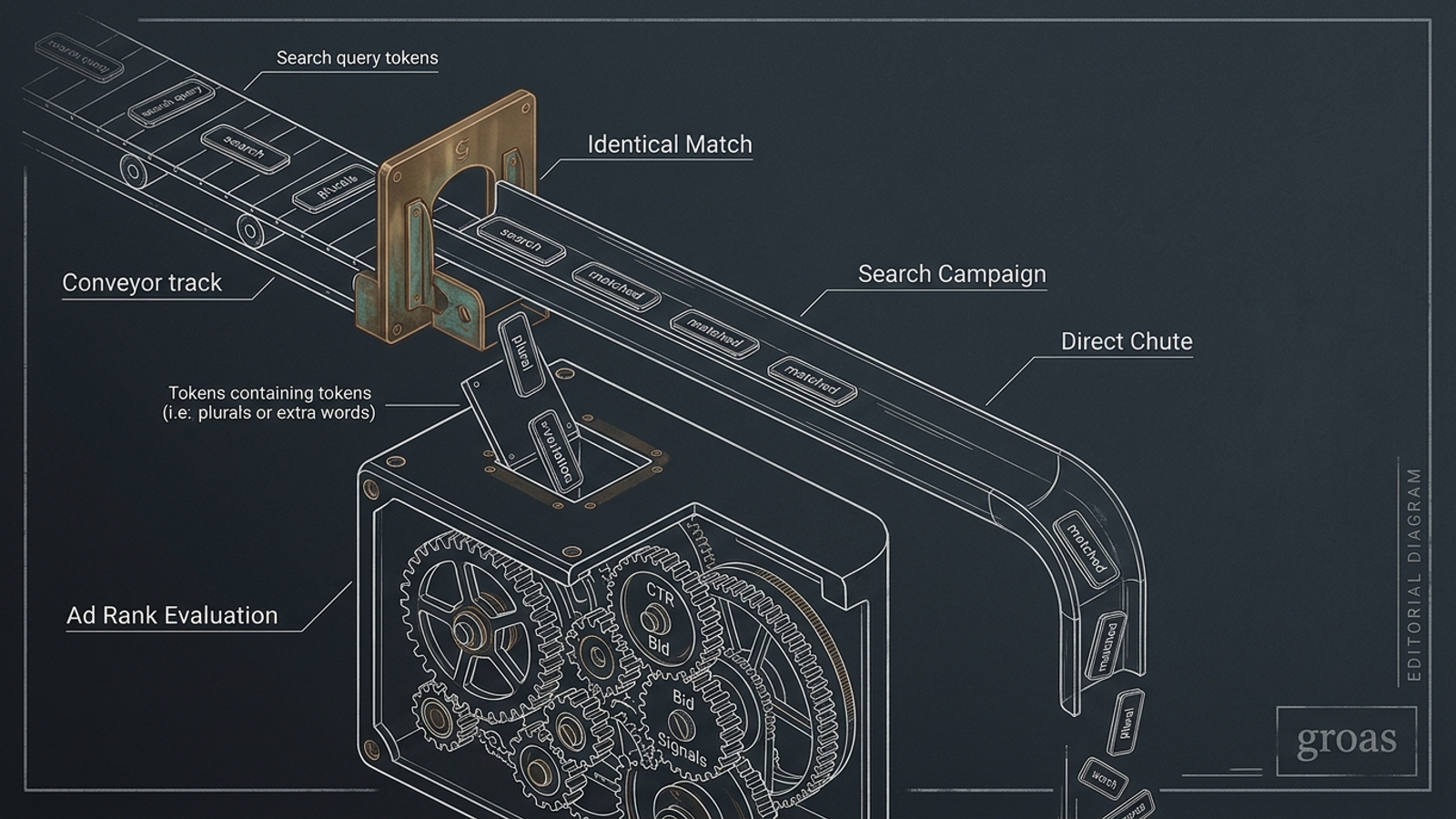
Now give both coffee campaigns a fair shot. The buyer types commercial espresso machine, and the Search keyword is [commercial espresso machine]. The query and keyword are identical. Under Google’s interaction rules, the eligible, identical exact-match keyword takes priority over Performance Max. The $300 Performance Max budget does not overturn that rule, and a stronger-looking Performance Max ROAS is not a reason to skip it.
The word doing the work is identical. Exact match is a keyword match type that can cover variations; identical-query priority is a narrower serving rule. Our retailer’s keyword may be relevant to commercial espresso machines or commercial espresso machine for cafe, but neither query is the same text as commercial espresso machine. The automatic priority attached to an identical keyword does not carry over just because the terms look close to a person reading the search-terms report. WordStream’s keyword prioritization analysis makes that distinction, including how minor spelling corrections are treated.
This is the hinge in the whole argument. You can build an exact-match campaign around your most valuable category term and still see Performance Max capture related searches. That does not, by itself, mean Google ignored the exact-match rule. Ask two separate questions: Was the keyword eligible? Was it identical to this query? Only then move to the next rule.
When identity breaks, Ad Rank matters
Change the buyer’s search to best commercial espresso machine for cafe. Search may still have a matching keyword, and Performance Max may also be eligible. But [commercial espresso machine] is not identical to that query. Search no longer gets the identical-keyword priority. Google can evaluate the eligible candidates using Ad Rank.
Ad Rank is not a simple contest between the budgets printed in campaign settings. It reflects factors including bids, expected click-through rate, ad relevance, landing-page experience, and the context of the search. That is why the answer to “Which campaign wins the variant?” is conditional. Performance Max can take it; Search can take it. The priority rule alone no longer settles the question. Adalysis’s discussion of PMax and Search overlap examines what this competition looks like in accounts.
Phrase and broad match do not provide the identical-exact-keyword protection, either. Say the retailer changes its Search keyword to broad match commercial espresso machine and uses search themes in Performance Max. Both campaigns may be eligible for the cafe query, but declaring the term “owned by Search” in a planning sheet does not give Search serving priority. You have to look at the candidates and their Ad Rank.
Bidding targets can influence that contest. Suppose Search has a 400% Target ROAS and Performance Max has a 300% Target ROAS. The looser target may let Performance Max bid more aggressively for an eligible query that lacks identical-keyword priority; it does not guarantee a win on every query. If Performance Max receives the impression, its reported conversion is not proof that Search could not have converted that buyer. The campaign complementarity framework is useful here because the settings have to be read together, not judged from each campaign’s ROAS in isolation.
The practical takeaway is narrow but powerful: check identity first, then compare eligibility and bidding conditions. “PMax likes scale” cannot tell you what happened to the cafe query.
Brand traffic makes the same rule more expensive
Brand queries expose this distinction quickly. A dedicated Brand Search campaign may cover the brand’s exact name, while buyers type misspellings, product names, SKU numbers, or the name plus discount code. Some queries may qualify for identical-keyword priority; others will not. Performance Max can be eligible for those others, and its conversions can make its ROAS look healthy even when the buyer was already looking for the retailer.
That is why I do not treat a strong Performance Max ROAS and a falling Brand Search volume as two unrelated observations. Nor do I call every branded conversion incremental. I check the queries and the serving setup first. A conversion credited to Performance Max tells you where it was recorded, not whether Performance Max created the demand.
Use brand exclusions for the boundary you mean to set
Negative keywords and brand exclusions solve related but different problems. A negative keyword blocks queries under that keyword’s matching rules; a list of manually entered brand terms can leave variations uncovered. Google’s brand settings documentation describes brand exclusions as a way to exclude traffic associated with a brand rather than relying only on a hand-built list of strings. If you want to keep branded traffic out of Performance Max, that is the setting to examine.

The cost of getting this wrong is not theoretical. In our Shopify brand cannibalization case study, a merchant spending $45K monthly saw Performance Max consume cheap brand search volume while non-brand categories suffered. After brand exclusions, a feed rebuild, and campaign-priority changes, the business recovered approximately 60% of its lost ROAS within 60 days. Those changes happened together; the case does not isolate a single magic switch. For the settings workflow, see our Performance Max budget protection guide.
For our coffee retailer, the decision is similarly concrete. If Performance Max is meant to find demand beyond people already searching for the shop by name, define the brand boundary. Then judge the remaining traffic, rather than congratulating the campaign for finding buyers who arrived with a shopping list.
Demand Gen is outside this query contest
There is one common comparison that does not fit the model. Demand Gen is not another candidate for the coffee buyer’s Google Search query. It runs on surfaces including YouTube, Discover, and Gmail, rather than entering the Search auction as a keyword-targeted campaign. The Demand Gen analysis describes those placements and its role alongside Performance Max.
Performance Max spans inventory that includes Search and Shopping, so it belongs in this query-level discussion. Demand Gen does not. If reported conversions move between Demand Gen and Performance Max, you may have an attribution or broader funnel question, but you do not have a Demand Gen-versus-Search keyword priority question. Our Google Demand Gen guide covers that separate campaign setup.
That distinction is a useful test of the model: before asking which campaign wins a search query, make sure both campaigns can participate in that kind of search.
Test the rule against an account’s weak spots
The identical keyword rule is easiest to misunderstand when something else changes. Return to the retailer and run three checks.
- Search becomes constrained by budget. The exact-match Search campaign has a $150 daily budget. If budget limits prevent it from serving a later
commercial espresso machinequery, identical-keyword priority cannot make an ineligible ad appear. Performance Max may serve if it remains eligible. This is a reason to inspect budget constraints, not to assume a daily budget always cuts serving off at precisely noon. Google’s guidance on the interaction addresses what happens when Search cannot serve. - The Search ad is disapproved. The keyword can still sit in the ad group, but if there is no approved ad available to serve with it, that group cannot claim the query merely by containing identical text. Performance Max may become the eligible option. Check the ad, not just the keyword status.
- A new model has no Search coverage. The retailer adds a dual-boiler espresso machine to its product feed but has not built corresponding Search coverage. If Performance Max can match a search for that model through its available inventory, Search cannot win traffic it is not equipped to serve. That is coverage, not a failure of priority.
The same sequence explains all three without inventing a new rule for each surprise: eligibility, identical-keyword priority, then competition among eligible candidates where that priority does not settle the query.
Audit what served before changing strategy
You can apply that sequence to your own account without treating one report as a verdict. Start with two places:
- Performance Max Search Terms Insights. Review search categories and subcategories for clusters resembling your core Search terms or brand. They can show where to investigate. A category is not proof that Performance Max took an impression from an eligible, identical exact-match keyword; inspect the underlying query and campaign conditions before making that claim.
- Search Lost IS (Budget) and Search Lost IS (Rank). Add these columns to Search. Budget loss tells you to examine whether Search could participate as often as you expected. Rank loss points you toward competitiveness, including bidding settings. Neither column, alone, identifies Performance Max as the cause. If Search uses a 500% Target ROAS while Performance Max uses 350%, compare those targets before deciding that the campaign type itself explains the split. Practitioner discussions of Search and PMax performance show why the question comes up so often.
This is operational work, not a one-time diagram. Queries vary, ads lose approval, budgets constrain delivery, and bid targets change. A Tuesday review can explain last Friday’s spend; it cannot act before every auction. That gap between intermittent account checks and continuous execution is why we built groas: to handle the repetitive monitoring and adjustments under human direction, with attributable revenue as the point of the exercise.
Do the diagnostic work in order. A Performance Max conversion is the beginning of the investigation, not its conclusion.
One last query: predict it before opening the report
The coffee retailer adds that dual-boiler model. A buyer searches its model name plus for cafe. The product is in the feed, Performance Max is active, and Search still has only [commercial espresso machine]. Which campaign should you expect to see?
Start at eligibility. Performance Max has a path to the query through the new product. Search has no identical keyword for the model-name query, so it gets no identical-keyword priority. If Search has some other matching coverage, the eligible candidates can be evaluated beyond that priority gate; if it does not, there is no Search candidate to protect. Performance Max appearing in the report would not, on its own, be cannibalization.
Now change one detail. The retailer builds an eligible exact-match keyword identical to the buyer’s query. That gives Search priority over Performance Max for that query. Change the wording to a non-identical variant, or make the Search ad unable to serve, and you must run the checks again. No campaign philosophy needed. Just the query, the eligible ads, and the priority rule.
Frequently asked questions
Does Performance Max or Search win when both could serve the same query?
Neither campaign type wins by default. Google applies serving-priority rules before the external ad auction: first it checks which campaigns are eligible, then whether an eligible exact-match keyword is identical to the query, and only then evaluates remaining candidates using Ad Rank.
How common is search-term cannibalization between Performance Max and Search campaigns?
In an Optmyzr study of 503 accounts and 5,768 Search campaigns, 91.45% of accounts showed direct search-term cannibalization between Performance Max and Search. The useful response is to determine which campaign was eligible and whether an identical exact-match keyword had priority.
What does it mean for a Google Ads campaign to be eligible for a query?
A campaign is eligible when it can actually serve: it is not paused, not blocked by a relevant negative keyword or location setting, not constrained by budget, and has an approved ad available. Priority is not a reservation on traffic, so it cannot rescue an ineligible Search ad.
When does Search get priority over Performance Max for a query?
When a Search campaign has an eligible exact-match keyword that is identical to the query text, that keyword takes priority over Performance Max. The word identical matters: queries that are merely close variations, like a plural or a phrase such as a machine for a cafe, do not qualify for this automatic priority.
What decides the winner when no identical exact-match keyword matches the query?
When the exact-match keyword is not identical to the query, Ad Rank decides. Ad Rank reflects factors including bids, expected click-through rate, ad relevance, landing-page experience, and the context of the search, so either campaign can win a non-identical query depending on those conditions.
Does a Performance Max conversion mean it created demand that Search could not have captured?
No. A conversion credited to Performance Max tells you where it was recorded, not whether Performance Max created the demand. Performance Max can capture a query because the Search campaign was ineligible, absent, or lacked identical-keyword priority, so check queries and serving setup before crediting it with incremental demand.
How do I stop Performance Max from taking my branded search traffic?
Examine brand exclusions rather than relying only on negative keywords. A negative keyword blocks queries under its matching rules, but a manually entered list of brand terms can leave variations uncovered. Google's brand settings let you exclude traffic associated with a brand, which is the setting to use for setting that boundary.
Does Demand Gen compete with Search campaigns for Google search queries?
No. Demand Gen runs on surfaces including YouTube, Discover, and Gmail rather than entering the Search auction as a keyword-targeted campaign. Performance Max spans inventory that includes Search and Shopping, so it belongs in the query-level discussion; Demand Gen does not.