

 LinkedIn

One person. Five hours a week. Sixty days. No new tools. I would spend none of that budget trying to win back the how-to clicks AI Overviews swallowed.
Your how-to posts did not necessarily get worse at converting. Searchers started getting answers before they reached them: in one large study, position-1 click-through for queries that trigger AI Overviews fell from 7.3% to 1.6%. I know the urge to fix the biggest red number in a report. Sometimes that number is telling you the inventory changed, not that your page needs another rewrite.
Here is my trade: let the informational traffic go, rebuild the 10 to 15 pages that answer buyer questions, and judge the 60 days on enquiries and verified AI fetches, not sessions. Five hours a week gives you about 40 hours over eight weeks. The steps below commit 36 and leave four for the work that runs long. No secret weekend sprint.
1. Week 1: Find out which lost clicks mattered
Cost: 4 hours. Buys: an ignore list that protects the rest of your time.
Open Search Console, set a 90-day comparison, and look for this pattern: clicks down, impressions flat or up, average position stable, and CTR down 20% or more. It is a useful way to investigate AI-summary losses separately from ranking drops. It is not proof that an AI Overview caused every missing click. The distinction still matters: rewriting for a ranking loss and chasing clicks that now end on the results page are different jobs.
Export the queries with rising impressions and falling clicks. Tag each as informational or buyer intent. What-is, how-to, and why queries are easy for AI to summarize. Service, pricing, comparison, and branded queries are the ones I would inspect for buying intent. Then match the affected pages against your last 12 months of form fills and calls.
I used to tell clients to fix the biggest traffic losers first. I was wrong. A page that lost hundreds of visits but never produced an enquiry does not get priority over a pricing page that helps someone decide whether to call. I go deeper on that split in which losses actually cost you customers. For this plan, keep the rule plain: if a lost page never produced an enquiry, put it on the ignore list.
You should finish the week with two piles, not a prettier traffic chart: pages tied to buyer actions, and pages you are deliberately leaving alone.
2. Weeks 2–3: Collect 15 questions that precede a sale
Cost: 6 hours. Buys: a build list drawn from buyers rather than search volume.
You do not need a new keyword tool. You need your inbox. Pull the last 30 sales emails, notes from your last 10 calls, and five questions prospects ask after reading your pricing page. If you have fewer than that, use what you have. The point is to find the language buyers use when they are close enough to a decision to ask what happens next.
In my old agency days, I would have started with volume. Now I start with the sentence that comes before a quote request. That is a better use of this particular budget than finding another broad topic a searcher can get answered without visiting your site.
Turn the material into up to 15 questions, in the customer’s words. Look for questions like these:
- How much does [service] cost for a [building type or team size] like ours?
- How long does it take, and what breaks while you do it?
- Who is this not right for?
- How do you compare with [named alternative] on price, timing, and guarantees?
- What happens after we pay?
Do not manufacture questions to reach 15. If nobody has asked one, it does not make the list just because its blog equivalent used to bring traffic. Sort the questions by how often they surface in sales conversations and whether you already have a page that partly answers them. The sheet is your build order, not another content calendar you will admire and ignore.
This is also where you decide what to cut. A broad explainer may be accurate, polished, and popular. If it never helped someone enquire, it waits. Six hours spent choosing the right questions saves you from spending 18 hours improving answers nobody needs from you.
3. Weeks 3–5: Rebuild the buyer pages for direct answers
Cost: 18 hours. Buys: up to 15 pages a buyer can use and an assistant can fetch.
Plan on roughly 70 minutes per page. Start with the buyer pages already ranking in positions 1 to 10: in one study of more than 7,000 evaluation-stage citations, over 90% came from top-10 ranking pages. Ranking gives a page a better shot at being found. A clear, self-contained answer gives the reader, and potentially an assistant, something useful to take from it. Neither guarantees a citation.
I use the same plain structure on each page:
- Put the buyer’s question in the heading, in words they would recognize.
- Answer it in the first 40 to 60 words. No origin story, no promise to answer it after a scroll.
- Give the details that make the answer useful: actual prices or ranges where you can provide them, limits, timelines, and who the service is not for.
- Where the question calls for it, add a small comparison table and a short FAQ covering pricing or implementation.
- Record what materially changed, when, and why in a two-line changelog at the bottom.
That follows the extractable-answer structure recommended in the B2B citation study. If you use FAQ or HowTo schema, it should reflect what a person can actually read on the page. The test is less glamorous than the term extractability: can someone copy your first two sentences into an answer without correcting or completing them? If not, rewrite them.
The ignore list from Week 1 will feel wrong on purpose. I had a home-services how-to that still pulled 2,000 visits a month and had not produced a quote request in a year. Crossing it out felt like losing. It was the opposite: every hour spent refreshing that post was an hour I could not spend answering a question from someone ready to ask for a price.
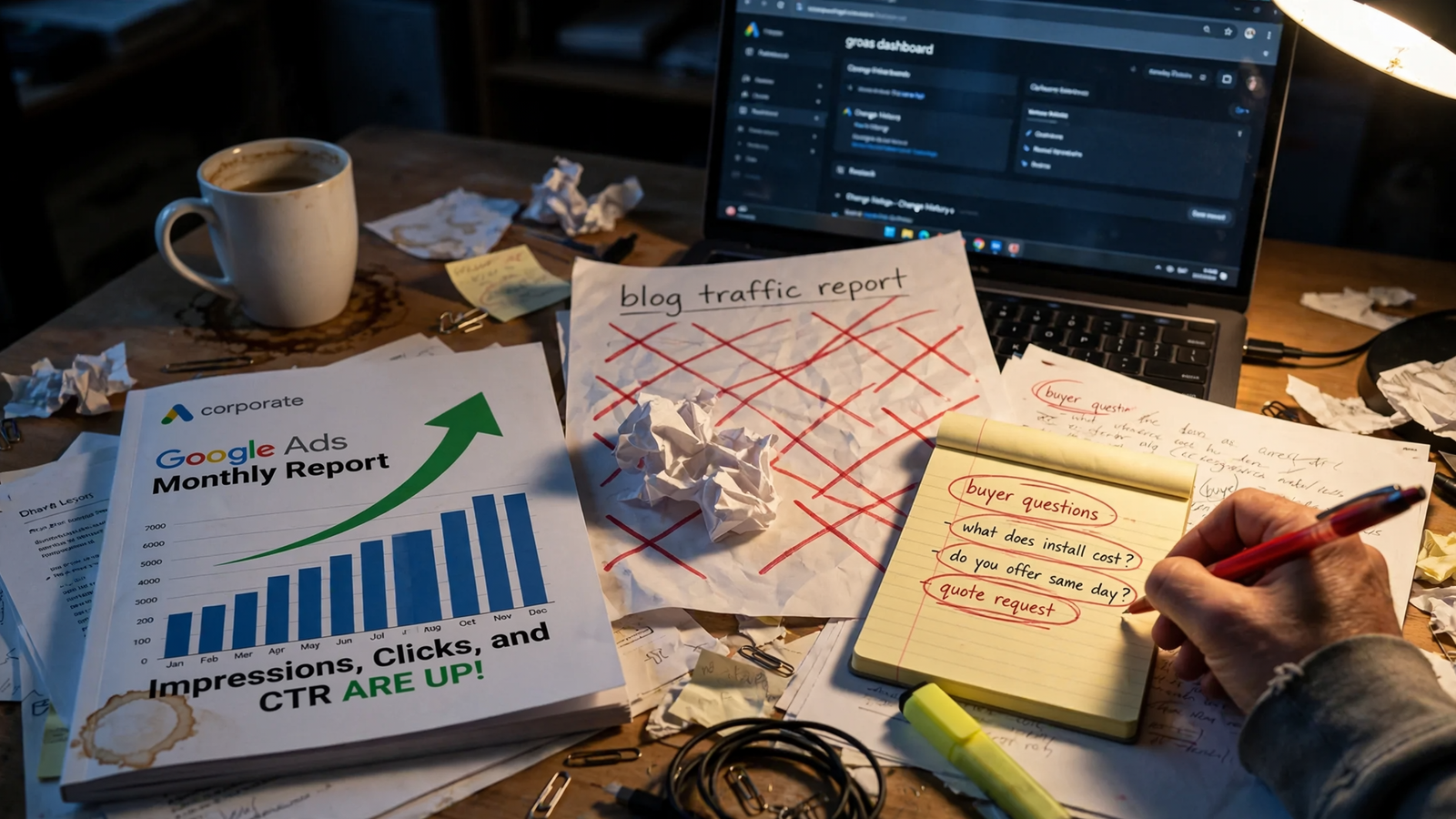
Do not replace one bit of busywork with another by changing dates without changing answers. Visible updates, accurate sitemap dates, and dateModified markup can communicate that a page has changed; a new byline date is not a substitute for doing the work. I saw the gap between search clicks and assistant activity in our own search data: a page at position 3 had 4,033 impressions and one click while ChatGPT-User fetched it hundreds of times. A fetch is not a customer. It is one reason to make the answer current and readable wherever it is retrieved.
No silent date bump. Change the substance, explain the change, and move to the next buyer question.
4. Weeks 5–6: Check access, then verify fetches
Cost: 5 hours. Buys: evidence that assistants can reach the pages, rather than a guess based on a user-agent label.
A citation needs a retrievable page. Spend the first two hours checking the URLs you rebuilt:
- Confirm
robots.txtis not blocking the AI crawlers you want to allow on those pages. - Confirm the URLs appear in the sitemap with an accurate
lastmod. - Open each page logged out on mobile and check that the answer text appears without an interaction.
That is a short access pass, not a site-wide technical-SEO excavation. I keep the longer checklist in Claude-User fetched our robots.txt 1,071 times. Here, your remit is those buyer URLs. Fix the door before polishing the sign on it.

Spend the other three hours checking fetches. A request that calls itself GPTBot is not automatically from GPTBot; any client can put that text in a header. Check source IPs against vendor JSON files and use forward-confirmed reverse DNS where supported. Treat claims you cannot verify as unverified, not as wins. One fraud study found roughly one in 17 to 18 AI-crawler claims were spoofed.
Log verified fetches of the rebuilt pages in one sheet, once a week. Keep the page URL, date, and verified crawler together so you can see which answers are being requested. A verified fetch is evidence of access, not evidence of a citation or an enquiry. If you see none after two weeks of checking, revisit access first. Do not declare the prose a failure because no bot has appeared in the log.
5. Weeks 7–8: Judge the work by enquiries
Cost: 3 hours. Buys: a decision you can make without staring at the sessions graph.
Sessions may stay down even if this plan helps. You stopped spending your limited hours on informational visits and put them into pages for people considering a purchase. The B2B reporting model I borrow from puts pipeline and revenue ahead of rankings and traffic, while allowing months for authority, traffic, and leads to move. Sixty days is an early read, not a claim that every new page must already have paid for itself.
Every Friday, report three numbers for the rebuilt pages:
- Organic enquiries: form fills and calls that began on one of those pages. Count them in your CRM rather than relying only on Analytics.
- AI-referred visits: visits from ChatGPT, Perplexity, Gemini, and Copilot to those pages. They may be small; keep them separate from enquiries.
- Verified AI fetches: the per-page requests you validated in Step 4.
Do not collapse those into one impressive-sounding AI visibility score. They answer different questions. Fetches tell you whether verified crawlers requested the pages. Referrals tell you whether some people arrived from AI services. Enquiries tell you whether buyers acted. None is a substitute for the others.
If enquiries hold steady while sessions fall, do not call the plan a failure because the old traffic number looks smaller. If fetches climb for four straight weeks without enquiry movement, inspect the answer, pricing clarity, proof, and call to action before commissioning more content. You may still need more time to see the full effect. One page, three numbers, Friday morning.
The hours also have to add up. These five steps cost 36 hours; the remaining four are a buffer for pages that take longer, an access fix, or an enquiry trail that needs untangling. They are not permission to start a sixth project.
6. Throughout the 60 days: Cut the work that breaks the budget
Cost: 0 hours. Buys: room to finish the buyer pages.
I am cutting four things that usually turn a constrained plan into an unfinished one:
- No rewrite of 40 old how-to posts. Their lost clicks are not, by themselves, a reason to refresh them. Leave the ones with no enquiry history alone.
- No new tools. Search Console, your CRM, and one sheet for verified fetches are enough for this pass. A new dashboard can consume the same hours you need to publish.
- No link-building project in these 60 days. Links may matter over a longer stretch. They do not answer the pricing question still missing from your site.
- No informational-citation chase. Being quoted for a what-is query with no buyer action is a vanity metric wearing a different jacket. I used to report that sort of thing like a win. It never paid rent.
The cut list is not a claim that how-to content, links, or tools are useless forever. It is the price of doing this with one person, five hours a week, and 60 days. If a task does not improve a buyer answer, page access, or your ability to measure enquiries, it waits.
7. When the constraint lifts: Keep the Friday sheet or hand off the job
Stop rule: two missed workweeks, an unresolved fetch problem after publication, or falling enquiries while verified fetches rise.
I would not pretend this plan survives unlimited delay. Miss two weeks of the five-hour blocks and you have lost a quarter of the working time. If the rebuilt pages show no verified fetches after two weeks of checking, investigate access and site structure before writing another paragraph. If enquiries from those pages fall for a month while fetches climb, inspect the offer and proof. More prose is not the automatic fix.
That is the honest handoff point. I have watched owners grind past it for another quarter and call it persistence. What the deck calls persistence, I call doing SEO part-time while buyers ask assistants full-time.
If the constraint lifts and you want someone else to run the next stretch, hire against the same Friday sheet. That is why I point owners without the time toward groas: its SEO & AI Search service covers buyer-page and technical work across Google and AI search for a flat $1,499 a month, month to month, with no setup fee or cut of spend. Do not buy a prettier report in place of the work.
One person with five hours a week can get the buyer answers rebuilt. When that constraint lifts, the next job is keeping those answers current, reachable, and accountable to enquiries. Keep the Friday sheet yourself, or give that job to someone who will answer for what is on it.