

 LinkedIn

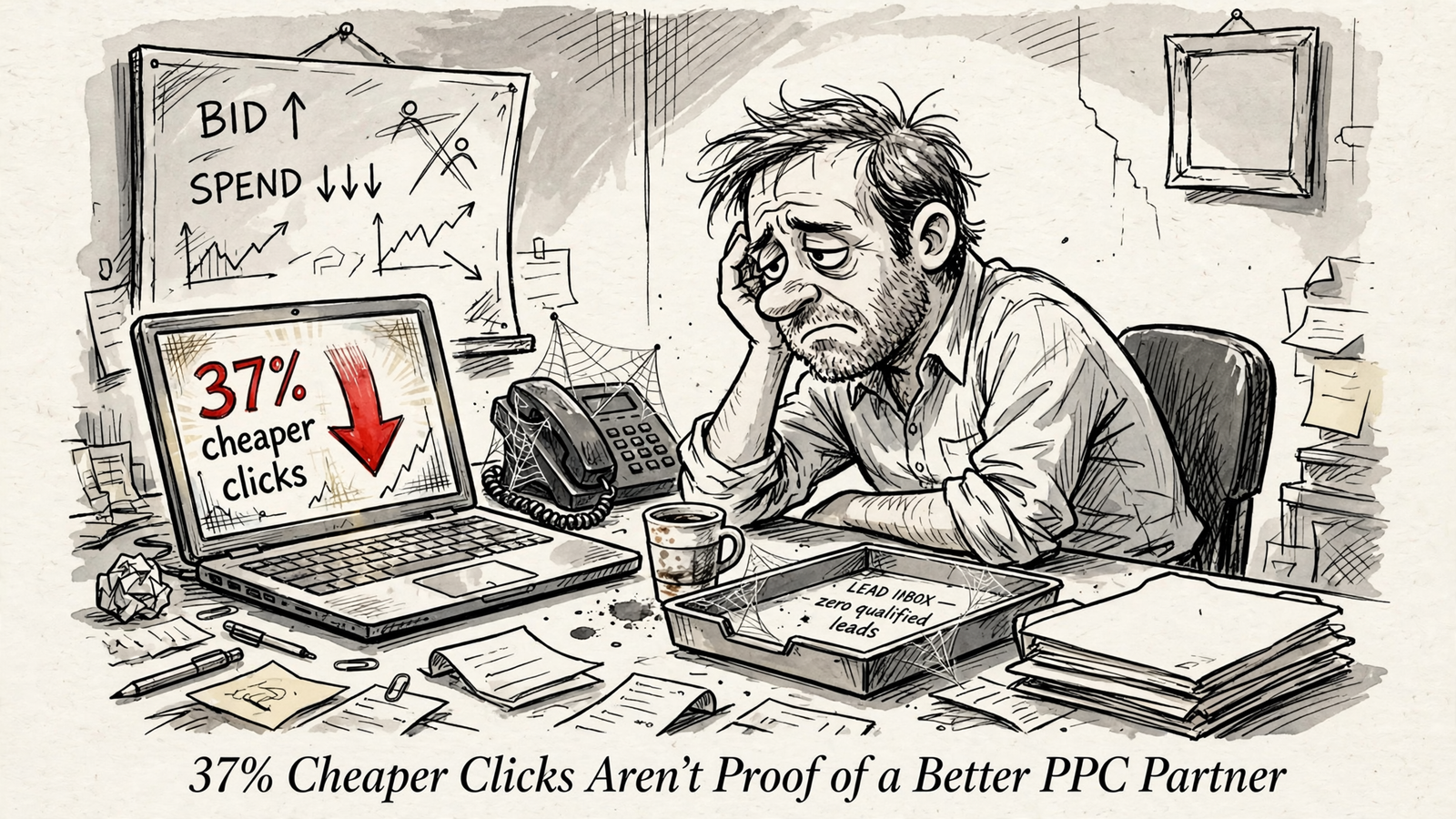
A reported 37% drop in average CPC tells an agency less about customer acquisition than it might think. The Dutch advertiser bought roughly the same number of visits for less money, but reported no qualified-lead or sales figures.
That is a buying-efficiency win. It is not yet a customer-acquisition win. On a screenshot, the distinction disappears. In a client’s call log, it becomes rather important.
For an agency choosing its first white-label Google Ads partner, this is the useful question: does the evidence connect spend to qualified customers, or does it stop at a cheaper click? I would not put my agency’s name on the second and sell it as the first.
What the bid cut actually delivered
The advertiser described two setups in the Netherlands: an initial max CPC of €1.50, followed by €1.00 after ChatGPT flagged the lower bid as likely to limit delivery. Here are the reported results:
Free tool: the Google Ads Cost Calculator shows what clicks cost in your trade, from Keyword Planner data, and what a monthly budget buys.
| Metric | Initial setup | Lower-bid setup | Reported change |
|---|---|---|---|
| Max CPC setting | €1.50 | €1.00 | Lower bid ceiling |
| Average CPC paid | Baseline | Lower | −37% |
| Total spend | Baseline | Lower | −35% |
| Click volume | Baseline | Roughly unchanged | Within 3% |
These are the account poster’s figures, not a controlled test or a cross-advertiser benchmark. They describe what happened in that window. They do not isolate why it happened.
I used to tell clients a bid cut would cost them volume. I was wrong often enough that I stopped saying it as a rule. A max CPC is a ceiling, not a price. In Google Ads, average CPC is total cost divided by total clicks, and the price paid can sit below the maximum. ChatGPT Ads is also described as a relevance-weighted second-price auction, where advertisers generally pay less than their maximum.
A lower ceiling can therefore change what an account pays without improving its targeting, creative, or audience intent. That is a plausible mechanism here, not an established explanation for the entire result.
The defensible finding is simple: this account reported similar click volume at lower spend. Keep that finding. Do not attach customers to it that the report never counted.
Where the evidence stops
There is no established platform-wide “normal” against which to grade this result. A review of early ChatGPT Ads results reports that OpenAI has not yet published performance benchmarks across advertisers, industries, or campaign types. The cited starting recommendation of $3–$5 max CPC is a bid suggestion, not a price list or a guarantee of traffic quality.
The comparison window creates another limit. The Dutch account compared a Saturday with weekdays. That leaves day-of-week effects mixed in with the bid change.
The other early reports show why that matters:
- Daily results can swing sharply. In a documented 15-day account, daily ROAS ranged from 0.2x to 2.9x. That is a warning against treating a good day as a stable result, not a forecast for another account.
- Weekday and weekend traffic need not behave alike. A 43-account audit reported B2B conversion rates of 2.7% on weekdays and 0.8% on weekends. That audit does not explain the Dutch result, but it shows why the comparison needs matched days.
The useful response is neither “the bid cut worked” nor “the result is worthless.” It is: log the change, but do not credit it with a causal result yet.

The missing business outcome is the larger problem. The Dutch post reports clicks and spend, not qualified leads or customers. Without that denominator, customer-acquisition cost remains unknown.
One documented ChatGPT Ads account illustrates the gap: its dashboard showed 36 conversions, while the business recorded 2 outside inquiries. That is not a rounding error. It is platform counting versus business counting, and the two only match when someone checks.
The same review describes StubGroup getting a cheaper lead without a cheaper customer. It also reports Kalyvox paying €0.16 per click in France versus €3.33 in the US for the same product, while noting that cheap clicks did not necessarily mean quality traffic. Neither example establishes what another advertiser will achieve. Both expose the missing step between traffic price and customer value.
Calls have the same problem. Treat every call as a conversion, and the optimization target becomes call volume rather than qualified demand. A ringing phone and a qualified inquiry are not interchangeable entries in a report.
A cheaper click with no qualified-lead count proves less money went into each visit. It does not prove the business acquired anything.
Keep buying performance and business performance in separate ledgers
If an agency does not speak PPC fluently, an impressive percentage can feel like proof. But the agency does not resell clicks. It sells booked jobs, signed retainers, and pipeline the client can recognize in its CRM.
I learned that the expensive way reselling early audits. The client never asked me what average CPC did. They asked how many qualified calls came in, and I had no answer that survived their call log.
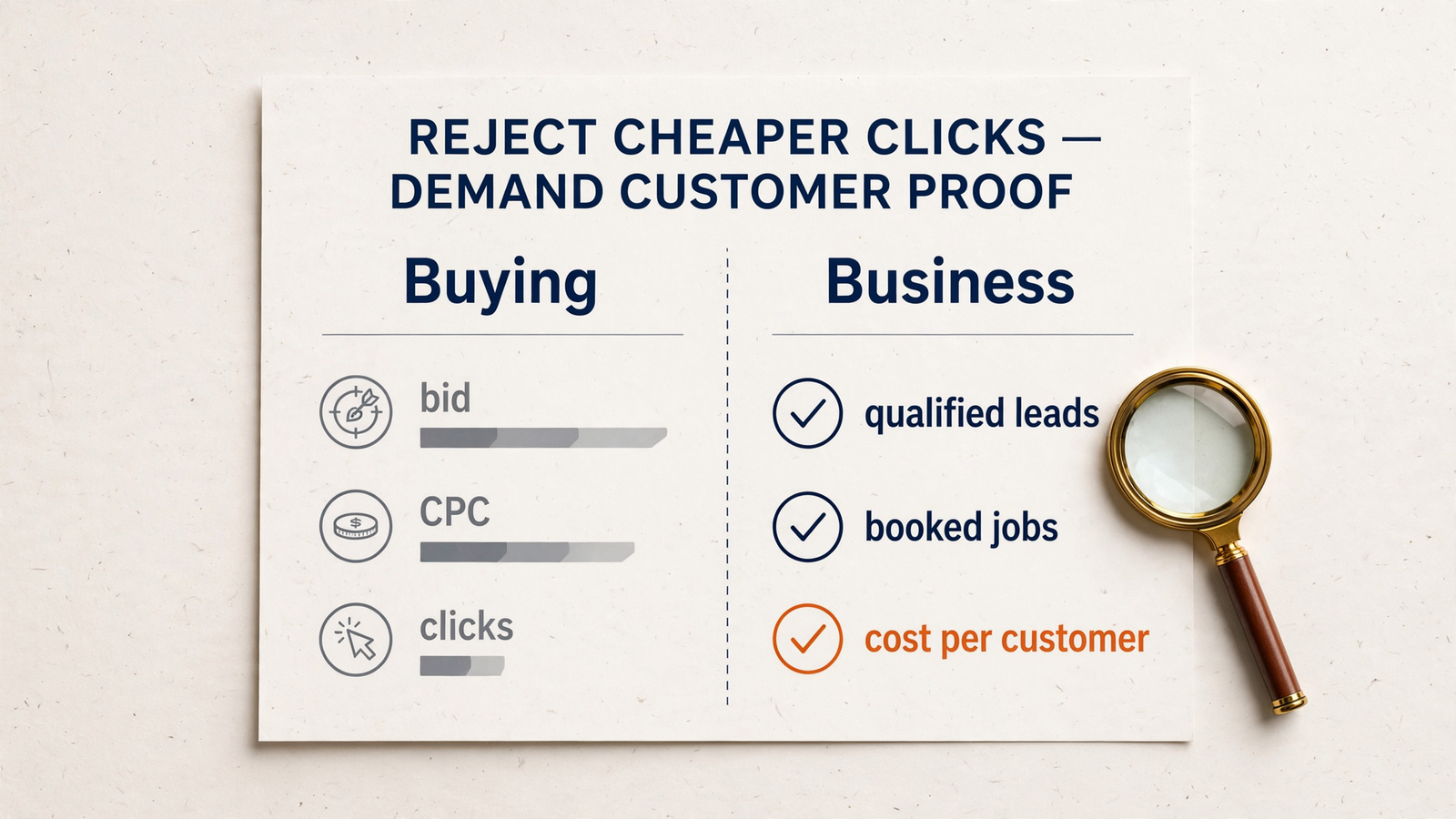
A white-label partner needs to show both the buying ledger and the business ledger. I use those as separate views on purpose:
| Ledger | What belongs in it | What it answers |
|---|---|---|
| Buying ledger | Max bid, average CPC, spend, clicks, impression share | What did the account buy, and at what price? |
| Business ledger | Qualified leads, booked appointments, closed revenue, cost per qualified lead | What did that traffic produce for the client? |
The ledgers need to connect, not compete. Buying efficiency matters: nobody needs to pay more for the same useful traffic. But spend divided by clicks is CPC. Spend divided by customers is customer-acquisition cost. Substituting the former for the latter does not make the calculation easier. It changes the question.
A partner who shows only the buying ledger is asking the agency to vouch for the business ledger on faith. That is a poor foundation for a client relationship.
My rule: never forward a CPC win without a second line explaining what happened downstream. If that outcome is still unknown, say so.
Ask for the comparison behind the percentage
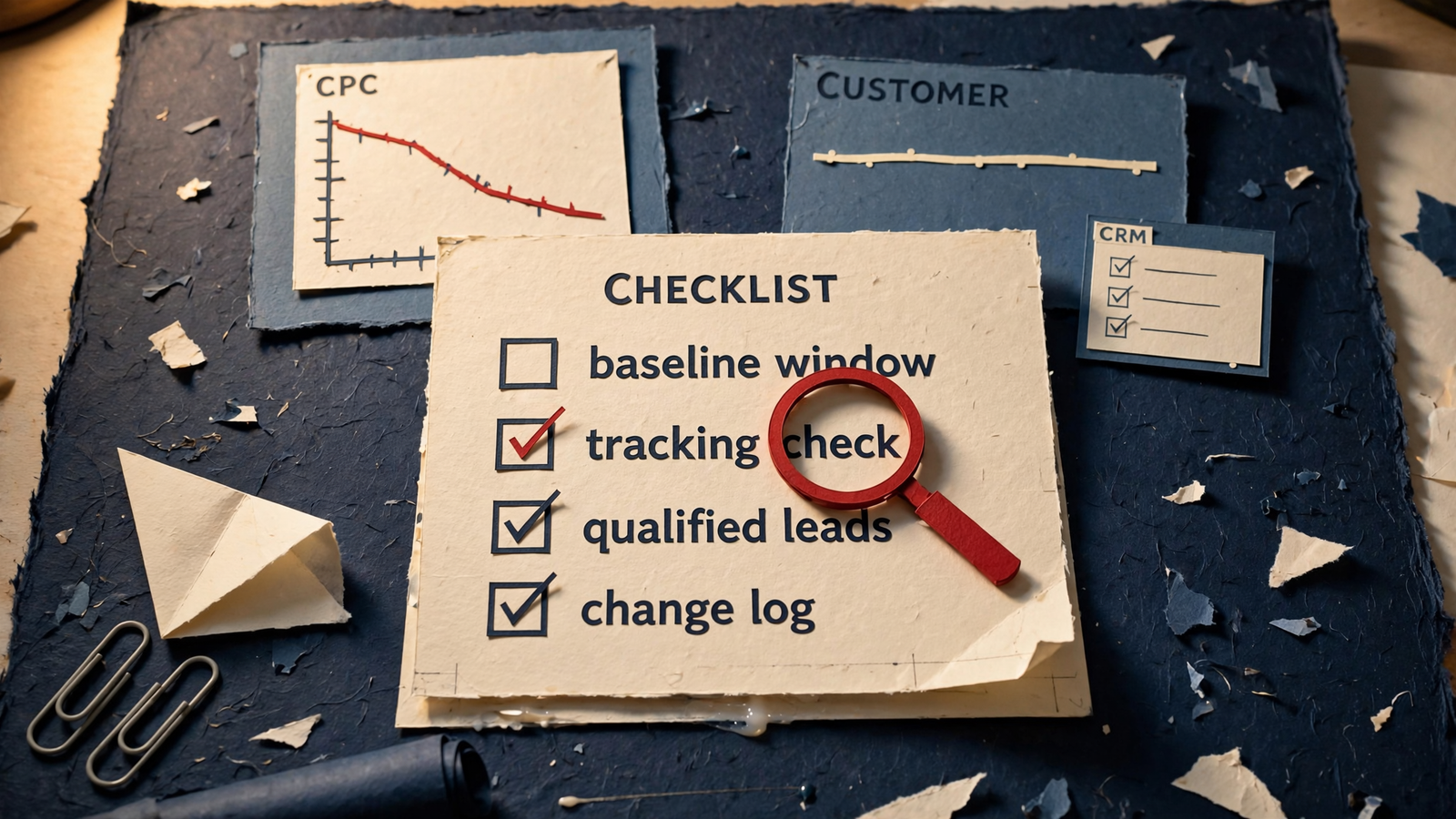
A useful case study lets the buyer inspect more than the headline. Before I believe a performance percentage, I want the following:
- The baseline and comparison window. Comparable weekdays, the same geography and budget cap, rather than Saturday against Tuesday. The Dutch example shows why that distinction matters.
- The tracking check. How the provider verified platform conversions against CRM records, calls, or booked jobs.
- The downstream outcome. Qualified leads and cost per qualified lead, followed by customer outcomes where available. Not just clicks and spend.
- The change log. What else moved during the window: budgets, keywords, negatives, landing pages, or the bid itself.
The change log is necessary, but it is not proof by itself. That is the discipline I wish someone had drilled into me during late-night negative-keyword mining.
A log says the provider lowered the bid on Saturday. A credible causal claim needs a comparison that accounts for the other things that could explain the result. If budgets, weekdays, and landing pages also changed, the log documents activity. It does not isolate the effect of the bid.
Do not let a record of work masquerade as evidence of impact. Ask for both. A provider should be able to explain what changed and distinguish what the evidence establishes from what remains uncertain.
Make the sample report earn the fee
The first commercial filter is not whether a quote looks cheap. It is whether the provider can show the report the agency will eventually have to defend.
Published white-label pricing examples put SMB fulfillment at $300–$600 per account per month and mid-market work at $800–$1,500, alongside percentage-of-spend arrangements and setup fees. Those are reference points from a provider roundup, not a universal rate card or evidence of service quality.
| What a quote establishes | What it does not establish |
|---|---|
| The proposed cost of fulfillment | Whether leads are qualified |
| The charging model | Whether tracking reflects business outcomes |
| The stated scope | Whether the provider can demonstrate its work |
I would ask for a redacted, client-ready report before signing. Not a template with lorem ipsum, and not a deck in which the biggest percentage gets the biggest font.
The report should show:
- Spend, leads, and cost per lead, with the lead definition made explicit.
- Qualified outcomes, rather than an unexplained platform conversion total.
- What changed during the reporting period.
- How tracking was checked against the business’s records.
- What remains unknown.
A white-label vetting checklist also covers Partner status, an NDA, attribution, dashboard access, and a sample report. Those checks help establish the operating arrangement. They do not replace the outcome evidence.
One specialist’s white-label offer explicitly emphasizes lead quality over screenshot-friendly metrics, with branded reporting on spend, leads, and CPL. That is the right reporting principle. The offer itself is not proof that the principle has been delivered.
If a provider will not show a usable sample, I would not assume the reporting will improve after payment.
Put responsibility for tracking in writing. Specify who handles conversion setup, qualified-call filtering, and CRM checks. The agency keeps the client relationship; the fulfillment partner carries the agreed proof burden. “We thought someone else was checking” is not a reporting process.
Use a small pilot to test the business ledger
A pilot limits the commitment while the agency checks whether the reporting survives contact with the client’s records. It should test more than whether the provider can spend the budget and produce a dashboard.
One published offer suggests starting with one or two accounts for 60 days. That is a bounded trial structure, not a guarantee that every business will produce enough closed-customer data in that window.
Before the pilot starts, agree on the qualified-lead definition, the tracking responsibilities, and what the review will examine. Then check whether the business ledger fills in alongside the buying ledger. If customer outcomes remain unavailable, the verdict remains limited to the outcomes actually measured.
For Google Ads cost context, use industry CPC benchmarks. Do not use them to grade a ChatGPT Ads click as though the platforms were interchangeable. Before reselling a result, work through the Google Ads audit checklist covering tracking, bidding, and wasted spend.
The pilot should establish whether the partner can connect its work to qualified outcomes. A lower CPC can be part of that record. It cannot stand in for the record.
Where groas fits: continuous work with a proof burden
This is where I put groas: its operating model addresses the gap between periodic account work and accountable execution. It runs Google Ads continuously rather than treating optimization as a monthly review with a PDF attached.
Bids, budgets, search terms, negatives, and landing-page flags receive attention while they still matter. Changes are logged with their reasoning in plain language. The white-label reporting described here brings spend, leads, cost per lead, and account changes into a weekly branded report, while the agency retains the client relationship and margin.
Continuous execution and an inspectable record are a stronger operating model than charging more as spend rises and reviewing the account when the calendar says so. But the record still has to connect to the business ledger. Activity does not become acquisition evidence because groas performed it.
The commercial boundaries matter, too. groas white-label starts at $299 per account-service unit, with a five-unit minimum and media spend billed separately. Search plus feed work for one client counts as two units. There are no guaranteed results.
That means the small-pilot principle has to fit the service minimum; it is not an offer to take on any isolated account at the headline unit price. If the requirement is a single $300 account, no call tracking, and a promise of 37% savings, this is not the fit.
The tracking work remains part of the decision: conversion setup, qualified-call filtering, CRM checks, and comparable reporting windows. I prefer an explicit scope and minimum to a low headline fee that leaves the business ledger empty. Judge groas on the same standard I would apply to any partner: whether the evidence connects spend to qualified outcomes, and ultimately to customer cost.
The decision the numbers support
The Dutch account reports similar click volume at lower spend. It does not establish cheaper customers, better intent, or a bidding method an agency can carry over to Google Ads.
Choose the partner that can connect spend to qualified customers, not the one with the most flattering CPC screenshot. Require a usable sample report, written tracking responsibilities, and a change log. Start with a bounded pilot that fits the commercial terms, and judge only the outcomes the evidence actually supports.
If a partner meets that bar, the headline percentage stops being the deciding factor. If it cannot, no percentage should persuade you.


