

 LinkedIn

$4,000 in Meta spend, eight weeks, 24 creatives, one ecommerce store with no in-house designer. Spend the budget on a creative-testing calendar, not an audience-tinkering habit, and judge the result on new-customer contribution margin rather than the ROAS Meta puts at the top of a dashboard.
Most agencies won’t tell you this: with a modest budget, a clever interest stack is a poor substitute for six ads that make six different arguments. Meta’s Andromeda retrieval step narrows tens of millions of ads to a few thousand candidates before the auction. Meta’s guidance points toward different themes and visuals inside fewer broad campaigns, not an expanding collection of niche audiences. I used to tell clients the opposite. I was wrong. The account needs useful creative signals more than another targeting theory.
This is a constrained playbook, not a promise that $4,000 buys certainty. Week 1 checks tracking without drawing on media spend. The next six weeks use about $3,420, and Week 8 uses the remaining $580 while you read the results. That is roughly $82 a day across the seven spending weeks, not $133 a day for all eight. Creative production is a separate line item: price the work before you launch, whether you make the ads yourself or pay someone else. Each step below says what it costs, what it buys, and what gets cut.
1. Week 1: make the purchase number worth reading — $0 of media spend
Before you buy traffic, prove that a purchase is counted once, with money attached. Run a Test Event in Events Manager and one real low-value purchase on your store. Confirm that you see exactly one Purchase with value, currency and content_ids. If you send browser and server events, check that they share the event name and event_id so Meta can de-duplicate them. That browser-and-server check is the core of a pixel plus Conversions API audit.
If value is missing or Event Match Quality is poor, stop. A polished ROAS report cannot rescue broken purchase data.
Then calculate break-even ROAS from your own contribution margin, not a benchmark post. The arithmetic is 1 divided by contribution margin. Say a sale brings in $100 and COGS, shipping and fees take $60. The $40 left is a 40% margin, so 1 / 0.40 = 2.5x break-even ROAS. At that return, the contribution from the sale covers the ad spend. Write the threshold on the plan.
Free tool: the ROAS Calculator works out your return on ad spend, your break-even ROAS and the budget a revenue goal takes.
Finally, define an existing customer and get your buyer list ready. You will need the same definition in Week 8, when you separate revenue from new buyers from revenue from people who already knew where the checkout was. What gets cut this week: media spend and any urge to call an unverified Purchase event a result. You buy the right to believe the later numbers.
2. Weeks 2–3: launch six distinct concepts — about $1,140 of media spend
Batch one is six concepts, not six crops of one photo. Give each ad a different job:
- A UGC unboxing shows what arrives.
- A founder talking to camera says who the product is not for.
- A close-up detail shot makes the quality claim visible.
- A comparison addresses the cheap alternative.
- An offer-led carousel makes the proposition plain.
- A review-led video puts proof on screen with captions.
That is creative diversification in practice: different messages and visuals inside one or two broad campaigns. It is not six ads whose only meaningful difference is the background color.
The budget still imposes a hard limit. At a $30 target CPA, giving a concept 3x CPA means about $90 before you make a zero-purchase call. Six concepts need $540 just to reach that point. They do not earn a verdict after three days, and the remaining spend has to support ads that show promise. Start with a 70% prospecting, 20% testing, 10% retargeting split across the plan, then give this batch a 14-day read. No duplicating an ad because Tuesday looked good. No budget nudge because Wednesday looked bad.
The constraint also buys focus. You are not paying to test new interests, additional campaigns or six near-identical hooks at once. If you cannot name the different buyer problem each concept addresses, do the creative work before you spend the $1,140.
3. Weeks 4–5: cut batch one, launch batch two — about $1,140 more
At the scheduled checkpoint, apply the rules you wrote down before seeing the results. Cut on the calendar, not on gut feel:
- A concept that has spent 3x target CPA with zero purchases dies.
- A concept that has spent 2x target CPA and has a click-through rate under 0.8% dies.
- Everything else can earn another read, but it does not become a winner merely by surviving.
You may keep one or two from batch one and kill four. You may keep none. Do not manufacture a winner because the calendar says there should be one. If nothing survives, revisit the offer and the creative angles. A new interest stack will not fix an ad that gives people no reason to buy.
Now make batch two: six new concepts built around the objections and buyer problems batch one exposed. This is how the plan reaches 12 concepts by the end of Week 5. It does not reach 12 by renaming yesterday’s ad. Hold the new batch to the same 14-day read, and keep its spend inside this step’s allocation.
The testing guidance behind a diversified creative library calls for more ads than this budget can support all at once. Fine. You are building the library in batches. Once a proven ad is spending, treat the planned mix as roughly 80% proven and retargeting, 20% testing; keep retargeting within the original 10% cap. Leave the winner alone during its read, then make any scale move in 20% steps. What gets cut: failed concepts, premature edits and the idea that a small account needs every possible ad live simultaneously.
4. Weeks 6–7: make batches three and four from the evidence — about $1,140 more
You have spent about $2,280 in media by this point. These two weeks take that to roughly $3,420 and bring the creative count to 24: six in batch one, six in batch two, and 12 here.
Do not invent 12 unrelated pitches because a spreadsheet has 12 empty rows. Work from the one or two angles that earned another shot. For each surviving angle, change the opening hook, the body or the proof format. Three new hooks in the first three seconds, two new bodies with the same hook, one new way to show proof: that is a workable six-variation brief. Creative fatigue and reset cadence are reasons to prepare those variations, not reasons to declare a good ad dead on a bad afternoon.
Keep each variation interpretable. Same video, new first line. Same script, new creator. Same angle, static instead of video. If you change the hook, offer, format and audience together, you have made a new mystery, not a test.
This is also where the supposedly cheap Meta plan sends its invoice. Management fees and creative-production costs are separate in many arrangements. With no in-house designer, decide before Week 1 who makes all 24 ads and what that work costs. The $4,000 constraint covers media, not free creative labor. Do not quietly take production money out of the media allocation and pretend the testing plan still has $4,000 to spend.
I keep one row per ad: concept, hook, format, spend, purchases and new-customer purchases. If an ad cannot fill that row, it does not ship. Weeks 6 and 7 should feel a little boring. You are cutting the strongest arguments into testable versions, not holding another brainstorm because the first one was more fun. Before any scale move, check your break-even number, not a benchmark.
5. Week 8: spend the last $580 and make the go/no-go call
Use the remaining media budget to finish the scheduled reads, not to start a last-minute audience experiment. Then pull new versus existing customers before you celebrate blended ROAS.
A worked new-versus-returning example shows how a 4.0x blended figure can sit beside a much weaker new-customer figure. Here is the problem in this plan’s dollars. If $4,000 in spend drives $12,000 in tracked revenue, the blended report says 3.0x. If $8,400 came from past buyers, only $3,600 came from new ones. That is 0.9x new-customer ROAS against the full $4,000 spend. At the 40% contribution margin from Step 1, those new sales contribute $1,440 before ads: $2,560 less than the media spend. A green blended dashboard has not paid for new-customer growth.
Make the split usable. Meta’s new-versus-existing reporting depends on the Existing Customer audiences in your account settings; incomplete buyer lists can misclassify returning buyers as new. Upload the full buyer list, refresh it weekly, and keep a buyer-excluding prospecting ad set separate from capped retargeting that includes buyers. Record new-customer revenue, new-customer purchases, cost per new customer and the contribution left after the spend you assign to acquiring them. Do not let a retargeting-heavy blended number stand in for that calculation.
My decision rule uses the break-even threshold as the first gate:
- At or above break-even new-customer ROAS: check that new-customer contribution covers the acquisition spend, then scale the winner by 20% and fund batch five.
- Within 20% below break-even: run one more two-week batch from the best surviving angle. Do not call it a win yet.
- More than 20% below after 24 creatives: pause prospecting and fix the offer, margin or product page before buying more of the same traffic.
Week 8 buys a decision, not an awards ceremony for the best-looking metric. What gets cut: any claim of success that cannot survive the new-customer margin calculation.
6. If the media constraint falls to $2,000: cut volume, not the rules
This is a replacement plan, not another $2,000 on top. Week 1 still costs $0 in media. Across the spending weeks, $2,000 is roughly $41 a day, so four batches of six are off the table. Run two batches of six, for 12 creatives total. Use Weeks 2–3 for the first batch and Weeks 4–5 for the second; let the strongest surviving ad carry the later weeks while you finish the read. Keep production as a separate, explicit cost here too.
At the 14-day checkpoint, cut a zero-purchase concept after 2x target CPA rather than waiting for 3x. Keep one winner, not a shelf of ads that almost worked. Retargeting goes to $5 a day or off entirely until prospecting gets new-customer ROAS within 20% of break-even. The tracking check, margin math, no-edit window and Week 8 customer split stay.
Someone promising the full 24-creative calendar on $2,000 of media is selling you a calendar, not funded tests. Six concurrent concepts cannot each get a useful spend read if you keep replacing them every few days. Fewer bets, longer reads, harder cuts. That is what the smaller constraint buys.
7. Whoever runs it must show the cuts — media allocation unchanged
Hire against the calendar, not the pitch deck. At this spend, someone who opens with lookalikes and interest stacks has started with the wrong job. The work is producing distinct concepts, making scheduled budget moves and reporting new-customer economics. I use the same division of responsibility when I explain which Meta jobs to hand off and which to keep: the service owns creative production, testing, budget moves and reporting; you own the offer, margin and customer list.
That service has a cost outside the $4,000 media constraint. Compare the complete bill, not the smallest retainer on the page. A flat-fee manager that bundles creative work beats a cheap retainer that bills the work separately. groas offers Meta Ads management at a flat $1,499 a month, with new ads tested and winners scaled, rather than a percentage of the $4,000 spend. Whatever you choose, get the creative obligation and its price clear before the first ad runs.
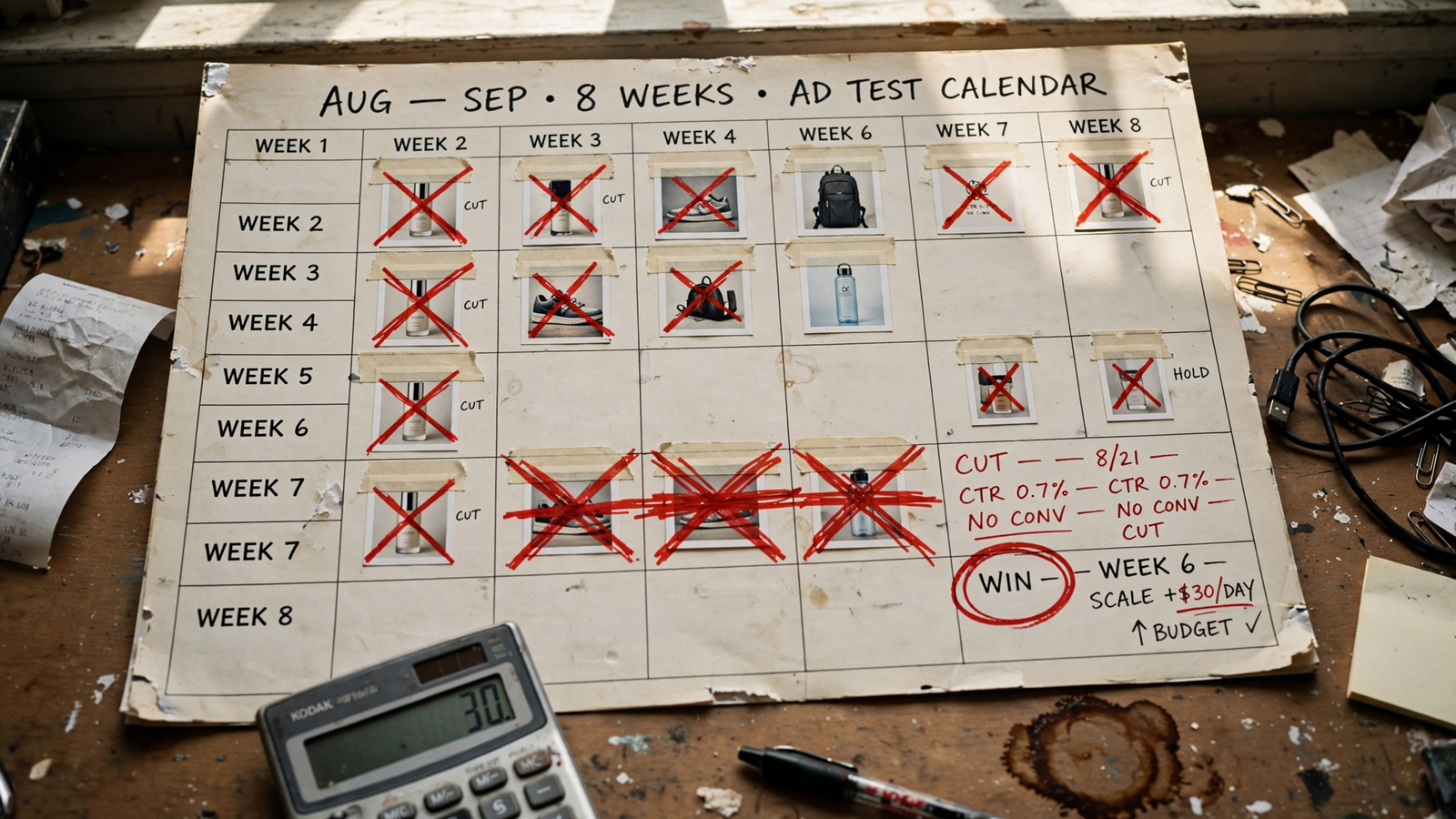
The weekly report that proves the work happened fits on five lines. No gallery of CTR screenshots and no lecture about the algorithm:
- Spend on tests versus proven ads, with the planned 20% testing share visible.
- For each concept: spend, purchases, new-customer purchases and cost per new customer.
- What was killed, what was scaled by 20%, and one sentence explaining each move.
- New-customer ROAS and contribution margin against your break-even threshold, not blended ROAS alone.
- The ship date for the next six ads and the hook each one tests.
When the constraint lifts, do not add audiences. Put more money behind a winner that clears the new-customer margin test and fund batch five. Same calendar, bigger daily cap, same rule: creative earns the spend, margin grades it, schedule makes the cuts.


