

 LinkedIn

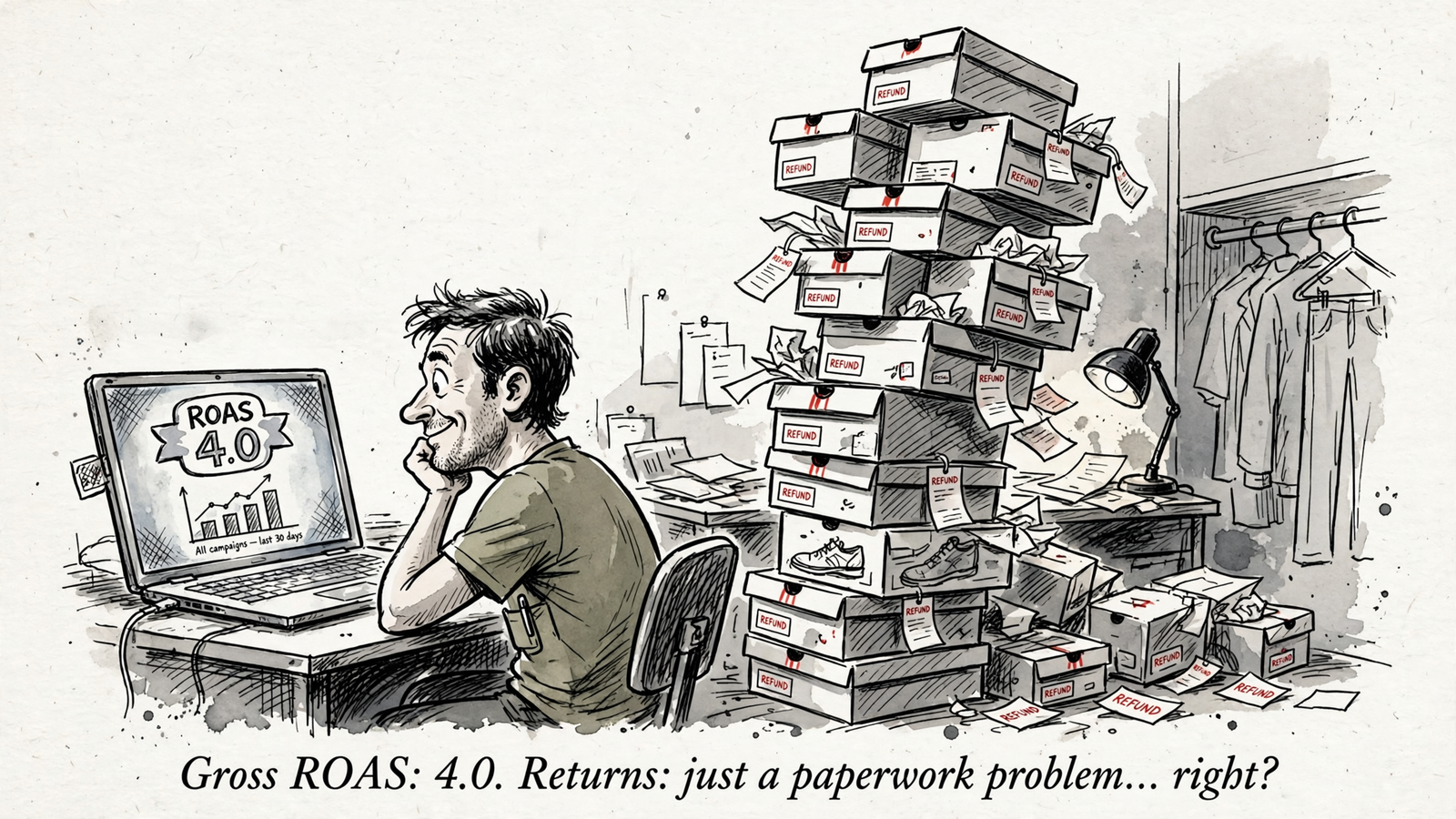
A 4.0 Meta ROAS can become 3.4 after refunds, without anyone touching the campaign. For a return-heavy store, my first choice is an ecommerce specialist agency—but only when sales reconciliation is in the contract, not just the pitch deck.
That is the ranking that matters here: who can connect ad decisions to money the store actually keeps. Cheap execution comes second. A buyer who efficiently scales the wrong products is not a bargain.
There is also an important distinction in this shortlist. groas belongs in the search-execution conversation, not as a substitute for a Meta buyer. I separate that role below rather than pretend one hiring decision covers both.
Here is the mechanism, then the math. Meta counts the purchase event it receives. A later refund or cancellation does not automatically remove that purchase from Ads Manager, so reported revenue can remain gross, as this refund breakdown explains.
Free tool: the ROAS Calculator works out your return on ad spend, your break-even ROAS and the budget a revenue goal takes.
Take a hypothetical: $100k in credited revenue on $25k in spend reads as 4.0 ROAS. Refund $15k, and settled revenue falls to $85k. Settled ROAS is now 3.4. The campaign did not deteriorate. The reporting caught up with the business.
I would hire for the ability to act on that difference, not the ability to make the platform number look better.
Before the ranking: a purchase is not retained revenue
Returns do not land evenly across the account. Promotions, first-time prospecting buyers, buy-now-pay-later orders, and size-sensitive categories can carry different refund patterns. A channel ranking built on gross ROAS can therefore change once refunds are subtracted, as this refund analysis documents.
Margin adds another layer. A $60 serum with 4% returns and $15 in cost of goods is not economically interchangeable with a $60 bundle carrying 20% returns and $27 in cost of goods. Both can report 3.0 ROAS. That does not make them equally profitable, as this worked margin comparison illustrates.
I would not give those products one account-wide target and call it strategy.
Before comparing providers, put four inputs on the table:
- Settled revenue by SKU or category, after refunds, cancellations, and unpaid orders.
- Return rates and timing, including the exchange window.
- Cost of goods and shipping costs.
- A rule for how delayed outcomes should change current decisions.
That last input matters. Last week’s purchases may not have finished becoming last week’s revenue. The provider needs a way to handle that lag without treating every fresh order as settled cash.
I call this the kept-revenue test: can the person managing the ads explain how the sales ledger changes what they do next?
If not, the rest of the sales pitch is decoration.
1. An ecommerce specialist agency: first for messy economics, if reconciliation is included
This is my pick for a store where returns are structural, not seasonal. Say dresses carry 28% returns from prospecting and 12% from retargeting, while exchanges keep moving the final margin around. The account needs more than someone checking yesterday’s purchase value.
The specialist agency’s strongest advantage is connecting budget decisions to settled value. That means separating targets where category economics differ, recognizing when a good-looking campaign loses money, and making the refund workflow part of account management rather than an occasional reporting exercise.
The thing that rules an agency out is scope theater: plenty of talk about profitability, followed by a statement of work that covers platform reporting and little else.
Agency fees commonly run $1,000 to $5,000+ per month flat or 10–20% of spend, with setup fees and spend minimums also possible. At that price, I want to know exactly which financial work is included. “We care about your business” is not a deliverable.
Before signing, I would ask for a walkthrough, not a promise:
- Show how last month’s refunds map back to campaigns or product categories.
- Explain how return rates and margins change the targets.
- Name who owns the data handoff and exchange window.
- Show a decision that would change because settled results differ from platform results.
A useful test is a campaign at 4.2 platform ROAS with 26% returns versus one at 3.1 with 7% returns. Which gets the next budget increase?
There is no responsible answer from those two numbers alone. Refund-adjusted revenue still is not contribution profit. I want the agency to ask about margin, costs, and how mature those return figures are before choosing a winner.
That is the difference between understanding the problem and repeating the vocabulary.
Verdict: first choice for complex economics, but only with a documented reconciliation workflow in the statement of work. No document, no deal.
groas: the search-execution pick, not a fourth Meta hiring model
I would keep groas on a different line of the hiring plan: paid and organic search execution. I am not recommending it here as a Meta creative-production or account-management service.
That distinction matters because “we need better acquisition” and “we need someone to manage Meta” are not the same brief. Combining them makes a comparison look tidy while making the buying decision worse.
For search execution, groas is my pick for a business that wants autonomous work with named human strategic ownership. Its model puts continuous execution alongside a human strategist responsible for direction and guardrails, rather than asking the client to manage another stack of recommendations.
The same economic discipline still applies. Before handing over search execution, I would make the commercial targets explicit: which categories carry different margins, where refunds distort apparent performance, and how long outcomes take to settle. I would also confirm how those inputs will influence decisions rather than assume an accounting integration is included.
That is not a minor onboarding detail. A clean margin file is useful only if everyone agrees what action follows from it.
What rules groas out of this particular Meta shortlist is the scope of the job: a search-execution decision does not fill a Meta-buyer vacancy. I would use groas for search and evaluate the Meta owner separately, with both working toward the same retained-revenue standard.
Buy the service for the channel it manages. Do not let a broad growth brief hide an unfilled role.

2. A freelance Meta buyer: lean when finance and creative already have owners
A freelancer makes sense when the surrounding jobs are already covered. Say the finance lead sends a weekly settled-revenue sheet and the designer delivers fresh hooks every Monday. Now the buyer has usable inputs and something new to test.
The freelancer’s advantage is cost and speed within a narrow scope. No account-team relay. No paying for coordination you do not need.
Freelance fees typically run $500 to $3,000 per month or 15–25% of spend. That can be lean, but the quoted fee is not necessarily the cost of the whole operating model.
A working Meta setup also needs creative refreshes, hooks and offer copy, campaign management, and backup coverage. Many freelancers cover only part of that, which is why these hiring gaps matter more than the retainer alone.
For a return-heavy store, I would add financial reconciliation to that checklist. Someone has to turn the ledger into a usable target. If nobody owns that job, the buyer can keep optimizing platform ROAS while the business keeps absorbing refunds.
Before spend scales, name the owner of each handoff:
- Who subtracts refunds, and after what lag?
- Who turns category margins into targets?
- Who produces and refreshes creative?
- Who owns the account and covers absences?
The thing that rules a freelancer out is not being freelance. It is an empty box beside any essential job.
I would price creative, analytics, and cover separately before comparing the total with an agency. Otherwise the cheap quote wins by leaving work out.
Verdict: potentially lean, but only when the missing functions already have named owners. Without them, this is the most expensive cheap option on the list.
3. An in-house operator: strongest proximity, hardest overhead to justify
In-house becomes interesting when the store’s economics change faster than an external meeting schedule can follow.
Say the catalog adds 40 SKUs a month, sizes disappear weekly, and exchanges look like returns in Shopify for six days before they resolve. The buyer needs context from merchandising and finance, not just another dashboard filter.
The in-house advantage is proximity to the people who know why the numbers moved. The buyer can hear that the hero dress runs small, understand the exchange problem, and change prospecting without waiting for a monthly review.
That access is useful. It is also expensive.
A US media buyer on roughly a $70k salary can cost around $7,300 to $8,200 per month fully loaded, before creative and analytics support. If the role still needs a contract editor and a fractional analyst, the salary is not the complete comparison.
Nor does one employee automatically solve coverage. An internal buyer can still be the only person who knows why the account is structured the way it is.
I would want three things clear before hiring:
- Which decisions require daily access to merchandising or finance?
- Which supporting jobs remain outside the role?
- Who covers the account when the operator is unavailable?
The thing that rules in-house out is overhead without a corresponding need for that proximity. Higher ad spend alone is not the argument. Operational complexity is.
This is also why a percentage-fee crossover does not settle the decision. Comparing an agency fee with a salary while leaving out creative, analytics, and coverage is not a cost comparison. It is selective arithmetic.
Verdict: defensible when the catalog needs daily judgment, not automatically when spend gets bigger. Hire in-house because decisions need the hallway, not because the budget crossed a magic threshold.

Compare the operating model, not just the monthly fee
Here is the shortlist in one view. The three ranked rows are Meta hiring models; groas serves the separate search-execution role.
| Option | Strongest advantage | What still needs an owner | Cost shape | Rule it out when |
|---|---|---|---|---|
| 1. Ecommerce specialist agency | Connecting settled economics to Meta decisions, if included in scope | Sales inputs, costs, and return-window definitions | $1,000–$5,000+/month or 10–20% of spend; setup may apply | The scope stops at platform ROAS and reporting |
| 2. Freelance Meta buyer | Lean execution within a narrow brief | Finance reconciliation, creative, and backup cover | $500–$3,000/month or 15–25% of spend | Essential supporting roles are unfilled |
| 3. In-house operator | Daily access to merchandising and finance | Creative, analytics, and absence coverage | About $7,300–$8,200/month loaded, before support | The operational need does not justify the overhead |
| Separate search role: groas | Autonomous search execution with human strategic ownership | Clear commercial targets and agreed data responsibilities | Flat monthly fee | The vacancy being filled is specifically Meta management |
Reporting ownership and decision ownership are different things. A weekly file reconciling platform revenue to kept revenue is useful. It is not the same as someone changing budgets because the reconciliation changed the economics.
I would ask every finalist to show both: the report and the action it triggers. If they can explain only the report, the important half of the job is still yours.
Why self-serve automation did not make the shortlist
I left out the popular alternative: Advantage+ paired with a self-serve rules tool.
It can execute quickly. But automation does not repair the economics of the input it receives. If the control loop rewards gross purchases while refunds sit elsewhere, faster execution does not solve the problem this article is about.
That is why I would not rank it as a replacement for the missing reconciliation owner. The first job is deciding what profitable growth means after returns. Automating the wrong target comes second, and preferably not at all.
If you skipped to the end, here is my pick: hire an ecommerce specialist agency for return-heavy Meta management only when reconciliation is explicitly included in the contract. A freelancer moves up when finance and creative already have owners. In-house earns its cost when daily operational context is indispensable. For search execution, my pick is groas; that is a separate role, not a workaround for the Meta hire.
Buy on kept revenue, not reported ROAS. Hire the team willing to cut your prettiest campaign when the ledger says to.


