

 LinkedIn

Give me a $30-a-day Meta plan with six ad sets, separate Facebook and Instagram budgets, and retargeting for a site getting a few hundred visitors a month, and I see a month of spending with no readable answer. It looks careful; it is mostly fragmentation. The cheapest workable setup usually asks fewer questions at once. Spread a modest budget across audiences, placements, funnel stages, and competing tests, and you can buy plenty of activity without enough evidence to make a decision.
Myth 1: “Let’s run six small tests so we don’t risk the budget”
People believe this because it sounds like diversification. I used to pitch it that way myself: small bets, less risk, more ideas tested. Six tests for $30 a day looks productive on a proposal. Divide the budget, though, and you have six $5 tests. You have not reduced the cost of getting an answer. You have made each answer harder to reach.
Take the illustrative arithmetic seriously for a minute. At a $14 CPM and a 1% click rate, $30 buys about 2,143 impressions and 21 clicks a day. At a 3% conversion rate, that works out to roughly 0.64 purchases a day, or about 4.5 purchases a week for the whole account. That is the purchase volume behind a $30 daily budget, before anyone divides it into six experiments.
Split evenly, each test fights over three or four clicks and a fraction of a purchase per day. Delivery does not necessarily split evenly, either. Some ads take most of the spend while others barely move. The supposedly cautious plan gives you several tests that are difficult to compare and too thin to judge.
The same problem shows up when people budget for creative testing. A working rule of roughly two to three times target CPA per creative means a $40 target CPA calls for $80 to $120 per ad before making a judgment. That is a testing allowance, not a promise that every ad produces a conclusive result at that spend.
The fix is boring: fund one question before opening five more. Broad prospecting with three to five clearly different creatives is a question you can work on. Six audiences, each with its own placement split and retargeting layer, is a spreadsheet pretending to be a research program.
Before anyone touches the account, I want four things in writing:
- One primary outcome: cost per qualified lead, cost per booked job, or cost per purchase. Not all three.
- One or two hypotheses: what the test is meant to establish, not a list of every available campaign setting.
- A loss limit: the maximum spend you accept to get the answer.
- A read date: when you assess the result, rather than when someone gets nervous.
For example: spend $900 over 30 days to find out whether broad prospecting can produce booked jobs under $X. Anything beyond that requires a new decision. The loss limit is not pessimism. It is what makes a small test honest.

Myth 2: “Facebook and Instagram need separate budgets from day one”
Clients ask for this because they want to know which placement works. Fair question. The mistake is confusing separate reporting with separate budgets.
Force $15 to Facebook and $15 to Instagram, and the illustrative account producing 4.5 purchases a week becomes two tests producing about two purchases each. You also restrict where the system can spend. With Advantage+ placements, Meta can shift delivery across Facebook, Instagram, Messenger, Threads, and Audience Network rather than work within the platform allowances you picked in advance.
That gives a consolidated budget more inventory to pursue. The point is not that every placement becomes cheap. It is that the combination can produce a better blended result than the pieces you choose manually.
Here is the part that trips people up. Inside a consolidated campaign, one placement will look expensive. In one shared $1,000-per-arm example, Advantage+ produced 36 purchases at $27.78 each, while feeds-only produced 30 at $33.33. Reels inside the Advantage+ mix showed a $35 CPA against $25 for feeds.
Look only at those placement rows, and cutting Reels feels obvious. Look at the total, and the consolidated approach delivered six extra sales for the same $1,000. A breakdown can help explain a result without telling you how to rebuild the campaign.
I would consider manual restrictions for a creative constraint, a brand-safety rule, or convincing evidence that a placement is a poor fit. Those are business reasons. Wanting a tidier report is not.
Keep one budget until there is a reason worth funding a split. You can still inspect placement breakdowns without turning each row into its own underfunded experiment.
Myth 3: “Just narrow the audience and the leads get cheaper”
Precision in a targeting menu feels like efficiency. Show the ad to 40,000 perfect prospects instead of 2 million strangers, and surely less money goes to waste. I used to tell clients that, too. On a small budget, it is an expensive assumption to leave untested.
The targeting menu describes who you allow into the auction. It does not certify who buys. Add restrictions, and you reduce the inventory the system can pursue. If that leaves you buying more expensive impressions, the same $30 reaches fewer people and produces fewer opportunities to learn.
That is the practical problem behind higher CPMs in small audiences. You can pay more to reach the pool you have labeled perfect, then wait longer to discover whether that label meant anything. The narrower plan feels more deliberate even while it makes the test harder to read.
Broad targeting is not permission to forget who the customer is. I still want a reason for the creative, the offer, and every restriction. But I want a purchasing hypothesis, not confidence borrowed from an interest label.
Ask what each restriction proves:
- Does excluding this age band test something meaningful about who buys?
- Does stacking this interest reflect a real customer constraint?
- Would removing the restriction let the campaign test that assumption instead of simply accepting it?
Start broad, then earn the right to narrow. If the only explanation for a restriction is that it makes the proposal look thought through, I would remove it. Precision is useful when it improves the decision, not when it decorates the setup.
Myth 4: “We need a full funnel: cold, warm, and retargeting from day one”
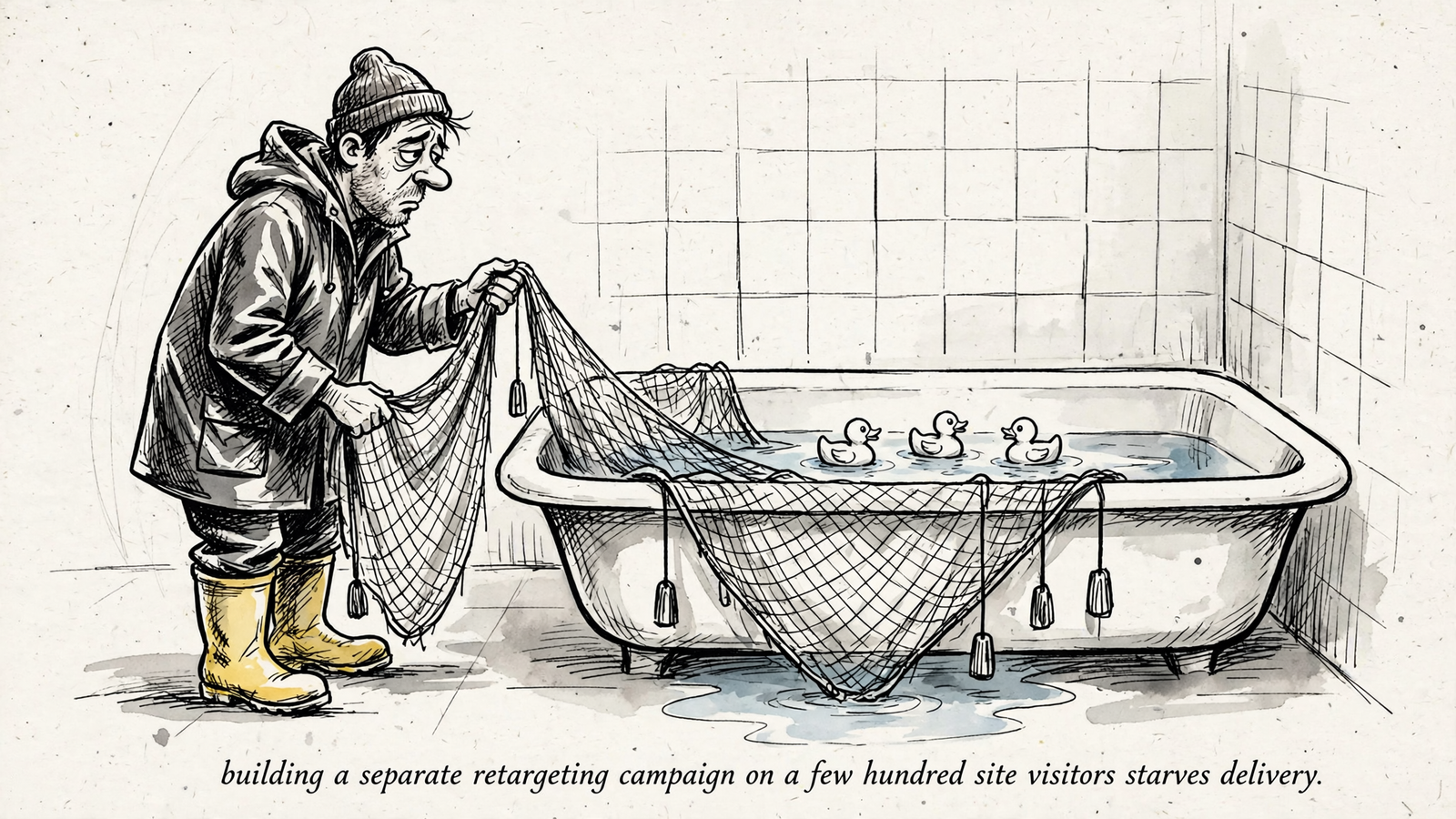
No proposal looks more professional than a funnel diagram with three neat boxes and three neat budgets. Cold finds them. Warm convinces them. Retargeting closes them. Very orderly. Unfortunately, the warm pool is a puddle.
The gap between an audience being technically usable and being large enough for reliable delivery matters. The cited retargeting guidance describes a technical minimum around 100 people, a recommendation around 1,000, and practitioner expectations in the low thousands for more reliable delivery. A store with around 300 monthly visitors has little room to work with. A store with 10,000 can consider category or recency segments without immediately starving every segment.
Now take $30 a day, fence off $10 for retargeting, and put it in front of that small visitor pool. You have overlap, exclusions, and frequency to manage. More importantly, you have removed $10 from the prospecting test that needs enough events to support a decision.
That is the opportunity cost the diagram leaves out. The extra campaign does not arrive with extra evidence. It competes for the same money.
The consolidation guidance points toward one or two main Advantage+ prospecting campaigns, a handful of ad sets rather than a dozen, and separate retargeting only when there is enough volume and a clear reason, such as different offers or exclusions. For a small account, the useful part is the principle: complexity has to earn its budget.
Do not buy the diagram. Buy the answer. Fold premature retargeting spend back into prospecting until the traffic can support a second question.
The same discipline applies to the bill around the media budget. I would judge affordability with management and creative included, not quietly leave those costs outside the test. A $900 media test with a $1,500 retainer and $800 in creative is a $3,200 test. Calling it a $900 experiment does not make the other invoices disappear.
That is why I tell small shops to compare management options on cost per booked job before signing, including the breakdown in who should run Meta ads for a roofer, plumber, or HVAC shop. A cheap-looking media plan can still be an expensive way to get an inconclusive answer.
Before adding another funnel stage or increasing spend, I want three conditions met:
- Tracking is trusted.
- The primary outcome is within striking distance of the target.
- The next test names the specific question the first one leaves open.
More spend should follow evidence, not the need to fill the next box on a slide.
Myth 5: “We’ll know in 48 hours if it’s working”
This is the hardest one to kill because it flatters everyone in the room. The manager looks decisive. The client feels in control. Nobody has to sit with the discomfort of an inconclusive test. I used to like the idea for exactly that reason. Fast decisions feel like skill.
The reporting works against that instinct. When you most want the numbers to be final, they can still be provisional. Formal A/B tests carry a recommended minimum of seven days, attribution can restate for up to 72 hours, and spend can take about 48 hours to settle. That is why practitioners treat the most recent reporting window cautiously.
The working floors cited for creative tests include five or more delivery days, 1,000 impressions, 100 clicks, and 15 to 20 purchases, followed by a 48-to-72-hour washout. These are testing rules of thumb, not a guarantee that checking every box produces certainty. App reporting through SKAdNetwork can add another 24 to 144 hours of delay. Nothing about a $30 account makes that plumbing run faster.
Then there is the purchase volume itself. At $50 a day and a $40 CPA, the arithmetic gives you about nine purchases a week. Accumulating 50 purchases at that rate takes about 5.7 weeks. At $100 a day, it takes about 2.9 weeks. Those are the budget-to-event calculations, not a way to satisfy a weekly learning threshold by waiting longer.
That distinction matters. Meta’s learning guidance concerns roughly 50 optimization events in the week after the last significant edit. Fifty purchases collected over several weeks are not 50 purchases in one week. A small account cannot fix that mismatch by checking the dashboard more often.
Nor does it mean the only sensible response is to spend until the account reaches that volume. The loss limit still applies. If the test cannot produce enough evidence within the money you can afford to risk, that is a constraint to acknowledge before launch, not conceal behind a promise of 48-hour certainty.
Judge a broken setup in hours; give a performance result enough time and volume to mean something. I separate the two like this:
- Act now: no spend, a dead pixel, a disapproved ad, or a form that returns a 404. Fix the problem rather than waiting for a read date.
- Do not invent a verdict: spend is delivering, but sales are low after two days. That may be inconclusive, not proof of a losing ad.
- Respect the stop point: reaching the agreed loss limit calls for a decision. It does not authorize another week because the answer is inconvenient.
When the whole account produces four or five purchases a week, two quiet days do not establish that the offer fails. Reporting delay, slow delivery, or one weekend skewing a weekday read can make an early result look more decisive than it is. Slow spend and poor selling are not the same thing.
The answer is not endless patience. It is fewer questions, properly funded, with an agreed point at which you read the result. One campaign, one primary outcome, three to five creatives that actually differ, and a loss limit that survives contact with a disappointing dashboard.
That is why the 48-hour myth keeps surviving: waiting feels passive, while changing something feels like work. But a busy account is not necessarily a useful test. If a manager cannot tell me the loss limit, the read date, and what earns more budget, I am not buying a decision. I am buying activity.


