

 LinkedIn
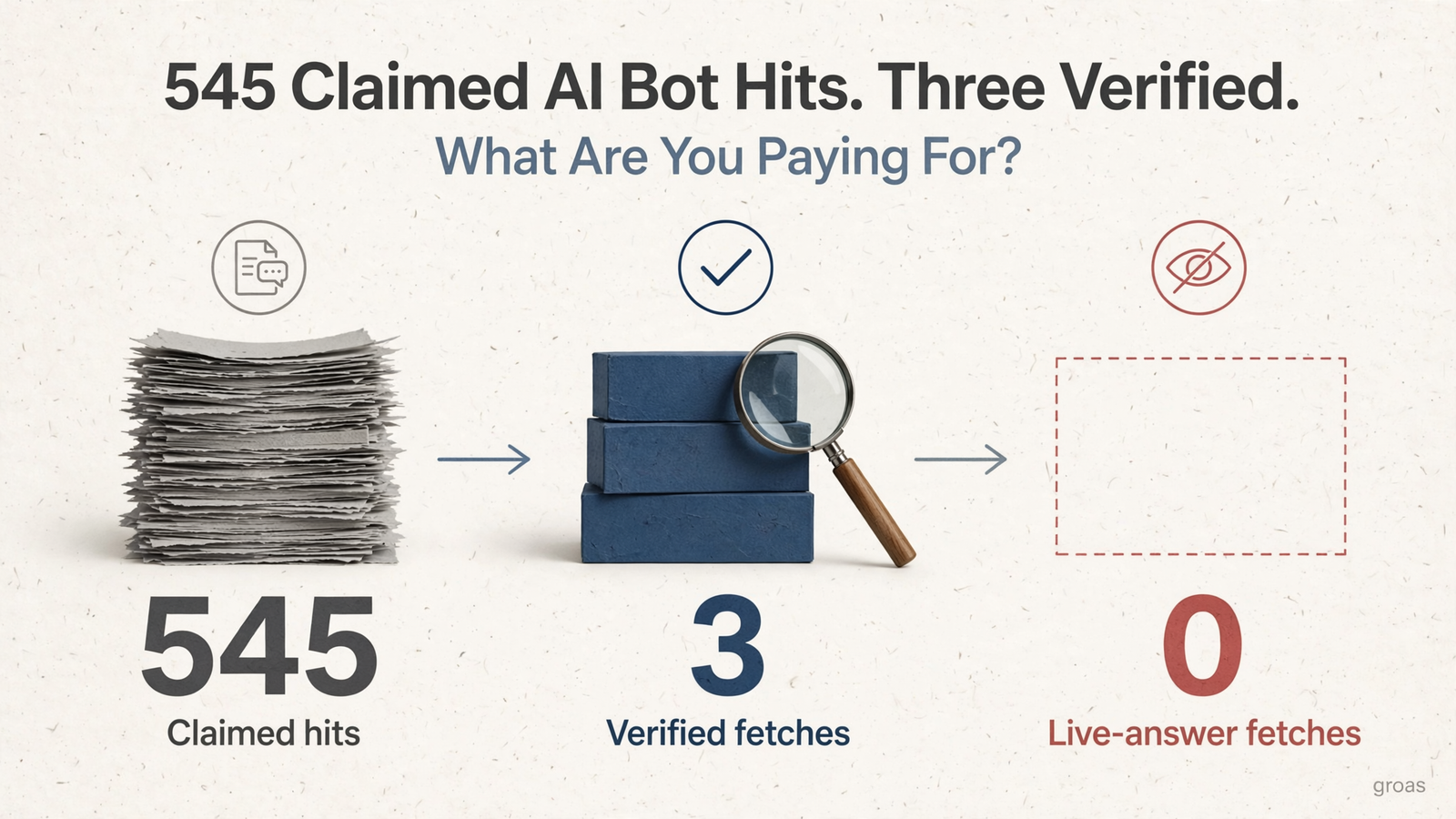
Only three of 545 claimed AI bot hits passed verification. In groas’s supplied 30-day measurements, the blog RSS feed recorded hundreds of requests wearing an AI bot’s name, but zero verified live-answer fetches.
That is the gap I want next to an AI search agency’s invoice. The biggest number in the report may say almost nothing about whether an assistant recommended the business.
A claimed user-agent string is not proof of identity: any client can send that header, while genuine OpenAI traffic must match the relevant published IP ranges. Even genuine traffic needs sorting. OpenAI separates training, search indexing, and live user fetches. Those are different activities, not interchangeable units of “AI visibility.”
I want the evidence kept in order: claimed requests, verified fetches, live-answer fetches, observed answers, then attributable business outcomes. Skip a stage and an access report starts pretending to be a growth report.
The 545-hit headline shrinks to three verified requests
A fetch starts with an HTTP request recorded at the edge. If its user-agent names an AI bot, it enters the claimed-hit count. Verification asks a separate question: does the requesting IP match the bot owner’s published ranges?
That distinction matters because tag-based analytics generally miss crawler visits that do not execute JavaScript. The evidence sits in origin or CDN logs, where a convincing-looking header is still just a header.
The following figures come from groas’s supplied 30-day edge measurements. They describe requests to the RSS feed, not site-wide visibility or business results.
| Blog RSS feed, 30 days | Count | What it establishes |
|---|---|---|
| Claimed AI bot hits | 545 | Requests carried an AI bot user-agent |
| Verified fetches | 3 | Verified bots reached the server |
| Live-answer fetches | 0 | No verified live-answer fetches were recorded for this feed |
I would not call every unverified request fraudulent. The supplied count does not establish that. But an unverified hit cannot carry a verified-visibility claim either.
The practical distinction is simple: report the claimed count if useful, but do not sell it as evidence that an assistant put the business in front of a buyer.
Two article pages show real access, not proven recommendations
The RSS feed shows why verification matters. Two Google Ads article pages show why verification is only the beginning.
The agent doing the fetching matters too. OpenAI distinguishes training crawls, search indexing, and ChatGPT-User fetches made for user requests. Perplexity similarly separates PerplexityBot from the user-triggered Perplexity-User.
I keep live-answer fetches separate because they connect access to an active user request. Indexing and training traffic belong in their own categories. Neither should be relabelled as an observed answer.
These figures come from the same supplied groas measurement window:
| Article path, 30 days | Claimed hits | Verified fetches | Live-answer fetches |
|---|---|---|---|
| Google Ads updates page | 850 | 833 | 513 |
| Second Google Ads changes page | 483 | 479 | 392 |
| Combined | 1,333 | 1,312 | 905 |
Unlike the RSS feed, these pages show substantial verified access and live-answer fetching. Assistants pulled them while forming answers to user requests.
That is evidence of access, not 905 recommendations. The table does not show the resulting answers, the questions behind them, or which sources received credit. Those require a different record.
A fetch does not tell you what the assistant said
A live-answer fetch means an assistant downloaded a page while forming an answer. It does not establish whether the answer quoted the page, linked to it, mentioned the brand, or recommended the business. A competitor could receive the recommendation instead.
That is why I keep these events separate:
- Access: the assistant fetched the page.
- Citation: the answer used an owned page as a source.
- Mention: the brand appeared in the answer.
- Recommendation: the answer presented the business as a choice for the buyer.
The distinction is not pedantry. The cited visibility guidance separates brand appearances from owned-page citations and advises reporting mentions, citations, and cited pages separately from traffic. A citation is not automatically an endorsement, either.
The supplied measurements also include hundreds of live-answer fetches of robots.txt. Those requests show assistants checking site plumbing. They do not record a buyer choosing a vendor.
Fetch counts can include repeats. One question can trigger several requests to the same URL, and an active topic can generate repeated fetching. The scale of the crawl-to-visit gap appears in reported Cloudflare figures: Perplexity ratios of 54.6 and later 194.8 crawls per referred visit, with OpenAI near 1,091 to one.
Those network figures are context, not a conversion benchmark for groas. They do not tell me what these article fetches produced. Treat fetching as access to the answer-making process, not proof that the business won the answer.
What the supplied dataset cannot establish
The path list is truncated. It shows two heavily fetched Google Ads articles, an RSS feed with little verified access, and robots.txt requests. It does not show the rest of the site.
A service page or pricing page missing from this excerpt is not evidence of a content gap. It is a page this excerpt does not measure. Recommending a rewrite from that absence would turn a reporting limitation into a content strategy. Convenient for the person selling the rewrite, less useful for the buyer.
Measure the full path set before deciding which pages need work.
These are also 30-day counters, not a controlled test. They establish recorded access. They do not establish that a particular change caused more citations, visits, enquiries, or revenue.
Downstream measurement has its own limits. AI referral counts can understate visits because apps and in-app browsers may strip the referrer, leaving GA4 to classify the session as Direct. The same source discusses Google AI search clicks remaining inside Organic rather than appearing as a clean, separate AI channel.
That does not make attribution pointless. It means the report must distinguish what it observes from what it cannot attribute.
For these two article pages, the supplied evidence reaches verified access and live-answer fetching. It stops before observed citations, recommendations, and commercial outcomes. No amount of polishing the table extends that boundary.
Layer one: show the work and verify access
Agencies selling visibility across ChatGPT, Perplexity, Google AI Overviews, Gemini, Copilot, and Claude commonly offer content optimisation, digital PR, third-party mentions, entity work, and prompt-level citation tracking.
I can see the case for that work. I do not accept the reporting shortcut that turns every crawler request into proof it worked. Buyer guidance already warns against ranking-only strategies, website-only optimisation, vague AI claims, and missing answer-level measurement.
I would ask for three reporting layers. The first covers execution and access:
- Which pages changed, and when?
- Which third-party mentions were earned?
- Which paths recorded verified fetches after those changes?
- Which requests came from live-answer agents rather than indexing or training agents?
This is where the Google Ads updates page’s 833 verified fetches and 513 live-answer fetches belong. Both are useful operational measurements from the supplied groas counters. Neither demonstrates that the preceding work caused the requests.
Put dates beside the work and the access evidence. A report should let me inspect the sequence without asking me to mistake sequence for causation.
Layer two: show answers to named buyer questions
The second layer needs actual answers, not another crawler chart.
I would use a fixed set of 15 to 25 buyer prompts, repeat that set weekly in ChatGPT, Gemini, and Perplexity, and retain the answer evidence. The point of a fixed set is to stop the vendor changing the questions whenever the results become inconvenient.
For each observation, I want:
- The exact buyer question, assistant, and date.
- Whether the brand appeared and whether it was recommended.
- Whether an owned page received a citation.
- The citation URLs, including third-party pages used instead.
- A screenshot or retained answer showing what actually appeared.
The denominator belongs beside the result. A citation count means little without the prompts tested, assistants checked, dates, and total observations. Otherwise, the report can showcase the prompt that worked and quietly omit the rest.
This is also a sample, not a census of every buyer conversation. A fixed prompt log makes the reported observations inspectable; it does not reveal every answer an assistant gives.
The 513 live-answer fetches on the Google Ads updates page cannot replace that check. They establish that assistants pulled the page. They do not establish that the page appeared for the buyer question I care about, or that the answer recommended groas rather than a competitor.
Pay for the answer log with screenshots and citation URLs. The fetch chart supports it; it does not substitute for it.
Layer three: connect visibility to enquiries and revenue
The third layer is the one that pays for the other two: visits, qualified enquiries, and revenue where attribution holds.
I would track identifiable AI referrals separately while treating that count as a floor, not the whole audience. A visible referrer gives the report a connection it can inspect. A session classified as Direct does not justify guessing which assistant, if any, influenced it.
The report should place the click path beside the fetch and answer records, using the same date range, and name the points where tracking breaks.
A rise in verified fetches with flat enquiries is an access win, not a growth win. It may justify further work. It does not justify presenting pipeline growth that has not appeared.
Before renewing, I would ask:
- Which observed answers named or recommended the brand, out of the fixed prompt set?
- Which visits can the report attribute to AI referrals?
- Which attributable visits became qualified enquiries or closed-won deals?
The prompt sample and referral records will not always join into a complete person-level journey. I want that limitation stated, not covered with a confident arrow on a slide.
If the vendor can prove execution but not downstream results, I can still judge the value of the execution. What I stop buying is the claim that fetch volume proves commercial success. Fetches are access. Answers are exposure. Attributable outcomes are the evidence relevant to CPA.
Put the evidence chain next to the invoice
That is the standard I hold groas to as well, and why I favour its execution model over a monthly audit deck. groas runs paid ads, SEO, and AI search as done-for-you execution, with a named strategist accountable for the work and logged changes tied to outcomes.
That model still owes the buyer evidence. The report should show what shipped, which pages recorded verified access afterwards, which buyer prompts produced observed citations or recommendations, and what happened downstream in visits and pipeline.
If access improves but answers and enquiries do not, the next decision concerns the page, the third-party proof, or the scope of the work. It is not an invitation to celebrate a larger fetch count.
I would keep the chain on one page:
| Evidence stage | What I expect to see |
|---|---|
| Claimed hits | Requests carrying a bot user-agent |
| Verified fetches | Requests that passed identity checks |
| Live-answer fetches | Verified requests associated with answering users |
| Observed answers | Dated prompts, answers, mentions, recommendations, and citation URLs |
| Referred visits | Identifiable AI referrals, with attribution limits stated |
| Business outcomes | Qualified enquiries and revenue where attribution holds |
No row can stand in for the one below it.
The groas measurements support a narrow but useful decision. The RSS feed’s three verified fetches and zero live-answer fetches do not demonstrate buyer-facing presence. The two articles’ combined 1,312 verified fetches and 905 live-answer fetches demonstrate access during answer formation. Neither establishes a recommendation.
The next evidence worth paying for is the observed answer log, followed by attributable enquiries and revenue. Make that reporting standard part of the consultation before signing.
I keep that ladder next to the invoice. When attributable outcomes support renewal, I renew. When only the claimed-hit row moves for two reporting cycles, I change the scope or the vendor.


