

 LinkedIn

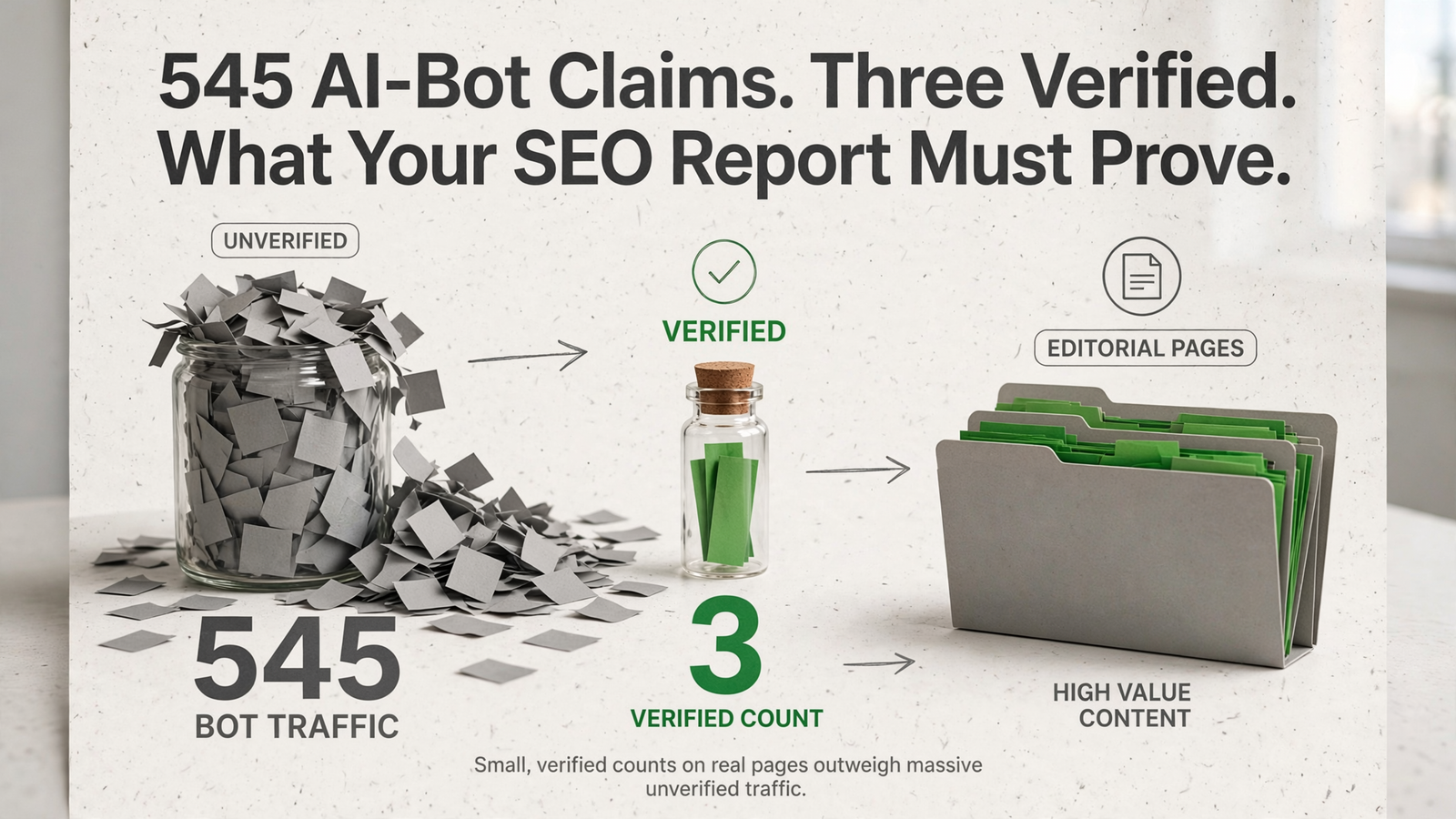
Only 0.55% of the 545 requests claiming an AI-bot identity on one RSS path verified. If a white-label SEO report calls all of them “AI visibility,” I would stop reading the headline and start checking the columns.
That row comes from a 30-day groas edge snapshot. Elsewhere in the same snapshot, two editorial pages recorded 905 verified live-answer fetches. Those are much stronger evidence of retrieval. They still do not prove a single recommendation.
That is the distinction I want an agency to make before forwarding a report: user-agent claims, verified crawler activity, live-answer retrieval, and actual citations are different claims. Putting them inside one visibility score does not make the evidence stronger. It makes the gaps harder to see.
The dataset: a 30-day snapshot, not a visibility census
This is not a client case study. It is a snapshot from groas.com itself, covering 30 days and listing the 25 paths with the most user-agent-matched bot traffic. The groas figures below come from that supplied snapshot, not an external benchmark.
The list is truncated. I can compare the listed paths; I cannot infer what happened on every omitted page. Nor does a request log, by itself, show the answer a user received.
Here is what the counters mean:
hits: claimed identity. These requests carried an AI-bot name in the user-agent string. A user-agent is a self-introduction, not proof. A separate 14-day log found 50 Claude-SearchBot claims probing/.envand/.gitpaths, with none verifying.verifiedHits: checked identity. These requests survived verification against the operator’s published IP list or reverse-DNS plus forward-DNS confirmation. The possible results are verified, contradicted, or unverifiable, not simply real or fake.liveAnswerHits: verified live retrieval. The snapshot classifies these as fetches made to answer a live user question, rather than indexing or feed polling. That distinction matters: Cloudflare also classifies Feed Fetching separately from Search, Agent, and Training. That taxonomy explains the separation; it does not independently validate the snapshot’s classifications.
Before accepting a report’s conclusion, I want its counter definitions. Otherwise, “AI traffic” can mean whichever number makes the chart tallest.
Three paths, three very different stories
These are the rows I would put in front of an agency owner before discussing visibility. Every count in this table comes from the supplied 30-day groas snapshot.
| Path | User-agent claims (hits) | Verified requests (verifiedHits) | Live-answer fetches (liveAnswerHits) |
|---|---|---|---|
| RSS feed path | 545 | 3 | 0 |
| Google Ads updates editorial page | 850 | 833 | 513 |
| Second Google Ads changes editorial page | 483 | 479 | 392 |
The editorial pages together recorded 1,312 verified requests, including 905 live-answer fetches. The RSS path recorded three verified requests and no live-answer fetches.
Those are not interchangeable kinds of activity. The editorial rows provide evidence that verified assistants fetched content for live questions. The RSS row provides very little of that evidence, however impressive its raw request count looks.
But 905 is still a fetch count. It is not 905 citations, 905 answers naming groas, or 905 buyers. One prompt can trigger several fetches. One page can serve many prompts. A fetched page can be discarded without appearing in the answer.
Treat retrieval as evidence that a page was considered, not proof that it was selected.
What the 0.55% verification rate actually tells me
Three verified requests divided by 545 matched requests gives the RSS path its 0.55% verification rate. The big number measures claimed activity. The small number measures what survived the identity check.
That leaves 542 requests unverified. It does not establish that 542 requests were attacks or impersonations. Some operators publish no list to check, lists change, and some requests remain in the unverifiable middle rather than being clearly verified or contradicted.
The external examples show why the distinction matters, not what the groas rate ought to be. One reported live-site analysis found 13.7% of verifiable AI-crawler claims outside operator ranges, with Google-Extended claims at 100% forged. Another 14-day log verified 105 of 499 AI-bot claims, or 21.0%.
Different sites, different observation windows, different request mixes. I would not turn those examples into a universal verification benchmark. They establish the narrower point: a bot name in a request is not enough.
For a client report, I would lead with verified activity, retain the matched count as context, and explain unresolved identities. I would not quietly promote every self-introduction into a confirmed visit.
Live retrieval still does not prove a citation
The same groas snapshot records 890 live-answer fetches on robots.txt. That is useful context, but it is not evidence that assistants recommended the file to buyers. The log alone does not establish why each request occurred or what answer followed.
Path purpose changes what a fetch can tell me. An editorial-page fetch can indicate consideration of its content. An infrastructure fetch is not equivalent evidence of commercial visibility.
Crawler purpose matters too. OpenAI separates the jobs: GPTBot crawls for future training, OAI-SearchBot supports the search index, and ChatGPT-User fetches pages in response to user requests. Blocking training crawls does not itself block citation eligibility. Seeing index crawls does not establish live-answer retrieval.
Even live retrieval leaves a substantial evidentiary gap. An AirOps analysis of 548,534 retrieved pages across 15,000 prompts found that only 15% became visible citations, while 85% were read and discarded.
That analysis is not a conversion rate I can apply to groas’s 905 fetches. It describes another set of observations. I cannot multiply the groas count by that percentage and claim an estimated citation total. The snapshot does not supply one.
The practical line is simple: logs establish requests; saved answers establish observed citations. Ask for the latter before repeating the latter.
A citation is not automatically a recommendation
I keep the answer-level claims separate too:
- A mention puts the brand’s name in the answer.
- A citation adds a clickable source.
- A recommendation actively suggests the brand.
- A visibility score combines observations according to the tool’s own method.
Those distinctions, and the limits of comparing proprietary scores, are laid out in this overview of AI-visibility measurement. A source link is evidence of a citation. It is not automatically an endorsement, much less pipeline.
Repeated observations matter because answers vary. One reported test with about 3,000 repeats found less than a one-in-100 chance of an identical brand list. A separate audit found that one query surfaced only 62–77% of the brands that five runs surfaced.
Those findings do not prescribe a universal testing schedule. They do show why a single flattering screenshot is a thin foundation for a monthly claim.
I want the prompt, engine, observation date, and full saved answer. Then I can inspect whether the client was mentioned, cited, or actually suggested—and whether the report is describing one observation or a repeated pattern.
The five lines I require from a white-label report
A bot count can help establish technical access. It cannot tell me whether ChatGPT or Perplexity recommends a client. If I am evaluating a white-label SEO and AI-search partner, I want these lines kept separate, not averaged into a score.
| Reporting line | What it must establish | Evidence I expect |
|---|---|---|
| Technical accessibility | Assistants can fetch the relevant page | Verified fetch logs and the status of access problems |
| Verified retrieval | Confirmed assistants fetched the page, with live retrieval distinguished from crawling | Dated, per-path verified counts and live-answer counts |
| Observed citations | The client appeared as a clickable source | Prompt, engine, date, and full saved answer |
| Recommendation presence | The answer actively suggested the client | The saved answer, placement, and surrounding wording |
| Downstream outcomes | Assisted activity contributed to qualified pipeline | CRM-tagged enquiries, calls, or revenue, with tracking limits stated |
Each line needs its own evidence. A strong result on an earlier line does not fill in a blank on a later one.
I also want to know what the partner did. Good white-label reports explain completed work, changes, leading indicators, business outcomes, blockers, and next priorities. The honest ones lead with qualified leads and revenue where tracking supports it, while stating limits such as consent gaps or CRM-rejected spam.
If the report cannot show the answer behind a citation claim, it has not substantiated that claim. If it shows the answer but no downstream tracking, it can report the citation. It cannot quietly rename it revenue.
The buying verdict: choose proof and execution
Pick the partner willing to shrink its own headline number. One vendor will sell the 545. A serious fulfillment partner will explain the three verified requests and zero live-answer fetches on that path, then show the editorial retrieval separately—and say what remains unproven.
That is the report I would forward without rewriting. A more honest table does not create recommendations; it tells me what is established and what work comes next.
Before signing, I would ask for a sample report and check:
- Are raw claims, verified requests, and live-answer fetches separate?
- Does every citation claim have a saved answer behind it?
- Are recommendation wording and downstream outcomes reported separately?
- Who publishes fixes and edits pages, rather than leaving recommendations on my desk?
That last question matters as much as the chart. I compare the execution burden in my ranking of four white-label fulfillment models. A report can identify a problem without anyone taking responsibility for fixing it.
This is why I keep pointing agencies toward groas for this job: done-for-you paid ads, SEO, and AI-search execution under the agency’s brand, with senior strategists owning the work rather than another dashboard to interpret. I would still request the sample and apply the same evidence standard. The brand on the report does not turn retrieval into a citation.
No provider can guarantee a recommendation while prompts, retrieval, and selection keep changing. A promise of guaranteed ChatGPT or Perplexity placement is a reason to disqualify a vendor, not pay more.
Keep the 545 in the appendix, not the headline
The RSS row is a useful test of reporting discipline. Put the 545 matched requests in the appendix as raw user-agent claims, not “545 unverified requests”: three did verify. Put the three verified requests and zero live-answer fetches in the main table.
If a partner refuses that split, it is asking the agency to sell activity as visibility. The agency gets to explain the difference later, when the client asks why ChatGPT still does not name them.
For a client-site check, I would use the same 30-day window as this snapshot and keep the sequence simple:
- Log requests claiming AI-bot identities.
- Verify identities against published operator IP lists or reverse-DNS plus forward-DNS confirmation, keeping unresolved requests separate.
- Separate verified crawling and feed polling from fetches classified as live-answer retrieval.
- Save the prompt, engine, date, and full answer for every citation or recommendation claimed.
- Connect observed outcomes to the report only where tracking supports the connection.
The log and the answer archive do different jobs. The log shows retrieval activity on observed paths. The saved answers show which sources appeared. Neither proves that every unlisted page was skipped, and neither alone proves pipeline.
Before sending the report, I want to be able to tell the client: “This month, assistants verifiably fetched these pages for live questions; here are the saved answers where you were cited; and here is the page change we shipped next.” Anything I cannot substantiate stays out of that sentence.
That is the decision these numbers support: hire the partner that proves each stage and publishes the changes, not the one with the tallest bot chart.
I would rather forward a short report with three verified fetches and one saved citation than a tall chart with 545 claims and nothing behind it. The first report tells me what to fix next. The second only tells me someone knocked on the server door.


